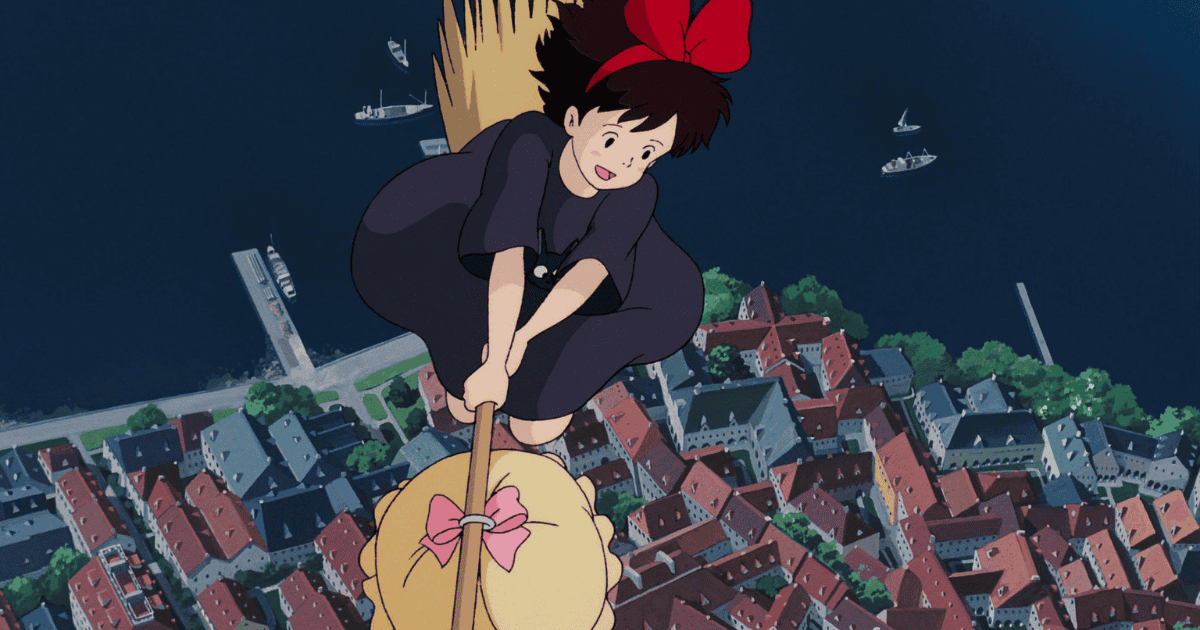
Every fan of Hayao Miyazaki’s 1989 coming-of-age masterpiece, Kiki’s Delivery Service(Studio Ghibli Official), eventually asks the exact same question: why does Kiki suddenly lose her ability to fly?
While audiences and critics have proposed countless theories ranging from adolescent depression to creative burnout, I want to bypass the conventional answers and explore a much deeper, psychological reality. If I had to summarize the devastating truth in a single sentence, without fear of being misunderstood, it would be this:
Kiki lost her magic because, metaphorically speaking, she was never actually flying that high to begin with.
I know that sounds incredibly counterintuitive—perhaps even harsh—so let’s carefully unpack the psychological journey that leads to this stark conclusion. Why did Miyazaki force a cheerful, optimistic young witch to hit such a brutal rock bottom?
*This is a translated version. The original (Japanese) is available here.
-
The Illusion of Invincibility
Kiki’s initial attempt to leave home on a flimsy broom she made herself perfectly captures the arrogance of youth. She attempts to forge her future relying solely on a “groundless sense of invincibility,” unaware that her confidence is merely a byproduct of her parents’ sheltered protection. -
The Mother’s Broom as “Unearned Talent”
The old, reliable broom Kiki’s mother forces her to take symbolizes inherited aptitude—raw, unearned talent passed down through blood. While this “safety net” allows Kiki to barely scrape by in the big city, it is a finite resource that cannot overcome true adult adversity. -
Running on Fumes: The Empty Savings Account
Through the heartbreaking herring pie incident and her awkward encounters with Tombo’s friends, Kiki realizes her inherited talent is no longer enough to navigate the complexities of life. Her magic fades at the exact moment she confronts her own profound limitations and loneliness. -
Miyazaki’s Brutal Theory on Artistic Talent
The profound dialogue between Kiki and the artist Ursula mirrors Hayao Miyazaki’s own creative philosophy. The film is ultimately a masterclass on raw talent: warning young people that natural gifts will eventually run dry, and true strength lies in having the grit to keep drawing, flying, and living when the magic fades.
On this pageContents
Kiki’s Delivery Service (1989) Analysis: The Real Reason Her Magic Faded
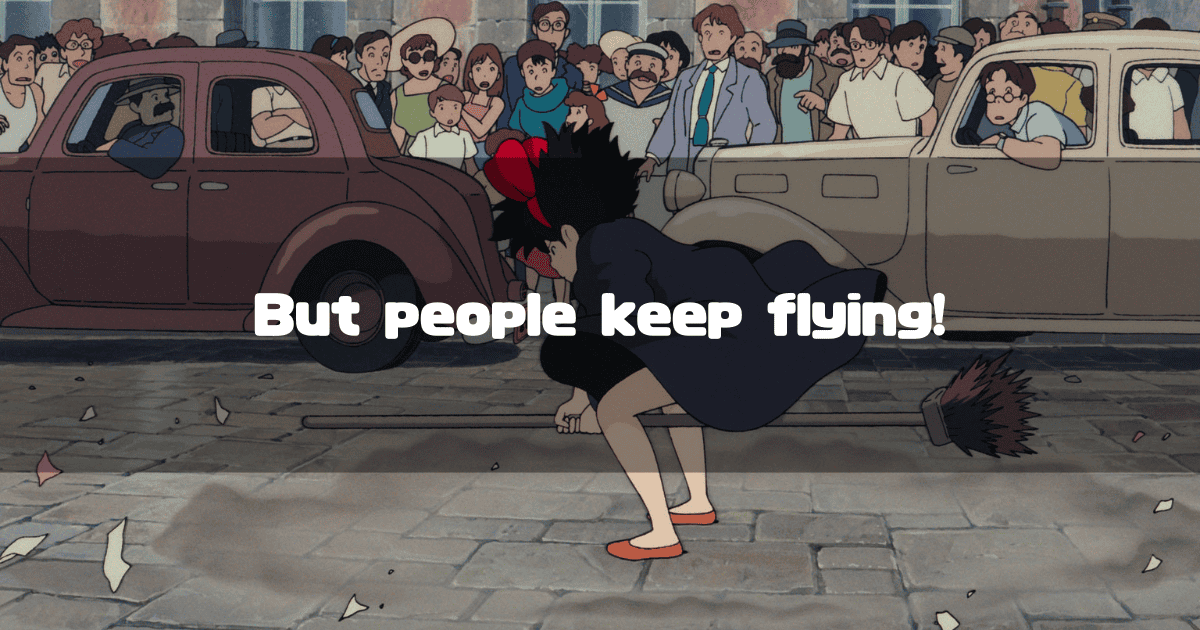
The narrative of Kiki’s Delivery Service opens with a highly specific, memorable conflict: Kiki works incredibly hard to weave her own custom broom for her departure, only for her mother to gently but firmly deny it, forcing Kiki to take her mother’s old, weathered broom instead.
Because the scene flows so naturally, most viewers brush it off as standard mother-daughter bickering. However, understanding why Miyazaki chose to start the entire story with this specific rejection is the absolute key to unlocking “why Kiki couldn’t fly anymore.”
To do that, we must first analyze the psychology behind Kiki insisting on using her own homemade broom.
The Arrogance of the Homemade Broom
When a teenager demands to “set out on a journey with a broom she made herself,” it is the ultimate manifestation of the universal adolescent desire to scream, “I can do everything with my own power!“
Even as grown adults, we sometimes fall into the trap of believing we must accomplish everything alone. However, we must recognize this urge as a manifestation of our own stubborn “infantilism.” There is absolutely no shame in relying on a community. Surprisingly, the world is full of people willing to help if you just let them.
Of course, leaving the nest and stepping into a foreign environment is a necessary rite of passage to build “your own power.” But there is zero logical reason why you shouldn’t rely on the wisdom and tools of others during that transition.
Conversely, the defining hallmark of youth is “lacking the self-awareness to realize you are still too immature to survive without help.“
This psychological blind spot is glaringly obvious when you observe Kiki at the start of the film. Her eyes are locked exclusively on a romanticized, brilliant future, completely blind to the actual grit required to get there. She doesn’t doubt her success for a fraction of a second. She is riding the peak of what we call a “groundless sense of invincibility.“
To frame it differently, Kiki foolishly believed that the tiny “savings account” of life experience she had accumulated over a mere 13 years under her parents’ absolute protection was wealthy enough to fund her entire adult future.
That immense, naive arrogance is precisely why Kiki felt she could conquer the world on a flimsy, amateur broom woven from her limited childhood knowledge. Miyazaki brilliantly visualizes her immaturity through the rejection of that homemade broom.
The Mother’s Broom: A Symbol of Unearned “Savings”
Despite her gentle demeanor, Kokiri (Kiki’s mother) is a seasoned witch who understands the brutal realities of the world. She instantly recognizes the dangerous “naivety” in Kiki’s plan to fly on an untested branch.
Yet, no matter how naive the child is, the time has come for her to leave.
In such a situation, the only thing a parent can do is provide a strong safety net—a farewell gift to fund the beginning of the journey.
While she likely gave Kiki some physical money, the true, explicit gift her mother insists upon is the old broom.
In the nuanced, metaphorical language of the film, that broom directly symbolizes the “raw aptitude inherited from her parents as ‘blood’“—what we casually refer to as natural talent.
As Kiki steps out the door, she lacks the maturity to ask others for help, stubbornly insisting on relying on her “own power.” But what does her “own power” actually consist of at age 13?
- The basic social manners cultivated in a tiny, sheltered village.
- The genetic talent of being able to fly.
And that is absolutely it. Even her “social manners” were forged entirely among protective adults and childhood friends, meaning her real-world resilience is virtually zero.
Her only true asset is “the talent of flight.” If she had used her homemade broom, her lack of skill would have grounded her immediately. By accepting her mother’s broom, Kiki is given a massive head start, allowing her to exploit her inherited talent to its absolute maximum potential.
When young people leave home, they are fueled by the blinding energy of that “groundless sense of invincibility.” They view their meager, unearned childhood savings as infinite wealth.
The broom her mother hands her is the ultimate symbol of the “life savings” Kiki has coasted on so far.
But here is the harsh reality of growing up: “savings” eventually run out.
The Big City Reality Check: When “Savings” Run Dry
Armed with her hometown confidence and the genetic talent gifted by her parents, Kiki takes to the sky. In her mind, she is an unstoppable force.
However, for a 13-year-old kid, being a “big fish in a small pond” means absolutely nothing to the ocean.
Kiki’s “groundless sense of invincibility” is brutally shattered on her very first day in the bustling, indifferent coastal city of Koriko.
She only manages to survive because she accidentally stumbles into the kindness of strangers like Tombo and Osono, unintentionally borrowing their strength when her own fails.
Through these grueling early days, Kiki slowly realizes how profoundly powerless she actually is. Yet, she manages to scrape by as a delivery girl simply because she possesses the incredibly rare, blessed talent of “flight.”
But soon, two devastating social problems arise that raw talent cannot solve:
- The infamous herring pie incident.
- The sudden, paralyzing insecurity around Tombo’s friends.
The “herring pie incident” wasn’t just a failure of her flight; it was a total rejection of her empathy and hard work. After flying through a freezing thunderstorm and utilizing her quaint ability to “use an old wood-burning oven,” the ungrateful recipient dismisses the pie entirely. Her hometown kindness is rejected by city apathy. Seeking comfort, she tries to lean on her blossoming friendship with Tombo, only to encounter his stylish, modern friends—triggering a massive wave of inferiority and social anxiety.
For the first time in her life, Kiki experiences true, agonizing “loneliness.” She crashes face-first into a “problem that cannot be solved by simply withdrawing from her childhood ‘savings account.’“
Her polite hometown manners are useless against teenage social dynamics, and her magical flight means absolutely nothing to girls with fancy clothes and cars.
Kiki has completely exhausted the unearned “savings” she brought from home. She is now standing in the terrifying void of adulthood, forced to tackle unknown problems with zero funds.
The Ultimate Crash: Why the Magic Actually Stopped
When we view her journey through this psychological lens, the reason her magic fades becomes crystal clear.
Kiki loses her magic the exact moment her brain processes a terrifying truth: everything she currently possesses (her childhood innocence and her raw talent for flight) is completely insufficient to build a sustainable adult life.
When she left home, she arrogantly assumed that her special trick of “flying” was enough to guarantee a brilliant future. The city taught her that reality is ruthlessly indifferent to natural talent.
When we watched Kiki soaring high above the clouds early in the film, we were watching “a child who hasn’t yet collided with reality, happily coasting on inherited momentum.” She hadn’t yet realized that her abilities were actually “not that great” in the grand scheme of the world.
Metaphorically speaking, realizing that her unearned abilities were “not that great” is the exact equivalent of “realizing she wasn’t actually flying that high.”
The reason Kiki’s magic plummets is because she finally gains the maturity to realize she was never flying that high to begin with.
Kiki’s Delivery Service (1989) Psychology: Miyazaki’s Masterclass on Artistic Talent
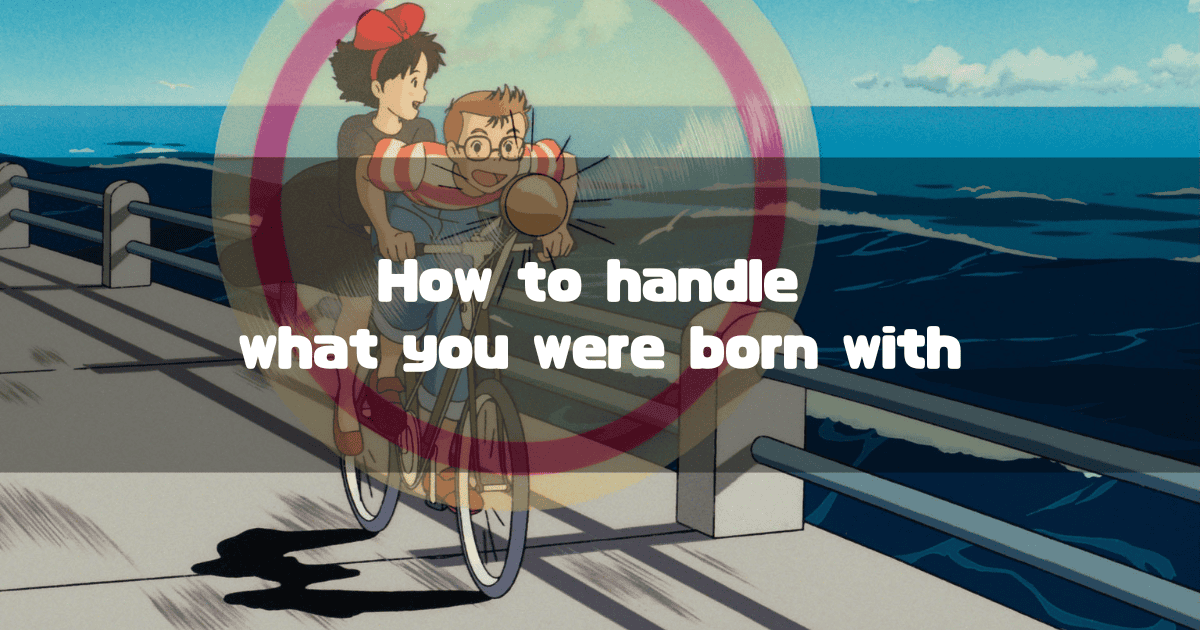
When you deeply analyze “the reason Kiki lost her magic,” it becomes impossible to ignore the overarching theme of “inherited talent” pulsating throughout Kiki’s Delivery Service.
Director Hayao Miyazaki himself entered the industry as a prodigy—a generational genius blessed from birth with an untouchable talent for “drawing pictures.”
Did an undisputed master like Miyazaki ever experience a dark, powerless slump like Kiki?
A fascinating answer to this question was captured in the production documentary This is How Ponyo was Born (ポニョはこうして生まれた, in Japanese).
During a Studio Ghibli training session for new animators on May 8, 2006, a rookie asked Miyazaki a very vulnerable question:
“When I’m drawing, I suddenly become unable to draw; a slump, I guess. It’s happened to me occasionally since I was a student. For times like that, could you tell me if there’s a good way to take a break or refresh?”
(Original Text, in Japanese)
「絵を描いてて、急に描けなくなるとか、スランプですね。そうなることが、たまに、学生の頃からあるんですけど。そういう時の、何かいい息抜きの方法とか、教えてもらいたいんですけど。」
Miyazaki’s response was characteristically intense and uncompromising:
“Once you shoulder the burden, you have no choice but to keep carrying it. Really. For me, intentionally taking a break doesn’t lead to a creative revival. I am dreaming about the problem even when I’m sleeping right next to it. The moment I wake up in my bed, I’m already thinking about it. So I must have been thinking about it in a dreamlike state. You won’t find the answer unless you force yourself into that state of obsession.”
(Original Text, in Japanese)
「背負ったらね 背負い続けるしかないんですよ。ほんとに。息抜きを意図的にやることによって僕は蘇生することはないですね。その問題と鼻付合わせて寝てても夢見てる。寝床で起きた瞬間にもう考えてる。だからきっと夢うつつの中で考えたに違いない。そういう状態にならないと答えは見つかってこないんですよ。」
This real-life advice violently echoes the profound, pivotal conversation between Kiki and the artist Ursula in the cabin:
Ursula: “Painting and magical powers seem to be very similar. Sometimes I can’t paint a thing.” Kiki: “You mean it? Then what happens? Without even thinking about it, I used to be able to fly. Now I can’t even begin to remember how I ever managed to do it.” Ursula: “At times like that, you know what I do? Paint. That gets rid of my frustrations. Draw, draw, and keep drawing!” Kiki: “But still, if I can’t fly…” Ursula: “Then I just stop. Take long walks, look at the scenery, doze off at noon. Don’t do a single thing. Then, suddenly I’m able to paint again.”
Kiki’s confession that she can no longer remember how to fly becomes even more revealing when the Japanese wording is compared with the English subtitle. See the original Japanese, romanization, literal translation, and the different wording used in the dub in our analysis of “Without even thinking about it, I used to be able to fly.”
While Ursula ultimately advises taking a break (unlike Miyazaki’s relentless advice to the rookie), her initial instinct to “Paint. Draw, draw, and keep drawing!” perfectly mirrors Miyazaki’s obsessive drive to push through the agony of a slump.
The ultimate thesis of the film is this: no matter how extraordinarily gifted a person is, the day will inevitably come when their raw talent runs dry. At that terrifying intersection, they must find the psychological grit to rebuild their identity from scratch. Director Miyazaki, despite his genius, undeniably battled through those exact same agonizing conflicts.
Kiki’s Delivery Service is not just a cute story about a witch. It is Hayao Miyazaki’s brutal, beautiful masterclass on artistic talent, aimed directly at young creatives who are currently coasting purely on their unearned “savings.” Ultimately, it serves as the most profound encouragement: the real magic only begins after the easy magic fades.
As for myself, lacking any world-class genius, I have been fortunate enough to live a comfortable life completely free from the luxurious torture of an “artistic slump.” A truly tragic, peaceful existence.
Can you name the movie before the scene comes into focus?
Put your visual memory to the test with a blurred Studio Ghibli scene.

Reader Comments