
Isao Takahata’s 1988 masterpiece, Grave of the Fireflies(Official Studio Ghibli), holds a notorious reputation worldwide.
For audiences everywhere, it is almost universally known as “the greatest movie you will never want to watch again.” Yet, precisely because it is so emotionally devastating, the film leaves an indelible, profound mark on the human soul.
Today, we are looking past the visceral trauma to deeply analyze the complex characters and voice actors who brought Grave of the Fireflies to life. Who exactly were these flawed, tragic figures struggling to survive at the end of the world?
Please be warned: this deep-dive character guide contains major spoilers for the entire film.
*This is a translated version. The original (Japanese) is available here.
On this pageContents
Grave of the Fireflies (1988) Main Characters & Voice Actor List
| Name | Age | Voice Actor (English Dub) |
|---|---|---|
Seita | 14 | J. Robert Spencer |
Setsuko | 4 | Rhoda Chrosite |
Aunt | Unknown | Amy Jones |
Mother | Unknown | Veronica Taylor |
Grave of the Fireflies (1988) Character Map
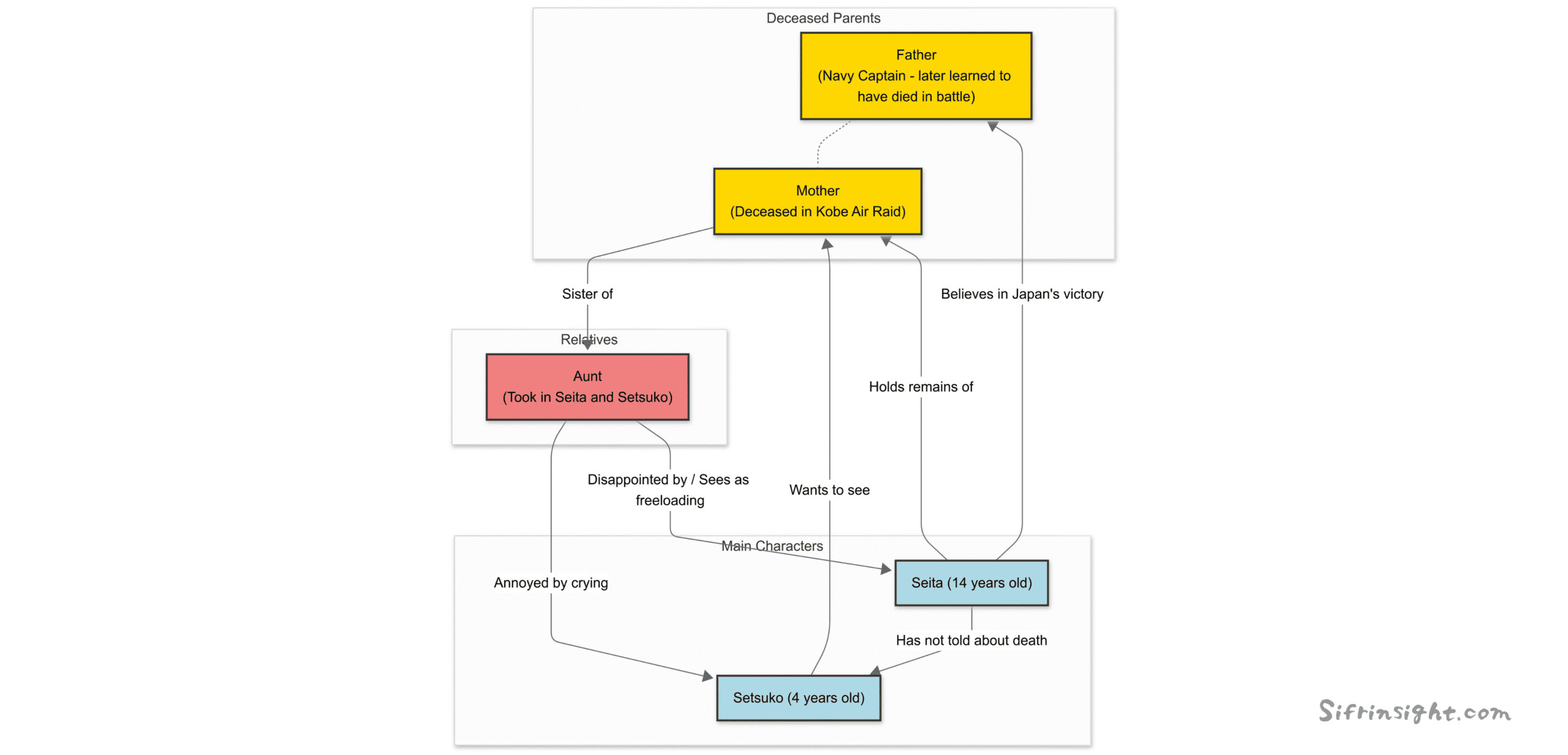
Notice the tragic breakdown of communication: While Seita desperately tries to hide their mother’s death from Setsuko, the cruel aunt eventually bypasses him and informs the four-year-old of the horrifying truth long before the film reaches its climax.
Grave of the Fireflies (1988) Deep Character Profiles and Analysis
Seita | Voiced by: J. Robert Spencer

The Tragic Older Brother
The protagonist of the story is Seita, a 14-year-old boy. The entire narrative of Grave of the Fireflies is actually a flashback; the film chillingly opens on the exact day of his death, September 21, 1945.
As the proud son of an Imperial Japanese Navy captain, he lived a comfortable life in Kobe with his mother and four-year-old sister, Setsuko. However, his world is incinerated when they lose their home and their mother to the horrific Kobe firebombing. The newly orphaned siblings are forced to take refuge with a distant, resentful aunt.
After their relationship with the aunt deteriorates into emotional abuse, Seita makes a fatal decision. Relying entirely on the “7,000 yen in savings” his mother left in the bank, he moves Setsuko into an abandoned hillside bomb shelter. This decision directly causes Setsuko’s agonizing death from malnutrition, and a broken Seita succumbs to the exact same fate just one month later.
Analyzing Seita’s Fatal Flaw
Seita’s reckless, stubborn actions undeniably led to the death of his little sister. But what was the true nature of his psychological flaw?
The easiest, most common critique is to call him “arrogant” and “selfish.” As a refugee living under the roof of an adult relative, common sense dictates he should have swallowed his pride, apologized, and contributed to the household.
However, when observing Seita’s behavior closely, I believe his fatal flaw wasn’t malicious selfishness, but rather that he was tragically frivolous and shortsighted, living entirely in the illusion of the present moment.
When Seita moves Setsuko into the cave, he isn’t executing a survival strategy; he is building a childish “secret base.” This is an incredibly naive, adolescent fantasy for a 14-year-old. But he was emboldened by a powerful weapon normal children didn’t possess: the 7,000 yen his mother left him. He believed money could buy independence.
Armed with cash, he embarked on his secret base project. But his youthful frivolity blinded him to the most crucial rule of human survival: the absolute necessity of “community connection.”
In peacetime, you might survive being socially isolated. But during the chaotic, starving aftermath of a war, isolation is a death sentence. Yes, his aunt was cruel and frustrating. But swallowing that frustration and enduring the abuse offered a significantly higher probability of survival than retreating into the wilderness. His inability to grasp this harsh reality confirms that his mindset was dangerously immature.
Yet, before we condemn him entirely, we must aggressively remind ourselves: He was only 14 years old. He was a traumatized child who should have been protected by the surrounding adults.
While Seita’s pride pulled the trigger, the true cause of their deaths is the profound societal apathy that allowed two children to starve in plain sight. I dive much deeper into this complex moral debate in another article.
Read the full analysis: Who is Truly to Blame for the Tragedy of Seita and Setsuko?
Setsuko | Voiced by: Rhoda Chrosite
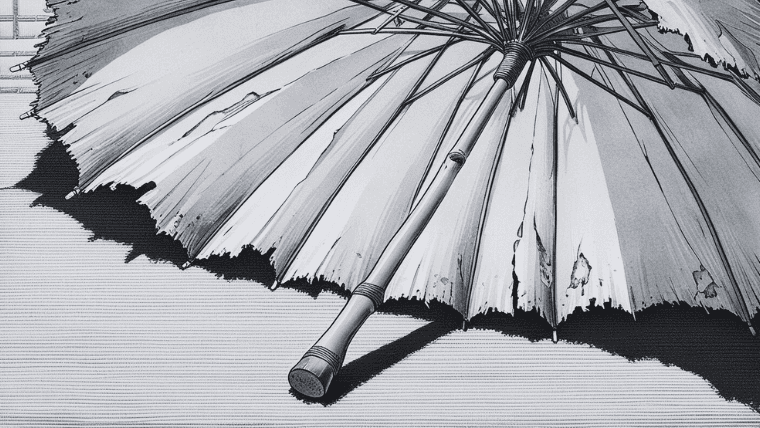
The Innocent Victim
Seita’s four-year-old sister is the emotional core of the film. Following the destruction of Kobe, she follows her older brother into the dark.
To protect her, Seita desperately hides the horrifying reality of their mother’s death. However, in a crushing twist, we learn that Setsuko actually knew the truth all along; the cruel aunt had coldly informed her. This means this tiny, four-year-old girl was silently carrying the agonizing grief of her mother’s death, hiding her tears to protect her brother’s feelings.
It is a heartbreaking display of bravery. Tragically, after following Seita into the isolated bomb shelter, Setsuko slowly and painfully dies of severe malnutrition.
The Agonizing Debate Over Setsuko’s Death
For most audiences, watching Setsuko wither away is so viscerally agonizing that they lock the film away forever, refusing a second viewing. Consequently, deep, analytical “discussion” about this movie is rare; the pain overwhelms the intellect.
However, when fans do force themselves to debate the film, the conversation almost entirely surrounds Setsuko’s death.
The debate usually boils down to: “How could Setsuko have been saved?” and “Who is ultimately responsible for her starvation?”
The audience is generally split into two factions: the “It is entirely Seita’s fault” camp, and the “It is the wicked aunt’s fault” camp. In modern pop culture, the faction blaming Seita has become the overwhelming majority.
Director Isao Takahata actually anticipated this modern reaction. In a Blu-ray interview, he noted he was genuinely “surprised” that audiences during the original 1988 release overwhelmingly defended and sympathized with Seita. Takahata deliberately wrote Seita to be frustratingly “selfish,” yet the older generation forgave him.
Why? Because the generation watching in 1988 still remembered the war. They understood that the era forced brutal “endurance” upon everyone, and surviving often meant making ugly, selfish choices. In this way, analyzing who you blame for Setsuko’s death essentially acts as a mirror, reflecting your own modern moral sensibilities.
Aunt | Voiced by: Amy Jones
The Pragmatic Survivor
She is the distant relative living in Nishinomiya who agrees to take in the orphaned siblings following the air raid.
Initially, she acts as a proper, helpful relative. However, as the harsh realities of wartime rationing set in, her resentment toward Seita ferments into blatant emotional abuse. She slowly starves the children of both food and affection.
Her toxic, degrading behavior—culminating in calling them a “plague god”—is the direct catalyst that drives Seita to flee into the wilderness.
Understanding the Aunt’s Cruelty
The aunt’s psychological abuse is depicted so brutally that the audience is practically forced to hate her. We watch her actions and instinctively think, “There is no excuse to be that cruel to grieving children.”
However, to truly understand her venom, we must analyze the defining keyword of the entire era: “Endurance” (gaman).
Under the aunt’s roof, Seita behaves like a spoiled prince. He refuses to join the neighborhood labor groups, refuses to help with chores, and contributes absolutely nothing to the community’s survival. He fundamentally lacks the concept of “endurance” (even though he believes he is enduring his own private trauma).
Conversely, the aunt is socially, physically, and economically forced to “endure” the agonizing collapse of her country. In her mind, she and everyone else in Japan are sacrificing everything to survive, making Seita’s lazy, arrogant existence a deeply offensive anomaly.
In that era, every single citizen was a victim of circumstance. We cannot view her cruelty in a vacuum without acknowledging the terrifying pressure of starvation.
Ultimately, judging this conflict requires weighing “Seita’s adolescent selfishness” against “the aunt’s pragmatic cruelty.” You have to ask yourself: “If my own children were starving, would I have been the aunt?” The answer to that question will radically change depending on your own life experience.
This is exactly why you should never watch Grave of the Fireflies unless you are mentally and emotionally prepared to confront your own darkest hypocrisies.
Mother | Voiced by: Veronica Taylor
The Lost Anchor
During the apocalyptic Kobe air raid, she evacuates to the neighborhood bomb shelter ahead of her children, leaving Seita behind to bury their emergency rations (like rice and pickled plums) in the yard.
Tragically, her shelter takes a direct hit. She suffers catastrophic, full-body burns that quickly lead to an agonizing death.
Because she dies so early in the film, we get very few hints about her deep personality. However, in her brief, elegant interactions with Seita before the bombing, she is clearly depicted as a profoundly calm, gentle, and loving woman. She is also revealed to suffer from a weak heart.
Her parenting style—gently indulging Seita with a soft “yes, yes”—stands in absolute, glaring contrast to the abrasive, dictatorial parenting of the aunt.
It becomes heartbreakingly clear that Seita’s tragedy is rooted in his inability to adapt. He continued to act like the spoiled, protected boy he was when his mother was alive, completely failing to adjust to a brutal new reality where that gentle mother no longer existed.
Other Characters
Seita and Setsuko’s Father
A highly respected, rising captain in the Imperial Japanese Navy. He only appears in proud photographs and Seita’s idealized flashbacks. Seita clings to his father’s memory, desperately writing letters to the fleet that go entirely unanswered.
In a crushing scene near the end of the film, Seita overhears old men at the bank discussing the total annihilation of the Combined Fleet, realizing that his father—his ultimate symbol of salvation—is dead.
The Aunt’s Daughter
The aunt’s biological daughter. While she rarely speaks, her visual reactions are vital. During the infamous “rice gruel incident”—where the aunt serves Seita and Setsuko only watery broth while giving her own family thick, nutritious rice—the daughter visibly shrinks in discomfort. Even as a child, she recognizes the chilling unfairness of her mother’s cruelty.
The Lodger
A young man renting a room from the aunt, who dutifully works long hours in the wartime labor service.
Many first-time viewers mistakenly assume he is the aunt’s older son, but he is strictly a paying lodger.
Like the daughter, he occasionally casts sympathetic, uneasy glances at Seita and Setsuko’s mistreatment. However, as a mere renter trying to survive the war, he possesses neither the authority nor the courage to challenge the aunt’s tyrannical rule over the household.
The Female Acquaintance
A neighbor from Kobe who survives the bombing. She is the one who horrifyingly informs Seita that his mother has been critically injured and taken to the makeshift clinic. Later, she offers the children a rare moment of genuine, unprompted kindness and concern.
In hindsight, Seita likely should have swallowed his pride and begged this neighbor for help. Yes, she would have strictly disciplined him, but it is highly unlikely she would have allowed two orphaned children to starve in a dirt cave. It is a tragic realization that sometimes, “a kind neighbor is far better than a resentful relative.“
*(Historical Trivia: In the original Japanese script, she is referred to as a “High-Miss,” a highly outdated, derogatory Showa-era term for an unmarried woman past the traditional “marriageable” age.)*
The Four Elementary School Students
A group of young boys who stumble upon Seita and Setsuko’s abandoned cave shelter while playing. They cruelly mock and heckle the siblings’ pathetic living conditions. While deeply unpleasant to watch, this scene serves a vital historical purpose: Takahata included it to prove that “even in the darkest days of the war, children were still finding ways to ruthlessly play and act like normal kids.“
The Farmer Who Lent the Cart
A local farmer who initially helps Seita by lending him a wooden handcart to move their belongings out of the aunt’s house, even selling them a meager amount of food.
However, when a desperate Seita returns weeks later begging to buy more rations, the farmer coldly rejects him, aggressively lecturing Seita to swallow his pride and apologize to his aunt.
Why the sudden change of heart? In a tight-knit farming village, the rumor mill is vicious. Helping a runaway teenager likely drew intense neighborhood criticism. To protect his own social standing within the community, the farmer had no choice but to cut Seita off. Survival required conformity.
The Farmer Who Beat Up Seita
The ruthless owner of the tomato field. When he catches a starving Seita stealing his crops late at night, he shows absolutely no mercy, beating the 14-year-old to a bloody pulp before dragging him to the police station.
His violence seems psychopathic, but Seita’s desperate physical resistance likely triggered the man’s rage. When Seita finally breaks down and tearfully begs for mercy “for his sick sister,” it is far too late. The tragic lesson here: If you are caught stealing to survive, you must drop to your knees and apologize the very second you are caught.
The Police Officer
The local precinct officer who receives a battered, bleeding Seita from the enraged farmer. Expecting the boy to be severely punished, the farmer is shocked when the officer calmly dismisses the charges and lets Seita go without consequence.
As a local “resident officer,” he was almost certainly aware of the tragic orphans living in the cave, and likely already suspected Seita was behind the recent crop thefts. More importantly, he recognized Seita as the son of a Navy captain—a title that still commanded immense respect. The officer made a quiet, merciful “comprehensive judgment” to look the other way.
The Doctor
The physician who examines a dying Setsuko near the climax of the film. He coldly delivers the fatal diagnosis: “It’s weakness due to malnutrition.”
When Seita begs for medicine or an injection, the doctor bluntly states the impossible: “She just needs nourishment.”
This was the absolute final, glaring warning. This was the moment Seita needed to sprint back to his aunt, fall to his hands and knees, and beg for rice. Instead, his pride flares up. He screams at the doctor, “Where am I supposed to find nourishment?!” and carries his dying sister back to the cave. He chose pride over her life.
The commercial subtitle renders Seita’s reply as “But where can I get that?!,” while the Japanese directly asks where nourishment could possibly be found. Compare the original Japanese, romanization, subtitle, and literal translation in our detailed analysis of Seita’s desperate outburst.
The Three Old Men at the Bank
The elderly men Seita overhears while trying to withdraw his mother’s savings. From their casual conversation, Seita learns the horrifying truth: Japan has unconditionally surrendered, and the Imperial Fleet is at the bottom of the ocean.
This scene brilliantly highlights the lethal danger of isolation. By severing ties with his aunt and the community, Seita became fatally “information-poor.” He didn’t even know the war had ended. Had he stayed connected to society, that information might have changed his entire trajectory.
The Man Who Gave Them Charcoal
The government worker who hands Seita a bale of charcoal and a wicker basket to cremate Setsuko. He cheerfully and efficiently explains the mechanics of burning a human body, completely unfazed by the tragedy before him.
His upbeat, bureaucratic demeanor feels jarringly inhuman. But it perfectly encapsulates the era: death was so commonplace that providing a proper cremation was considered a luxury, not a tragedy.
This chilling scene is the ultimate turning point of Grave of the Fireflies. It proves that the old world is gone; the post-war era is a “world of pragmatic survival and flip-flopping attitudes.” Seita, who refused to adapt, is left behind in the ashes, destined to end his life alone as the world callously moves on without him.
Can you name the movie before the scene comes into focus?
Put your visual memory to the test with a blurred Studio Ghibli scene.

Reader Comments