
Isao Takahata’s 1988 masterpiece, Grave of the Fireflies(Official Studio Ghibli), is universally known as the greatest animated film you will only ever watch once. Based on the harrowing semi-autobiographical novel by Akiyuki Nosaka, it is an emotionally pulverizing experience that leaves an indelible scar on the soul of almost everyone who views it.
While many audiences vividly recall being emotionally shattered the very first time they watched it, my own childhood experience was slightly different. As a kid watching it on TV, I was deeply disturbed by the horrifying visual of Seita and Setsuko’s mother wrapped in blood-soaked bandages, but the true, crushing psychological weight of the narrative didn’t fully hit me until I was much older. Today, it is clear why so many of my friends consider the film simply “too painful to endure.”
But reducing this film to just a “tragic tearjerker” is a massive disservice to its brilliance. Today, we are going to break down the complete plot, analyze the incredibly complex character dynamics, and uncover the hidden sociological warnings Isao Takahata left behind. What exactly should we have been looking at all along?
*This is a translated version. The original (Japanese) is available here.
- Detailed Synopsis & Ending Explained
The core narrative follows 14-year-old Seita and his 4-year-old sister, Setsuko. After losing their mother in the devastating Kobe firebombing of 1945, the war orphans briefly take refuge with an abusive aunt. Driven away by her cruelty and his own pride, Seita chooses to live in an abandoned bomb shelter. Tragically, without community support, Setsuko succumbs to severe malnutrition, and a month later, Seita dies of starvation in a train station. This article provides a comprehensive scene-by-scene breakdown and a character map. - Deep Plot Analysis & Unsolved Mysteries
Beyond the visceral tragedy, we will explore the film’s complex moral gray areas. We dissect the “Conflict between Seita and his Aunt,” the philosophical question of “Why Seita and Setsuko Had to Die,” the haunting mystery of “Why Seita Died in Sannomiya Station,” and the chilling reality of “Why Their Ghosts Cannot Pass On.” (Each section links directly to our exclusive deep-dive articles).
On this pageContents
Grave of the Fireflies (1988) Full Synopsis: A Descent Into Tragedy (Spoilers)
Quick Summary: The 5 Core Plot Points
To fully grasp the narrative descent of Grave of the Fireflies, here are the vital story milestones:
-
The Apocalyptic Catalyst
A massive American firebombing raid incinerates Kobe, resulting in the agonizing death of Seita and Setsuko’s mother and instantly obliterating their peaceful daily life. -
Total Isolation
With their father deployed as a naval captain and assumed dead, all familial support networks are completely severed, leaving the young siblings in terrifying solitude. -
A Hostile Refuge
The children seek shelter with their distant aunt. However, the suffocating poverty of wartime rationing quickly breeds extreme resentment, resulting in cold, emotionally abusive treatment. -
The Fatal Illusion of Freedom
Choosing independence over humiliation, Seita moves Setsuko into an abandoned hillside dugout. He fights a desperate, losing battle against severe food shortages to keep his sister alive. -
The Inevitable End
Crushed by the harsh realities of starvation and societal apathy, Setsuko slowly dies of malnutrition. Completely broken, Seita suffers the exact same fate shortly after.
Complete Character Map
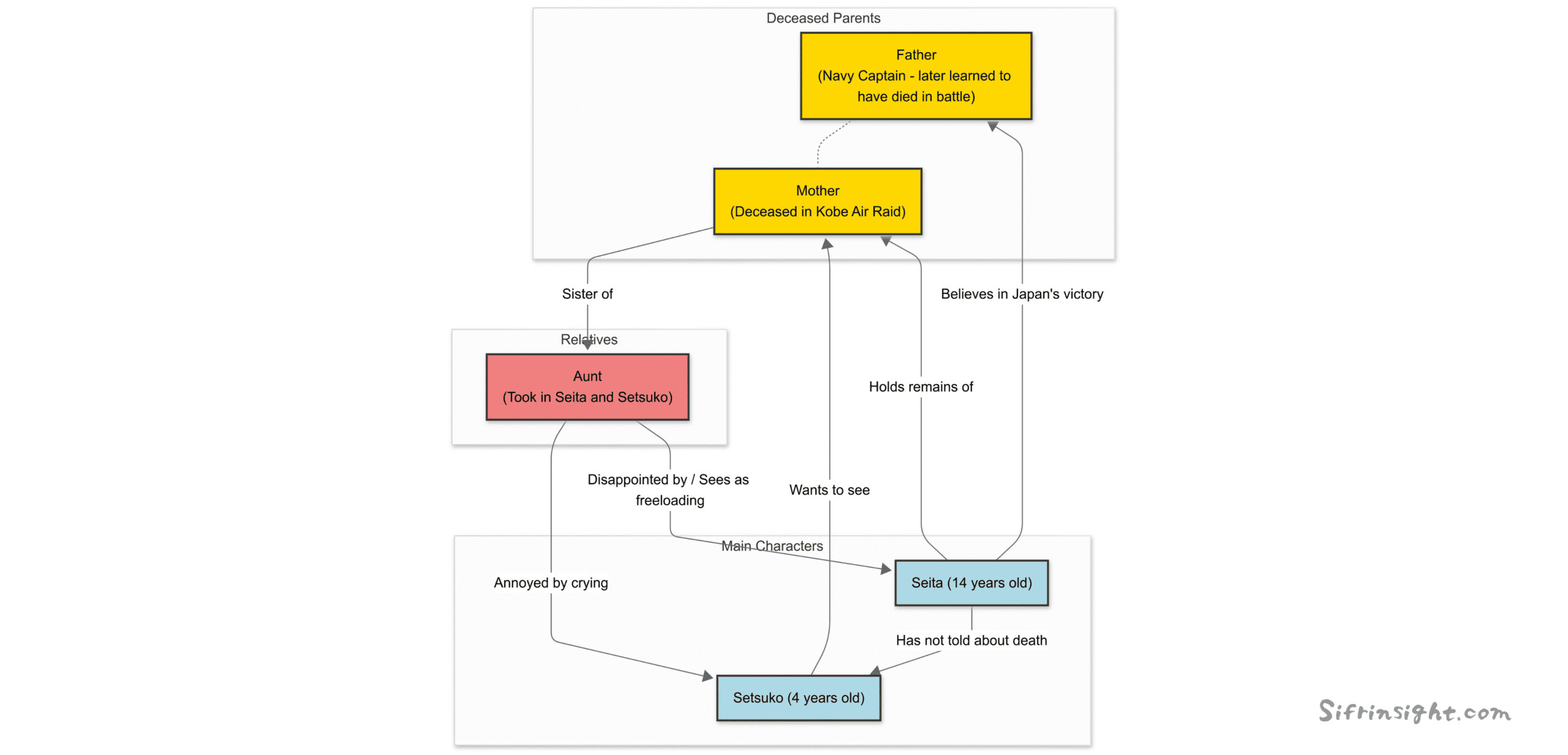
The Deeper Meaning of the Narrative
If forced to summarize Grave of the Fireflies in a single breath, it is “a visceral documentation of the absolute devastation inflicted upon innocent children at the end of a ruthless war.“
The central debate that continues to divide audiences decades later revolves around Seita’s fatal choice: Was he justified in leaving his cruel aunt’s house, or was his arrogant pride the literal weapon that killed his sister?
According to fascinating testimony from Director Takahata (featured in the Blu-ray bonus materials), Japanese audiences during the 1988 theatrical release were overwhelmingly sympathetic toward Seita. However, in our modern era, public opinion has shifted dramatically; viewers today are far more likely to condemn Seita as foolish and selfish.
To truly evaluate his actions and the impossible weight of his circumstances, let’s walk through the detailed, scene-by-scene synopsis.
Detailed Synopsis: A Scene-by-Scene Breakdown
Part 1: The Kobe Air Raid
The story focuses on 14-year-old Seita, the proud son of an Imperial Japanese Navy captain, living a relatively comfortable life in Kobe with his mother and 4-year-old sister, Setsuko.
On June 5, 1945, their world ends. A massive fleet of American B-29 bombers unleashes a catastrophic incendiary raid upon Kobe, turning the wooden city into a literal sea of fire.
While executing the standard evacuation protocols, Seita and Setsuko are separated from their mother. After surviving the fiery gauntlet, Seita eventually locates her at a makeshift medical clinic—only to find her wrapped head-to-toe in blood-soaked bandages, suffering from horrific, fatal burns. She dies shortly after, instantly transforming the children into war orphans.
Honoring a pre-arranged emergency plan, Seita takes Setsuko to live with a distant aunt in nearby Nishinomiya. Traumatized and protective, Seita cannot bring himself to tell his four-year-old sister that their mother is dead.
Part 2: The Plague God Playing the Organ
The aunt, a war widow, lives with her daughter and a young male boarder who works in a munitions factory.
Initially, the living arrangement is peaceful. However, as the war drags on and food rations dwindle to starvation levels, the aunt’s attitude toward the “freeloading” children rapidly deteriorates. Because Seita neither attends school nor works in the factories, she views them as useless parasites.
The tension boils over when the aunt unilaterally decides to confiscate and sell the exquisite kimonos and emergency food supplies (like pickled plums and rice) that Seita’s mother had buried in their yard before the air raid. Feeling increasingly unwelcome, Seita begins quietly cooking his own meager meals on a separate stove, using the 7,000 yen his mother left in the bank.
The psychological breaking point occurs during a quiet afternoon. To soothe a crying Setsuko, Seita softly plays the family organ. The aunt violently scolds him, furious that he would dare to play music and draw the neighbors’ criticism while the country is losing a war.
She ruthlessly spits out the ultimate insult, calling the children a “plague god” that has infected her home.
Unable to endure the emotional abuse any longer, Seita makes a fatal decision.
While modern audiences often condemn Seita for failing to swallow his pride, we must remember he is a severely traumatized 14-year-old boy who just watched his mother burn to death. Conversely, while the aunt’s “plague god” insult was unspeakably cruel, it was likely born from the sheer, terrifying panic of trying to keep her own biological children from starving.
Part 3: At Ages 4 and 14
Seeking freedom and peace, Seita packs their remaining belongings and moves Setsuko into an abandoned, lakeside bomb shelter (dugout). Though the conditions are primitive, the children initially revel in their newfound independence, lighting the dark cave with hundreds of captured fireflies.
Tragically, the illusion shatters the next morning. While burying the dead fireflies, Setsuko casually reveals that she already knows their mother is dead; the cruel aunt had explicitly told her. Seita realizes that Setsuko’s agonizing nighttime crying wasn’t just fear of the dark—she was quietly mourning her mother.
As the days pass, the brutal reality of isolation sets in. Without access to official rations or a community network, Seita resorts to stealing from local farmers and looting abandoned houses during air raids.
Despite his desperate criminal efforts, Setsuko begins to wither. Her body breaks out in severe rashes, and she suffers from chronic diarrhea. When Seita finally carries her to a local doctor, the physician offers a hollow, useless diagnosis: “She just needs nourishment.” In a starving country, the doctor offers absolutely no help.
Part 4: The End of the War
By severing ties with the community, Seita becomes dangerously isolated from the outside world. He doesn’t even realize the war is over until he visits the bank to withdraw the last of his mother’s money, only to overhear the adults discussing Japan’s unconditional surrender and the sinking of the Imperial Fleet—meaning his father is almost certainly dead.
He sprints back to the dugout with a bounty of expensive, nutritious food, including a slice of watermelon.
But he is too late. Setsuko is hallucinating, sucking on glass marbles she believes are fruit drops, and offering Seita “rice balls” made of mud. She takes one small, final bite of the watermelon, closes her eyes, and slips into a coma from which she never wakes.
Seita is forced to perform the most agonizing task imaginable: he gathers wood, places his tiny sister inside a wicker basket, and personally cremates her body under the summer sky. He carefully places her remaining bone fragments into her beloved Sakuma Drops tin.
The timeline flashes forward to September 21, 1945. Clad in filthy rags, his body completely broken by starvation and grief, 14-year-old Seita slumps against a concrete pillar in Sannomiya Station and quietly dies.
▼ Explore the film’s memorable dialogue in Japanese and English
Many of the film’s most devastating moments are expressed through deceptively short lines—from Seita announcing his own death and demanding to know where he can find nourishment to Setsuko asking why fireflies die so quickly. See the original Japanese, romanization, English subtitles, literal translations, and detailed commentary in 7 Grave of the Fireflies Quotes in Japanese and English, Explained.
Grave of the Fireflies (1988) Deep Analysis: Uncovering the Film’s Hidden Mysteries
Now that we have reviewed the tragic narrative, it is time to dissect the philosophical and psychological questions the film demands we answer. My comprehensive, personal analyses on these specific topics are compiled in the master post below:
Read the full analysis: Who is Truly to Blame for the Tragedy of Seita and Setsuko?
Before you dive in, consider the following points.
The Conflict With the Aunt: Where Does Your Sympathy Lie?
The fundamental pillar of any Grave of the Fireflies debate is the conflict between Seita and his aunt.
However, when analyzing this dynamic, the most important factor isn’t who was logically “right,” but rather examining your own emotional bias: “Who do I naturally sympathize with, and why?”
If you approach the situation objectively, it is incredibly easy to sympathize with both parties.
Today, adult viewers heavily sympathize with the aunt’s pragmatic desperation, often rushing to condemn Seita. Yet, as Director Takahata noted, audiences in 1988 overwhelmingly sided with Seita, viewing his departure as a heroic, albeit doomed, rebellion against an oppressive adult.
This proves that condemning the aunt (or Seita) is not an absolute moral truth; it is a reflection of the era we live in. Therefore, the greatest analytical exercise this film offers is forcing you to look in the mirror and ask: “Why does my sense of justice side with this specific character?”
The Ultimate Question: Why Did Seita and Setsuko Have to Die?
Once you confront your own biases regarding the aunt, you must face the ultimate, crushing question: “Why did these children actually have to die?”
The easiest, most comfortable answer is to say, “Because Seita was arrogant, foolish, and selfish.“
But does that answer truly satisfy your conscience? Seita was 14 years old. Is it morally sound to place the entire burden of a four-year-old’s death squarely on the shoulders of an orphaned, traumatized junior high school student?
If we stop blaming the child and start looking at the profound apathy of the society that surrounded him, Grave of the Fireflies transforms from a simple historical tragedy into a terrifying, urgent warning for how we live our lives today.
Takahata’s Hidden Intention and the Singular Ray of “Hope”
Grave of the Fireflies is an exercise in absolute despair. There is virtually no salvation to be found.
So, why did Director Takahata feel compelled to subject audiences to such agony? If he merely thought Akiyuki Nosaka’s novel was brilliant, he could have just recommended the book. Instead, he dedicated years of his life to agonizingly animating this horrific reality.
Is there truly no “hope” hidden within this bleak cinematic landscape?
I firmly believe that Takahata deliberately embedded one single, microscopic ray of human hope within the darkness. It is an easily missed gesture, but it represents the entire moral compass of the film.
The Final Moments: Why Did Seita Die Inside Sannomiya Station?
September 21, 1945, marks the tragic end of Seita’s life. However, he didn’t die in the dirt dugout where Setsuko took her final breath a month prior; he died leaning against a cold pillar inside a bustling train station.
From a purely cinematic and dramatic perspective, it would have been far more poetic and emotionally devastating for Seita to curl up and die exactly where his sister did. So why did Takahata specifically move his death to a public transit hub?
I argue that this specific location choice holds the absolute key to understanding the biological and psychological reality of the entire film.
The points above represent the core philosophical questions the narrative demands we answer. However, the film’s brilliance extends far beyond the physical world.
I have compiled my detailed answers to all these questions in the dedicated analysis post below:
Read the full analysis: Decoding the Philosophy and Psychology of Grave of the Fireflies
The Ghostly Purgatory: Why Can’t Seita and Setsuko Pass On?
The very first and last frames of Grave of the Fireflies establish a terrifying supernatural reality: Seita and Setsuko are ghosts. The film ends with their translucent spirits sitting on a hilltop, gazing down at a towering, neon-lit, modern Japanese skyline. They have been wandering the earth for decades.
It is standard ghost lore that spirits remain trapped due to lingering trauma or violent deaths. However, the deeply unsettling aspect of this film is that when the siblings reunite as ghosts, they are bathed in a warm red glow, smiling radiantly.
Why are two children who died in such agonizing despair smiling? And more importantly, why are they cursed to eternally observe a modern world they can never participate in? I explore the terrifying implications of their ghostly purgatory in the article below:
Read the full analysis: The Chilling Reason Seita and Setsuko Cannot Pass On
The Mechanical Mystery of the Molotov Bread Basket
The opening sequence of the film features a terrifying, visually stunning depiction of the Kobe firebombing. As the incendiary bombs fall, they resemble a glowing, apocalyptic “rain of fire.”
Director Takahata survived a similar raid and desperately wanted to animate exactly what he witnessed. However, when his team consulted a military expert from the Japan Self-Defense Forces, the expert bluntly stated: “Due to their mechanical structure, mid-air ignition of those incendiary bombs is scientifically impossible.”
So, was the “rain of fire” witnessed by Takahata and thousands of survivors a massive collective hallucination? Or was the military expert wrong?
We dive deep into the fascinating engineering and historical reality of the M69 cluster bombs in the mystery breakdown below:
Read the full analysis: Did Director Takahata Animate a Historical Lie?
The Psychological Case for Watching the Film Twice
Let’s be honest: Grave of the Fireflies is not an entertaining, popcorn re-watch. Most people endure it once, lock the trauma away in a mental vault, and form their lifelong opinions based on that single, agonizing viewing. But I strongly recommend watching it exactly one more time.
Why? Because the crushing trauma of the ending severely distorts your memory of the beginning.
If you watch the first act a second time, you will be shocked to realize that the Seita on screen is completely different from the selfish, lazy boy you remember. You are forced to realize that a massive, unseen psychological fracture happened to Seita.
I explore the hidden PTSD and the profound misjudgment of Seita’s character in the psychological profile below:
Read the full analysis: The Unseen Trauma: Why We Unfairly Judge Seita
It is definitely not a movie you need to torture yourself with three or four times, but returning to it a second time is crucial to truly empathize with the profound emotional wounds inflicted by war.
Grave of the Fireflies (1988) Trivia & Hidden Production Secrets
While researching the profound depths of this masterpiece, I uncovered a treasure trove of fascinating behind-the-scenes production secrets, historical trivia, and mind-blowing Easter eggs.
From the secret meaning hidden in the movie poster’s sky to the brutal, real-life guilt carried by the original author, Akiyuki Nosaka, I have compiled everything you didn’t know you needed to know in the article below:
Read the full analysis: Grave of the Fireflies: Ultimate Trivia and Hidden Secrets
You might just find a breathtaking piece of cinematic history to share with a fellow Ghibli fan tomorrow.
Can you name the movie before the scene comes into focus?
Put your visual memory to the test with a blurred Studio Ghibli scene.

Reader Comments