Isao Takahata’s The Tale of the Princess Kaguya (Official) isn’t just a simple retelling of a classic folktale; it is a visually breathtaking exploration of human sorrow, societal cages, and the heavy price of fleeting joy. Released in 2013 under the haunting tagline, “The crime and punishment of the princess,” the film ultimately served as the legendary director’s swan song. Yet, despite its profound depth and artistry, its 2.1 billion yen box office return left it commercially overshadowed.
While audiences flocked to Hayao Miyazaki’s The Wind Rises that same year, far too few experienced the quiet devastation of Princess Kaguya’s journey. I’ve poured my lingering frustrations over this tragic oversight into a dedicated deep dive—read my passionate defense of the film’s forgotten brilliance below:
In this article, we’re going to break down the complete narrative of The Tale of the Princess Kaguya, and explore how it drastically subverts its 10th-century source material, The Tale of the Bamboo Cutter. Fair warning: I will be covering the entire plot from beginning to end, so if you want to avoid spoilers, turn back now and watch the masterpiece for yourself!
*This is a translated version. The original (Japanese) is available here.
- Detailed Synopsis and Character Map
At its core, the story follows a miraculous girl born from a bamboo shoot. She thrives in the wild mountains but is forced to relocate to the rigid capital by her adoptive father. Burdened by her own unearthly beauty, she rejects proposals from high-ranking nobles and even the Emperor, ultimately facing a tragic return to the moon while her heart remains tethered to the Earth. Read on for our comprehensive scene-by-scene breakdown and character map. - A Shift in Focus: Choosing Humanity Over Aristocratic Comedy
Unlike the original folktale, which heavily features the comedic failures of five noblemen trying to win Kaguya’s hand, Takahata severely trims these episodes. Instead, the film zeroes in on Kaguya’s vibrant mountain childhood and her suffocating daily life in the capital. This deliberate shift highlights the director’s deep reverence for raw human emotion over aristocratic vanity. - A Darker Emperor and a Compressed Timeline
The original story portrays the Emperor’s interactions with Kaguya in a somewhat positive, romantic light across a long span of time. In stark contrast, Takahata’s film frames the Emperor’s advances as arrogant and deeply violating, triggering Kaguya’s immediate rejection. Furthermore, her time on Earth is drastically shortened, magnifying the tragedy that her life here was merely a fleeting, stolen moment spent mostly against her will.
On this pageContents
The Tale of the Princess Kaguya (2013): A Complete Story Breakdown (Spoilers Ahead)
Story Highlights & Character Relationships
Before we dive into the granular details, here is a quick overview of the major plot beats that define The Tale of the Princess Kaguya:
-
The Miracle in the Bamboo
Our protagonist, “Princess Kaguya,” materializes from a glowing bamboo shoot. A humble bamboo cutter, the Old Man (Okina), discovers her and takes her home to his wife, the Old Woman (Ouna). Believing her to be divine, they raise her as their own “Princess.” -
The Girl Known as “Takenoko” (Little Bamboo Shoot)
Growing at a supernatural, erratic pace, the lively girl earns the affectionate nickname “Takenoko” from the local village children. -
Wild and Free with Sutemaru
She spends her idyllic early years sprinting through the mountains and forests with a pack of wild children, forming a deep bond with their leader, Sutemaru. -
The Old Man’s Ambition
Fate shifts when the Old Man discovers overflowing gold and exquisite silk hidden within the bamboo grove. Interpreting this as a divine mandate, he resolves to transform his wild daughter into a high-society noblewoman, using the wealth to purchase a grand mansion in the capital. -
Leaving the Mountains Behind
Heartbroken and stripped of her freedom, the Princess is torn away from the only home she loves to begin a rigid new life in the capital. -
Aristocratic Brainwashing and Womanhood
Trapped in her new estate, she endures exhausting etiquette lessons from a strict tutor to become a “proper lady.” Amidst this stifling environment, she experiences her first menstrual cycle. -
A Name Imposed: “Princess Kaguya of the Flexible Bamboo”
While the Princess feels alienated by her changing body, the Old Man excitedly celebrates her transition into womanhood. He commissions a high-ranking aristocrat, Inbe no Akita, to formally name her. Mesmerized by her allure, Akita dubs her “Princess Kaguya of the Flexible Bamboo” (Nayotake no Kaguya-hime). -
The Coming-of-Age Nightmare
During her lavish “Hair-Tying Ceremony,” the Princess realizes she is merely a trophy meant to elevate her father’s status. Consumed by a suffocating despair, she visually shatters her reality, sprinting wildly into the night in a desperate bid to escape. -
The Five Suitors Approach
Her rebellion proves futile. Trapped once more, rumors of her unmatched beauty spread like wildfire, attracting marriage proposals from five elite noblemen. -
Setting Impossible Traps
Refusing to be bought, Princess Kaguya cleverly challenges the five nobles to retrieve mythical, nonexistent treasures to prove their “undying love.” -
The Fall of the Nobles
The desperate aristocrats attempt to deceive her with elaborate forgeries and lies, but Kaguya mercilessly exposes every single fraud. -
The Emperor Steps In
Intrigued by the woman who humiliated the highest lords of the land, the Emperor himself decides to claim her. -
A Royal Violation
The Emperor arrogantly assumes Kaguya rejected the others simply because she was waiting for a man of his supreme stature. He forces himself upon her, but she fiercely repels his advances. -
The Tragic Wish
Traumatized by the Emperor’s assault and cornered with no earthly escape left, Kaguya’s soul subconsciously screams out for rescue, wishing to return to her true home: the moon. -
The Bitter Realization
The moment her wish is granted, she deeply regrets it. She realizes she loves the messy, beautiful Earth, but the celestial beings are already descending to take her back. -
A Futile Defense
Desperate to keep their daughter, the Old Man and Old Woman hire an army to guard the estate. However, mortal weapons are entirely useless against the divine, pacifying power of the moon people. -
The Robe of Feathers
A celestial robe of feathers is draped over Kaguya, instantly wiping her earthly memories. Yet, as she ascends to the cosmos, a single tear betrays an inexplicable, lingering sorrow for the world she left behind.
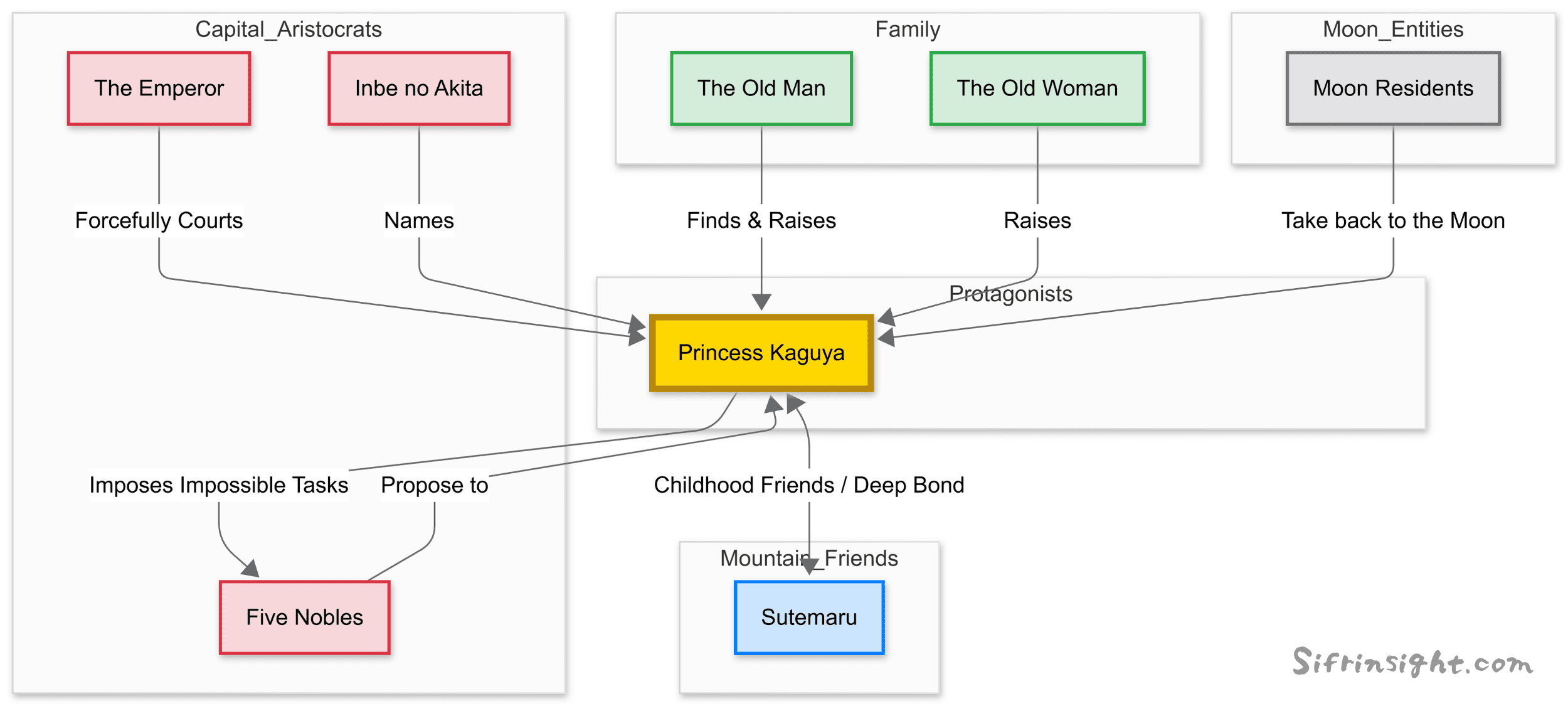
Character Map
Thematic Commentary: A Story of Forced Adaptation
While the skeleton of The Tale of the Princess Kaguya mirrors the ancient Tale of the Bamboo Cutter, Takahata’s execution is wildly different.
The most striking departure is the film’s relentless focus on the minute details of Kaguya’s daily life. We watch her struggle, adapt, and ultimately break under the weight of societal expectations. The film isn’t a fairy tale; it’s a terrifying portrait of forced adaptation to an entirely undesired reality.
And then there is the most haunting detail of all: nobody actually knows the protagonist’s real name.
Her adoptive parents genericized her as “Princess.” The wild children branded her “Takenoko.” The aristocrats projected their fantasies onto her, calling her “Princess Kaguya.”
But what was her true name back on the moon? We never find out.
In many ways, you can view The Tale of the Princess Kaguya as a “story where the core identity of the protagonist is entirely erased by the people around her.” When you frame it like that, it becomes an incredibly heavy, devastating narrative.
But enough of my thematic musings. Let’s ground this analysis by walking through the exact narrative beats of the film.
Detailed Synopsis: From the Bamboo Grove to the Moon
Let’s trace Princess Kaguya’s heartbreaking trajectory—from her radiant, dirt-stained youth in the mountains to her claustrophobic imprisonment in the capital, leading directly into the inescapable tragedy of the ending scene.
A Miraculous Birth in the Bamboo Grove
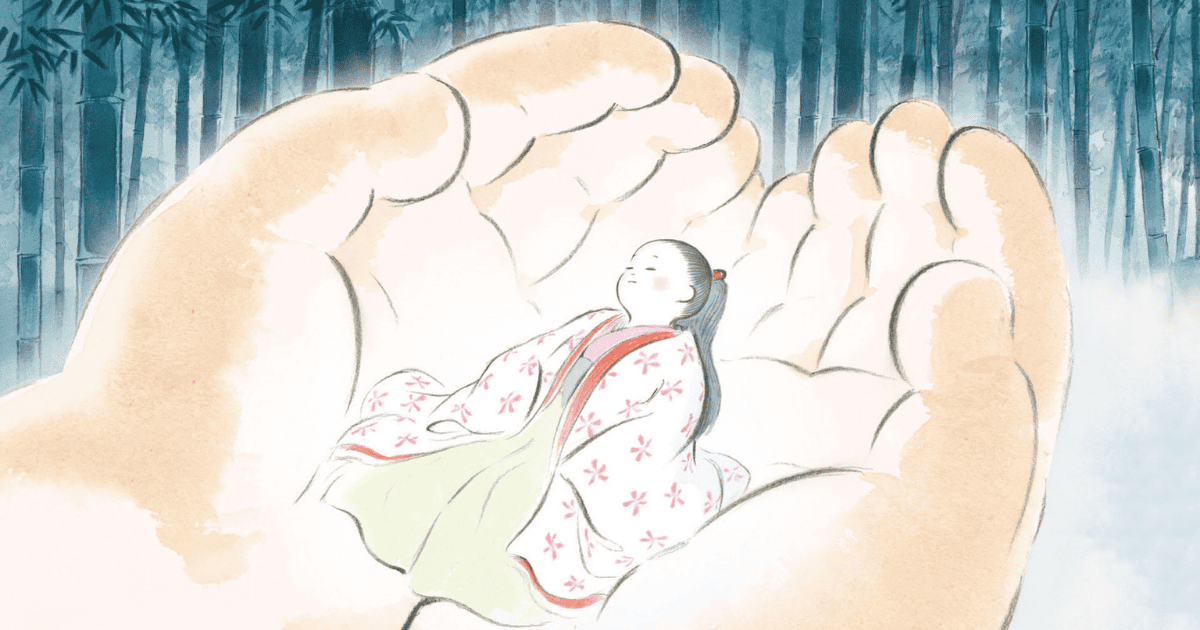
Our story opens deep within a serene bamboo grove. An Old Man (Okina), making his humble living cutting bamboo, spots a stalk glowing with a strange, celestial light. As he approaches, a bamboo shoot blooms open, revealing a miniature, exquisitely beautiful princess resting inside.
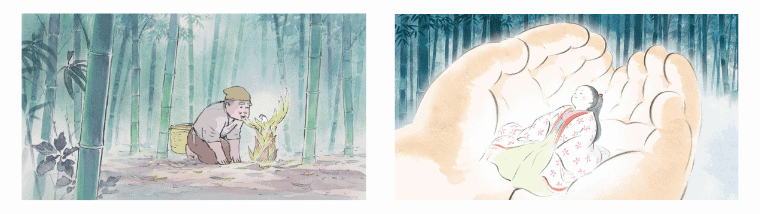
Convinced that heaven itself has gifted him this child, the Old Man gently carries her home.
He places the tiny being into the hands of his wife, the Old Woman (Ouna). The moment she touches the child, the miniature princess magically transforms into the size of a normal human baby.
Panicking about how to feed the infant, they rush out to find a wet nurse. But miraculously, the Old Woman’s body suddenly changes, allowing her to nurse the child herself.
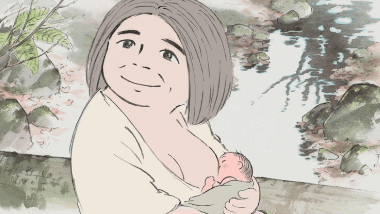
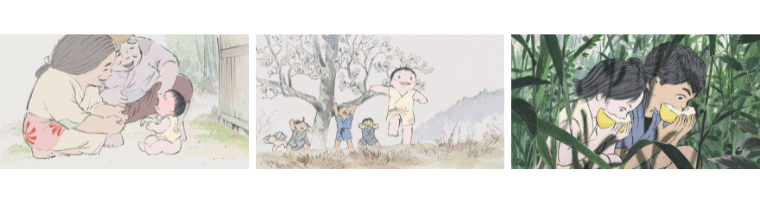
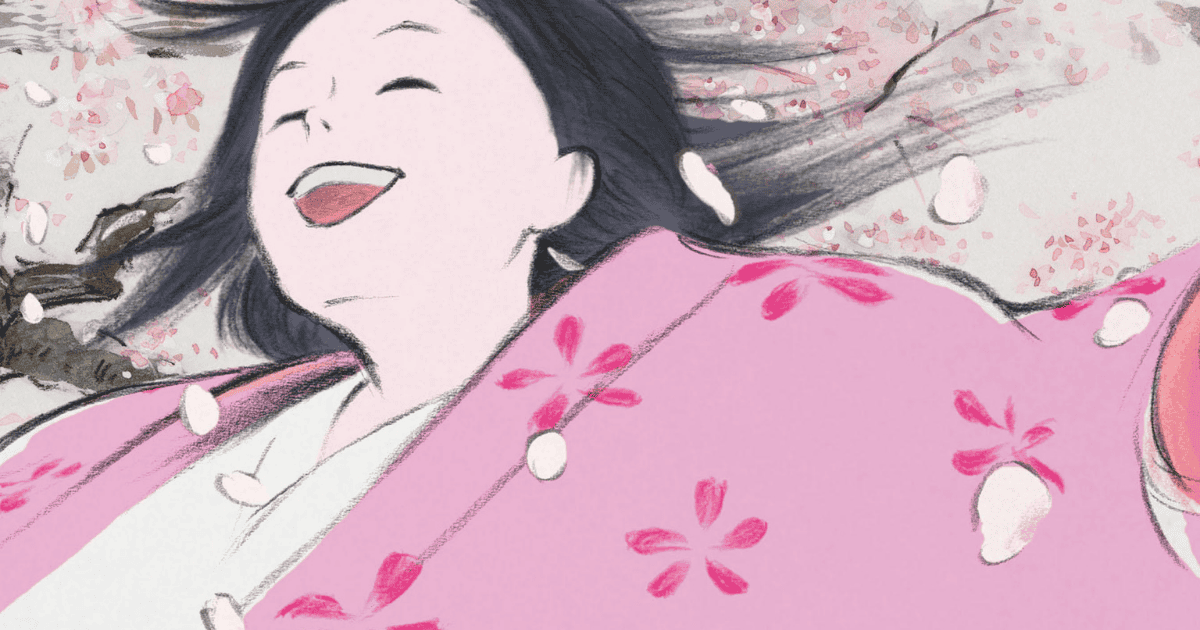
The couple dotes on the girl, reverently calling her “Princess.” However, her supernatural origin shows in her growth spurts; she ages months in mere moments. Fascinated by this, the local village boys nickname her “Takenoko” (Little Bamboo Shoot). She spends her days laughing, running through the mud, and experiencing the vibrant life of the mountains.
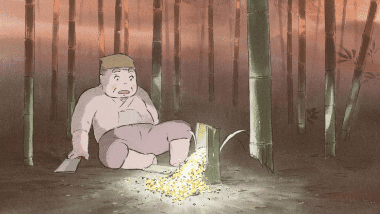
Meanwhile, the Old Man’s life changes again. While cutting bamboo, he discovers stalks bursting with solid gold and magnificent, aristocratic silks.
The Gilded Cage: Moving to the Capital
The Princess is blissfully happy in the dirt and the trees. The Old Man, however, interprets the celestial gold as a mandate: his divine daughter must not live as a peasant. Using the bamboo fortune, he purchases a sprawling, luxurious estate in the capital.
The change is brutally abrupt. Returning from a day of play, the Princess is immediately packed into a carriage. She is dragged away to the capital, completely unable to say goodbye to Sutemaru and her friends.
The capital offers luxury she has never seen, and initially, there is a flicker of childlike wonder at the beautiful clothes and grand architecture.
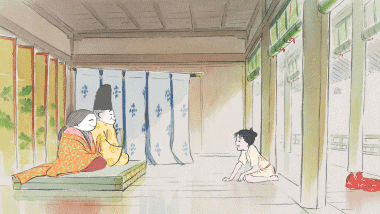
But the illusion shatters quickly. The Old Man hires a strict governess, Lady Sagami, to force the Princess into the mold of a high-born lady. She must learn to pluck her eyebrows, blacken her teeth, and suppress her emotions. Though it suffocates her, the Princess endures the mental torture simply because she wants to see her adoptive father smile.
During this intense period of isolation, she experiences her first menstrual cycle.
While the Princess is deeply unsettled by her physical maturation, the Old Man throws a celebration. Eager to legitimize his daughter’s status in high society, he pays a prominent aristocrat, Inbe no Akita, to officially grant her a name.
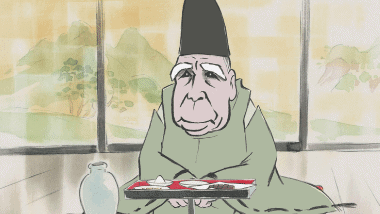
Akita is utterly hypnotized by her otherworldly aura. Inspired by her grace, he christens her “Princess Kaguya of the Flexible Bamboo” (Nayotake no Kaguya-hime).
Following the naming, the Old Man hosts a lavish banquet to celebrate her coming-of-age “Hair-Tying Ceremony.” But Kaguya is forbidden from joining the party; she is locked away behind screens, forced to listen to drunken lords mock her father’s desperate social climbing and demand to see the “prize.” Realizing she has been reduced to a mere commodity, Kaguya’s psychological dam breaks. In a visually spectacular and terrifying sequence, she bursts through the sliding doors, tearing through the capital and fleeing into the wilderness.
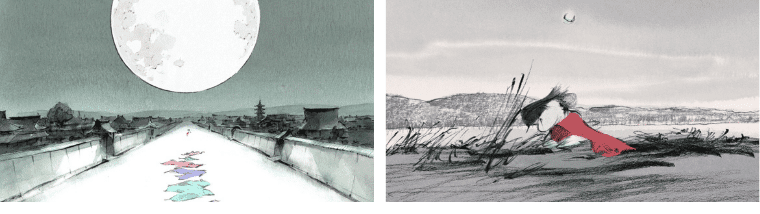
Bleeding, barefoot, and exhausted, she manages to reach the snowy mountains of her childhood home, only to collapse in the snow.
Suddenly, she awakens. She is back at the banquet, sitting quietly behind her screen. Her frantic escape was either a desperate dream or a spiritual projection. The horrifying realization sets in: no matter how loudly her soul screams, she cannot physically escape her cage.
From that moment on, the light in Kaguya’s eyes dies. She becomes the perfectly obedient, hollow aristocrat her father always wanted.
The Five Nobles and Their Foolish Lies
Word of the mysterious, flawless princess spreads through the capital, eventually catching the attention of five powerful nobles who had heard the rumors directly from Inbe no Akita.
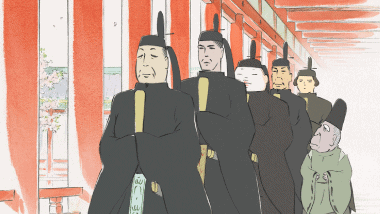
They gather outside her estate, attempting to woo her with flowery poetry, comparing her to mythical treasures. Refusing to be manipulated, Kaguya turns their words against them: she promises her hand only to the man who can physically bring her the legendary item he compared her to.
Three long years pass.
The humiliated nobles go to extreme lengths to procure these impossible treasures. Some hire master craftsmen to build fakes; others lose their lives in reckless pursuits. Ultimately, every single forgery is exposed, and Kaguya expertly repels their empty affections, securing her isolation.
The Emperor’s Arrogance and the Inevitable Return
Kaguya successfully outmaneuvered the five lords, but her defiance attracts a far more dangerous predator: the Emperor himself. Drunk on his own absolute authority, the Emperor assumes Kaguya rejected the lords because she was holding out for a man of his supreme power.
He sneaks into her estate. Without a word of warning or consent, he grabs Kaguya from behind.
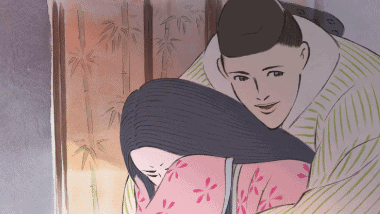
Horrified by his aggression, Kaguya resists with all her might. In her utter desperation to escape his grip, she triggers her latent celestial power and literally vanishes from his arms. Stunned and slightly humbled by the supernatural display, the Emperor begs her to reappear and hastily retreats.
But the damage is done. The Emperor’s assault triggered a deeply buried memory within Kaguya.
She remembers that she is a being of the moon. In that terrifying moment with the Emperor, she subconsciously cried out to the heavens to save her. Now, the celestial machinery is in motion. Despite her tearful pleas to cancel the rescue, the moon has decreed her return; her time on Earth is over.
Kaguya’s desperate refusal to return to the Moon produces one of the most important lines in the film. I look at the original Japanese, the English subtitle, and the meaning behind that dialogue in my collection of memorable The Tale of the Princess Kaguya quotes.
Devastated by the truth, the Old Man and Old Woman realize they are about to lose their daughter forever. They frantically attempt to build defenses.
With her final days ticking down, Kaguya makes one last pilgrimage to her mountain home. By a twist of fate, she reunites with Sutemaru. Though he is now married with a child, the two share a breathless, magical flight through the skies—a brief manifestation of the life she truly wanted.
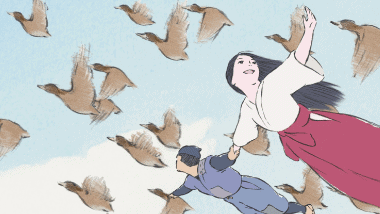
But the dream shatters. Sutemaru wakes up alone in the grass, and Kaguya is pulled back to her inescapable reality.
The fateful night arrives.
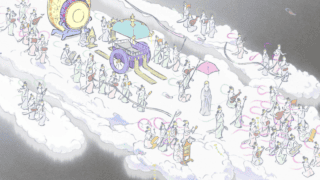
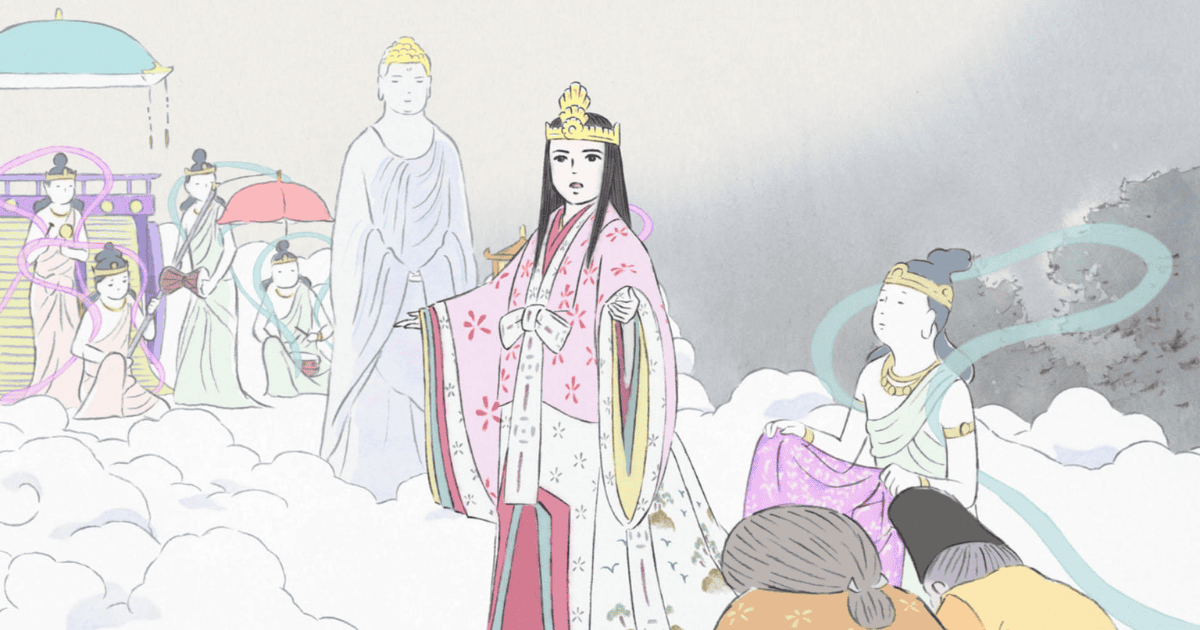
The Old Man has hired a heavily armed militia to lock down the estate. But as a hauntingly cheerful Buddhist procession descends from the moon, their earthly weapons turn to useless wood, and the guards are lullabied into a deep trance.
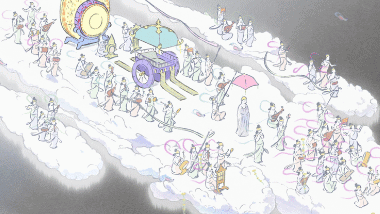
Kaguya is helplessly drawn out of the mansion by a hypnotic divine force.
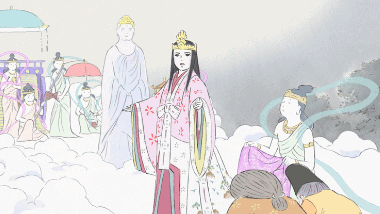
She tearfully begs for a few final seconds to embrace her adoptive parents. But a celestial attendant coldly drapes the lunar robe of feathers over her shoulders.
Instantly, the light leaves Kaguya’s face. Her memories of the Earth, the joy, and the pain are wiped completely blank. She takes her place in the procession, ascending back to the cold, emotionless moon.
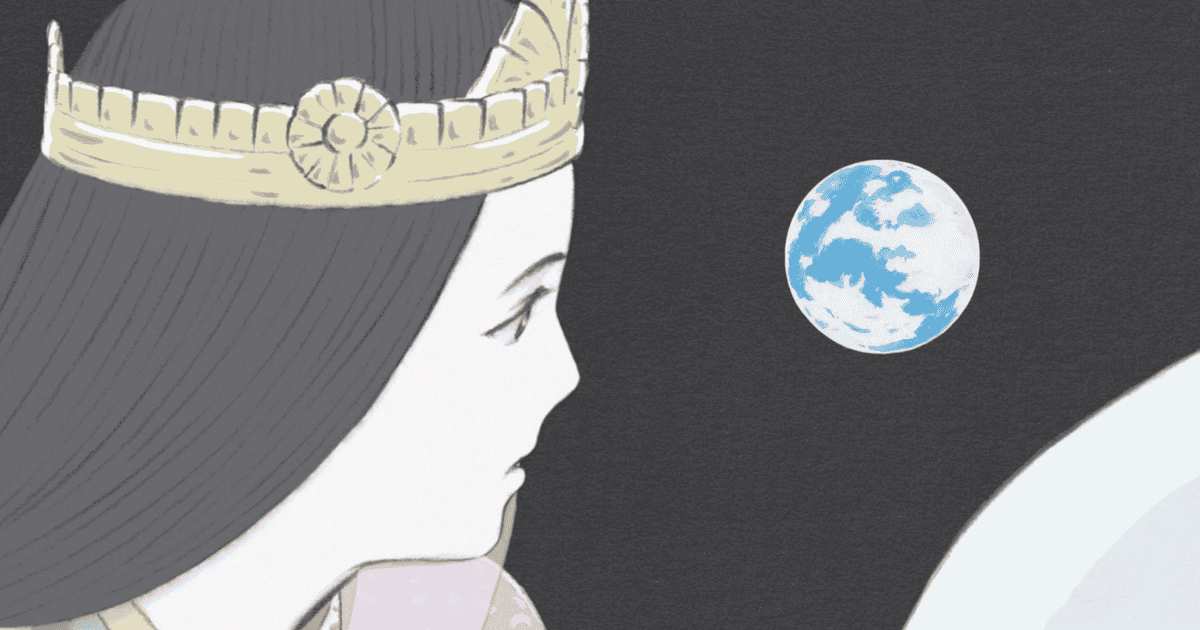
Yet, as she looks back at the brilliant blue marble of Earth, tears well up in her eyes.
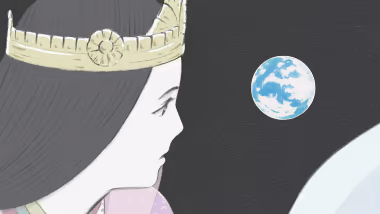
She no longer knows why she is crying. The memories are gone, but the echo of her love for humanity remains permanently scarred onto her soul.
What did her suffering mean? That is the heavy question Takahata leaves us to ponder.
That concludes my detailed breakdown of The Tale of the Princess Kaguya. You might assume that because it’s based on a famous folktale, there are no real surprises. But reading a plot summary cannot capture the sheer emotional violence of Takahata’s visual storytelling. If you haven’t seen it, I implore you to watch the actual film.
Now, let’s explore exactly how Takahata twisted the original The Tale of the Bamboo Cutter to create this modern psychological tragedy.
The Tale of the Princess Kaguya (2013): How the Film Defies the Original Folktale
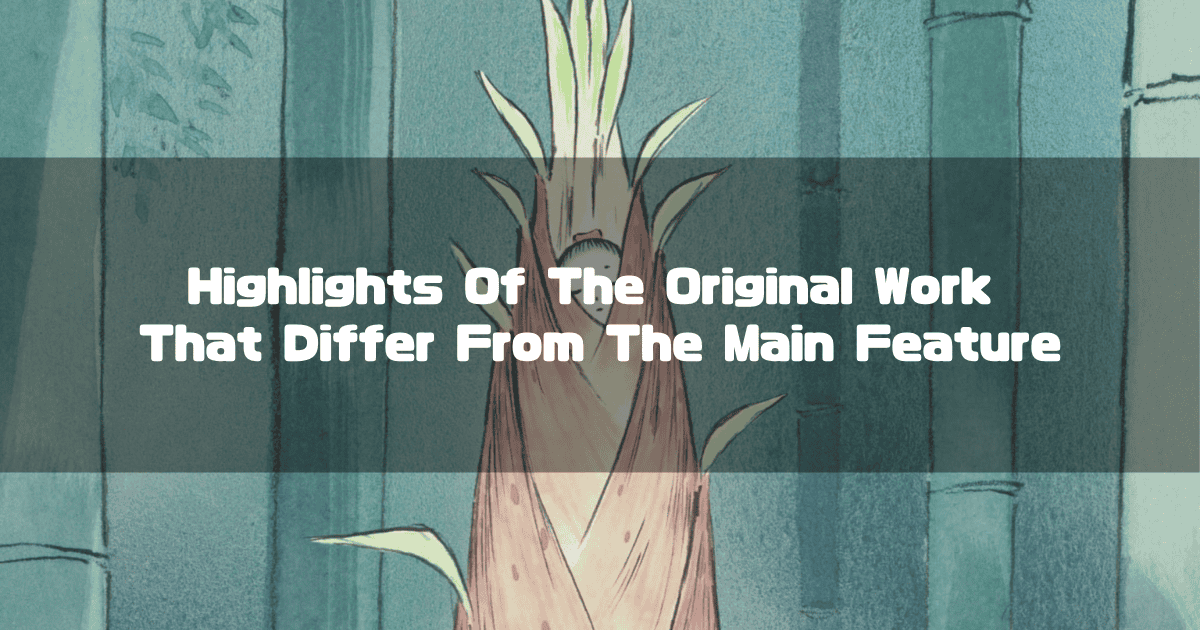
On paper, the plot sounds identical to the folktale: an old couple raises a girl found in bamboo, they get rich, she rejects five nobles, she rejects the Emperor, and she returns to the moon. But the devil is in the details, and Takahata’s modifications are vital to the story’s meaning.
Here are the four critical ways the movie deviates from the original text:
- The deep exploration of her grounded, dirty life in the mountains.
- The aggressive shortening of the five nobles’ comedy arcs.
- The much darker, violating nature of the Emperor’s courtship.
- The tragic compression of Kaguya’s timeline on Earth.
Prioritizing Daily Life Over Aristocratic Comedy
Takahata dedicates massive amounts of screen time to Kaguya’s connection with nature and her daily struggles in the capital. This obsession with “ordinary life” is a staple of his directorial style, grounding the supernatural Kaguya as a fundamentally human character.
To make room for this, he aggressively truncates the storylines of the five suitors. In the original Tale of the Bamboo Cutter, these five men are the absolute highlight of the text!
Historically, the story of the five nobles was written as a satirical comedy to mock the political elites of the Heian period. Their foolishness actually birthed several common Japanese idioms.
For context, the five famous suitors were:
- Prince Ishitsukuri
- Prince Kuramochi
- Minister of the Right Abe no Miushi
- Major Counselor Otomo no Miyuki
- Middle Counselor Isonokami no Maro
Kaguya challenged them to retrieve:
- The Stone Begging Bowl of the Buddha
- The Jeweled Branch of Hourai
- The Robe of Fire Rat Skins
- The Colored Jewel from a Dragon’s Neck
- The Cowry Shell Born of Swallows
Notice the agency shift: In the original text, Kaguya independently dreams up these impossible items to assign as tasks. In the movie, the pompous men boastfully compare her to these items first, and Kaguya brilliantly traps them by demanding they prove their own metaphors.
In the original folktale, their spectacular failures spawned classic Japanese phrases:
- Haji wo sutsu (Discarding shame/bowl) — To act shamelessly
- Tamasakaru (Losing one’s mind/jewel) — To space out
- Aenai (Unrewarding) — Anticlimactic
- Anatagegata (Not worth it) — Unreasonable
- Kainashi (Worthless/shell-less) — Contrary to expectations
The original author clearly delighted in humiliating these politicians. Yet, Takahata brushes them aside almost impatiently. His film isn’t interested in making fun of men; it’s entirely focused on Kaguya’s psychological suffocation.
The Emperor’s Unwelcome Advances
The film completely rewrites Kaguya’s dynamic with the Emperor. In The Tale of the Bamboo Cutter, the Emperor is a somewhat respectful figure. Kaguya rejects him primarily because her celestial nature prevents her from staying on Earth, but they actually exchange fond letters for years. Becoming his consort was viewed as an honorable, decent option.
Takahata destroys this romanticized dynamic. In his version, the Emperor is a predatory, arrogant figure who physically corners and grabs Kaguya against her will.
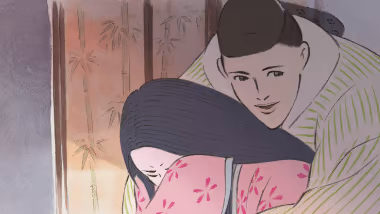
Why make this change? Because Takahata is directing a modern psychological drama, not a Heian-era political fantasy. A young woman raised in the wild mountains wouldn’t care about the prestige of the throne; she would only feel the sheer terror of a powerful man violating her bodily autonomy. It grounds her tragic wish to escape the Earth in visceral trauma rather than divine duty.
The Tragic Compression of Time
Let’s look at the timeline. The original text provides a very clear metric:
We have raised Princess Kaguya for over twenty years.
(Original Text, in Japanese)
かぐや姫を養ひ奉ること廿余年に成りぬ
訳:かぐや姫を養育し申し上げて二十年あまりになった
In the folktale, Kaguya lives on Earth for more than two decades.
The film, however, leaves the exact timeline ambiguous, forcing us to piece together the clues:
- When Kaguya flees back to the mountains, a charcoal maker mentions that Sutemaru’s group “won’t be back for 10 years.” When she meets Sutemaru again at the end, he has aged, suggesting nearly a decade has passed.
- During that same mountain escape, Kaguya assumes the dead winter landscape means the forest is “dead forever,” proving she had not yet lived through a full seasonal cycle with her adoptive parents.
When combined with her supernatural growth rate, it is highly likely that Kaguya was on Earth for only about 10 years in the film.
She deeply loved the Earth and cherished her feral days in the woods. Yet, she spent less than a year experiencing that joy before being locked in a cage for a decade. Knowing she was robbed of time makes her ultimate departure infinitely more tragic.
The Tale of the Princess Kaguya (2013): Unpacking “The Crime and Punishment”
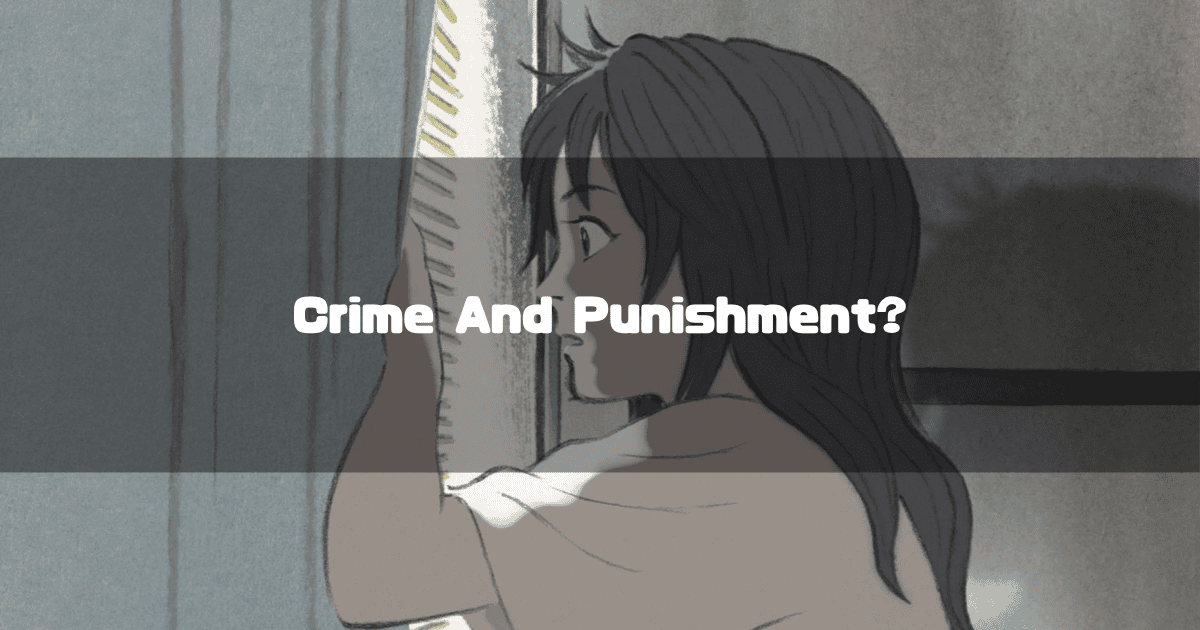
Whenever fans discuss this masterpiece, the promotional tagline inevitably comes up: “The crime and punishment of the princess.” It’s an aggressive, philosophical hook.
But what exact “crime” did this innocent girl commit, and what was her “punishment”? I’ve unpacked the complex theology and thematic clues in a dedicated essay right here. You won’t want to miss this analysis:
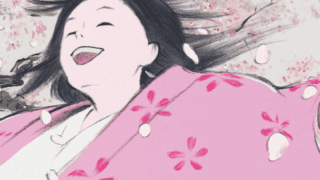
While writing that analysis, I hit a massive contradiction regarding her “punishment.” According to the lore, the moon is a “world without sorrow.” How can a realm devoid of negative emotion dish out “punishment”? If you’re as fascinated by this paradox as I am, join me down the rabbit hole in my follow-up investigation here:
I leave you with this question: Do you truly believe Kaguya was a sinner who deserved her fate?
Can you name the movie before the scene comes into focus?
Put your visual memory to the test with a blurred Studio Ghibli scene.



Reader Comments