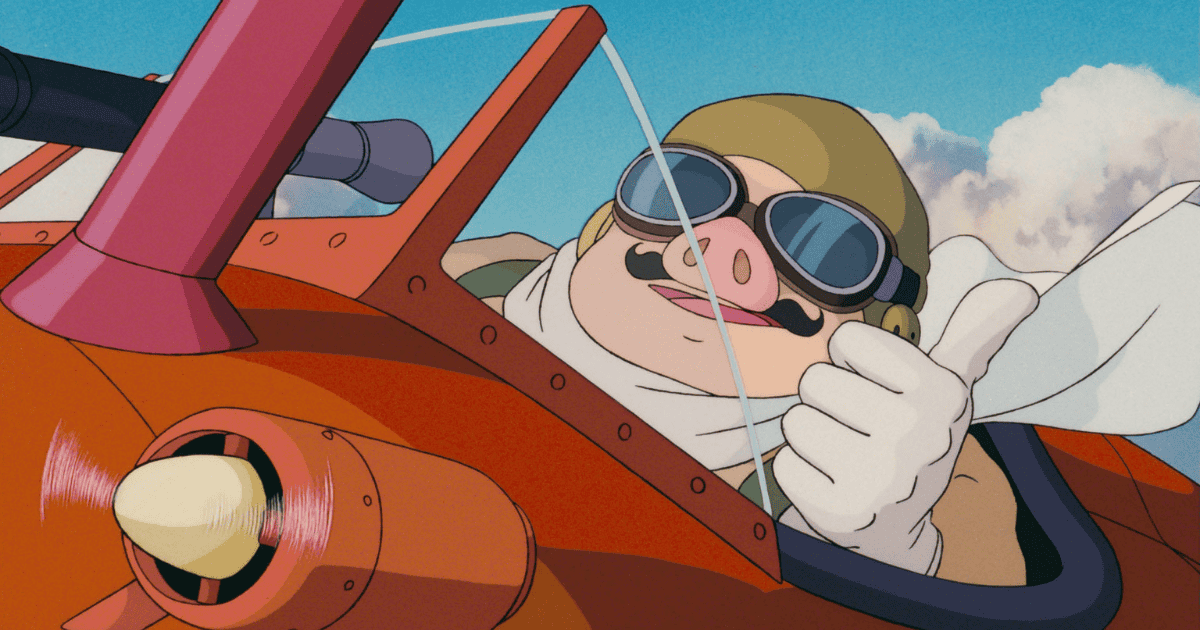
Porco Rosso (Studio Ghibli Official) is a 1992 animated feature film written and directed by Hayao Miyazaki. It was released in Japan on July 18, 1992.
In this article, I have selected 17 of my favorite quotes from the film.
Porco Rosso contains an unusually large number of memorable lines. Many of them also use deliberately stylish, cynical, or theatrical expressions, which made me wonder how they had been translated into English.
For each quote, I will look at the original Japanese, its romanization, the English subtitle, a literal translation, and what the dialogue reveals about the characters and the story.
These are not necessarily the 17 most objectively famous lines in the film. This is a personal selection, and some of them are here simply because they have remained strangely fixed in my memory since childhood.
The film’s official English title is:
Porco Rosso
Translation note: The English subtitle wording in this article is based on the commercially released Blu-ray available to the author. The English dub is also discussed where its wording creates a meaningful difference. Subtitle and dub wording may vary between releases and territories.
▼ Read the full story and analysis behind these quotes
On this pageContents
Porco Rosso Quotes in Japanese and English
“A pig’s gotta fly.”
飛ばねぇ豚はただの豚だ。
Tobanē buta wa tada no buta da.
A pig’s gotta fly.
A pig that does not fly is just an ordinary pig.
Read the Commentary and Analysis
I cannot be the only person who once misremembered this line as:
“A pig that cannot fly is just an ordinary pig.”
The difference may appear small, but the implications are not quite the same.
“Cannot fly” suggests that Porco happens to possess the ability to fly and therefore uses it.
“Does not fly,” however, expresses a matter of will. Porco must fly because he has decided that he will continue flying.
Porco Rosso is a story about a man who adopts a cynical pose and struggles to mock the human world from a distance. He cannot simply drift through the sky without purpose. His flying must be supported by an active and stubborn decision.
That is why the line must be:
“A pig that does not fly is just a pig.”
It cannot be reduced to “a pig that cannot fly.”
The subtitle’s “gotta” is an informal form of “have got to” or “have to.” The feeling is therefore close to:
“A pig has to fly.”
In the dub, Porco responds to Gina’s warning with “Sorry, baby. Gotta fly,” which expresses almost the same attitude.
This may be the single line most strongly associated with Porco Rosso. Even so, the English version has never struck me with quite the same force as the Japanese.
Perhaps that is only me.
“That’s the furthest thing from my mind.”
尻の毛まで抜かれて鼻血もでねぇ。
Shiri no ke made nukarete hanaji mo denē.
That’s the furthest thing from my mind.
I’ve been stripped so completely that even the hair on my backside is gone, and I cannot even produce a nosebleed.
Read the Commentary and Analysis
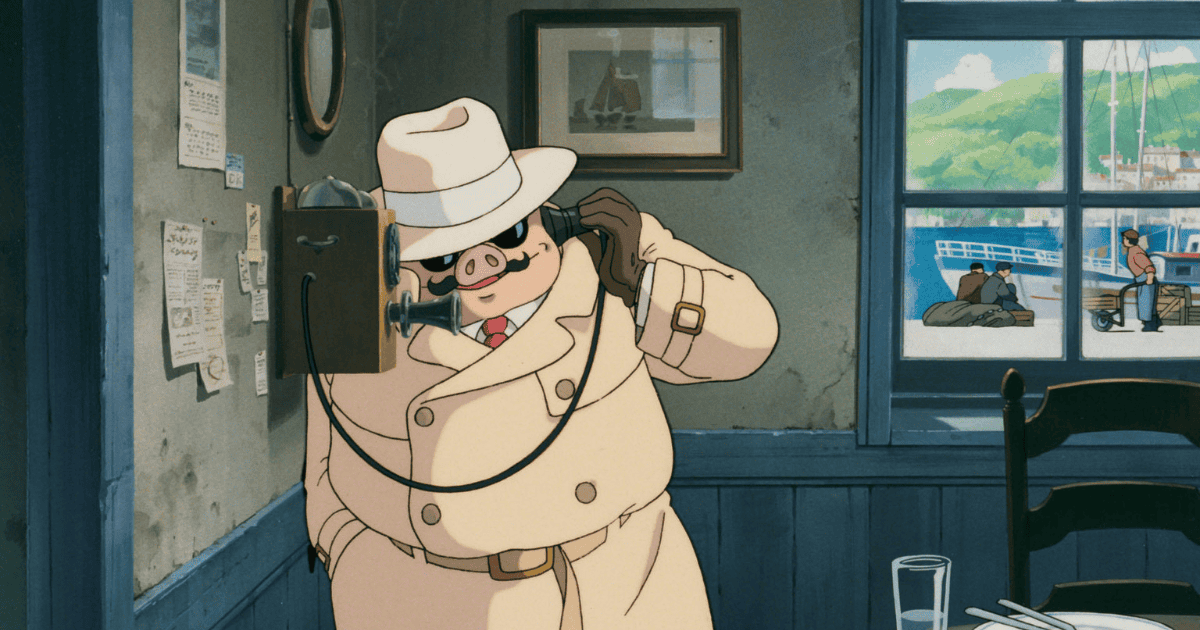
Porco says this after Mr. Piccolo warns him not to make a move on Fio.
The line does not carry any particularly profound meaning, but it has remained in my memory since childhood.
In fact, I included it largely because I was curious about the English translation.
The word “furthest” means the most distant. “That’s the furthest thing from my mind” therefore means that he is not considering such a thing at all.
The dub uses:
“Don’t worry. Just looking at her makes me tired.”
The Japanese joke is based on Porco’s financial condition. Mr. Piccolo has extracted so much money from him that Porco has effectively been stripped bare. He is saying that he has no energy, money, or desire left for anything else.
From that perspective, the dub’s use of “tired” may come slightly closer to the original physical exhaustion.
Ultimately, however, the subtitle and dub seem about equally distant from the grotesque Japanese metaphor.
▼ Read more about Porco’s background and character analysis
Madame Gina Quotes in Japanese and English
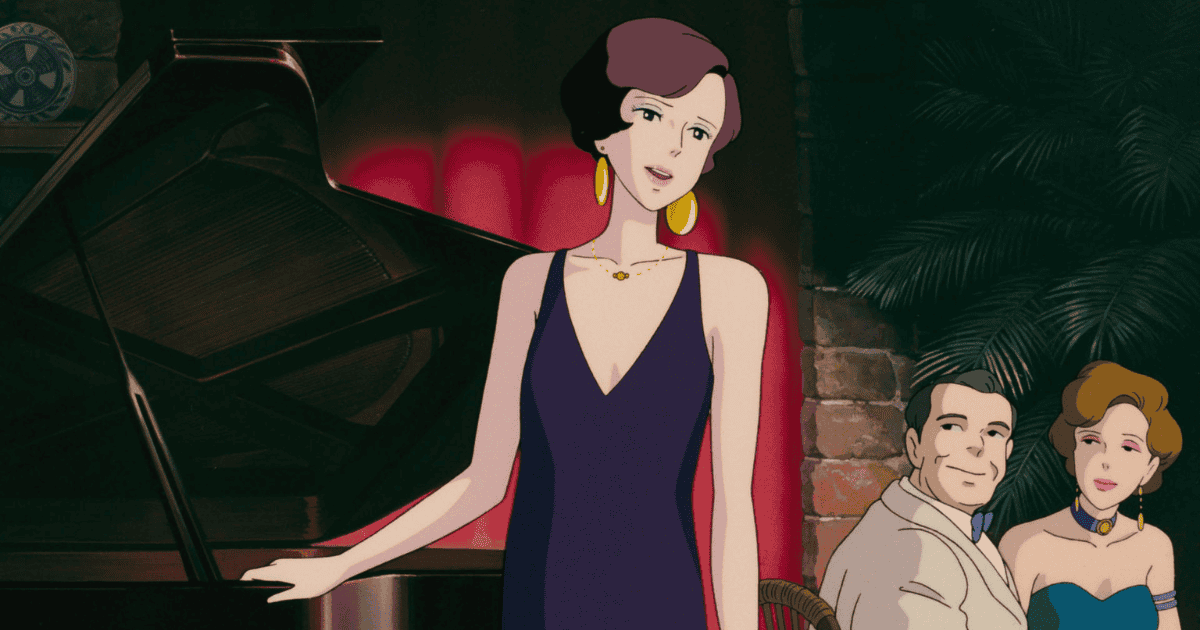
“I told him I’d lost three pilot husbands already.”
私は三回飛行艇乗りと結婚したけど、一人は戦争で、一人は大西洋で、最後の一人はアジアで死んだって。
Watashi wa sankai hikōtei-nori to kekkon shita kedo, hitori wa sensō de, hitori wa Taiseiyō de, saigo no hitori wa Ajia de shinda tte.
I told him I’d lost three pilot husbands already. One in combat, one in the Atlantic. The third died in Asia.
I told him that I had married seaplane pilots three times: one died in the war, one in the Atlantic, and the last one died in Asia.
Read the Commentary and Analysis
Madame Gina reveals this shocking fact near the beginning of the film.
For some reason, she appears capable of loving only aviators.
One might think that the death of her second husband would have revealed the destructive pattern. Nevertheless, her third husband was also a pilot, and she learns of his death immediately before—or perhaps during—the events of the film.
Why did Gina remain so determined to choose aviators?
The photograph showing Porco before he became a pig may offer a clue.
Porco’s human face has been scratched out, but three other men can be seen around him.
It seems reasonable to imagine that these three men became Gina’s three husbands. In other words, she chose her partners from the group already closest to her.
There is nothing particularly strange about that.
If we follow that reasoning too literally, however, Porco becomes an irrelevant fourth man in Gina’s life.
That is not an especially satisfying interpretation.
Porco is the protagonist of Porco Rosso. Surely the protagonist cannot have been treated with such complete indifference.
If Porco believed himself to be merely an unimportant fourth option, he would hardly visit the Hotel Adriano night after night to see Gina.
My suspicion is that, within Porco’s own self-conscious imagination, he believed he had always been Gina’s first man.
From Porco’s perspective, Gina repeatedly chose men who were simply more accessible than he was.
The story’s decision to give Gina three dead husbands may therefore serve an important dramatic purpose:
It creates a situation in which Porco never marries Gina but can continue believing that he might still have a chance, thereby giving him a reason to remain connected to her.
At the very least, the situation has that effect.
I discuss Porco and Gina’s relationship in greater detail in the following articles:

The English subtitle states immediately that Gina has already “lost three pilot husbands.”
As a result, it loses part of the Japanese line’s small narrative trick. In Japanese, the listener does not necessarily learn that the third husband is also dead until Gina reaches the phrase “the last one died in Asia.”
The dub comes closer to preserving that progression:
“I told him of the three pilots I’ve married. The first died in the war, the second died in the Atlantic, the last one… he died in Asia.”
“Marco, you’ll end up roasted.”
人を伝言板か何かと思ってるの!? いくら心配しても、あんた達飛行艇乗りは女を桟橋の金具くらいにしか考えてないんでしょう。マルコ、今にローストポークになっちゃうから……私イヤよ、そんなお葬式。
Hito o dengonban ka nanika to omotteru no!? Ikura shinpai shite mo, anta-tachi hikōtei-nori wa onna o sanbashi no kanagu kurai ni shika kangaetenai n deshō. Maruko, ima ni rōsuto pōku ni nacchau kara… watashi iya yo, sonna osōshiki.
Hey! I’m not a messenger. I worry about you pilots, but you treat me like the furniture. Marco, you’ll end up roasted. I won’t go to your funeral.
Do you think I’m some kind of message board? No matter how much I worry, you seaplane pilots think of women as nothing more than fittings on a pier. Marco, one day you’ll become roast pork. I don’t want a funeral like that.
Read the Commentary and Analysis
After disappearing following his first battle with Curtis, Porco finally contacts Gina.
Ignoring how deeply she has worried about him, he asks her to deliver a message:
“If that American comes to your place, tell him we’ll meet again.”
Gina responds with this furious speech.
If the woman I loved said something like this to me, I would immediately turn around and go back to her.
But Porco Rosso is also a story about Porco’s stubborn performance of masculine endurance.
He must conceal his excitement and turn his back on the woman.
Still, Porco, perhaps behavior like this is precisely why you remained number four.
Honesty really is the best policy.
The notable English expression is “end up.”
“End up” means to arrive at a particular final state, often unintentionally. For example, “end up all alone” means to finish one’s life alone.
I would very much prefer to avoid that outcome.
The Japanese image of women as metal fittings on a pier is changed to “furniture” in the subtitle. Both metaphors describe something useful, stationary, and taken entirely for granted.
“Life here is more complicated than in your country.”
ここではあなたのお国より、人生がもうちょっと複雑なの。恋だったらいつでもできるけど。
Koko de wa anata no okuni yori, jinsei ga mō chotto fukuzatsu na no. Koi dattara itsu demo dekiru kedo.
Life here is more complicated than in your country.
Life here is a little more complicated than it is in your country. Falling in love can be done at any time.
Read the Commentary and Analysis
This can be read as a beautifully ironic response to a proposal from a pretentious and mistaken American.
At the same time, I sense a slight lack of composure in Gina’s words.
When Gina stands in that garden, she is waiting for Porco. She is hardly in the emotional state to entertain Curtis’s proposal.
Immediately after this line, Gina notices Porco circling overhead.
The sight of her watching him is extraordinarily beautiful.
The subtitle removes the final Japanese sentence about being able to fall in love at any time.
The dub gives a slightly fuller version:
“Life is a little bit more complicated here than it is in America.”
▼ Read more about Madame Gina’s background and character analysis
Fio Piccolo Quotes in Japanese and English

“What’s the main thing a good pilot needs? Experience?”
ねえ、良いパイロットの第一条件を教えて! 経験?
Nē, ii pairotto no daiichi jōken o oshiete! Keiken?
Tell me, what’s the main thing a good pilot needs? Experience?
Tell me, what is the first requirement for a good pilot? Experience?
Read the Commentary and Analysis
Porco hears this question and cannot resist giving the stylish answer:
“Inspiration.”
It is the pointless self-consciousness of a middle-aged man trying to look cool.
Fio, however, may simply have been one step ahead of him.
She appears to have inherited not only Mr. Piccolo’s skill as a craftsperson but also his formidable commercial instincts.
Well played, Fio.
The subtitle is straightforward. The dub asks:
“Tell me, what do you think it takes to make a pilot great? Experience?”
Porco’s answer creates a small translation question.
The Japanese and English subtitles use “inspiration,” while the dub uses “intuition.”
Both words can describe knowledge or an idea that arrives without deliberate reasoning, but they are not completely identical.
“Inspiration” can mean a sudden good idea about what to do, write, or say. It can also refer to a person, place, or experience that gives someone new creative ideas.
“Intuition” refers more specifically to understanding something through feeling rather than through conscious examination of the facts.
In Japanese, the borrowed word “inspiration” generally suggests the first meaning: a sudden flash of insight.
In English, however, it can also suggest an external creative influence. The dub may therefore have chosen “intuition” to make Porco’s meaning more precise.
“The most precious thing to them isn’t money or women—it’s honor.”
私ね、小さい時から飛行艇乗りの話を聞いて育って来たの。飛行艇乗りの連中ほど気持ちのいい男達はいないって、おじいちゃんはいつも言ってたわ。それは海と空の両方が奴らの心を洗うからだって。だから飛行艇乗りは、船乗りよりも勇敢で、陸の飛行乗りより誇り高いんだって。彼らの一番大事なものは金でも女でもない、名誉だって!
Watashi ne, chiisai toki kara hikōtei-nori no hanashi o kiite sodatte kita no. Hikōtei-nori no renchū hodo kimochi no ii otoko-tachi wa inai tte, ojīchan wa itsumo itteta wa. Sore wa umi to sora no ryōhō ga yatsura no kokoro o arau kara da tte. Dakara hikōtei-nori wa, funanori yori mo yūkan de, riku no hikō-nori yori hokoritakai n da tte. Karera no ichiban daiji na mono wa kane demo onna demo nai, meiyo da tte!
I was raised on stories about seaplane pilots. My grandpa always said there’s no finer people anywhere. Their hearts are washed clean by the sea and sky. So, they’re braver than sailors and prouder than regular pilots. The most precious thing to them isn’t money or women, it’s honor.
I grew up listening to stories about seaplane pilots. My grandfather always said there were no more admirable men. He said that both the sea and the sky washed their hearts clean. That is why they were braver than sailors and prouder than land-based pilots. Their most important possession was neither money nor women, but honor.
Read the Commentary and Analysis
Fio delivers this speech when the members of the Sky Pirate Federation prepare to beat Porco after he returns to his hideout with his repaired seaplane.
Just as she did when she drew the word “inspiration” out of Porco, Fio skillfully transforms the situation into one that benefits her.
This ability must have contributed enormously to the later success of the Piccolo company.
The notable English expression is “be raised on.”
To be raised on stories, music, food, or beliefs means to grow up surrounded by them.
The dub makes the sentence more explicit:
“My grandpa has been telling me stories about seaplane pilots ever since I was born.”
The subtitle’s “regular pilots” refers to aviators who fly land-based aircraft, contrasting them with the seaplane pilots who belong simultaneously to the sea and the sky.
“And did Gina win her bet? That’s our secret.”
ジーナさんの賭けがどうなったかは、私たちだけのひみつ。
Jīna-san no kake ga dō natta ka wa, watashitachi dake no himitsu.
And did Gina win her bet? That’s our secret.
What happened with Gina’s bet is a secret known only to us.
Read the Commentary and Analysis
The answer has become widely known.
During the final shot, Porco’s seaplane can be seen behind the Hotel Adriano.
Gina therefore appears to have won her bet.
Nevertheless, the film also shows Porco continuing to circle through the sky.
He has not stopped flying.
He cannot remain a bounty hunter forever, but Porco will still continue resisting the idea of being tied down.
He keeps flying as though declaring:
“No one is going to capture me.”
That is the kind of story Porco Rosso is.
The subtitle turns Fio’s indirect Japanese statement into a direct question followed by an answer.
The dub remains closer to the original structure:
“And as for how Gina’s bet turned out, well, that’s our secret.”
▼ Read more about Fio’s background and character analysis
Donald Curtis Quotes in Japanese and English
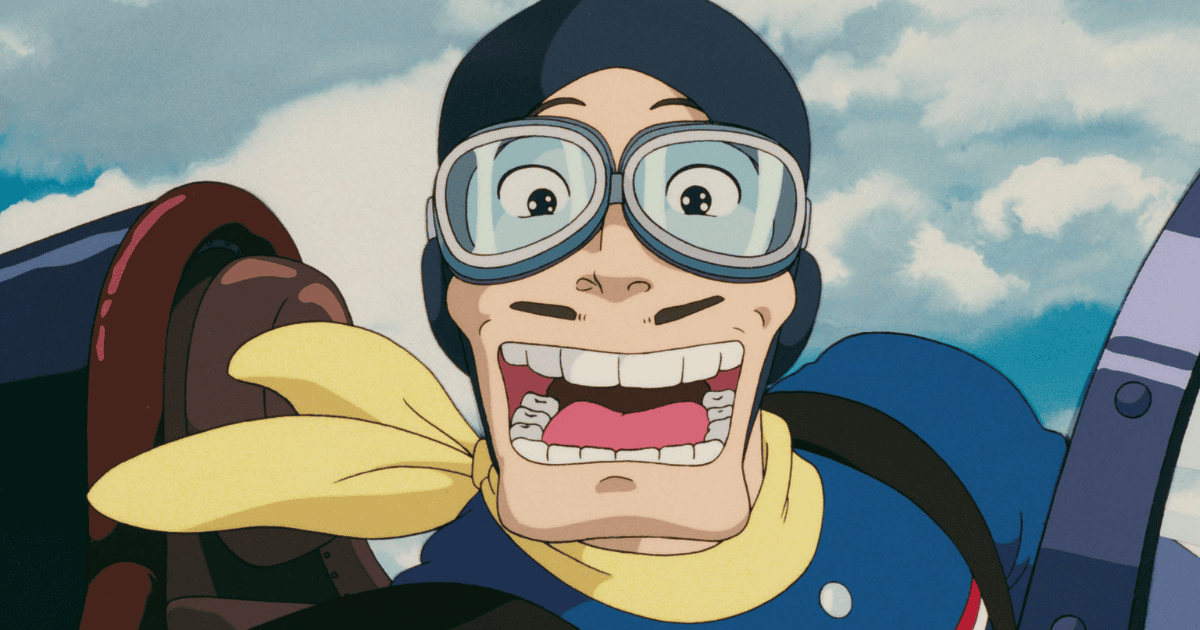
“The Rattlesnake. Winner of fame and fortune.”
金と名声を運んでくる幸運のガラガラヘビさ。
Kane to meisei o hakonde kuru kōun no garagarahebi sa.
The Rattlesnake. Winner of fame and fortune.
She is the lucky rattlesnake that brings me money and fame.
Read the Commentary and Analysis
Curtis says this after Porco asks whether the Curtis aircraft outside belongs to him.
During the events of the film, the plane ultimately brings Curtis only temporary fame and a considerable amount of debt.
Still, he later succeeds in becoming an actor.
Viewed across his entire life, perhaps the aircraft really does bring him money and fame.
The principal vocabulary point is simply that “rattlesnake” is the English word for garagarahebi.
The dub uses a substantially different line:
“I don’t mind saying she made me a bit of a celebrity in the racing world.”
This version communicates Curtis’s enormous self-confidence and slightly ironic manner.
The expression “I hope you don’t mind…” is also worth remembering. It means that the speaker hopes an action or question will not cause offense.
For example:
“I hope you don’t mind me asking this, but…”
This is a useful introduction before asking something potentially uncomfortable.
Some people may also remember “I hope you don’t mind” from the chorus of Elton John’s “Your Song.”
“My mother says you can get used to anything.”
心配するな! おふくろの話じゃ惚れるより慣れだってよ!
Shinpai suru na! Ofukuro no hanashi ja horeru yori nare da tte yo!
Don’t worry. My mother says you can get used to anything.
Don’t worry! According to my mother, getting used to someone matters more than falling in love.
Read the Commentary and Analysis
Curtis says this to Fio, who is seated as the “prize” on the day of his final duel with Porco.
Curtis is clearly an exceptional pilot and fundamentally seems like a decent person.
Even so, the extreme self-confidence displayed in this line approaches the abnormal.
That abnormal confidence may be precisely what later allows him to become an actor.
He will probably even become president, just like Ronald Reagan.
Self-confidence may be a force that transforms a person before they even recognize what is happening.
The subtitle removes the element of falling in love completely.
Subtitles have limited space and cannot preserve every component. Here, “you can get used to anything” recreates the basic idea by suggesting that love is unnecessary because familiarity will eventually be enough.
The dub uses:
“According to my sweet mama, it isn’t the love that counts.”
That version preserves the explicit contrast with love.
Personally, however, I slightly prefer the subtitle’s outrageous confidence that Fio can simply become accustomed to Curtis.
▼ Read more about Donald Curtis’s background and character analysis
Mr. Piccolo Quotes in Japanese and English
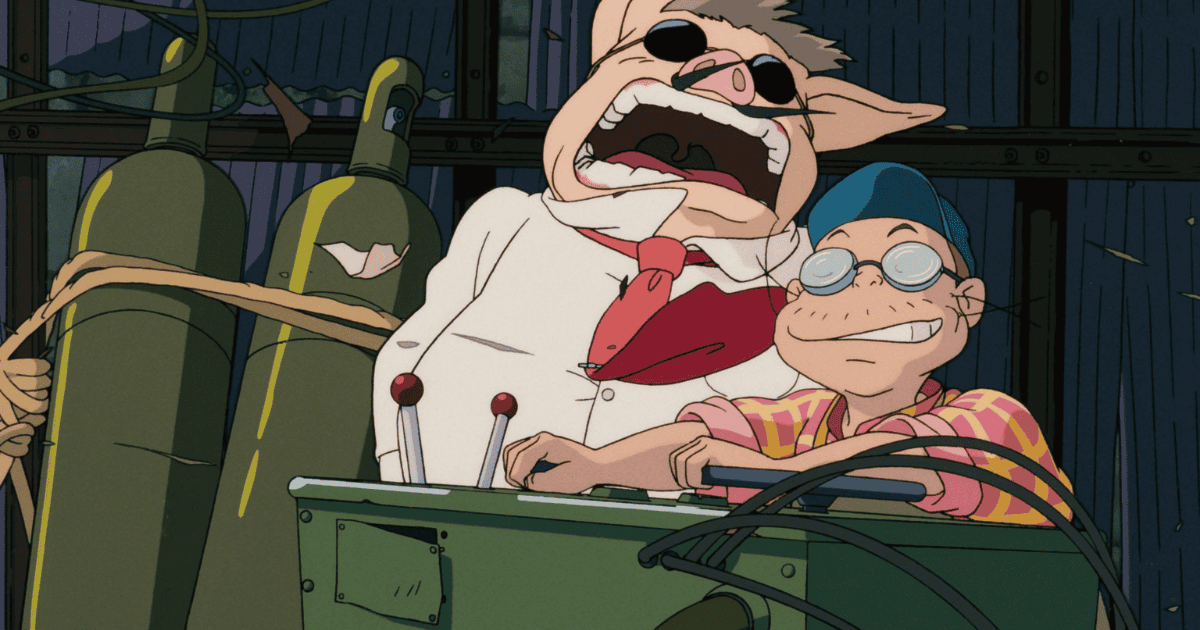
“The women are tough, and they work hard.”
心配するな、女はいいぞ。よく働くし、粘り強いしなあ。
Shinpai suru na, onna wa ii zo. Yoku hataraku shi, nebarizuyoi shi nā.
Don’t worry. The women are tough, and they work hard.
Don’t worry. Women are excellent. They work hard, and they are persistent.
Read the Commentary and Analysis
All the male workers have left town to find seasonal employment, and Porco complains that only women are available to rebuild his seaplane.
Mr. Piccolo responds with this line.
Whenever Porco Rosso is broadcast on Friday Road Show, this line makes me slightly nervous.
Some women work hard and remain persistent. Others do not.
The same is obviously true of men.
The instant we describe an entire group with one characteristic, the statement becomes inaccurate.
“Japanese people like rice” is false because some Japanese people dislike rice. “Russians love alcohol” is false because some Russians do not drink.
Nevertheless, it is worth asking why Mr. Piccolo says this—or, more precisely, why Miyazaki chose to give him this line.
The production circumstances of Porco Rosso were unusual.
After the release of Only Yesterday, animation director Yoshifumi Kondō and art director Kazuo Oga were exhausted.
Miyazaki’s response was to build the principal staff around women.
As discussed in Studio Ghibli Textbook 7: Porco Rosso(ジブリの教科書7:紅の豚, in Japanese), Ai Kagawa became animation director, while Katsu Hisamura was selected as art director.
Kagawa later served as an animation director on films including Pom Poko, Spirited Away, and Arrietty.
Seen in this context, the Piccolo company may reflect the actual production environment of Porco Rosso.
“Women work hard” may therefore have expressed Miyazaki’s practical experience and respect rather than a prejudice constructed entirely in his head.
His earlier experiences at Toei Animation may also have influenced the scene.
I can only hope that the line avoids becoming a future target of controversy.
The English subtitle keeps the gender reference.
The dub reportedly says only, “You’ll see very hard workers,” removing any reference to women.
One might speculate that the gendered generalization was considered potentially discriminatory, but I have no way to confirm the actual reason.
“Let’s eat up and get to work!”
さあ、モリモリ食べて、ビシバシ働こう。
Sā, morimori tabete, bishibashi hatarakō.
Let’s eat up and get to work!
Now, let’s eat heartily and work vigorously.
Read the Commentary and Analysis
Mr. Piccolo says this to the employees when the reconstruction of Porco’s seaplane begins in earnest.
If the previous line about women working hard reflects the actual situation at Studio Ghibli, this line can also be heard as Miyazaki addressing his own production staff.
The Japanese expression morimori taberu suggests eating energetically and in large quantities.
From a modern perspective, we might interpret it as eating plenty of nutritionally balanced food.
That probably is not what Miyazaki had in mind.
Miyazaki himself does not appear especially interested in food as an experience. He seems more like someone who treats it as fuel to be inserted before returning to work.
Documentary footage shows him calmly eating curry-flavored instant noodles.
Perhaps the real meaning is therefore:
“It may not be especially nutritious, but fill your stomach and then get back to work at full speed.”
The subtitle is straightforward.
The dub uses:
“You eat and work on making that cake.”
The sudden appearance of “cake” refers back to Porco’s earlier complaint that the women are supposed to be repairing an airplane, not baking a cake.
Mr. Piccolo is throwing Porco’s own remark back at him.
▼ Read more about Mr. Piccolo’s background and character analysis
Mamma Aiuto Boss Quotes in Japanese and English
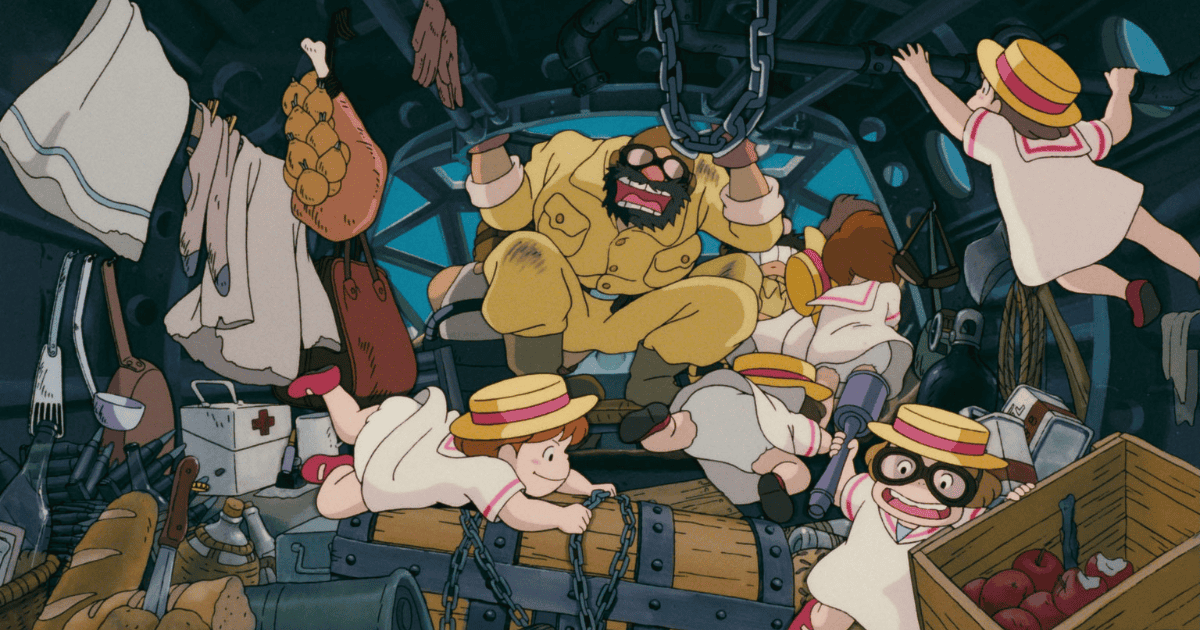
“We can’t leave anyone out.”
仲間外れをつくっちゃかわいそうだろうが。
Nakama hazure o tsukuccha kawaisō darō ga.
We can’t leave anyone out.
It would be cruel to leave one of them out.
Read the Commentary and Analysis
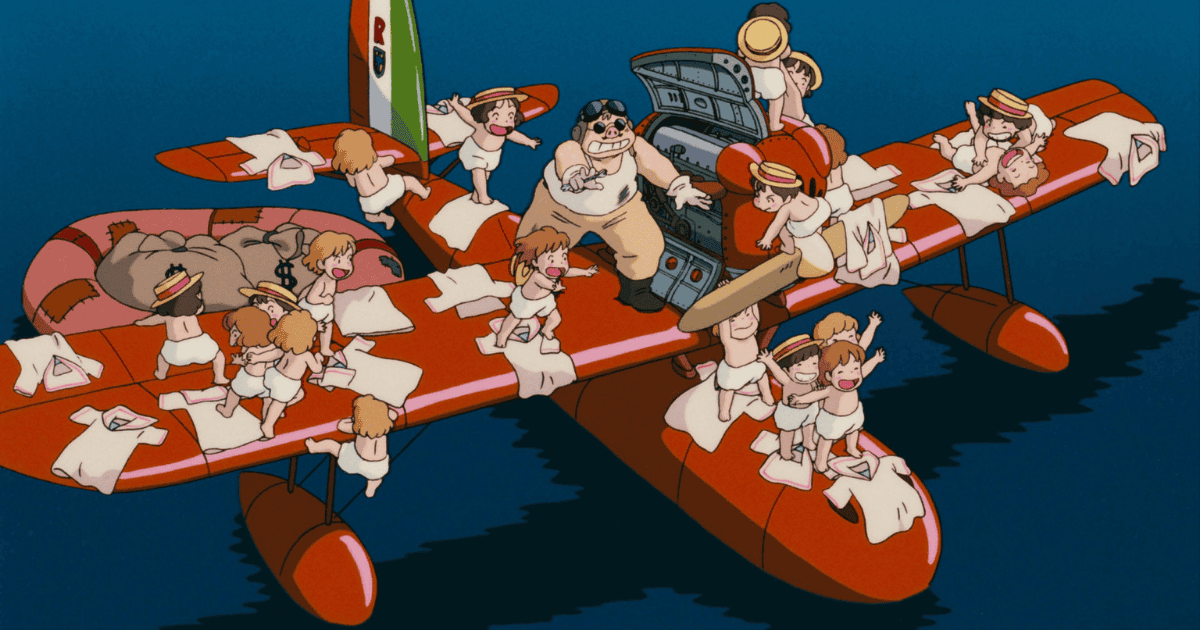
The Mamma Aiuto Boss says this with a completely straight face immediately after kidnapping a group of children at the beginning of the film.
Beginning with this kidnapping, Porco Rosso is actually filled with situations that could easily become violent and bloody.
If there is one reason we can still enjoy the movie as a lighthearted adventure, it may be this line.
The Mamma Aiuto Gang is, objectively speaking, a criminal organization that kidnaps children.
Porco is the righteous bounty hunter who defeats them.
Yet this line establishes that the pirates are not entirely terrible people.
It also allows viewers to accept Porco’s remarkably gentle treatment of them.
The line is therefore important because it transforms a story carrying the smell of blood into something audiences can enjoy without constant fear.
The useful English expression is “leave someone out,” meaning to exclude or omit someone.
The subtitle uses “can’t” to imply the emotional meaning of kawaisō: that excluding one child would be pitiful or cruel.
The dub makes that feeling explicit:
“It’s not nice to separate them from their friends.”
“I like this girl’s spirit.”
みんな聞けーっ! 俺はフィオ嬢の心意気に惚れた! この決闘は我がマンマユート団が取り仕切るぞ!!
Minna kike! Ore wa Fio-jō no kokoroiki ni horeta! Kono kettō wa waga Manmayūto-dan ga torishikiru zo!!
Listen, all of you! I like this girl’s spirit. The Mamma Aiutos will sponsor this fight!
Listen, everyone! I have fallen for Miss Fio’s courage! The Mamma Aiuto Gang will take charge of this duel!
Read the Commentary and Analysis
To secure Porco’s rematch with Curtis, Fio offers her own marriage to Curtis as part of the wager.
After seeing her bold decision, the Mamma Aiuto Boss delivers this declaration.
At first glance, he appears to be a foolish middle-aged man carried away by Fio’s heroic spirit.
In reality, however, he may be demonstrating excellent leadership.
He recognizes that Fio’s speech has already moved the surrounding pirates.
By becoming the first person to announce that his group will manage the duel, he ensures that the Mamma Aiuto Gang actually takes control.
The other members of the Sky Pirate Federation are reduced to spectators.
Fio’s speech saves Porco from immediate danger, but the Boss uses the same speech to increase his own group’s profits and influence.
His judgment is impressive.
At the same time, the pirates ultimately act for money.
That creates a contradiction with Fio’s declaration that the most important thing to seaplane pilots is neither money nor women, but honor.
The scene may therefore show that even these romantic pirates are being swallowed by the changing economic conditions of the world.
Still, earning money is important.
The subtitle translates kokoroiki as “spirit.” The word describes courage, resolve, generosity, or an admirable attitude toward life.
▼ Read more about the Mamma Aiuto Boss and the other characters
Ferrarin’s Quote in Japanese and English
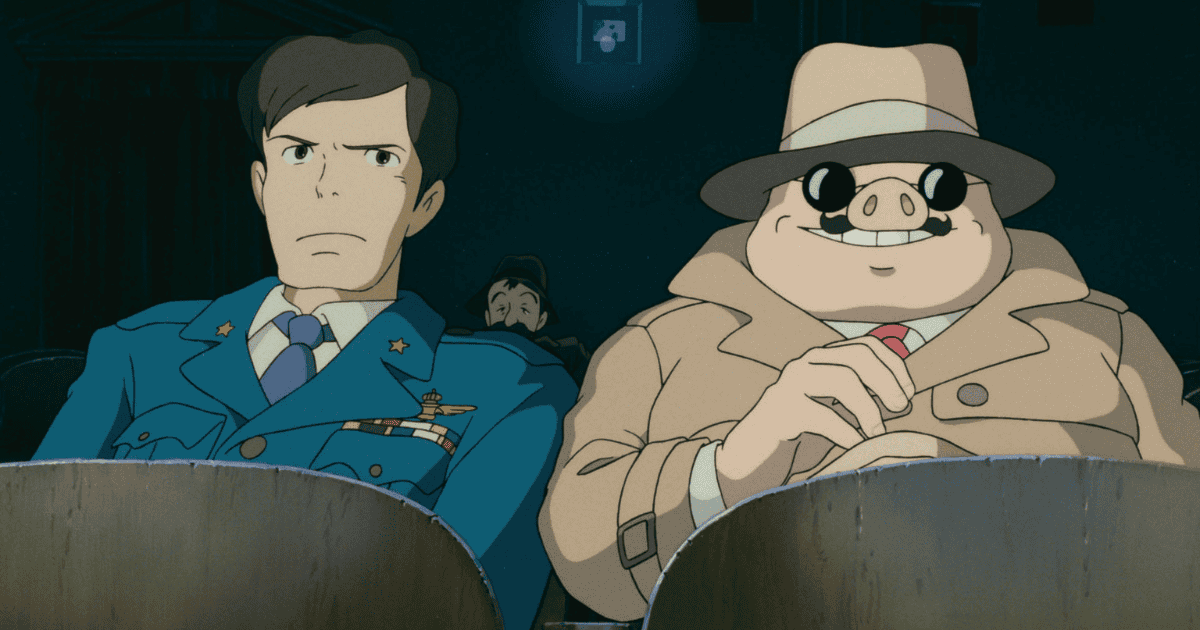
“Freelance daredevils are finished.”
冒険飛行家の時代は終わったんだ。国家とか民族とかくだらないスポンサーを背負って飛ぶしかないんだ。
Bōken hikōka no jidai wa owatta n da. Kokka toka minzoku toka kudaranai suponsā o seotte tobu shika nai n da.
Freelance daredevils are finished. To fly now you need a government or an airline to pay you.
The age of adventurous aviators is over. Now we have no choice but to fly while carrying ridiculous sponsors such as nations and ethnic groups on our backs.
Read the Commentary and Analysis
Ferrarin says this when he reunites with his former comrade Porco.
Porco answers:
“I only fly with money I earn myself.”
This exchange may express the essence of Porco Rosso.
Porco and Ferrarin both fought in the First World War while carrying the burdens of nations and peoples.
After the war, those supposedly sacred values were discarded, and money and economics became the standards by which everything was measured.
Porco is fighting against that reversal.
His existence asks:
“Wasn’t that supposed to matter?”
Whatever the historical circumstances, perhaps living in a way that looks at the present world and declares “This is wrong” is one definition of being cool.
The key English word is “daredevil.”
A daredevil is someone who takes extreme risks and appears almost indifferent to danger.
“Freelance daredevils are finished” therefore means that the age of independent, reckless aviators has ended.
The dub uses:
“The only way the Italians will let you fly is if you fly for our country.”
That version places greater emphasis on Ferrarin’s attempt to recruit Porco into state service.
▼ Read more about Ferrarin and the film’s other characters
Other Porco Rosso Quotes in Japanese and English
“War profiteers are villains. Bounty hunters are just stupid.”
そりゃあ戦争で稼ぐ奴は悪党さ。賞金で稼げねぇ奴は能無しだ。
Soryā sensō de kasegu yatsu wa akutō sa. Shōkin de kasegenē yatsu wa nōnashi da.
War profiteers are villains. Bounty hunters are just stupid.
Anyone who makes money from war is a villain. Anyone who cannot make money from bounties is incompetent.
Read the Commentary and Analysis
The owner of the weapons shop says this when Porco stops there on his way back from Milan.
A boy asks him about the difference between Porco’s work and warfare.
The irony is that the weapons dealer makes money both from war and from bounty hunters.
The line ultimately allows him to conceal the guilt of an arms merchant in front of the boy.
Perhaps the boy will grow up blaming himself for earning money through something dirty.
Later, he may begin telling himself:
“That is simply how the world works.”
The boy may even be a reflection of Hayao Miyazaki himself, who was born into the family connected with Miyazaki Airplane Manufacturing Company.
That is probably thinking far too deeply about the scene.
The English subtitle is just as sharply ironic as the Japanese.
A “profiteer” is not simply someone who earns a profit. It usually refers to someone who makes excessive or morally questionable profits, especially during a crisis or war.
A “villain” is a criminal, wicked person, or story’s antagonist.
The dub is even harsher:
“If you make money from war, you’re scum. If you don’t make money from bounty hunting, you’re an idiot.”
“Scum” is an extremely insulting word for a contemptible person, while “idiot” means a fool.
Preference between the subtitle and dub is entirely subjective, but I prefer the subtitle here. It is more compact, and the irony is beautifully balanced.
“Engine trouble! Engine trouble!”
ワレエンジンフチョウ、エンジンフチョウ。
Ware enjin fuchō, enjin fuchō.
Engine trouble! Engine trouble!
Our engine is malfunctioning. Engine malfunction.
Read the Commentary and Analysis
There may be nothing more to say.
This line was funny, wasn’t it?
I found it funny.
The comic quality represented by this line helps reduce the bloodiness hidden beneath the events of Porco Rosso.
I believe Miyazaki’s sense of comic timing is almost impossible to match.
The English wording itself is not especially interesting.
The dub simply says:
“We’re having engine trouble! We’re having engine trouble!”
The humor does not come from the literal meaning. It comes from the timing and the peculiar delivery.
Did English-speaking viewers also laugh at this moment?
I have always wondered.
Those are the 17 lines I personally selected from Porco Rosso.
Which quote from the film has stayed with you?
The images used in this article are from the Studio Ghibli Works Still Image Collection.
Can you name the movie before the scene comes into focus?
Put your visual memory to the test with a blurred Studio Ghibli scene.


Reader Comments