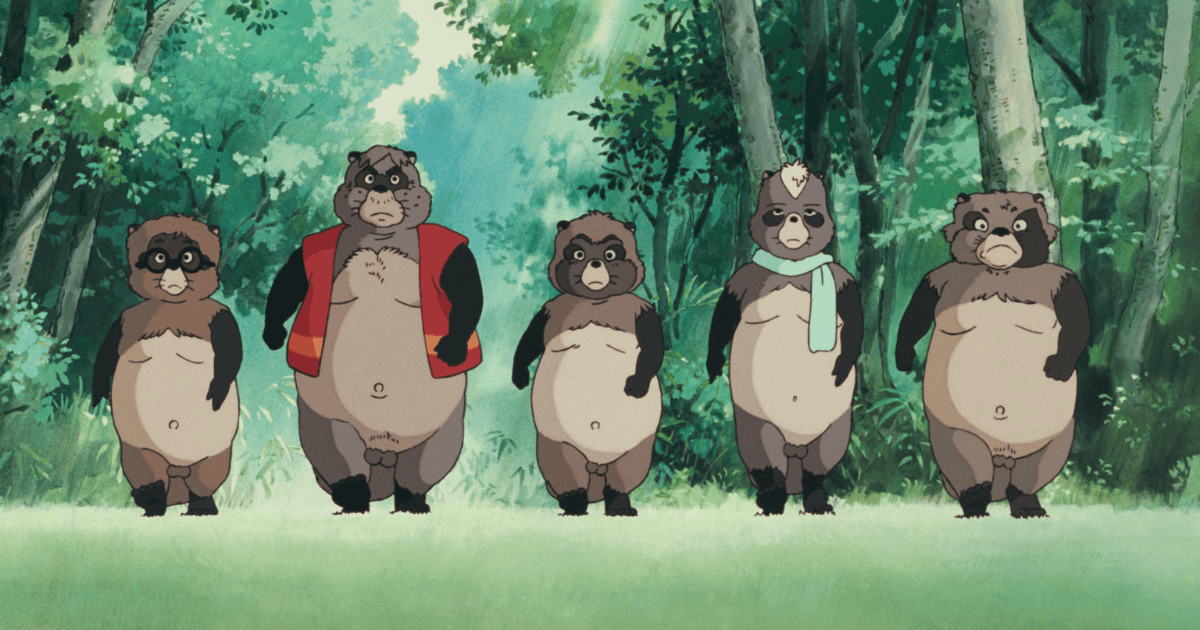
Pom Poko (Studio Ghibli Official) is a 1994 animated feature film written and directed by Isao Takahata. It was released in Japan on July 16, 1994.
In this article, I have selected eight of my favorite quotes from the film.
The dialogue in Pom Poko often becomes even more interesting when the original Japanese is compared with its English translation. For each quote, I will look at the Japanese line, its romanization, the English subtitle, a literal translation, and what the dialogue tells us about the characters and the story.
These are not necessarily the eight most objectively famous lines in the film. This is a personal selection, and several of them are included simply because they have remained strangely fixed in my memory.
The film’s official English title is:
Pom Poko
Translation note: The English subtitle wording in this article is based on the commercially released Blu-ray available to the author. The English dub is also discussed where its wording creates a meaningful difference. Subtitle and dub wording may vary between releases and territories.
Terminology note: The Japanese animals called tanuki are raccoon dogs, not North American raccoons. However, the English subtitles and dub frequently call them “raccoons,” so those words are preserved when quoting the English versions.
▼ Read the full story and analysis behind these quotes
On this pageContents
Ponkichi Quotes in Japanese and English
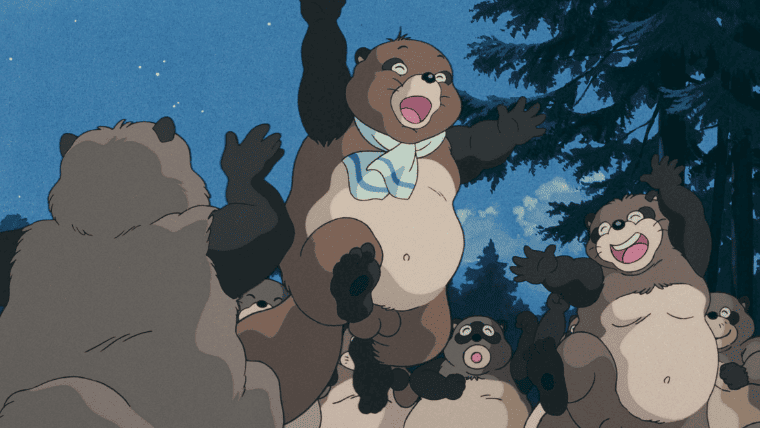
“But… if they all go away, we’ll never eat tempura again.”
だけど……あいつらみんな追い出しちまったら、もう食えないよ、天ぷら。さんまの干物。トウモロコシ。
Dakedo… aitsura minna oidashichimattara, mō kuenai yo, tenpura. Sanma no himono. Tōmorokoshi.
But… if they all go away, we’ll never eat tempura again. Or sardines… Or corn.
But if we drive all of them away, we won’t be able to eat tempura anymore. Dried Pacific saury. Corn.
Read the Commentary and Analysis
Ponkichi timidly says this after the young tanuki complete their first operation under Gonta’s leadership.
Carried away by their apparent success, Gonta declares that they should eliminate the humans entirely.
Ponkichi’s objection is not based on ethics, strategy, or environmental philosophy.
He is worried that without humans, the tanuki will no longer be able to eat tempura, dried fish, or corn.
The line is extremely funny and perfectly captures the peculiar spirit of Pom Poko. Even the hard-line Gonta is persuaded to leave at least some humans alive.
When we consider the structure of the entire story, however, Ponkichi’s words also become deeply sad.
That sadness is difficult to express, but its foundation is the reality that no matter what the tanuki do, they are going to lose.
It is easy to respond:
“That is exactly why you are going to lose!”
Yet the more painful truth is that they would lose even if they behaved differently.
That unavoidable defeat ultimately validates Ponkichi’s position.
If they are going to lose anyway, perhaps they might as well continue enjoying the things that connect them to the humans.
The story is generally told from the perspective of the talented tanuki who can adapt and transform. Shokichi, Ponkichi’s childhood friend, is the clearest example.
Yet perhaps the character who understood the eventual outcome from the beginning was an ordinary tanuki like Ponkichi.
At the end of the film, the transforming tanuki accept the humiliation of living permanently as humans. Ponkichi, however, continues living as a tanuki.
When an uncontrollable situation swallows everything around us, perhaps the best response is to step back and observe it from a distance.
That is what Ponkichi does.
I examine this interpretation in more detail here:
The subtitle changes sanma no himono, dried Pacific saury, into “sardines,” probably choosing a fish more immediately recognizable to English-speaking audiences.
The dub changes the list even further:
“It’s just that if we get rid of all the humans, that means we’ll never eat tempura again. Or beef jerky. Or popcorn.”
Tempura remains, but dried saury becomes beef jerky, while corn becomes popcorn.
The dub version gives the list a more unmistakably junk-food quality. Since hamburgers and doughnuts are mentioned immediately afterward, that choice may actually suit the scene surprisingly well.
“Could you stop saying that?”
テレビや何かでいうでしょう? 「開発が進んで、タヌキやキツネが姿を消した」って。あれ、やめてもらえませんか? そりゃ、確かにキツネやタヌキは化けて姿を消せるのはいるけど……。でも、ウサギやイタチはどうなんですか?
Terebi ya nanika de iu deshō? “Kaihatsu ga susunde, tanuki ya kitsune ga sugata o keshita” tte. Are, yamete moraemasen ka? Sorya, tashika ni kitsune ya tanuki wa bakete sugata o keseru no wa iru kedo… Demo, usagi ya itachi wa dō nan desu ka?
On TV, they’re saying that foxes and raccoons have disappeared because of urban sprawl. Could you stop saying that? Of course, some raccoons and foxes can transform. But what about the rabbits and the other animals? Some of us can’t just disappear.
You hear people say on television that tanuki and foxes disappeared as development progressed. Could you stop saying that? Certainly, some foxes and tanuki can transform and make themselves disappear. But what about the rabbits and weasels?
Read the Commentary and Analysis
Ponkichi says this after reuniting with Shokichi near the end of the film.
How we interpret this speech may determine what Pom Poko ultimately means to each of us.
The most obvious interpretation is:
“You humans killed the tanuki, foxes, rabbits, and weasels.”
Yet the important question is what follows from that accusation.
The film itself shows that tanuki eat mice. They also appear to eat weakened birds.
The accusation could therefore be turned back on them:
“You killed the mice and birds.”
There is no real contradiction here. However, Takahata’s decision to give Ponkichi this gentle speech at the end of the film appears to have a more complicated purpose than simple moral condemnation.
To understand it, we should remember objectively what the tanuki have been doing throughout the story.
Although the humans are almost entirely unaware of it, the tanuki have been engaged in a territorial conflict with them.
We tend to forget that human beings have always competed for territory with other animals.
That competition continues even now.
Humans do not possess transformation magic, but we are extraordinarily skillful and capable of passing knowledge from one generation to another.
Once our population became large enough, we began winning most territorial struggles against other animals—especially inside cities, which are effectively enormous human nests.
In Pom Poko, the humans do not realize that they are attacking mountain animals. Nevertheless, the development of Tama is a territorial invasion.
For me, the central meaning of Ponkichi’s speech is:
“Do not forget that you are fighting other living creatures for territory.”
That differs slightly from saying that the killing itself is simply evil.
Territorial competition is not necessarily an act of absolute evil. Human lives are built on the land obtained through it.
Still, we should remain conscious that our lives and cities have destroyed the habitats—and often the lives—of many other animals.
That awareness may be the narrow balance that humans are still capable of maintaining.
The alternative would be for us to disappear.
I am not strong enough to choose that, and I could not demand it from anyone else.
It is a profoundly difficult problem.
I think Takahata gave this speech to Ponkichi precisely so that the film would leave us with that discomfort rather than a simple answer.
The important English expression is “urban sprawl.”
It describes the uncontrolled expansion of housing, roads, and urban development into surrounding land.
The dub uses a somewhat different version:
“Many of you have probably heard someone on the news saying how animals are disappearing because of development. I don’t think that’s quite accurate. It’s true that some raccoons can transform and disappear. Although, what about things like rabbits and badgers? They can’t transform, so where do they go?”
The word “accurate” means correct or precise. The dub also changes weasels into badgers.
▼ Read more about Ponkichi and his role as the film’s hidden protagonist
Tsurukame Oshō Quotes in Japanese and English
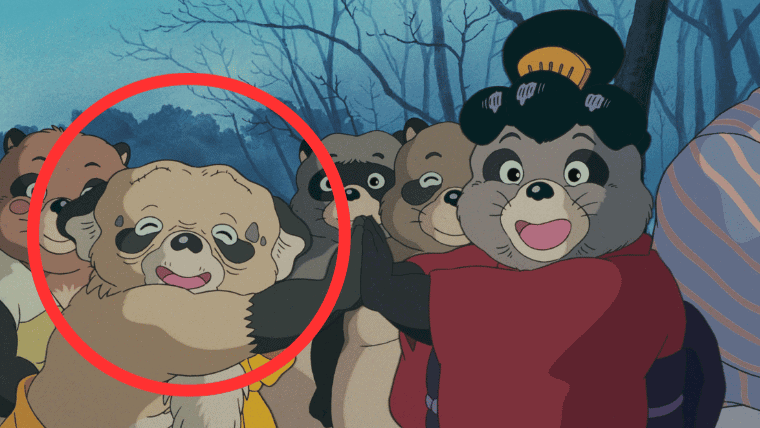
“We raccoons are too trusting.”
オラたちタヌキはヒトがいい。調子に乗る、サービスしすぎる! これが、失敗の元じゃ。
Ora-tachi tanuki wa hito ga ii. Chōshi ni noru, sābisu shisugiru! Kore ga, shippai no moto ja.
We raccoons are too trusting. It’s easy for humans to fool us. Then we get into trouble. Does everyone understand?
We tanuki are too good-natured. We get carried away and provide too much service. That is the cause of our failures.
Read the Commentary and Analysis
Tsurukame Oshō says this while using a picture-story show to teach the young tanuki the basics of dealing with humans.
Immediately afterward, he begins singing:
“Tanuki, dear tanuki, won’t you come and play?”
The supposedly disciplined students instantly respond in song:
“We’re right in the middle of training!”
They have revealed exactly how easily they become carried away.
The scene is extremely funny and affectionate. When we imagine Tsurukame Oshō’s life, however, the line begins to look different.
The essential clues are his title, Oshō, and the fact that he lives at Manpuku-ji Temple.
Perhaps he originally occupied the abandoned temple and transformed into a priest to deceive the humans.
After playing the role for long enough, however, he may have begun genuinely living as a Buddhist priest.
Even then, people eventually forgot Manpuku-ji, and the temple fell into ruin.
I develop this interpretation further by comparing Tsurukame Oshō with Moro from Princess Mononoke:
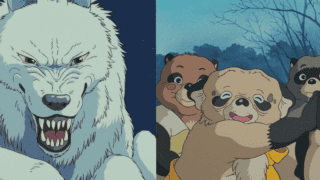
The lesson may therefore be an act of self-reproach from the tanuki who provided humans with more “service” than anyone else.
The subtitle uses “trusting,” describing someone who readily believes others and does not expect deception.
It then adds the verb “fool,” meaning to deceive someone.
The dub remains closer to the Japanese structure:
“We raccoons are too good-natured. We shouldn’t try so hard to please. This is where we all go wrong. You understand?”
“Good-natured” describes someone kind, friendly, and easygoing. It captures the charm and weakness of the tanuki especially well.
“First we should pay our respects to those who died.”
作戦の犠牲となった気の毒な人間たちに、まずは惜しみない哀悼の意を表すべきではあるまいかの?
Sakusen no gisei to natta kinodokuna ningen-tachi ni, mazu wa oshiminai aitō no i o hyōsu beki de wa arumai ka no?
The humans who died were victims of this war. First we should pay our respects to the memories of those who died.
Should we not first express our deepest condolences to the unfortunate humans who became victims of the operation?
Read the Commentary and Analysis
Tsurukame Oshō says this to restrain the celebrating tanuki after the completion of Gonta’s first operation against the humans.
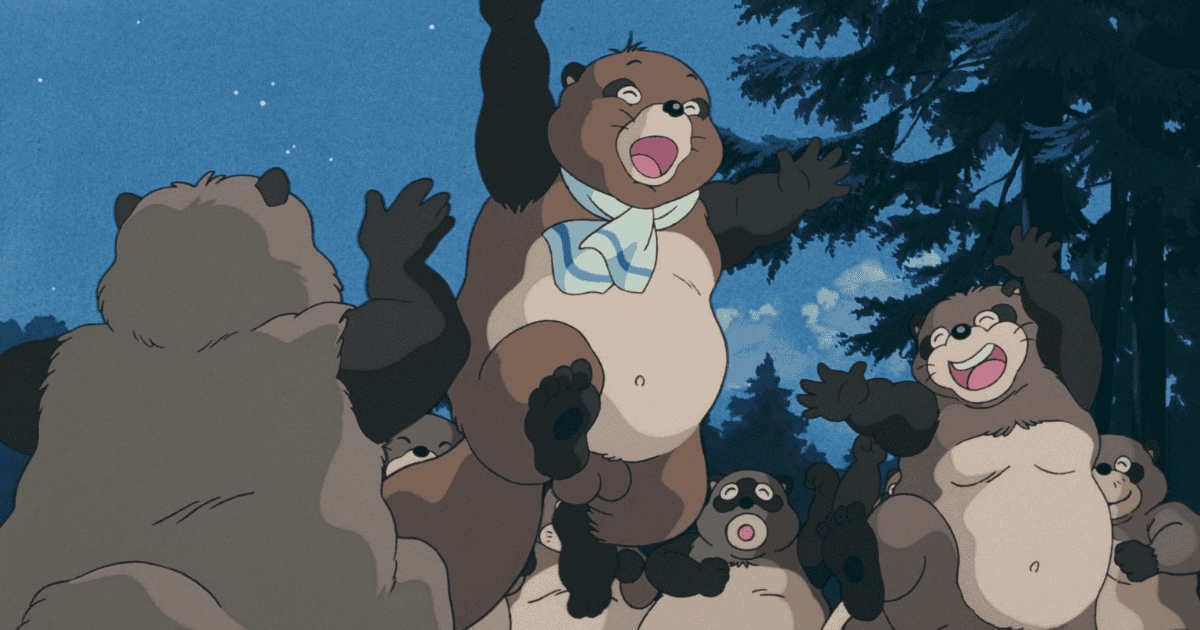
For a brief moment, the tanuki appear to follow his words and pretend to offer a silent prayer.
They soon abandon the mourning and begin celebrating.
In other words, most of them have no genuine intention of grieving for the humans.
Looking at the scene from the opposite direction, however, suggests that Tsurukame Oshō alone may have been completely sincere.
His possible history again matters.
As discussed above, he may once have transformed into a human priest to trick people, only to become a real priest through years of performing that role.
That life would have brought him into sustained contact with humans.
Perhaps those relationships gave him a genuine ability to mourn human deaths.
The important English expression is “pay one’s respects.”
It means to demonstrate respect, often toward someone who has died or toward a bereaved family.
The dub uses the same expression:
“This isn’t a time for celebration. Three humans died because of us. Shouldn’t we be paying our respects to those poor people who were victims of this operation?”
“Our only choice is to tell the humans…”
このうえは、「妖怪大作戦」を実行したのがオラたちタヌキであることを、人間たちの前に明らかにするしかないとオラは思うがの。
Kono ue wa, “Yōkai Daisakusen” o jikkō shita no ga ora-tachi tanuki de aru koto o, ningen-tachi no mae ni akiraka ni suru shika nai to ora wa omou ga no.
Our only choice is to tell the humans… that Operation Goblin was the work of us raccoons.
At this point, I believe our only choice is to reveal to the humans that we tanuki carried out the Great Yōkai Operation.
Read the Commentary and Analysis
Operation Specter fails exactly as every viewer expected it to fail.
While the other tanuki sink into despair, Tsurukame Oshō makes this proposal.
The important point is that he is the only character who thinks of dialogue as a possible solution.
As suggested by his other lines, humans were probably much closer to Tsurukame Oshō than they were to the other tanuki.
That personal history may be why he is still capable of imagining direct communication.
Tsurukame Oshō continues believing in us humans until the very end.
The difficult translation problem is the Japanese word yōkai.
Even Japanese people cannot always define precisely what a yōkai is. Depending on the creature and context, it may be translated as monster, spirit, apparition, goblin, or supernatural being.
The subtitle chooses “Operation Goblin.”
The dub chooses “Operation Specter”:
“It seems to me that we raccoons have finally come to a point where we have absolutely no choice. We must reveal to the humans that we were the ones who staged Operation Specter.”
A specter is a ghostly apparition.
The word may also remind some viewers of the “Brocken specter,” the enormous shadow that can appear on clouds or mist under particular conditions.
In that sense, “Operation Specter” is not a bad attempt to translate something that may be fundamentally untranslatable.
▼ Read more about Tsurukame Oshō and the film’s other characters
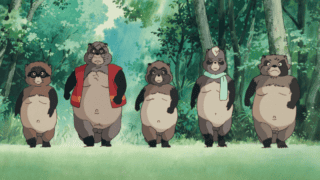
Bunta’s Quote in Japanese and English
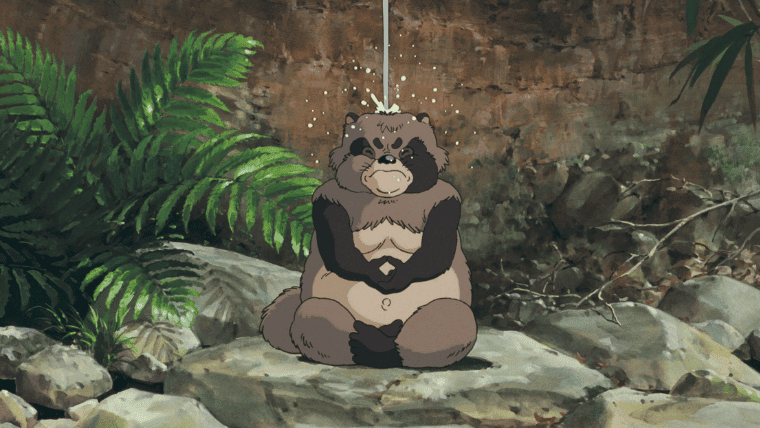
“They were raccoons after all.”
人間どもの方がタヌキだったんだ! 奴ら、タヌキの風上にも置けないクサイクサイ古狸なんだ!
Ningen-domo no hō ga tanuki datta n da! Yatsura, tanuki no kazakami ni mo okenai kusai kusai furudanuki nan da!
They were raccoons after all. Old, stinking raccoons!
The humans were the real tanuki! They are stinking old tanuki who are not even worthy of standing upwind of a tanuki!
Read the Commentary and Analysis
Bunta says this after returning from his unsuccessful journey to Sado and seeing the completely transformed Tama Hills near the end of the story.
The film carefully shows the development progressing throughout the story.
Yet we become so distracted by the tanuki’s chaotic struggle that we may not fully recognize how much of the landscape has already disappeared.
Bunta’s reaction suddenly forces both him and the audience to confront reality.
We begin to feel that we ourselves have been deceived by what the humans accomplished.
Humans do not possess the tanuki’s ability to transform something instantly.
What we do possess is the ability to work collectively, piece by piece, until something enormous has been created.
Ants and other small creatures have similar abilities, but few animals of our physical size can reshape the world on the same scale.
Modern humans also live surrounded by devices that appear almost magical.
We can use smartphones without being able to build them. We can operate microwave ovens without understanding how to manufacture one. We can live in high-rise apartment buildings without knowing how to construct them.
Perhaps we live while constantly being deceived by ourselves.
Does destruction wait at the end of that process?
Or will we somehow continue living?
Pom Poko remains a film that speaks directly to the present.
The subtitle’s notable word is “stinking.”
Its literal meaning relates to a terrible smell, but it can also intensify an insult, as in “stinking drunk.”
The Japanese expression tanuki no kazakami ni mo okenai humorously adapts a phrase meaning someone is so disgraceful that they are unworthy even to stand upwind of the group.
The dub abandons the wordplay and expands the accusation:
“The only way this makes any sense is if all you humans are raccoons! You’re all stupid, evil, selfish raccoons!”
▼ Read more about Bunta and the film’s other characters
Yashimano Hage’s Quote in Japanese and English
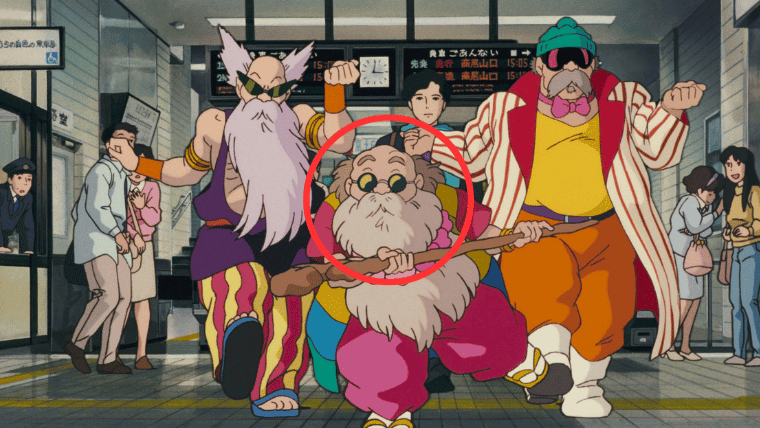
“They will be dumbfounded by the mystery of the cosmos.”
突然、人間たちは森羅万象の神秘に驚き、いかに人間が卑小な存在であるかを思い知るのじゃ。
Totsuzen, ningen-tachi wa shinra banshō no shinpi ni odoroki, ikani ningen ga bishōna sonzai de aru ka o omoishiru no ja.
They will be dumbfounded by the mystery of the cosmos and realize how insignificant humanity really is.
The humans will suddenly be astonished by the mysteries of all creation and realize just how insignificant they are.
Read the Commentary and Analysis
Yashimano Hage gently says this to the excited Tama tanuki after the Shikoku elders carry out Operation Specter.
Every person watching the film probably fills their mind with question marks:
“What is this old man talking about?”
The elders’ optimism and complete failure to anticipate the human reaction are part of the charm of Pom Poko.
By this stage of the story, however, the timing has become almost too painful for laughter.
Perhaps driven by guilt, or perhaps having finally despaired of the world, Yashimano Hage later becomes the leader of the Dancing Prayer cult.
He takes the ordinary tanuki toward a collective death.
Yet one ordinary tanuki escapes that fate.
That tanuki is Ponkichi.
Shokichi reunites with him at the end, proving that Ponkichi did not join the others on their final journey.
Thinking back, Ponkichi had always been skeptical of the revival of transformation magic. Something about him had always been different from the others.
I believe Ponkichi is unquestionably the hidden protagonist of Pom Poko.
The notable English word is “dumbfounded.”
It means extremely surprised or shocked to the point of being temporarily unable to respond.
Its slightly formal and theatrical quality suits the ancient elder’s grand declaration.
The dub becomes even more elaborate:
“And now, since they’ve witnessed something they can’t explain no matter how hard they try, they will be forced to realize that humans are not the only worthy form of life in the universe.”
It begins to sound almost like a speech delivered by Yoda in Star Wars.
That is also rather entertaining.
▼ Read more about Yashimano Hage and the film’s other characters
Ryutaro’s Quote in Japanese and English
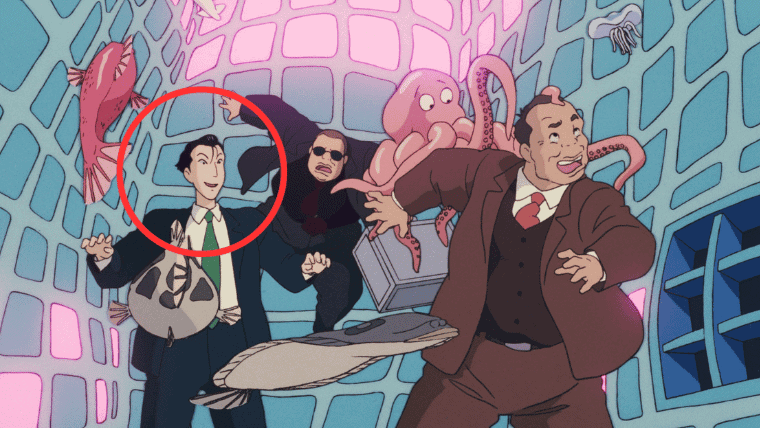
“At least the strongest ones will survive.”
種を保存するなら、できるだけ優秀な遺伝子を残すべきです!
Shu o hozon suru nara, dekiru dake yūshūna idenshi o nokosu beki desu!
At least the strongest ones will survive.
If the species is to be preserved, we should leave behind the best genes possible.
Read the Commentary and Analysis
After the spectacular failure of Operation Specter, Ryutaro—a transforming fox who has already adapted to human society—approaches Kincho VI.
He proposes that the skilled transforming tanuki survive by living permanently as humans.
Kincho VI asks the obvious question:
“What will happen to the ordinary tanuki?”
Ryutaro gives this cold answer.
The contrast with the deeply troubled Kincho VI makes it easy to conclude that foxes are simply heartless.
Yet what a person says and what that person feels are not necessarily the same thing.
The foxes of Tama probably experienced their own version of the tanuki war.
There may once have been an entirely unseen story called something like Shōwa Fox War Kon Kon.
Ryutaro may have avoided discussing those experiences because they were too personal.
He presents himself as sophisticated and perfectly adapted, but perhaps he and the other foxes are just as emotionally awkward as the tanuki.
We should also imagine the story that the film never tells us.
The subtitle shortens the Japanese drastically, which makes the statement feel even more merciless.
The dub uses:
“The fittest can survive in order for the species to continue.”
The word “fittest” is the superlative form of “fit,” meaning those best suited to their environment.
The phrasing clearly recalls the expression “survival of the fittest.”
The Japanese explicitly refers to preserving superior genes, while both English versions turn the statement into a principle of selection and survival.
▼ Read more about Ryutaro and the film’s other characters
My Three Favorite Pom Poko Quotes
Those are the eight lines I personally selected from Pom Poko.
My own top three are:
- “We raccoons are too trusting. We get carried away and provide too much service.”
- “They were raccoons after all.”
- “But what about the rabbits and the weasels?”
The first expresses the lovable weakness that repeatedly ruins the tanuki’s plans.
The second forces both Bunta and the audience to confront how completely humanity has transformed the Tama Hills.
The third turns the entire film into a quiet warning: development does not make animals mysteriously disappear. It takes away the places where they were living.
Which quote from Pom Poko has stayed with you?
The images used in this article are from the Studio Ghibli Works Still Image Collection.
Can you name the movie before the scene comes into focus?
Put your visual memory to the test with a blurred Studio Ghibli scene.

Reader Comments