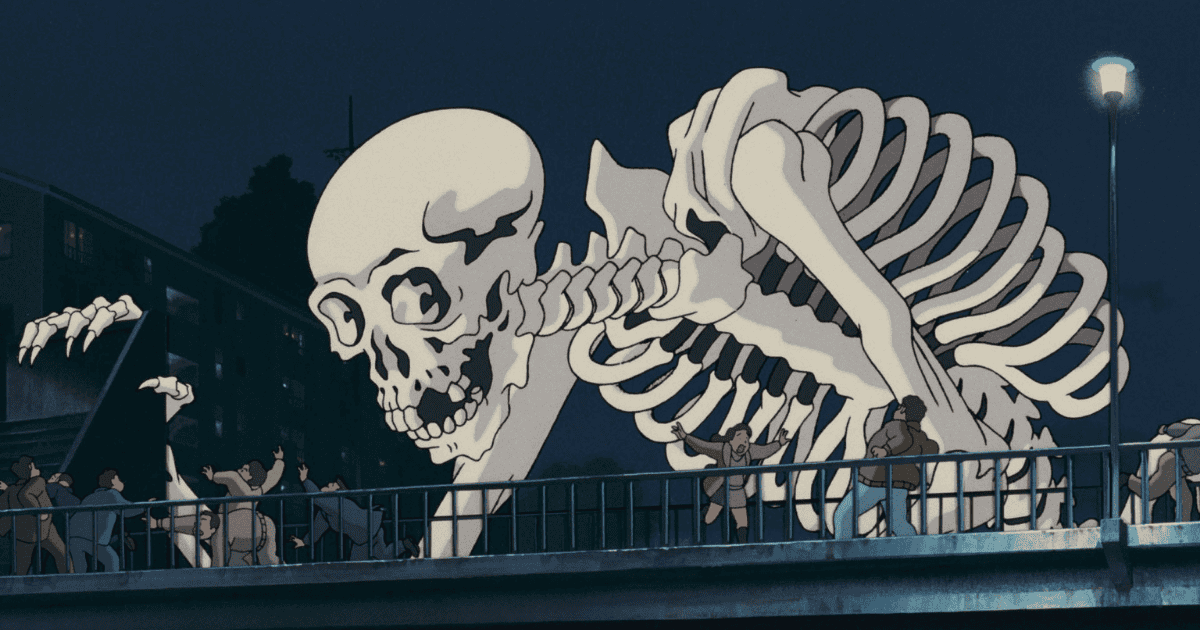
In my previous analysis, I explored the meta-critique hidden in Oroku’s dialogue and the bizarre, anatomical truth behind her “Secret Art.” Today, we turn our attention to the absolute centerpiece of Isao Takahata’s Pom Poko(Official Studio Ghibli): the spectacular, chaotic, and ultimately doomed Operation Specter (Yokai Grand Operation).
When watching the film, it becomes painfully obvious early on that Operation Specter is never going to work. Even if the shape-shifting tanuki had executed the grand parade perfectly without Gyobu’s tragic, sudden death, the end result wouldn’t have changed. The human expansion was unstoppable.
To make matters worse, those hopelessly naive tanuki elders from Shikoku celebrate the fleeting illusion, boldly claiming, “This will turn the tide for the better!”
It is incredibly easy to feel frustrated by the tanuki’s monumental waste of magical energy. But if you feel that frustration, you might be fundamentally misunderstanding how Pom Poko is meant to be watched. Let’s start by unpacking the true nature of this cinematic masterpiece.
*This is a translated version. The original (Japanese) is available here.
- Pom Poko is Structurally a Comedy
While the tanuki’s desperate fight for survival is a serious ecological tragedy, their frantic, fruitless efforts are depicted with a comical absurdity, establishing a brilliant theatrical structure where “tragedy is comedy.” Operation Specter is the symbolic highlight of this dark humor. - Operation Specter = A Metaphor for the Animation Industry
The shape-shifting tanuki symbolize overworked animators. The hidden cameos of famous Miyazaki characters and the indifferent, dismissive reactions of the human citizens powerfully express the agonizing disconnect between the creators who bleed for their art and the passive consumers who watch it. - The End Credits as a Plea for Gratitude
The lyrics “Remember their wonderful names” from the upbeat ending theme, Itsudemo Dareka ga, serve as a direct tribute to the massive wall of staff names scrolling on the screen, acting as Takahata’s modest plea for the audience to respect the artists. - Breaking the Fourth Wall
The film is masterfully bookended: the “tanuki staring at the camera” at the beginning pulls us into the fantasy, and the “human boy staring at the camera” at the end violently pushes us back into reality, showcasing Takahata’s strict control over the escapist nature of anime.
On this pageContents
Pom Poko (1994) Analysis: Operation Specter as the Pinnacle of Comedy
A Tragedy Designed to Make You Laugh
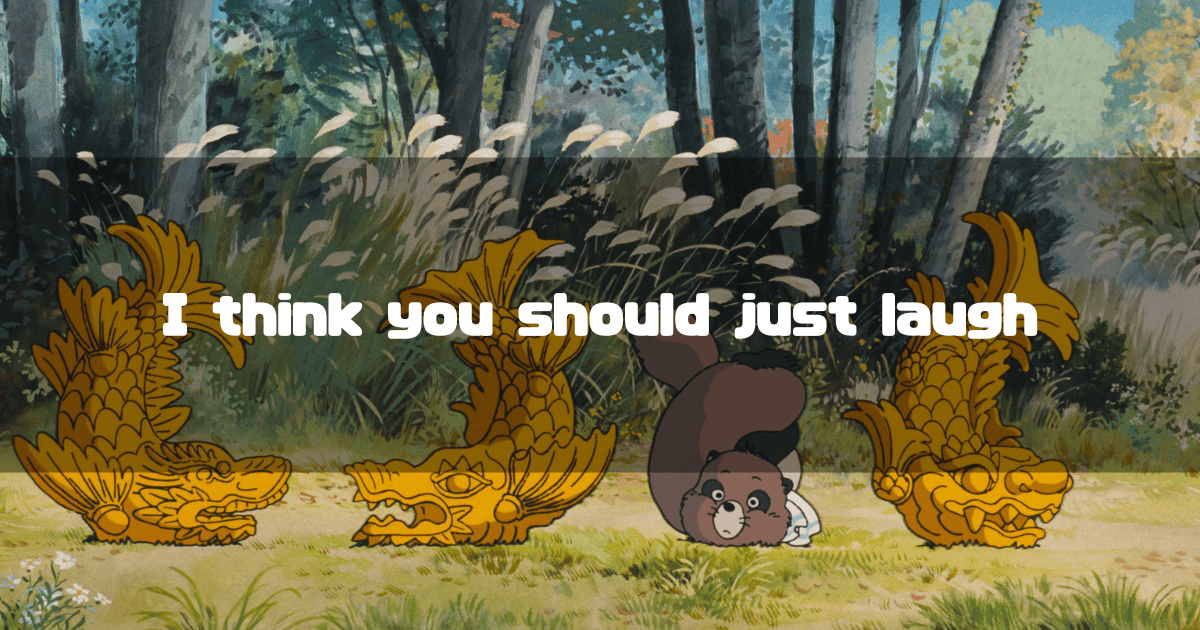
Because Pom Poko tackles the grim “war between humans and nature,” we naturally tend to watch it with a heavy heart, thinking, “Humans are so cruel, and the poor tanuki are so pitiful.” While that is a completely valid ecological reading, I didn’t see it that way as a child, nor did my father. We simply enjoyed it for its sharp, rakugo-style humor.
Fundamentally, Pom Poko is a dark comedy designed to make you laugh through the pain. Takahata’s deliberate casting of famous rakugo masters for the voice acting and narration wasn’t a mere stylistic choice. He knew the bleak premise needed a specifically theatrical, comedic delivery to prevent the film from becoming unbearably depressing. Hiring modern stand-up comedians would have been too cheap; traditional rakugo provided the perfect blend of absurdity and gravitas.
Rakugo is a traditional Japanese form of comic storytelling dating back to the Edo period. A single performer kneels on a stage, using only a paper fan and a small cloth to tell a long, complex, and highly comical story. The performer portrays multiple characters through slight shifts in pitch and posture, always concluding with a clever narrative punchline (ochi).
The genius of this comedic approach is summarized by the classic theatrical truth: “Comedy is tragedy, and tragedy is comedy.”
For the tanuki, their war against humanity is an absolute, existential tragedy. Yet, no matter how desperately they fight, from an objective outsider’s perspective, their frantic, chaotic efforts often look hilariously futile. That is exactly how you depict “tragedy as comedy,” and Pom Poko embraces this absurdity with blatant brilliance.
Operation Specter as the Comedic Climax
If you look closely, Operation Specter is framed comically from the very beginning. Take, for example, the highly anticipated arrival of the “legendary” elders from Shikoku:
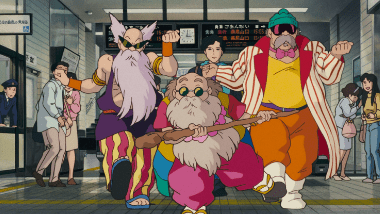
They show up in Tokyo dressed in eccentric, outdated finery, treating their arrival like a casual vacation. From a purely visual standpoint, the second these geezers appear on screen, the audience instantly knows: “Oh, this is hopeless.” Entrusting the survival of their species to these guys is a guaranteed disaster.
And sure enough, relying on the Shikoku elders accomplishes absolutely nothing. But the tragicomic irony is that the tanuki who summoned them were dead serious, and the elders genuinely believed they were performing a miracle.
Operation Specter serves as the ultimate comedic climax of the tanuki’s doomed struggle. They spin their wheels spectacularly on the grandest stage imaginable.
In fact, shortly after this massive failure, the film’s tone sharply pivots into pure, unadulterated tragedy, with the radical tanuki launching suicidal kamikaze attacks into police barricades. No one is laughing then.
But Operation Specter isn’t just a symbol of futile resistance. It is famously packed with hidden cameos from other Studio Ghibli films. Why did Takahata do that?
Pom Poko (1994) Meta-Commentary: The Parade as the Animation Industry
Ghibli Cameos and Takahata’s Critique
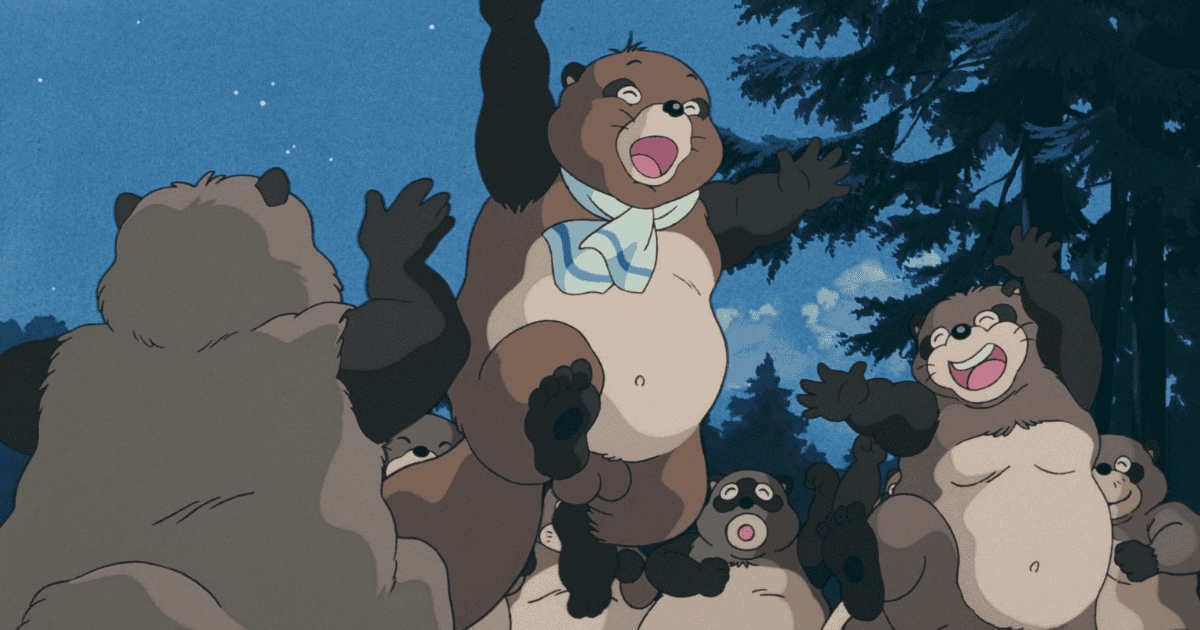
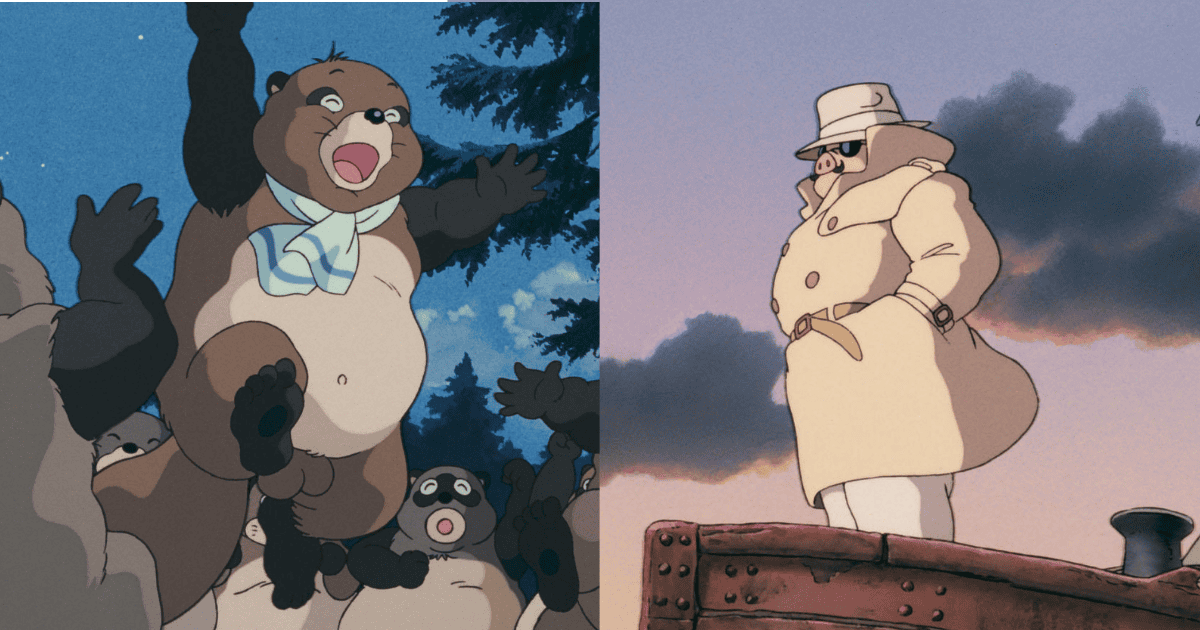
During the dazzling, psychedelic parade of Operation Specter, four iconic characters from other Ghibli masterpieces secretly fly across the screen.
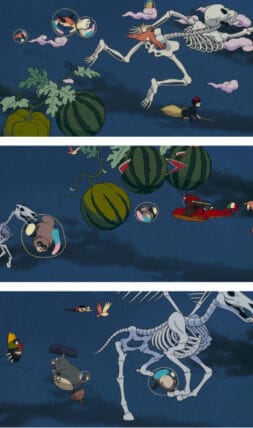
You can spot Kiki from Kiki’s Delivery Service, Porco Rosso zipping by in his red plane, Totoro floating on his spinning top, and Taeko from Takahata’s own Only Yesterday.
While this seems like fun, harmless fan service, it is actually a sharp meta-critique from Director Takahata. Including the hyper-realistic Taeko alongside Miyazaki’s blockbuster fantasy creations was likely Takahata’s way of declaring: “This is the true direction animation should be taking!”
As I discussed in The Hidden Meta-Critique and Oroku’s Dirty Secret Art, Takahata harbored complex feelings of rebellion against the simplistic original pitch given to him by Hayao Miyazaki and Toshio Suzuki.
This leads to a profound, undeniable realization: To Isao Takahata, Operation Specter is a literal, visual metaphor for the animation industry itself.
The Tanuki Are the Animators
Within the lore of the film, shape-shifting is revered as “the greatest marvel of the natural world.” In our reality, the meticulous, grueling work of animators—drawing thousands of keyframes to breathe life into still images—is an equal “marvel.” Modern audiences have become so accustomed to high-quality anime that we rarely stop to be amazed by the sheer miracle of moving drawings.
Operation Specter—the ultimate, exhausting display of the tanuki’s magical energy—is a direct parallel to the agonizing labor of animation production. And how do the humans react?
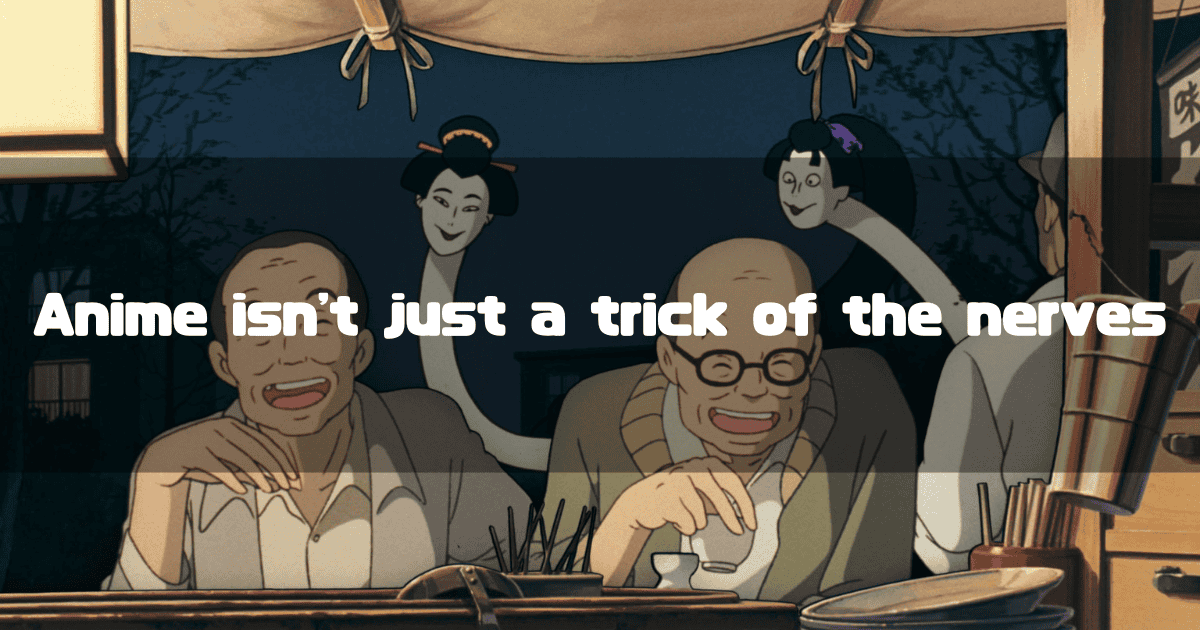
During the spectacular parade, some drunk old men at a food stall casually dismiss the terrifying ghosts, slurring, “It’s just a trick of the nerves, making you see things.” This brilliantly mocks the ignorant, dismissive comments we often make while passively consuming media. It feels like Takahata is personally scolding the audience: “Don’t just stare blankly! What you are watching isn’t a cheap optical illusion; it is the culmination of our animators’ blood, sweat, and tears!“
The irony deepens the morning after the parade. Some human children excitedly say, “That was really fun!”, to which their mother replies, “It makes me want to believe in UFOs.” The humans completely misinterpret the tanuki’s desperate, life-or-death performance as mere occult entertainment or a theme park stunt. This perfectly represents the cold apathy of modern anime consumers, who binge-watch content without ever considering the immense human effort behind the screen.
When the exhausted tanuki weep after the operation, crying, “We are pouring our very lives into this, why don’t they understand?!”, it is the literal lament of overworked animation creators. And when the furious Master Tsurukame hijacks a live TV news broadcast to scream, “We were the ones who did that!”, it is the raw, desperate cry of artists demanding recognition.
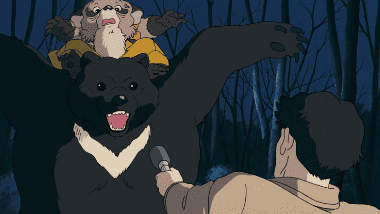
Tsurukame Oshō’s actual proposal is even more striking than this summary suggests: he argues that their only remaining choice is to reveal that the tanuki themselves created Operation Specter. Compare the original Japanese, romanization, English subtitle’s “Operation Goblin,” literal translation, and the dub’s “Operation Specter” in our detailed analysis of his declaration.
Animation is not magically generated by machines. It is the crystallization of immense human sacrifice. Yet, the public usually only remembers the name of the famous director or the lead voice actor. It is entirely understandable why the unseen staff would want to scream, “We made this!”
Watching Pom Poko often feels like receiving a stern, passionate lecture from Director Takahata. And the reason I love this film is that he is absolutely right. We need to be more mindful, respectful consumers of art. Being a good audience requires effort.
When you understand this metaphor, the end credits take on a devastatingly poignant new meaning.
Pom Poko (1994) Ending Theme: Remembering Their Wonderful Names

The film closes with the upbeat, chaotic folk song Itsudemo Dareka ga (Someone is Always There) by Shang Shang Typhoon. As I wrote in my nostalgic essay, Memories of Pom Poko, hearing this song as a kid instantly reminded me of the live-action debt-escape movie Yonige-ya Honpo 2.
The Yonige-ya Honpo (The Night Movers) series is a popular Japanese comedy-drama film franchise from the 1990s. The story centers on a covert, professional moving team that helps desperate people overwhelmed by debt secretly pack up and flee their homes in the middle of the night to escape ruthless creditors.
Notably, the song Itsudemo Dareka ga by Shang Shang Typhoon was originally used as the ending theme for Yonige-ya Honpo 2 (1993), making its inclusion in Pom Poko a bizarre, fascinating piece of cross-media trivia.
But watching it now as an adult, the song carries a profoundly different emotional weight. The chorus features the lyric: “Someone is always, surely, by your side. Remember their wonderful names.”
In the context of Takahata’s meta-critique, “their wonderful names” almost certainly refers to the massive wall of text scrolling up the screen: the end credits. After spending two hours scolding us for being passive consumers, Takahata uses the final song to gently plead, “At the very least, take a moment to look at their names.”
Realistically, it is impossible for an audience to memorize the hundreds of names in an anime’s credits. But Takahata is asking us to simply pause, acknowledge the scrolling text, and respect the immense human sacrifice required to bring those drawings to life.
This layered metaphor—where the tanuki’s magical illusions represent the painstaking craft of animation—is what elevates Pom Poko from a quirky environmental fable into an absolute masterpiece.
Pom Poko (1994) Appendix: Breaking the Fourth Wall
In the final moments of the film, the surviving tanuki use the last of their collective magic to project a heartbreaking, beautiful illusion of the untouched, pristine countryside over the concrete sprawl of Tama New Town. As the illusion fades, a human boy spots Ponkichi and his friends fleeing into a golf course.
The boy turns directly to the camera, looks right at the audience, and asks, “I wonder if tanuki can really transform?”
Why does this specific, fourth-wall-breaking scene exist? While only the late Takahata knew his exact intentions, it undeniably serves as a jarring mechanism to forcefully pull the audience out of the narrative and push them back into reality.
Pom Poko is frequently described as a “critique of fantasy.” Takahata was acutely aware of the “original sin” of animation: creating captivating fictions that encourage people to escape their real-world problems. Therefore, he felt morally obligated to install a psychological exit door, jolting the viewers awake before the credits rolled.
Conversely, we must remember the very first shot of the film: a seemingly ordinary, realistic tanuki staring directly into the camera lens. We are pulled into the fantasy world by a tanuki’s gaze, and we are pushed out of it by a human boy’s gaze. The entrance and the exit are perfectly mirrored.
This staggering level of structural genius is exactly why Pom Poko remains one of the most fascinating, brilliant films in Studio Ghibli history.
The images used in this article are from Still Images from Studio Ghibli Works.
Can you name the movie before the scene comes into focus?
Put your visual memory to the test with a blurred Studio Ghibli scene.

Reader Comments