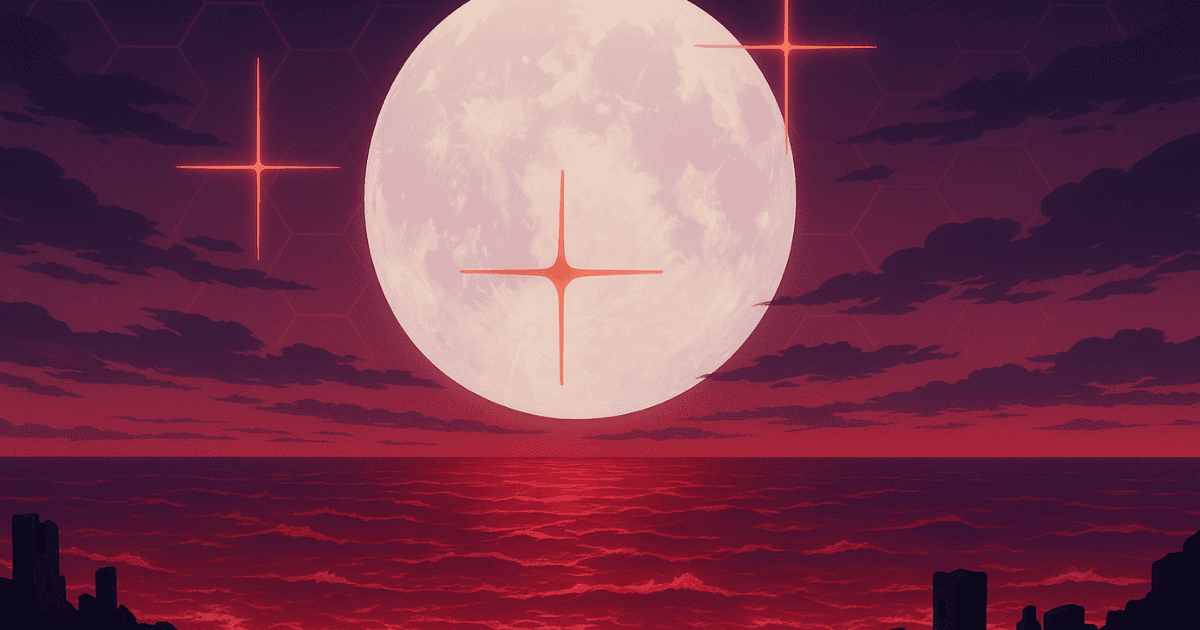
“Sekai-kei“—roughly, “world-type”—is one of those terms that seems intuitively suggestive even when it is difficult to explain. Since I want to ask who the first sekai-kei protagonist was, though, I need a working definition.
For this article, I will use Sekai-kei to mean the following. It will not cover every use of the term, but it should serve here:
“A work in which the protagonist’s problems are directly linked to the world’s problems, so that resolving the former has an enormous effect on the latter.“
The concept was strongly influenced by Neon Genesis Evangelion and belongs to the period after it. Chronologically, then, an Evangelion character could not be a Sekai-kei protagonist.
Even so, I think the first Sekai-kei protagonist is there in Evangelion. Shinji Ikari would seem the obvious candidate, but he is not my answer. I would give that distinction to Gendo Ikari.
*This is a translated version. The original (Japanese) is available here.
- The Protagonist of the World and the Protagonist of the Story
In my reading of television Evangelion, Shinji is the story’s protagonist, while Gendo is the world’s. Shinji’s efforts do not change that world; Gendo is the one driving it. - Gendo’s Goal and Its Pursuit
Gendo wants to see his wife, Yui, again. To do so, he uses the Human Instrumentality Project to try to change the world—a connection between the personal and the worldly that fits my definition of Sekai-kei. In the end, Shinji stops his plan. - Shinji’s Growth and the Father He Must Overcome
I see The End of Evangelion as a story of Shinji moving beyond his father. At the end, he takes the protagonist’s place and parts from his mother. There is growth, but also catastrophe.
On this pageContents
Evangelion: The Story and Its World
Hideaki Anno’s Neon Genesis Evangelion aired on television from 1995 to 1996. It drew viewers in with mysteries surrounding SEELE, the Angels, and the Human Instrumentality Project. Those questions were not resolved during the television run and carried over into the 1997 film, The End of Evangelion.
I have written before about why we found the television ending unsatisfying:
Related reading: Evangelion and Gundam: A Reading of the TV Finale
The central point was the gap, in television Evangelion, between the protagonist of the story and the protagonist of the world.
Shinji is, of course, the story’s protagonist. My argument was that his problems had no resolution that would fit the series’ modern reality, leaving it to end with “Congratulations.”
Who, then, is the protagonist of the world? For me, that is Gendo.
Within the world of Evangelion, Shinji is unfortunately something of a supporting player. However he struggles, he does not change its course; rapid changes take place beyond his knowledge.
Gendo is the one actively trying to impose his own purpose on that world. SEELE is doing most of the plotting, but in structural terms, Gendo seems more suited to the role of protagonist: he uses or deceives that secret society in his effort to reach his goal.
So what did Gendo want badly enough to deceive the world?
Gendo’s Goal, Revealed in the Film
Throughout the television series, Gendo’s suggestive words and behavior leave both Shinji and us baffled. Yet what he wants comes down to something quite simple:
“He just wanted to see his beloved wife, Yui Ikari, who had vanished inside the Eva, one more time.“
“Seriously, Gendo?” many viewers may have thought. There is a very obscure hint in television episode 15, “Lies and Silence.” Visiting Yui’s grave—or rather, her memorial—with Shinji, Gendo says:
“People can live on by forgetting their memories. But there are some things you must never forget. Yui taught me about those irreplaceable things. I come here to reaffirm that.”
I hear something like this behind those words: “Daddy still loves Mommy! I brought you, even though we rarely see each other, because I wanted you to know. You understand, don’t you, Shinji? Daddy still wants to see Mommy!”
How on earth is Shinji supposed to understand all that?
If he could have understood his father’s purpose from that conversation, he would not have suffered so much. Gendo presses on quietly and single-mindedly, apparently hoping that his son will follow his example and move forward.


The Miracle in The End of Evangelion
Gendo’s personal problem, then, is that he wants to see Yui. He tries to resolve it by using the Human Instrumentality Project to change the state of the world.
Is that not Sekai-kei in exactly the sense I have defined?
He even comes within a step of success. Gendo is forty-eight, apparently; perhaps he will remain the oldest Sekai-kei protagonist. Gendo, this sort of thing is for high-school students. At your age, you ought to spare a thought for the trouble you are causing everyone else.
While Shinji, the story’s protagonist, suffers over his relationships, Gendo steadily advances his plan. But it fails at the last moment—and the person who stops it is his son.
More than that, Shinji takes his father’s place as the protagonist of the world.
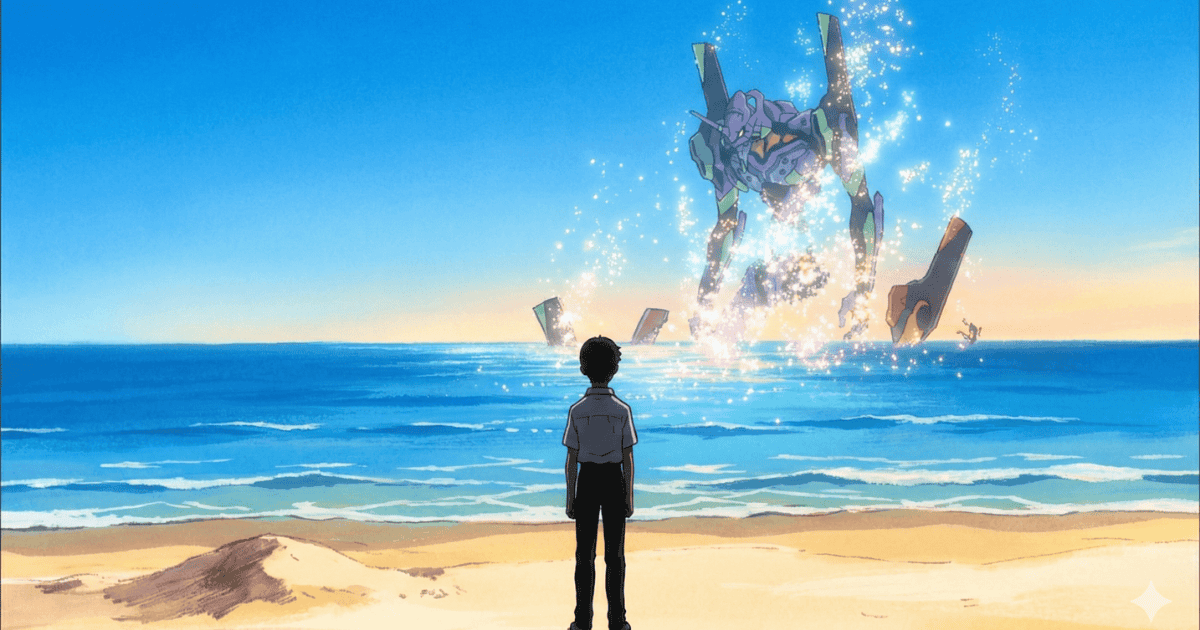
So much else demands our attention in The End of Evangelion that it is easy to lose track of its story. Structurally, though, I read EoE as a son overcoming his father, and in its closing stages as a son parting from the mother who sleeps within Unit 01.
In other words: “Thank you, Father; goodbye, Mother.” But it does not quite become “Congratulations to all the Children,” and we lose sight of the story’s structure. Seen that way, the television ending’s strengths become clearer too.
Although the concept of “Sekai-kei” belongs to the period after Evangelion, I see Gendo—who tries to change the world for the personal purpose of seeing his wife—as the first Sekai-kei protagonist. Shinji, the protagonist of the story but not of its world, takes that place from his father at the end of The End of Evangelion. In that sense, he moves beyond him.
From that angle, The End of Evangelion turns out to be a good story about moving beyond one’s father. How did it end up feeling like that, then?
A Final Thought
Strip The End of Evangelion down to its structure and it is a good story. Yet what shocks me most is the sense of being scolded by Anno: “You lot! Stop watching anime and get back to everyday life! You’re disgusting!”
I want to answer, “It’s your fault for making something so interesting!” But perhaps Anno feels responsible for what he has created. There may be something of Miyazaki in that feeling. Miyazaki is said to have complained about parents showing their children Totoro; I suspect the real issue is using it routinely on television.
We may feel scolded by the maker of The End of Evangelion, but I do not think a film can be made from aggression toward others alone. Might there also have been anger directed inward, helping give the work the form it took?
Even so, perhaps we should keep Anno’s rebuke in mind, live our everyday lives properly, and watch anime only when we really have some time to spare. Surely he would allow us that much.





Reader Comments