Evangelion: 3.0 You Can (Not) Redo (2012) is an animated film overseen by chief director Hideaki Anno.
I still remember seeing it on opening day, from the front row of a packed cinema. Early on, WILLE confines Shinji without explaining anything or listening to him. He is as bewildered as Rip Van Winkle waking up in another era. I wanted to retort, “Are you lot Gendo Ikari or what?!”
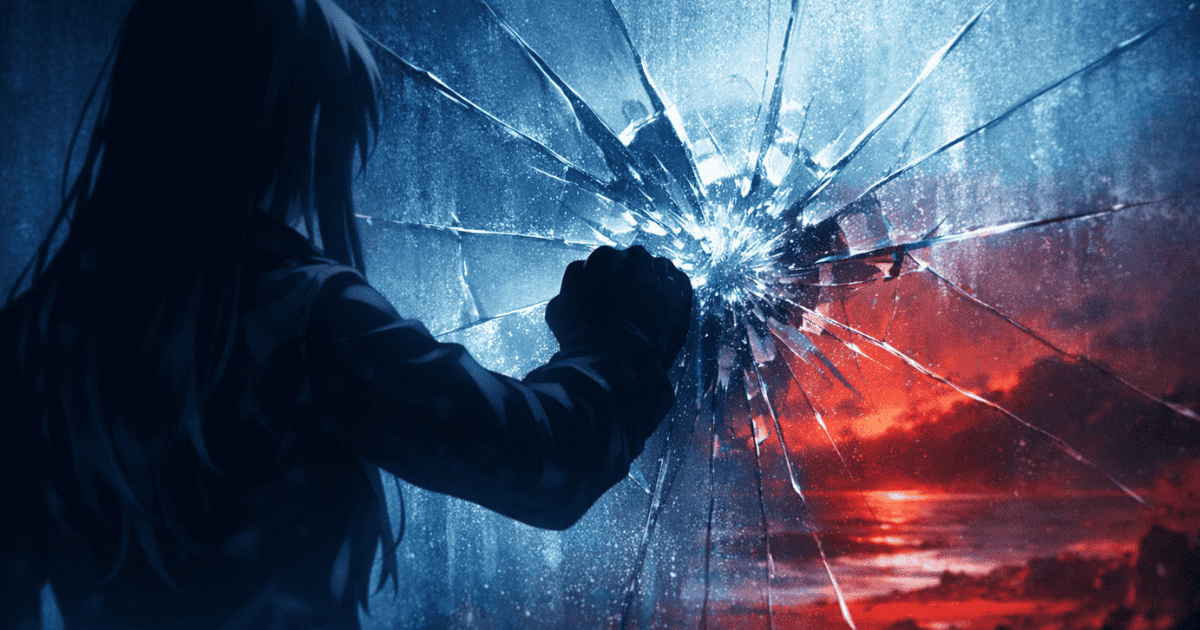
Here I want to consider Asuka’s feelings when she punches the glass between herself and Shinji, one of the most memorable moments in the film. From there, I will explore what their final conversation in Evangelion: 3.0+1.0 Thrice Upon a Time might mean.
On the surface, Asuka’s feelings in Evangelion: 3.0 seem clear enough. Something like: “You’re still talking like a kid? Look at the situation! We’ve been fighting for fourteen years! Grow up already, idiot!” It is understandable that someone who has fought all that time would be irritated by this innocent boy waking up as though no time had passed.
Looking back from Evangelion: 3.0+1.0, however, I want to dwell a little more on what Asuka might have felt, then consider the ending.
I will use Princess Mononoke as a point of comparison. A conversation between Akihiro Miwa and Hayao Miyazaki about Moro and Okkoto, the two mountain gods, seems to illuminate Asuka’s feelings. Let us start there. If you do not know Princess Mononoke, you may prefer to skip to the next section.
For the characters’ endings and the full story, see our synopsis and character analysis of Evangelion: 3.0+1.0.
*This is a translated version. The original (Japanese) is available here.
- Moro and Okkoto’s Past
The production documentary describes them as former lovers. I read Moro’s irritation not simply as mockery, but as sadness and frustration with someone she once loved. That relationship offers a way to think about Asuka. - Asuka’s Punch: Expectation and Disappointment
Perhaps Asuka strikes the glass because feelings for the boy she once liked still linger. Her disappointment is personal: she cannot simply be indifferent to him. - The 3.0+1.0 Ending: Letting Go of Shinji
I read “I liked you too, Asuka” as giving her a resolution to those feelings and allowing her to take a new step toward Kensuke. - “Your Heart”: A Few Words That Release Someone
Like Zenigata’s words in The Castle of Cagliostro, Shinji’s confession can be read as freeing someone from the past. A few words can lift a curse.
On this pageContents
Moro and Okkoto in Princess Mononoke
Watching Princess Mononoke alone, you might take Moro and Okkoto for old allies. Their background, however, goes beyond that.
This appears in the recording-session footage of the production documentary How Princess Mononoke Was Born.
Akihiro Miwa voices Moro in Japanese. The scene in question is Moro and Okkoto’s reunion in the Forest Spirit’s forest after a long separation.
Moro warns Okkoto, who wants an all-out war against the humans: “I don’t like it. Trying to settle everything at once plays right into the humans’ hands.” Miyazaki apparently feels the nuance is not quite right and has the sound director explain a background detail to Miwa: Moro and Okkoto were once lovers and parted a hundred years ago. The sound director is at a loss, but the following exchange takes place:


In other words, Moro is not simply mocking the boar for walking into a human trap. She feels, “I can’t just leave him alone.” They were once close, so she cannot help saying, “You still haven’t stopped being an idiot, have you?”
If he were a stranger, she could ignore him.
Before recording their later reunion, after Okkoto has become a demon, the following conversation takes place:
Not wanting to see him again carries both beautiful memories of the past and expectations for the present. Moro is irritated with Okkoto because he is not the person she wants him to be.
With that comparison in mind, let us return to Asuka.
Why Asuka Punches the Glass in Evangelion: 3.0
To use Moro and Okkoto as a way into Asuka’s feelings, I have to start from the premise that Asuka once liked Shinji. Her behavior before Evangelion: 3.0+1.0 seems to support that, but let us look at her in the final film too.
Asuka in Evangelion: 3.0+1.0
Asuka is irritated for what feels like the entire length of Evangelion: 3.0+1.0.
She should effectively be an adult of about twenty-eight, yet she is still irritated, irritated, irritated.
Of course, the cause is Shinji, who has become a complete wreck. (It brings his state in The End of Evangelion to mind, doesn’t it?) Even so, she seems excessively annoyed.
Yet, despite all that, Asuka never abandons Shinji. At the end of Evangelion: 3.0, she cannot leave him there as an empty shell, and brings him to Village-3.
I do not think this means she is still in love with him. Rather, something unresolved keeps smoldering inside her. She remains tied to the feeling that she liked Shinji back then.
Perhaps that feeling led to the act nobody but Asuka committed: punching the glass between them.
The Feelings Behind Her Punch
By this point, I think the feeling becomes clearer. If I tried to put Asuka’s thoughts at that moment into words, they might sound like this:
I’ve fought for fourteen years in a world without you. I’ve struggled to stay alive through extraordinary conditions. These battles are on a different level from the ones we fought as children, and things are desperate. Even so, we all saved you, using Unit-01 as our excuse. I wondered what you would be like after fourteen years—and then you turn up saying this? I know you’re confused. You’ve only just woken up. But, but, but, but! Because it was you, I thought you’d show us something more! I’m disappointed! And the next thing you say is “Ayanami”? I’m right here!
Something like that, perhaps. It is not so different from the anger described at the start, but a little more of her complicated feeling toward Shinji comes through.
What matters is that she was irritated because it was Shinji, and punched the glass because it was Shinji. With someone else, surely she would have stopped at a sarcastic remark. (She would have made the remark, I think.) That “because” reveals the feelings for Shinji still lodged inside her. In a way, perhaps it even shows the kindness she rarely lets anyone see.
This seems to bring us closer to the reason for the punch. It also lets us begin to see what their conversation on that beach might mean.
The Ending: Asuka Lets Go of Shinji
“I Liked You Too, Asuka”
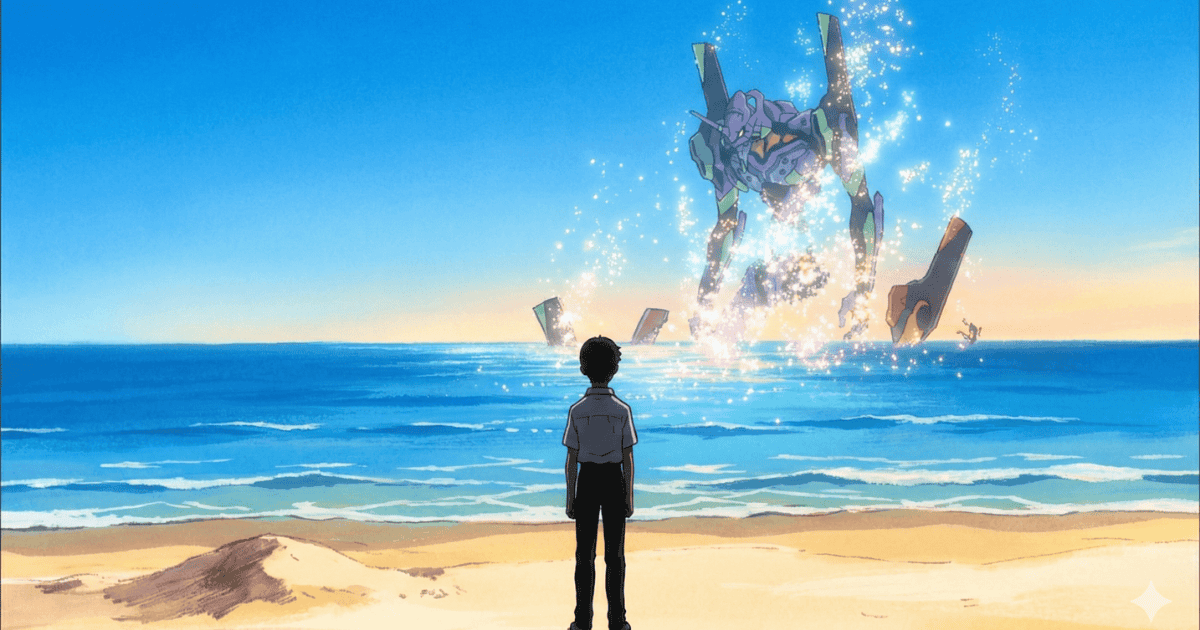
Near the end of Evangelion: 3.0+1.0, Asuka appears physically grown, finally free of the Curse of Eva. And she lies on the beach that left us so bewildered in The End of Evangelion.
Seeing it, I thought, “Oh?” But what happens there is entirely different from the old film.
Shinji says, “I liked you too, Asuka.” Thinking back even to the TV series, had we ever heard him speak so openly? I applauded him in my head: “Well said, Shinji!” More importantly, those words mattered to Asuka.
Asuka, now an adult, knows that she once liked Shinji. What matters is how Shinji felt.
Shinji had seemed interested in Ayanami, but had never clearly put his own affection into words. Now he finally does, and I imagine Asuka thinking, “I knew it!” Something that had bothered her all along is resolved.
In this reading, she is released from what has kept her irritated for so long—from the presence called “Shinji” within her.
Perhaps it is because she has let go of that Shinji that she can go to Kenken, Kensuke.
Mariya Takeuchi’s song “Kokuhaku” (“Confession”) expresses this sort of feeling beautifully. Listening to it might bring you a little closer to Asuka’s state of mind.
Honestly, I do not know whether Shinji really liked Asuka back then. What matters is that he said he did in this scene. True or not, his ability to say it seems to show how he has grown.
That is where I could end the discussion of Asuka, but I want to take a small detour. We know another line that freed someone from a curse.
“Your Heart”
At the end of Hayao Miyazaki’s The Castle of Cagliostro, Lupin leaves Clarisse behind. Zenigata tells her that Lupin stole “your heart.” Perhaps those words free her from the presence called “Lupin.”
To me, that line serves much the same purpose as Shinji’s confession.
Perhaps Cagliostro ends so satisfyingly because we feel that Clarisse will take a new step afterward.
Without those words, perhaps unresolved feelings would have kept smoldering inside her. Like Asuka, she might have remained irritated and spent her life waiting for Lupin.
Answering “Yes” to Zenigata means recognizing that Lupin stole her heart. It also means accepting that Lupin considered her heart worth stealing. In my reading, she and Zenigata are confirming together that Lupin was in love with her.
Seen that way, perhaps Shinji at the end of Evangelion: 3.0+1.0 takes on the roles of both Lupin and Zenigata himself.
I meant to write a short piece using Princess Mononoke as a point of comparison. Before I knew it, I wanted to discuss the endings of Evangelion and Cagliostro too—and Mariya Takeuchi’s song. Worse, bringing in Princess Mononoke may have made the whole thing harder to follow rather than easier.
Well, I have wandered off track a little, but perhaps we have got a bit closer to Asuka’s feelings.
For a wider comparison of the two works, see our discussion of their shared structures, including Irontown and San.

This article uses some images provided by Studio Ghibli Works Stills



Reader Comments