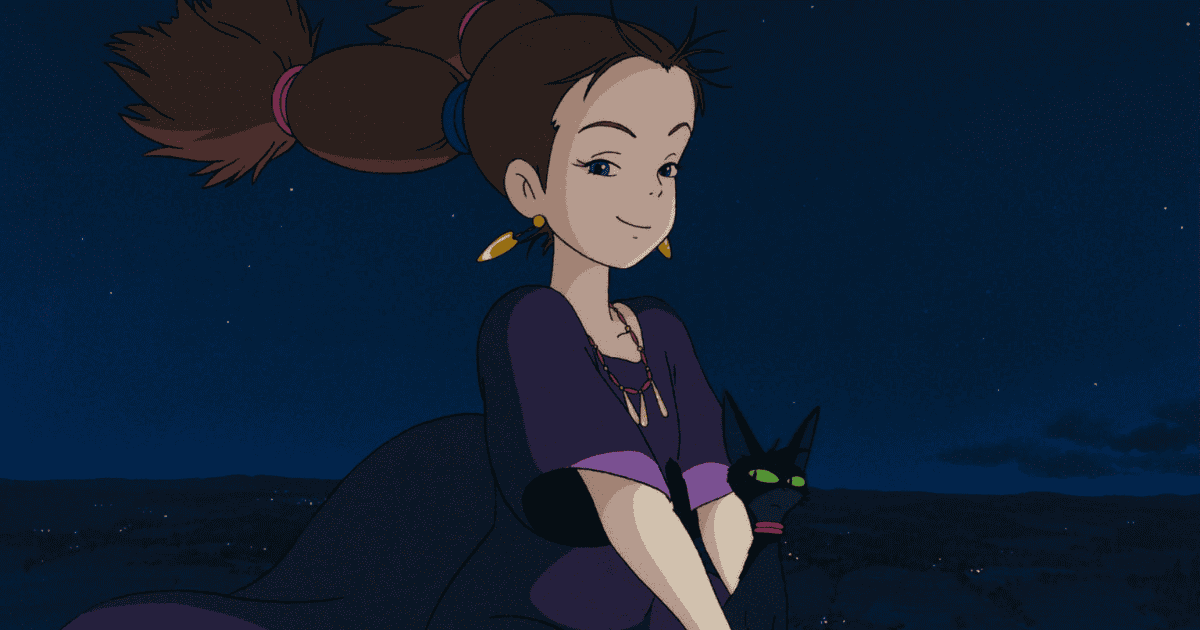
Why does Jiji still only meow at the end of Hayao Miyazaki’s 1989 film Kiki’s Delivery Service(Studio Ghibli Official)? Alongside its story, the film left a strong impression through Yumi Matsutoya’s songs. But that final silence is what I want to consider here.
To think about it, we first need to ask: what kind of presence is Jiji in Kiki’s life? I will begin with three questions about him, then develop my own reading of the ending.
*This is a translated version. The original (Japanese) is available here.
- Jiji as Kiki’s Inner Voice
In the new town, Jiji’s conversations with Kiki take place away from other people. This suggests a way of reading his voice as a reflection of her inner life. - The Stuffed-Animal Metaphor
Jiji can be read as the equivalent of a child’s stuffed animal: a partner in talking to herself. His ability to impersonate a toy, and the remarks made about it, give this reading weight. - Problems That Involve Other People
The herring-pie incident and Kiki’s discomfort with Tombo’s friends confront her with problems she cannot resolve entirely within herself. - Silence as a Sign of Growth
In this interpretation, Jiji’s silence marks Kiki’s growth beyond a position of protection toward independence. - Gratitude and Release
The ending becomes a story of Kiki’s gratitude to a companion who supported her, and of Jiji being released from the role of a stuffed animal.
On this pageContents
Kiki’s Delivery Service (1989): Three Questions About Jiji
Question 1: Jiji Talks Only When He Is Alone with Kiki
In a story about a witch, we readily accept flight on a broom and conversation with a cat. The people in the film seem to accept the flying, too: it is unusual, but not beyond belief.
What about talking to a cat? That is harder to judge, because the people in the new town never see Kiki and Jiji having a conversation.
There is one notable exception before she leaves home. When Jiji recommends her mother’s broom, Kiki calls him a traitor, and the people around them can see the exchange.
Jiji’s remark about the broom also connects with my reading of inherited talent and parental support in the film. For the Japanese wording, romanization, English subtitle, literal translation, and commentary, see our analysis of “Your mother’s broom would be better.”
People in the town seem to take surprisingly little notice of Jiji. Osono, her husband, and the elderly woman at the house where the herring pie is baked do notice him, but Kiki does not converse with him in front of them. When Osono makes milk porridge for a feverish Kiki and says there is some for Jiji too, he answers with an ordinary meow.
Why does this happen?
There seems to be something carefully arranged about Jiji’s role. The episode in which he pretends to be a stuffed animal makes this especially noticeable.
Question 2: Jiji Can Pass for a Stuffed Animal
Kiki meets Osono on the day she arrives in town and ends up living at the bakery while starting a delivery business. What a stroke of luck! One of her first jobs is to deliver a stuffed cat as a present for a customer’s nephew.
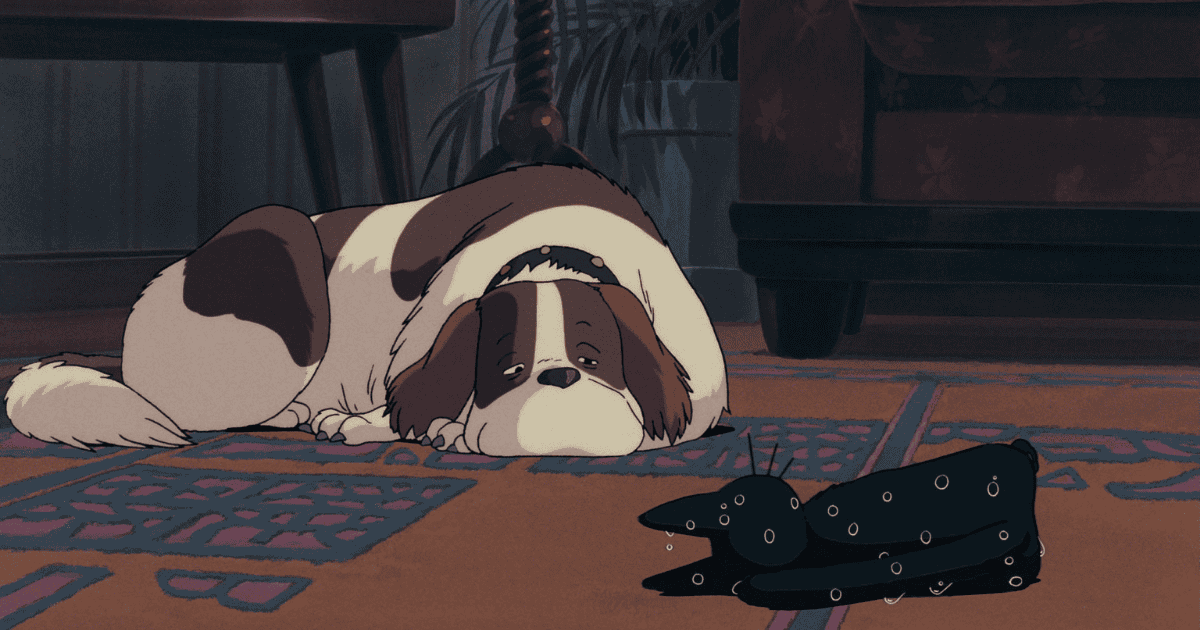
She loses the toy on the way. As a makeshift solution, Jiji pretends to be the stuffed animal while she searches for it. Remarkably, the plan works: even while the child plays with him, he keeps up the act.
But surely that is impossible?
A living cat could not really pass for a stuffed animal. Yet Jiji does. Why? When he first sees the toy, he quietly says, “It’s me.” That, too, seems significant.
Question 3: What Happens Before Jiji Stops Talking?
Two incidents occur before Jiji loses his human voice. The first is the herring-pie delivery, which has stayed with so many viewers.
The second involves Tombo’s friends. Kiki was meant to meet him on the night of the pie delivery, but ends up in bed and misses the appointment. Osono later finds a way to bring them together again, and they go to see the airship on his propeller bicycle.
Sharing the excitement of that ride helps them finally become friends. Then Tombo’s other friends appear.
They arrive in a battered car, but they are still the “cool kids.” To someone from the country, they seem like the unapproachable city itself—people unlike her. Kiki finds them hard to like—and perhaps we do, too. Then she suffers because she has found herself feeling that way.
After these incidents, Jiji suddenly stops talking and seems to lose interest in Kiki. We more or less accept it as part of the story, but why does it happen at this point?
Kiki’s Delivery Service (1989): Reading Jiji’s Silence at the End
Jiji as Kiki’s “Stuffed Animal”
One way of understanding Jiji answers all three questions: he is, for Kiki, like a stuffed animal.
Imagine a little girl talking to her favorite toy. In one sense, she is talking to herself. But it remains an important conversation: sharing her joys, voicing her frustrations, and discovering the parts of herself she is not happy with. Talking to the toy helps her look at herself.
That conversation, however, can only address problems she can resolve within herself. The toy is a spokesperson for her inner life. When another person is essential to the problem, it has nothing to say: the answer does not yet exist within her.
Read this way, Jiji’s convincing act as a stuffed animal and his “It’s me” seem to be telling us what he represents for Kiki. After he stops talking, Ursula visits Kiki and remarks that Jiji looks just like a stuffed animal. There is the suggestion again.
The herring-pie incident and her encounter with Tombo’s friends bring Kiki up against problems that truly involve other people—problems she cannot settle simply by talking to herself.
She might ask Jiji whether making and delivering the pie was the right thing to do, or why she felt so uneasy about Tombo’s friends. But no answer comes. She has to find one she does not already have. A stuffed animal that speaks for her inner self can no longer help.
In this reading, Jiji was never speaking human words in the first place: what Kiki heard was her own inner voice reflected back to her.
His silence, then, represents inner growth—something to welcome. Seen this way, the ending begins to look different.
The Ending: Gratitude and Jiji’s Release
As a child, I remember finding Jiji’s final meow rather sad. But if he has been Kiki’s stuffed animal, his silence is both natural and something to celebrate. She has faced a problem she cannot resolve alone, yet recovered her magic and taken a new step.
Perhaps rescuing Tombo is her first real act of self-reliance. When she leaves home, she gets her mother’s broom; when she reaches town, she meets the almost saintly Osono. Now she moves beyond that protected position and acts on her own. I imagine her looking at Jiji and realizing that she has crossed a line she cannot recross: she no longer needs him in the same way.
She can still feel grateful to the companion who supported her. And perhaps she is pleased that he can be a cat again. His finding a mate also fits this reading: his role as her stuffed animal is over, and he returns to being a cat.
For me, the ending depicts a girl growing beyond her stuffed animal, her gratitude for its support, and Jiji’s release from that role.
What felt sad when I was little now seems a rather refreshing, good ending. I also see a parallel with Midnight Run, the road movie in which Jack and Duke travel from New York to Los Angeles. Jack carries all kinds of inner problems, while Duke can be read as an expression of his sense of justice and desire to be a decent person. Like Kiki and Jiji, they generally do not talk when other people are present. If you have not seen it, that perspective may offer another way to enjoy it.
Can you name the movie before the scene comes into focus?
Put your visual memory to the test with a blurred Studio Ghibli scene.


Reader Comments