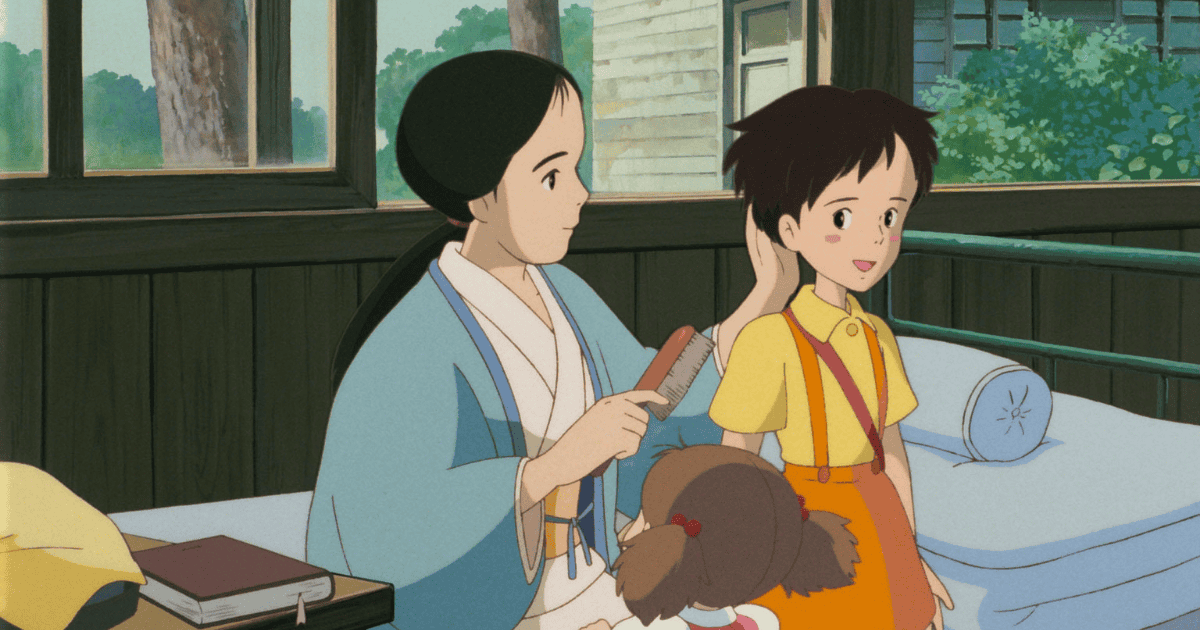
In Hayao Miyazaki’s 1988 masterpiece, My Neighbor Totoro(Studio Ghibli Official), one of the most tender, emotionally resonant scenes occurs when Yasuko Kusakabe gently combs her daughter Satsuki’s hair in the hospital. However, if you look closely at the family’s visual design and listen carefully to the dialogue, a startling psychological reality emerges: the mother is telling a deliberate lie. What exactly is this lie? And more importantly, is it a profound act of maternal love, or a cynical attempt to save face in front of strangers?
*This is a translated version. The original (Japanese) is available here.
- The Hidden Origin of the “Hair-Combing Scene”
This iconic moment of quiet affection isn’t just fiction; it was deeply inspired by Director Hayao Miyazaki’s own complicated distance from his mother, combined with a heartbreaking true story shared by a Studio Ghibli production staff member. - Theory 1: A Beautiful Lie to Build Self-Esteem
Satsuki visually takes after her father, yet her mother insists, “You look just like me.” This gentle deception may be the ultimate maternal affirmation—giving an exhausted, motherless girl exactly what her heart desperately needs to hear. - Theory 2: A Cynical Lie Born from Public Vanity
Alternatively, the mother may have panicked upon seeing Satsuki’s horribly unkempt hair. Surrounded by judging eyes in a shared hospital ward, she may have claimed they “look alike” to excuse the messy hair as “naturally wavy” rather than a sign of her husband’s neglect. - The Father: A “Useless Parent” but a Brilliant Survivor
Tatsuo Kusakabe appears utterly useless at housework and childcare. However, viewing him as a 32-year-old academic desperately fighting to secure a career to feed his family casts his “neglect” as a ruthless, necessary sacrifice. - The Father’s “Insanity” and Mei’s Isolation
To survive academia, the father gambled entirely on Satsuki’s hyper-independence, effectively abandoning four-year-old Mei to raise herself. This dark calculation exposes the terrifyingly fragile reality of the Kusakabe family.
On this pageContents
My Neighbor Totoro (1988) Analysis: The Secret Behind the Mother’s Lie
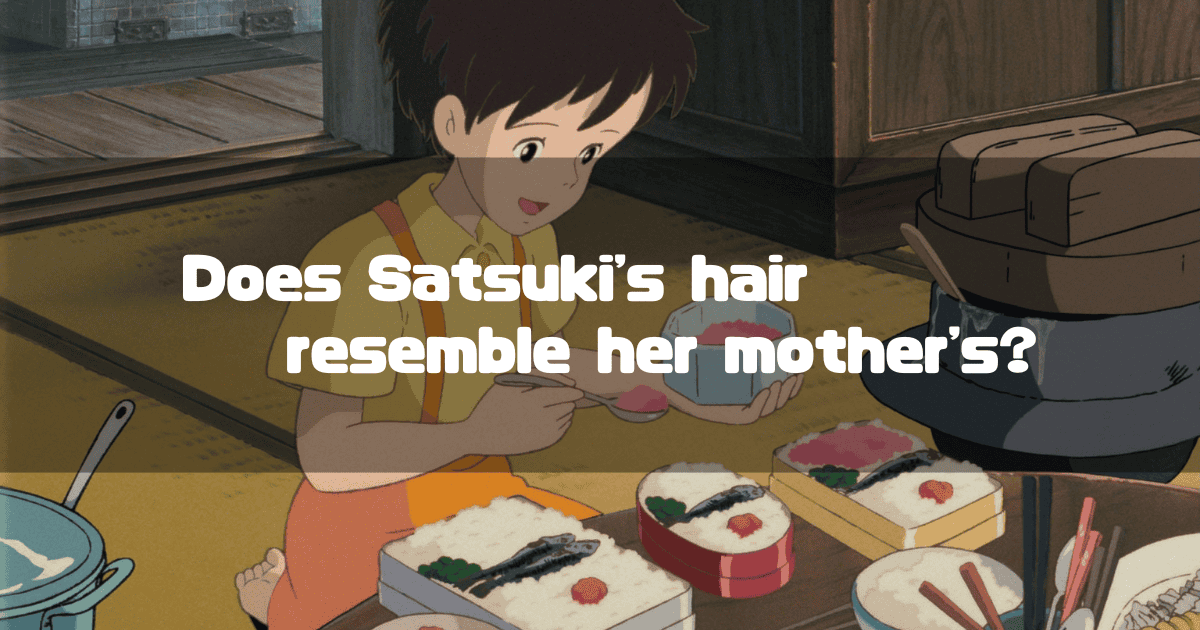
The Hidden Real-Life Story Behind the Scene
The quiet, tear-jerking scene where Yasuko combs Satsuki’s hair is permanently etched into the hearts of Ghibli fans. Interestingly, Director Hayao Miyazaki has spoken openly about the deeply personal origins of this exact moment.
In Ghibli Textbook 3: My Neighbor Totoro (ジブリの教科書3:となりのトトロ, in Japanese), Miyazaki was asked why the protagonists were written as sisters. He confessed that if they had been brothers, the emotional weight would have been “too painful” for him to direct. He elaborated on his own family dynamics:
“…My own relationship with my mother wasn’t as close as Satsuki’s. I was more self-conscious, and my mother was too, so even if I visited her in the hospital, we couldn’t just hug—in other words, it makes perfect sense that Satsuki is a little shy and doesn’t run up to her right away. So, what would Satsuki’s mother do? …She’d probably comb her hair or something—I believe she’s establishing a kind of physical intimacy by doing so. That is what emotionally supports Satsuki. Actually, there’s a true story behind this. A production staff member, Kihara-kun, shared a story he heard from a certain woman.”
(Original Text, in Japanese)
「……………僕自身と母親との関係てのは、あんなサツキみたいに親しいものじゃないですからね。もっと自意識過剰で、それはおふくろの方だってそうで、病院にお見舞いに行ったからって、抱きつくわけにも行かない—つまり、サツキがちょっとはずかしくってすぐ寄っていかないのが、もっともなんですね。そうすると、サツキのおふくろさんはどうするだろう……………たぶん髪の毛でもとかしてあげるんじゃないかな—そうすることによって一種のスキンシップを取ってると思うんです。それがサツキを支えているんですね。実は、そういう話が本当にあって、制作の木原くんがこういう話をきいたことがりますってある女性の話しをしてくれたんです。」
The “Kihara-kun” he mentions is Hirokatsu Kihara, the production desk manager at the time, now famous for his horror series Kaidan Shin-Mimibukuro. This anecdote is fully detailed in Kihara’s book, Our Totoro – Hayao Miyazaki and the Era of ‘My Neighbor Totoro'(ふたりのトトロ-宮崎駿と『となりのトトロ』の時代, in Japanese).
Kihara heard this story from a close friend in high school. The woman’s mother had been hospitalized long-term; she only ever knew her mother from the confines of a hospital bed. Yet, every time she visited, her mother would brush her short hair over and over again. Because of that simple, repetitive touch, the woman never forgot her mother’s love. She proudly told Kihara:
“So even though I essentially had only one parent and was often bullied for it, I never once felt lonely, and I never went astray,” she said, laughing proudly.
Upon hearing this deeply moving confession, Miyazaki simply murmured, “That’s a nice story.”
Knowing that this beautiful cinematic moment was forged from Miyazaki’s own complex maternal trauma and a stranger’s real-life resilience makes it infinitely more powerful.
However, precisely because Miyazaki layered so much raw human emotion into this scene, a cynical “devil” inside me starts whispering when I watch it as an adult. Humans are incredibly complex. What was Satsuki’s mother *truly* thinking when she looked at her daughter’s hair?
The Blatant Visual Evidence of the Lie
Now, let’s address the elephant in the room: “the mother’s lie.” It occurs during this specific exchange:
- Mother: “Such wavy hair… just like mine when I was your age.”
- Satsuki: “Will it be like yours when I grow up?”
- Mother: “Probably. You take after your Mom.”
The subtitle’s “wavy hair” is not the only possible way to translate the Japanese word kusekke. For the original Japanese, literal meaning, and the different approach taken by the English dub, see our detailed translation notes on Yasuko’s memorable line.
I am going to say it bluntly: the lines “Just like mine” and “You take after your Mom” are absolute lies. Let’s look at the visual evidence in the film.
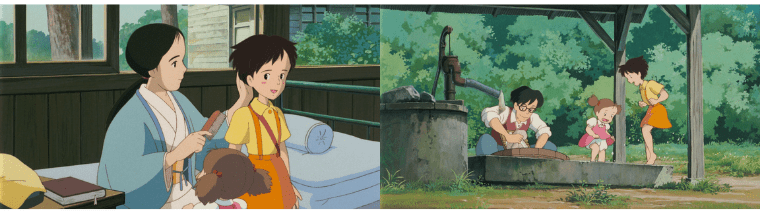
While Satsuki and her mother might share a similar forehead, look at little Mei. Mei’s hair is parted perfectly down the middle, making her a spitting, undeniable image of her mother.
Now, look at the image on the right. Tatsuo (the father) has incredibly thick, unruly, messy hair—and Satsuki’s hair behaves the exact same way. The father is an academic who clearly doesn’t care about grooming, and Satsuki is far too busy running the household to fix her own hair. In their natural state, the father and daughter are visually identical.
Furthermore, consider the quiet scene below where Satsuki sits down to write a letter to her mother.
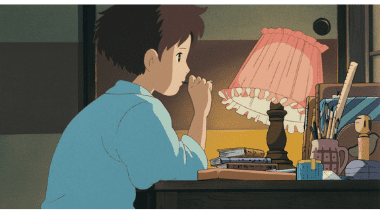
This beautifully mirrors the shots of her father buried in his academic research. From her physical traits to her personality, Satsuki undeniably takes after her father. So, why did Yasuko look her in the eye and say they were the same?
Theory 1: A Beautiful Lie to Build Self-Esteem
The most heartwarming, emotionally resonant reason for this lie is simple: she knows Satsuki loves her unconditionally. She knows that Satsuki is desperate to be just like her.
Yasuko is painfully aware of the Kusakabe family’s grim reality. She is trapped in a hospital bed, and her husband is completely useless at domestic chores. She knows exactly how crushing the burden is on her young daughter. In that fragile moment, hearing “You are just like me” is the highest possible form of self-affirmation Satsuki could ever receive. In fact, right after saying it, Yasuko pulls her daughter into a tight embrace.
Yes, it is a lie—but it is the most profound expression of maternal love imaginable. For a young girl who sacrifices her childhood to care for her sister and cover for her incompetent father, having her messy hair gently combed likely healed Satsuki’s soul far more than any standard hug ever could.
…But let’s pause. Satsuki’s hair was incredibly messy. And that brings us to the darker whisper of the devil.
What did the mother *actually* think the second Satsuki walked into that hospital room looking like a disaster?
Theory 2: A Cynical Lie Born from Public Vanity
Picture the setting: Shichikokuyama Hospital. Yasuko is in a shared ward, surrounded by other adult women. What flashes through her mind when her oldest daughter walks in with hair that looks like a bird’s nest? For a split second, Yasuko almost certainly thought, “Oh, no.”
She probably wanted to immediately write an angry letter to her clueless husband demanding, “Please pay at least a little attention to our daughter’s grooming!” But why couldn’t she just let Satsuki have messy hair in peace?
Was it because she thought Satsuki would be embarrassed?
No. I am about to say something highly unpleasant about human nature.
Are you ready?
In that specific moment, surrounded by judging eyes, the mother likely thought, “I am deeply embarrassed for these strangers to see my daughter looking so unkempt.“
When she loudly proclaims, “Still the same wavy hair. Just like mine when I was a child,” wasn’t she secretly performing for the other patients in the room? She was projecting an excuse: “My daughter’s hair is naturally wavy, it isn’t messy because her father is neglecting her.” This cynical vanity perfectly explains why she hesitates and answers with a non-committal “Probably” when Satsuki joyfully asks, “Will I be like you, Mom?”
It sounds cruel to Satsuki, but the hospital is Yasuko’s entire social world. We cannot entirely blame her for experiencing a fleeting moment of social vanity.
Let’s recall Miyazaki’s quote once more:
“…I was more self-conscious, and my mother was too, so even if I visited her in the hospital, we couldn’t just hug…”
Am I taking a wildly cynical view? Absolutely. Does this theory ruin the beauty of the scene? Not at all. But recognizing this complex, selfish human flaw makes the scene feel infinitely more real.
My Neighbor Totoro (1988) Conclusion: The Dual Nature of the Mother’s Lie
To summarize our psychological deep dive:
The iconic hospital scene in My Neighbor Totoro is a cinematic triumph, blending Director Miyazaki’s complicated relationship with his own mother and a moving true story from the production desk manager.
Yasuko knowingly lies to Satsuki—a girl who is clearly the spitting image of her father—by telling her, “You look just like me.” On one hand, this is a beautifully tragic lie designed to give a traumatized, exhausted child the ultimate emotional validation.
On the other hand, human vanity is inescapable. The mother likely experienced a sharp spike of embarrassment upon seeing her daughter’s disastrous hair in front of her wardmates. By loudly blaming the mess on “naturally wavy” genetics, she successfully protected the family’s public image from the stigma of a neglectful father.
I have watched My Neighbor Totoro countless times since I was a child. But as the years pass, my perspective shifts. Perhaps analyzing the mother’s vanity means I am drifting far away from Miyazaki’s original, innocent intent. But I believe it is proof that Ghibli’s characters are alive. Because they are written as flawed, living humans, we can endlessly speculate on the messy, complex emotions swirling beneath their gentle smiles.
My Neighbor Totoro (1988) Appendix: The Father’s Brilliant Insanity
We’ve spent a lot of time analyzing the complex psychology between Satsuki and her mother. But as a man, I cannot in good conscience end this article without psychoanalyzing the father.
To the casual viewer of My Neighbor Totoro, Tatsuo Kusakabe’s defining trait is his sheer “uselessness.” He completely loses track of a four-year-old Mei, and he spectacularly oversleeps on the exact morning he is supposed to handle the domestic chores. He appears so utterly clueless that you have to wonder if he grasps the severe emergency of his wife being hospitalized.
However, dismissing him as merely “useless” misses the terrifying brilliance of his character.
According to the official lore, Tatsuo is a 32-year-old part-time university lecturer and an archaeologist in the humanities. He is undeniably brilliant. But at 32, he is also in the absolute fight of his life. As a young academic, he is throwing every ounce of his sanity into securing his research career. If we judge him by modern parenting standards, we would scream, “Stop working and take care of your children!” But the reality is much darker. If Tatsuo fails to secure his academic position, his family plunges into devastating poverty. When you view his actions through the lens of economic survival, his “uselessness” transforms into a terrifying “resolve.”
Tatsuo made a ruthless decision: he chose the path of the researcher. This is not a path for ordinary men. In many ways, Tatsuo is the spiritual predecessor to Jiro Horikoshi in The Wind Rises, and a direct alter ego of Director Miyazaki himself. He is a man cursed by the reality that he “cannot *not* work.”
Now, I am going to propose something incredibly dark.
The true “insanity” of Tatsuo Kusakabe is his cold, unspoken calculation: “Well, Satsuki will figure it out.” To take it a step further, he also calculated, “Mei is… well, it is what it is.” I firmly believe this brilliant researcher mathematically weighed “my career vs. raising Satsuki,” decided Satsuki was strong enough to survive, and then completely gave up on trying to balance “my career vs. raising Mei.”
The structural tragedy is stunning. “Satsuki, who cannot easily hug her mother,” acts as the surrogate for “Miyazaki, who had a distant relationship with his own mother,” and her soul is saved by a simple hair-combing. Meanwhile, “the father who cannot stop researching,” acting as the surrogate for “Miyazaki who cannot stop animating,” effectively abandons Mei—the child who desperately needs constant affection—leaving her to wander alone into danger.
It is a profoundly gloomy realization.
Of course, this is highly speculative. Both the “cynical lie” of the mother and the “calculated insanity” of the father are theories I have constructed on my own. It is highly unlikely Tatsuo actually thought, “Oh, well,” regarding Mei’s safety. His lack of overt panic does not erase his deep love for his children.
But when I watch My Neighbor Totoro through the tired, cynical eyes of adulthood, these are the dark, complex passions I see radiating from the screen.
Perhaps this just means I have finally grown up into one of the “people who can no longer see the magic.”
The images used in this article are from “Studio Ghibli Works Still Images.”
Can you name the movie before the scene comes into focus?
Put your visual memory to the test with a blurred Studio Ghibli scene.
Reader Comments