
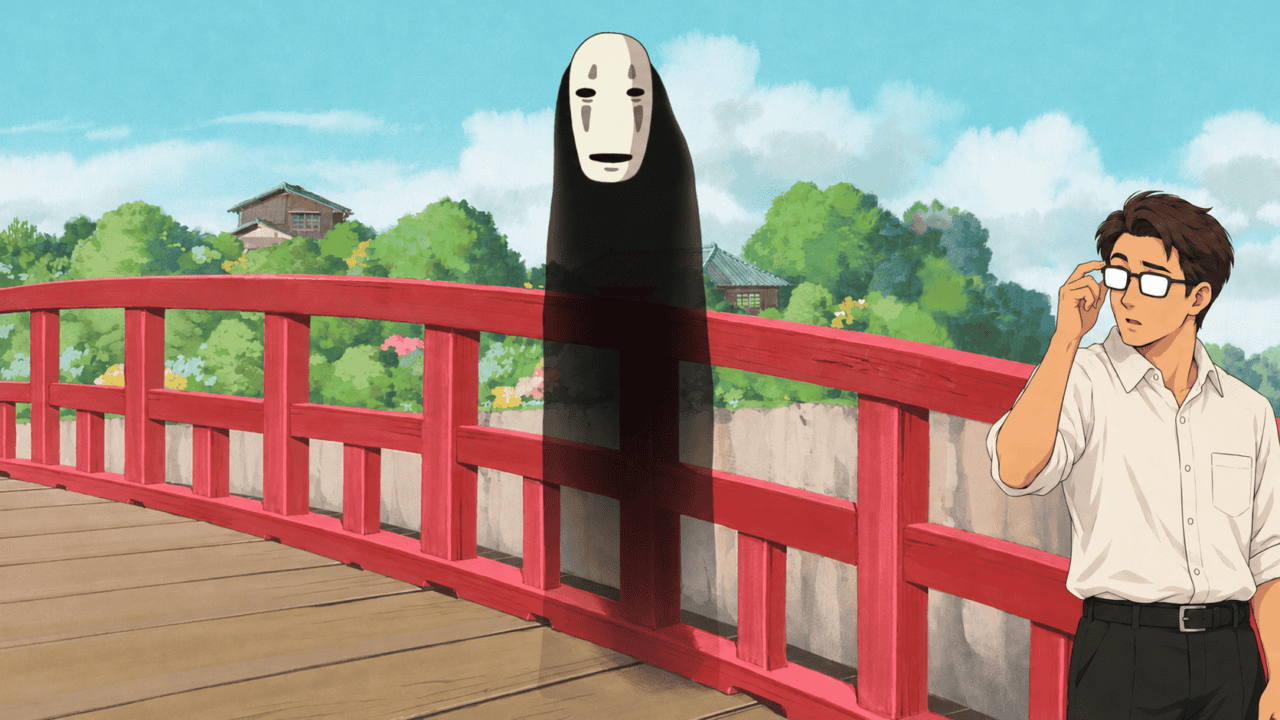
Spirited Away (Official Website) is a feature-length animated film directed by Hayao Miyazaki, released in 2001.
Here I have collected some trivia and behind-the-scenes stories about Spirited Away. You do not need them to understand the film, but I think several are rather interesting: Chihiro’s real-life model, No-Face’s unexpected promotion, a song written for an abandoned project, and what Chihiro remembers after leaving the bathhouse.
*This is a translated version. The original (Japanese) is available here.
On this pageContents
Spirited Away: Trivia and Behind-the-Scenes Stories
Early story plans, casting choices, and unused projects all left traces in the finished film. These stories offer different ways to revisit familiar characters and scenes.
Chihiro’s Real-Life Model: Ten-Year-Old Chiaki
Chihiro, the protagonist of Spirited Away, has a specific real-life model: Chiaki, then ten years old. She is the daughter of Seiji Okuda, who worked in Nippon Television’s film division and handled its relationship with Ghibli.
After Princess Mononoke, two proposals for Miyazaki’s next film were developed: an adaptation and an original story. Both were eventually abandoned.
Miyazaki’s next suggestion was “Chiaki’s film.” He seems to have entertained some rather meddlesome thoughts: “What will become of Chiaki if we leave her to those parents? Shouldn’t we make a film for her?” At a production press conference held at the Edo-Tokyo Open Air Architectural Museum on March 26, 2001, he also explained:
“Actually, I have about five ‘girlfriends’ around Ms. Hiiragi’s age (she was thirteen at the time), whom I have known well since they were babies. Every summer, we spend two or three days together at a mountain cabin. Watching them, I thought there were no films for these children. Wanting to make a film they could really enjoy was the aim—or rather, what prompted me to make it.”
(Original Text in Japanese)
「実は僕には、ちょうど柊さん(当時13歳)くらいの、赤ん坊の頃からよく知っているガールフレンドが5人ほどいまして、毎年夏に山小屋で2、3日一緒に過ごすんですが、その子達を見ていて、この子達のための映画がないなとおもいまして、その子達が本当に楽しめる映画を作ろうと思ったのが、狙いというかきっかけです。」
He also said the idea had come to him when these young “girlfriends” were around ten.
- Ghibli Textbook 12: Spirited Away (ジブリの教科書12 千と千尋の神隠し)
In the Early Plan, Zeniba Was the Final Boss and No-Face Had a Minor Role
The climax of Spirited Away as we know it is No-Face’s rampage. Yet he was only a minor character in the initial plan. His promotion to a central role came about by “accident.”
In the early outline, when roughly the first forty minutes of storyboards had been completed, Chihiro would defeat Yubaba, discover an even more powerful witch named Zeniba, and join forces with Haku to defeat her too. She would then succeed in restoring her parents.
Suzuki pointed out that following this outline would take the film past three hours and require another year of production. Miyazaki and animation director Masashi Ando opposed that extension; the story eventually took its present shape.
Reflecting on this in Ghibli Textbook 12, Suzuki noted:
“Miya-san explained the initial idea passionately, but it did not really strike a chord with me. To be honest, I thought it might be a little ridiculous (a rueful laugh). But I could hardly tell him that outright, could I?”
(Original Text in Japanese)
「(初期構想について)宮さんは熱弁してくれたんですけど、僕はあまりピンとこなかった。いや、正直にいうと、ちょっとバカバカしいんじゃないかと思った(苦笑)。だけど、それを率直にいうわけにもいかないですよね。」
Suzuki says the figure of three hours came to him on the spur of the moment. Nevertheless, that specific number brought about a change of direction and the story we now know.
When Suzuki said they could still postpone the release, Miyazaki rejected the idea. After a brief silence, he suggested bringing No-Face to the foreground. In this account, Suzuki made the final choice between the original plan and the No-Face version.
That seems to be how events unfolded, but I sense something of Miyazaki and Suzuki’s unspoken rapport in the exchange. It is hard to imagine that someone with Miyazaki’s years of filmmaking experience could not see that the original plan would exceed three hours. Surely he knew it too.
Why, then, did the conversation take this course? Perhaps Miyazaki did not find the original idea particularly interesting himself, yet was not entirely confident about putting No-Face at the center either. Letting Suzuki choose may have been his way of moving the No-Face version forward—or of gaining confidence in it. This is only my speculation, of course, but I do not think it is too far-fetched.
- Ghibli Textbook 12: Spirited Away (ジブリの教科書12 千と千尋の神隠し)
Suzuki Recommended Bunta Sugawara for Kamaji
I think many of the voices in Spirited Away suit their characters wonderfully, starting with Mari Natsuki as Yubaba and Zeniba. Bunta Sugawara as Kamaji is another fine example.
I suspect many viewers, like me, remember Kamaji’s line: “Don’t you understand? It’s love. Love.”
Behind Sugawara’s casting was Suzuki’s suggestion that “Only Sugawara could make the word ‘love’ convincing.”
- Ghibli Textbook 12: Spirited Away (ジブリの教科書12 千と千尋の神隠し)
The Theme Song Was Written for an Abandoned Project
The ending theme of Spirited Away is Yumi Kimura’s “Always With Me” (Itsumo Nando Demo), a song I like very much. Originally, the theme was to be “To the River of That Day” (Ano Hi no Kawa e), with music by Joe Hisaishi and lyrics by Miyazaki. When the lyrics proved difficult to write, Miyazaki remembered “Always With Me” and suggested using it instead.
The important point is why Miyazaki remembered it. Kimura and lyricist Wakako Kaku had written the song on their own initiative for a different project, Rin the Chimney Painter. Here is the sequence of events:
- Moved by Princess Mononoke, Kimura sends Miyazaki a fan letter, enclosing a CD on which she has sung its theme song and other pieces.
- Miyazaki replies, saying he is developing Rin the Chimney Painter and outlining the project.
- Although she has not been asked to write anything, phrases and a melody come to Kimura. She asks Kaku to collaborate on the song and sends it to Miyazaki, thinking it might suit the project.
- There is no news for a long time. Rin is abandoned, but the song eventually becomes the theme of Spirited Away.
It sounds like a story someone might invent, yet this is what happened.
Incidentally, some fragmentary information survives about Rin the Chimney Painter, the project abandoned before this film. It seems to have gone roughly as follows:
- The setting is a bathhouse left standing in a Tokyo devastated by a series of earthquakes.
- A twenty-year-old female student arrives from Osaka and is allowed to live at the bathhouse on condition that she paints pictures on its chimney.
- Rin comes into conflict with a group led by a sixty-year-old man who stands in her way.
- For some reason, Rin falls in love with the old man.
Part of me would like to see it. What do you think?
- Ghibli Textbook 12: Spirited Away (ジブリの教科書12 千と千尋の神隠し)
How Bayside Shakedown Displaced Rin and Made Way for “Chiaki’s Film”
As mentioned above, Rin the Chimney Painter preceded this film. The project that swept it aside was, surprisingly, Bayside Shakedown The Movie.
While Miyazaki was working on Rin and drawing large numbers of image boards, Suzuki went to see Bayside Shakedown. In Ghibli Textbook 12, he describes his reaction:
“Under the guise of a comic police story, it beautifully expressed the moods, outlooks, and behavior of young people today. It brought home to me that this was the present age.”
(Original Text in Japanese)
「コメディタッチの刑事もののふりをしながら、今の若者たちの気分、ものの見方、行動パターン、すべてが見事に表現されている。これが現代かと思い知らされました。」
Rin was a twenty-year-old woman. After seeing Bayside, Suzuki became worried about whether Miyazaki, approaching sixty, could portray a woman of that age convincingly. He went to Miyazaki’s studio and told him his impressions of the film.
Miyazaki immediately threw away the many image boards he had drawn for Rin and suggested making “Chiaki’s film” instead.
The speed of that decision is astonishing, but I sense their unspoken rapport here too. Despite all those image boards, perhaps Miyazaki himself felt Rin was not quite working. Meanwhile, the idea that would become Spirited Away may have been growing in his mind. Hearing Suzuki’s thoughts on Bayside Shakedown seems to have helped him take the plunge. The truth remains a mystery, though.
- Ghibli Textbook 12: Spirited Away (ジブリの教科書12 千と千尋の神隠し)
The Hostess-Club Story Behind Chihiro’s Growth
Spirited Away won the Golden Bear at the 52nd Berlin International Film Festival in 2002 and the Academy Award for Best Animated Feature in 2003. Miyazaki did not attend either awards ceremony.
He did, however, attend the ceremony for the Japan Foundation Award in 2005 (Official Website).
Afterward, Miyazaki said to Suzuki, “This film began with something you said, Suzuki-san. Don’t you remember? The story about the hostess club.”
Suzuki had heard the story from an acquaintance who liked visiting hostess clubs. Ghibli Textbook 12 describes it this way:
“Many of the young women who come to work at hostess clubs are initially shy and have difficulty communicating with people. But as necessity drives them to make an effort to talk with all kinds of customers, they gradually become more lively.”
(Original Text in Japanese)
キャバクラへ働きに来る子たちは、もともと引っ込み思案で、人とのコミュニケーションがうまくできない子も多い。ところが、必要に迫られて、一生懸命いろんなお客さんと会話するうちにだんだん元気になっていく。
There is certainly an overlap with Chihiro’s experience.
The Terrifying Fate Awaiting Those Who Refuse to Work
In the film, Chihiro keeps asking Yubaba to let her work. She gets a job and ultimately reaches a happy ending. But what if she had lost her nerve and said, “Actually, never mind” instead?
It is a natural question. Miyazaki’s project proposal, “Chihiro of the Mysterious Town: The Aim of This Film,” gives an answer:
“In the bathhouse ruled by Yubaba, if Chihiro says even once, ‘I don’t want to’ or ‘I want to go home,’ the witch will immediately throw her out. With nowhere to go, her only options will be to wander until she disappears, or to be turned into a chicken and keep laying eggs until she is eaten.”
(Original Text in Japanese)
湯婆婆が支配する湯屋では、「いやだ」「帰りたい」と一言でも口にしたら、魔女はたちまち千尋を放り出し、彼女はどこにも行くあてのないままさまよい消滅するか、ニワトリにされて食われるまで卵を生みつづけるかの道しかなくなる。
What a terrifying fate. Perhaps Chihiro’s ability to keep asking for work already expresses her strength to live.
Yubaba Keeps Her Floor Dim to Save on Expenses
Early in the film, Chihiro reaches Yubaba’s oddly dim office. The darkness reflects her fear and works beautifully. I am sure there was an expressive intention behind it, but animation director Masashi Ando also tells an amusing story about it.
Ando says Yubaba was conceived as an unpleasant nouveau riche and deliberately drawn to look gaudy, which was also Miyazaki’s intention. But in Ghibli Textbook 12, he explains another side of her:
“Yubaba keeps the top floor of the bathhouse, where she lives, quite dark to save energy. It is a way of cutting expenses (laughs). Apparently, she has quite a lot on her mind as a business manager.”
(Original Text in Japanese)
湯婆婆自身は、自分が住んでいる湯屋の最上階などはかなり薄暗くして省エネ体制をとっているんです。経費削減ということで(笑い)。あれで相当経営者として頭を悩ませているということらしいです。
It is a wonderfully human detail.
- Ghibli Textbook 12: Spirited Away (ジブリの教科書12 千と千尋の神隠し)
After Leaving the Tunnel, Chihiro Forgets What Happened at the Bathhouse
Chihiro has all sorts of extraordinary experiences in the film. Carrying those memories through everyday life might be rather difficult; at the very least, nobody would believe her.
In fact, after passing back through the tunnel, she has forgotten what happened on the other side. This is explicitly noted in Miyazaki’s storyboards:


That feels rather sad in its own way. Yet Zeniba’s line takes on new significance here: “Nothing that happens is ever forgotten. You just cannot remember it.”
Even if she appears to have forgotten, the experience has accumulated within her and will become a foundation for her later life.
- Ghibli Textbook 12: Spirited Away (ジブリの教科書12 千と千尋の神隠し)
- Studio Ghibli Storyboard Collection 13: Spirited Away (千と千尋の神隠し スタジオジブリ絵コンテ全集〈13〉)
Your Take
What is your view? Choose the answer that comes closest to your own response.
Reader poll
Can you name the movie before the scene comes into focus?
Put your visual memory to the test with a blurred Studio Ghibli scene.


Reader Comments
Have a thought or interpretation? Leave a comment