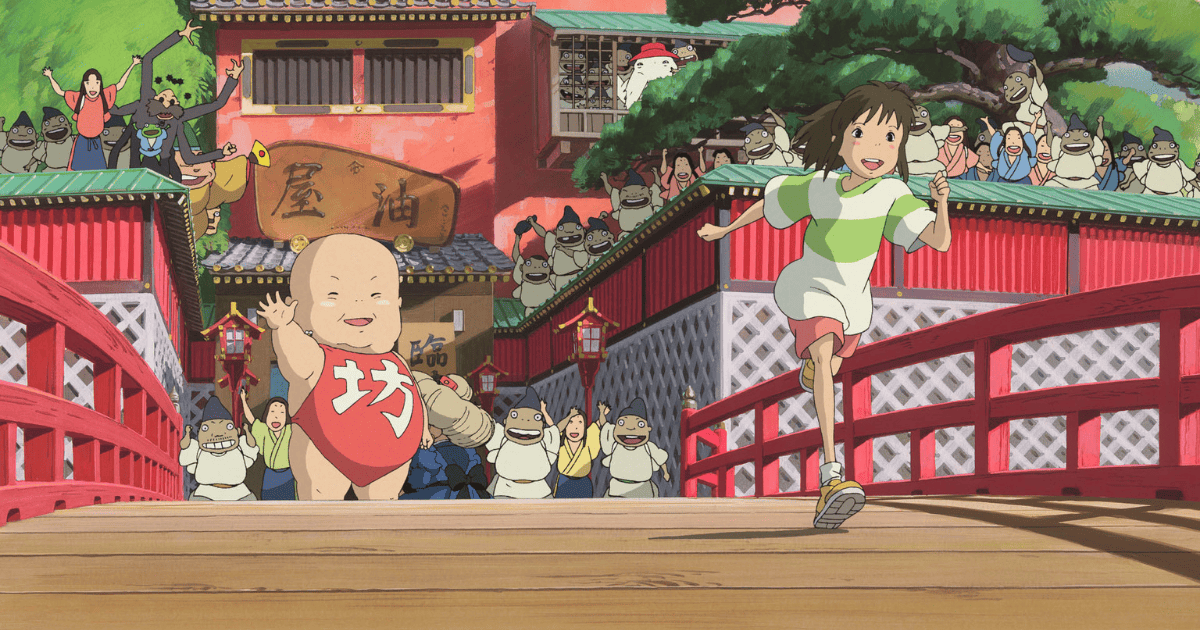
Spirited Away(Official Studio Ghibli Website) is an acclaimed 2001 animated feature film directed by the legendary Hayao Miyazaki.
In this article, we are going to dive deep into the fascinating cast of Spirited Away. By looking back at the characters and their English voice actors, we will explore their individual charms, psychological motivations, and hidden backstories. What kind of people (and spirits) actually populate this bizarre, magical bathhouse?
If you are also interested in the words that define these characters, see our guide to memorable Spirited Away quotes in Japanese and English, with the original Japanese, English subtitles, and translation notes.
Please be warned: this deep-dive character guide contains major spoilers for the entire film.
*This is a translated version. The original (Japanese) is available here.
On this pageContents
Spirited Away (2001) Main Characters & Voice Actors List
| Name | Age | Voice Actor (English Dub) |
|---|---|---|
 Chihiro Ogino | 10 | Daveigh Chase |
 Haku | 12 (apparent age)[1] | Jason Marsden |
 Yubaba | Unknown | Suzanne Pleshette |
 Zeniba | Unknown | Suzanne Pleshette |
 Boh | Unknown | Tara Strong |
 Kamaji | Unknown | David Ogden Stiers |
 Lin | 14 (apparent age)[2] | Susan Egan |
 No-Face | Unknown | Bob Bergen |
- [1]
- According to a post on the official Kinro (NTV) Twitter account.
- [2]
- According to a post on the official Kinro (NTV) Twitter account.
Spirited Away (2001) Character Map
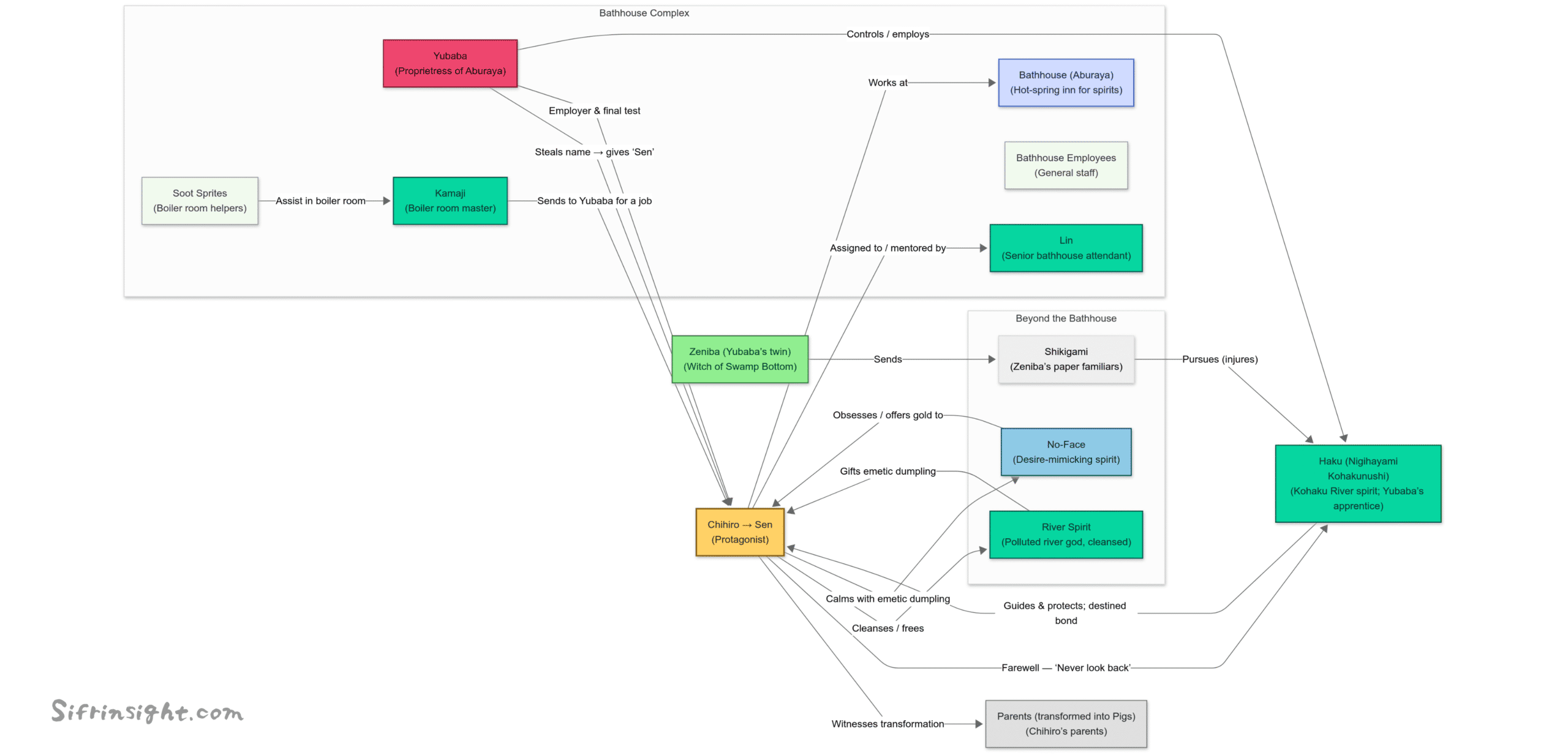
Chihiro and her parents mistakenly wander into a mysterious spirit realm where eight million gods gather to rest. There, her parents greedily devour sacred food and are cursed, transforming into pigs.
To survive and find a way to save her family, Chihiro is forced to work at the Aburaya—a massive bathhouse run by the terrifying witch Yubaba. Through gruelling labor and strange encounters, Chihiro undergoes a profound coming-of-age transformation.
Spirited Away (2001) Character Profiles & Deep Analysis
Chihiro Ogino | Voice Actor: Daveigh Chase

Chihiro Ogino’s Basic Information
The central protagonist of the story. She is an ordinary 10-year-old girl. The film famously opens with her sulking in the back of her father’s car, deeply resentful about having to move to a new school.
- Her father, feeling adventurous, suddenly veers onto a bumpy, unpaved forest road.
- Her parents march into a creepy tunnel, completely ignoring Chihiro’s desperate pleas to stop.
- They begin ravenously eating food at an abandoned stall without permission.
- As a result of their gluttony, they are transformed into massive pigs.
- Consequently, Chihiro is trapped in the spirit world, facing the terrifying reality that her physical body is fading away.
Watching this sequence of events, the audience instinctively roots for Chihiro. Because she is so clearly a helpless victim of her parents’ selfish, reckless decisions, our empathy for her is immediate and powerful.
Throughout the film, Chihiro achieves incredible personal growth through her grueling labor at the Aburaya bathhouse. The culmination of this growth is the final trial imposed upon her by Yubaba.
In that climax, Chihiro somehow immediately sees through Yubaba’s trick and realizes her parents are not among the pigs. When I first saw that scene in theaters, I vividly remember thinking, “Wait, how did she know?” I have compiled a deep-dive philosophical analysis on this exact mystery in the following article:
Read the full analysis: Ending Explained: How Did Chihiro Know Her Parents Weren’t Pigs?
While I explore various metaphorical and legal theories in that article, part of me simply accepts Director Miyazaki’s blunt explanation: “She knows because she grew up.” What do you think?
Haku | Voice Actor: Jason Marsden

Haku’s Basic Information
A mysterious, magically gifted boy who saves Chihiro from fading away at the very beginning of the story.
Towards the end of the film, his true identity is revealed: he is the spirit of the Kohaku River, a river that was paved over for an apartment complex in the human world. His true name is “Nigihayami Kohakunushi.” Because he lost his home, he came to the spirit realm to learn magic from Yubaba, who promptly stole his name and enslaved him.
Haku is a deeply beloved character, but an incredibly dark, fascinating “urban legend” persists regarding his true identity. The theory claims that Haku is actually “Chihiro’s older brother, who drowned while saving her when she fell into the river as a toddler.”
It sounds like a wild internet rumor, but when you examine the film’s official storyboards and thematic parallels, it is shockingly persuasive. I explore this theory in detail below:
Read the full analysis: Is Haku Actually Chihiro’s Dead Brother?
Akio Ogino | Voice Actor: Michael Chiklis

Akio Ogino’s Basic Information
Chihiro’s father, aged 38. According to Miyazaki’s storyboards, he works for a construction or architecture-related firm.
He is depicted as an overly confident, cheerful man, but he initiates a series of wildly reckless decisions at the beginning of the movie:
- He aggressively drives his Audi down a suspicious, unpaved forest road just to explore.
- He brazenly leads his family into a creepy, dark tunnel.
- He confidently starts devouring food at an abandoned restaurant, assuming his credit card will fix any problems later.
- Consequently, he is turned into a pig.
It is an astounding display of arrogant, middle-class hubris. As a kid, I was furious with him. However, as an adult, I can actually defend his actions just a little bit.
It is highly plausible that his “reckless adventure” was a desperate attempt to break the toxic atmosphere inside the car. What he likely feared most was a blow-out argument between a pouting Chihiro and her increasingly irritated mother.
He probably felt guilty that his job forced Chihiro to change schools. If Chihiro continued to complain endlessly, the mother was inevitably going to snap. By acting like a goofy, adventurous “bad guy” and forcing a detour, he was trying to distract them and change the mood.
If you view his reckless driving as a clumsy parenting tactic, he becomes slightly more sympathetic. (Though eating the magical food without permission is still indefensible!)
Yūko Ogino | Voice Actor: Lauren Holly

Yūko Ogino’s Basic Information
Chihiro’s mother, aged 35.
From the very first scene, she maintains a noticeably cold, detached attitude toward Chihiro. When I watched the film as a child, her lack of warmth felt strange. But looking back, she is clearly just exhausted by her 10-year-old’s relentless whining. That coldness is simply a manifestation of “parental fatigue.”
When she casually walks into the dark tunnel, leaving a terrified Chihiro behind, it is a classic parenting bluff. Every parent has eventually used the tactic: “Fine, stay here. Mom’s leaving without you!”
Therefore, her coolness isn’t inherently malicious… unless you subscribe to the “Dead Brother” theory mentioned earlier. If Chihiro’s older brother drowned, the mother’s emotional distance suddenly takes on a much darker, traumatized context.
Yubaba | Voice Actor: Suzanne Pleshette

Yubaba’s Basic Information
The terrifying witch and dictatorial owner of the “Aburaya” bathhouse.
She derives her immense magical authority from an unbreakable contract: she is magically bound to “give a job to anyone who asks for one.” If she actually operated this way in reality, her business would collapse, which implies she relies heavily on terror and intimidation to keep weak people from asking in the first place.
Yubaba famously controls her employees by stealing their true names and assigning them new ones. We accept this as dark magic without question. But is Yubaba actually “stealing” their names?
From a corporate perspective, the dynamic looks very different. She is essentially assigning them a mandatory “workplace nickname.” I explored the hidden, toxic corporate culture behind Yubaba’s magic (and how it mirrors Hayao Miyazaki himself) in the article below:
Read the full analysis: Why Does Yubaba Steal Names? Miyazaki’s Secret Message
Zeniba | Voice Actor: Suzanne Pleshette

Zeniba’s Basic Information
Yubaba’s identical twin sister. She is an immensely powerful witch—so powerful that even Kamaji is terrified of her.
In stark contrast to her sister’s lavish, greedy lifestyle, Zeniba lives a humble, domestic life in a modest cottage at “Swamp Bottom.” There are several lingering “mysteries” surrounding the twin witches:
- What exactly is Zeniba’s magical contract?
- Why did Yubaba force Haku to risk his life to steal Zeniba’s golden seal?
- Why are they permanently separated?
I believe the answers lie in their conflicting magical oaths. If Yubaba’s oath is “to give work,” Zeniba’s oath must logically be “to complete work.” I unpack this complex dynamic here:
Read the full analysis: Why Yubaba Stole Zeniba’s Seal (And the Divided Soul of Miyazaki)
Boh | Voice Actor: Tara Strong

Boh’s Basic Information
Yubaba’s impossibly giant baby (who strangely refers to her as “Granny” in the Japanese dub).
Boh is physically enormous but possesses the emotional maturity of a toddler, refusing to ever leave his plush nursery. Later in the film, Zeniba transforms him into a tiny, adorable mouse. By traveling with Chihiro and being forced to walk on his own two feet, the spoiled giant learns independence.
From a narrative standpoint, Boh’s existence is a puzzle. “Why did Miyazaki include such a bizarre character when the plot could easily function without him?“
My conclusion is simple: Boh exists to give the tyrannical, absolute ruler Yubaba a relatable “human weakness.”
If you rewatch the contract scene, Yubaba was violently refusing to hire Chihiro. The only reason Chihiro successfully secured a job is because Boh suddenly threw a massive temper tantrum in the next room. Panicked by her crying baby, the terrifying witch hastily signed the contract just to get Chihiro out of her face.
Boh proves that even an all-powerful CEO has an Achilles’ heel when it comes to family.
Kamaji | Voice Actor: David Ogden Stiers

Kamaji’s Basic Information
The gruff, multi-armed old man who runs the boiling room at the very bottom of the bathhouse. With his six extendable arms and spider-like aesthetic, he appears terrifying at first.
In reality, he is the ultimate “good guy.” Along with Lin, he acts as Chihiro’s fiercest protector. Whenever Kamaji is on screen, the audience feels a profound sense of “reassurance.” He even gives Chihiro his precious, decades-old train tickets to save Haku.
He perfectly embodies a recurring Miyazaki archetype: the “dependable, quiet adult who supports the youth from the shadows.”
Lin | Voice Actor: Susan Egan

Lin’s Basic Information
A senior bathhouse worker assigned to manage Chihiro. Outwardly, she is harsh, snarky, and complains about having to babysit a human. In private, she is a deeply caring “big sister” figure who fiercely advocates for Chihiro.
Lin harbors a powerful dream of saving enough money to leave the bathhouse and cross the ocean to a better life. Every viewer instinctively hopes she makes it.
An interesting piece of lore: Because Lin works at the Aburaya, Yubaba must have stolen her true name as well. What was her original name? Knowing Yubaba’s naming conventions, it likely contained the character for “Lin” (Rin). I would love to see official confirmation of her past.
Chichiyaku | Voice Actor: Paul Eiding

Chichiyaku’s Basic Information
A high-ranking bathhouse employee (essentially the General Manager). He acts superior and sycophantic toward Yubaba while treating lower-level employees poorly.
He is initially extremely hostile toward Chihiro, but after she successfully pacifies the rampaging No-Face, he completely changes his tune and treats her with deep respect.
Aniyaku | Voice Actor: John Ratzenberger

Aniyaku’s Basic Information
The Assistant Manager of the bathhouse, second in command under Chichiyaku.
Driven by pure greed for fake gold, he suffers the horrifying fate of being swallowed whole by No-Face. He is eventually regurgitated after Chihiro force-feeds the monster her bitter dumpling.
Like his boss, he becomes fiercely protective of Chihiro after she saves his life. You could call him grateful, or you could simply call him a fickle opportunist.
Foreman | Voice Actor: Rodger Bumpass
Foreman’s Basic Information
The grumpy employee who manages the front desk and controls the inventory of highly sought-after herbal bath tokens.
Aogaeru (The Frog) | Voice Actor: Bob Bergen

Aogaeru’s Basic Information
A low-ranking frog employee who has a remarkably terrible time throughout the movie. He is magically paralyzed and silenced by Haku early on, and later becomes the very first victim swallowed by No-Face.
No-Face uses Aogaeru’s stolen voice to communicate and demand food. After Chihiro rescues him from No-Face’s stomach, the frog joins the rest of the staff in cheering for her success.
No-Face (Kaonashi) | Voice Actor: Bob Bergen

No-Face’s Basic Information
A lonely, mysterious spirit who sneaks into the bathhouse after Chihiro pities him and leaves a door open.
In his natural state, he is a blank slate who only mutters soft “Ah… ah…” sounds. He lacks his own identity. However, when he swallows the greedy bathhouse employees, he absorbs their toxicity, becoming a bloated, arrogant, gold-spewing monster.
Thematically, No-Face represents a “hollow, parasitic consumer who lacks his own voice and can only project the desires of the society around him.”
So, how does Miyazaki “cure” this toxic consumerism? Through honest labor. No-Face finds ultimate salvation and peace by becoming Zeniba’s quiet spinning assistant. As long as he focuses on his craft, he won’t go on a monstrous rampage.
Fun Fact: There is a famous Ghibli rumor that No-Face’s body language was modeled after Hiromasa Yonebayashi, a lead animator at the studio at the time. According to Yonebayashi himself, Miyazaki saw his sketches for No-Face and laughed, saying, “Doesn’t it look exactly like Maro?” (Maro being Yonebayashi’s nickname).
Other Characters
Stink Spirit / River Spirit | Voice Actor: Koba Hayashi
A massive, sludge-covered entity that oozes into the bathhouse. Everyone assumes he is a toxic “Stink Spirit,” but through Chihiro’s grueling efforts, she pulls a “thorn” (a bicycle) from his side, unleashing a tidal wave of human garbage.
He is actually an ancient River God, heavily polluted by modern humanity. Cleansing him serves as Chihiro’s ultimate trial by fire, earning her the respect of the entire bathhouse.
Oshira-sama | Voice Actor: Ken Yasuda
The massive, silent Radish Spirit who kindly shields Chihiro from view while sharing an elevator ride. In Japanese folklore, Oshira-sama is a tutelary deity of the home and agriculture worshipped in the Tohoku region.
Kasuga-sama
The eerie, faceless spirits wearing traditional paper masks and formal robes who disembark from the glowing ferry at the start of the film. They are based on the invisible deities worshipped at the famous Kasuga Grand Shrine in Nara.
Ushi-oni
A terrifying, demon-faced spirit relaxing in the baths. In traditional folklore, the Ushi-oni (Ox-Demon) is a brutal yokai from western Japan known for attacking humans on beaches. In the bathhouse, however, he is just a paying customer.
Ōtori-sama
The adorable, giant yellow chick/duck spirits seen bathing together in massive wooden tubs.
Kashira
The three bouncing, disembodied green heads that follow Yubaba around her office. Zeniba magically transforms them into a decoy version of Boh. Because they are missing from the crowd at the end of the film, fans often joke that Yubaba likely executed them for failing to protect her real baby.
Yu-Bird
Yubaba’s personal spy—a grotesque crow possessing Yubaba’s exact facial features. Zeniba curses it, turning it into a tiny, harmless fly-bird that comically accompanies the mouse-version of Boh.
Soot Sprites (Susuwatari)
The fuzzy black balls of soot that carry coal for Kamaji in the boiler room. They are the exact same species of spirit (Makkurokurosuke) seen in My Neighbor Totoro, though the bathhouse variant has grown magical arms and legs to perform physical labor.
The images used in this article are from Studio Ghibli Works Still Images.
Can you name the movie before the scene comes into focus?
Put your visual memory to the test with a blurred Studio Ghibli scene.
Reader Comments