
In Detective Conan: The Private Eyes’ Requiem, Suehiko Ito’s terrifying game of cat-and-mouse seems driven by a straightforward, albeit brutal, desire: revenge against the police who drove Reiko Shimizu to suicide. On the surface, he simply wants to expose police incompetence by forcing private detectives to uncover the truth. But dig a little deeper, and this superficial motive completely shatters.
To truly understand the dark psychology at play, we must connect three seemingly isolated events: the armored car robbery, the assassination of Masaharu Nishio, and the hostage-taking extortion plot. Once linked, they reveal Suehiko Ito’s true, devastating motive. The ultimate truth is that what he clung to until the bitter end wasn’t money or revenge. It was the desperate need to prove that Reiko Shimizu actually loved him.
To reach this psychological breakthrough, we must answer several glaring inconsistencies scattered throughout the film:
- Why didn’t Ito just take the easiest route and turn himself in to humiliate the police?
- Is it possible that Ito was completely blind to the reality of the Masaharu Nishio assassination?
- Why was the final disarm password “Suehiko Ito” instead of “Reiko Shimizu”?
Let’s break down the evidence and unravel the terrifying delusion that drove Ito’s actions.
*This is a translated version. The original (Japanese) is available here.
- Revenge Is Only the Tip of the Iceberg
The outward motive is retaliation for Reiko Shimizu’s death. However, Ito’s refusal to simply confess, combined with his elaborate scheme to force detectives to hunt for the truth, exposes a psychological obsession that goes far beyond mere vengeance. - Connecting the Three Crimes
The armored car robbery, the sniper attack on Nishio, and the hostage crisis seem disjointed. But if we assume Ito and Shimizu were already lovers, these events merge into a single, tragic timeline where Shimizu pulled the strings, and Ito blindly acted out of devotion. - The Desperate Need to Protect a Secret
Ito triggered the events of the film specifically to bury the secret that Shimizu was complicit in the previous crimes. To Ito, that shared guilt was the very foundation of their romance. - The Final Proof of Love
Deep down, Ito likely suspected he was just a pawn. Yet, he desperately needed the world to prove that Reiko Shimizu genuinely loved him. The final password, “Suehiko Ito,” and his hideout in Dreamland perfectly symbolize a man violently clinging to a romantic fantasy.
On this pageContents
Deep Analysis: The Mystery of Detective Conan: The Private Eyes’ Requiem (2006)
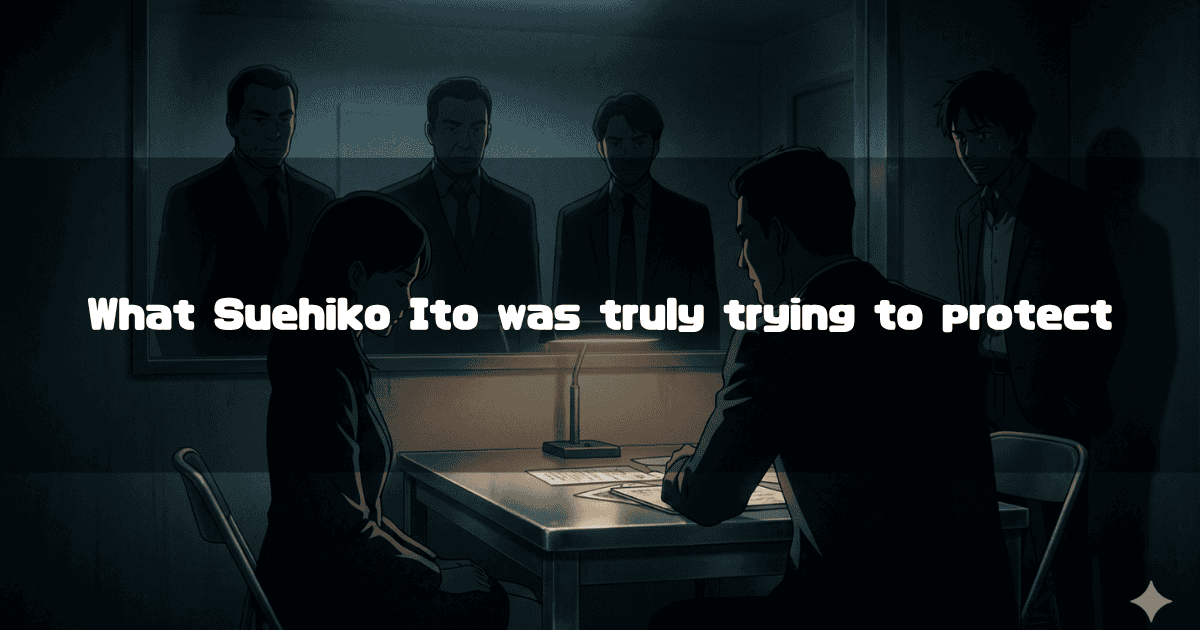
The Superficial Motive: Why “Revenge” Doesn’t Add Up
First, let’s examine Ito’s explicit justification for taking hostages and forcing the detectives to solve the case. He claims it is pure retaliation because the police cornered Reiko Shimizu during voluntary questioning, driving her to suicide. His master plan? To publicly humiliate the authorities by having famous private detectives expose their fatal error. However, this logic is deeply flawed.
If Ito’s only goal was to destroy the police department’s reputation, he didn’t need a convoluted hostage situation. He only needed to prove that the police bullied an innocent woman into suicide while the real killer was roaming free. In short, Ito should have just turned himself in. While the mascara found on the rifle scope hinted that Shimizu might have aimed the weapon, it was incredibly weak evidence to definitively label her the killer.
Similarly, the bloodstains on Nishio’s chair and the floor were purely circumstantial. The police lacked hard evidence, which is exactly why they only brought Shimizu in for “voluntary questioning.”
Had Ito surrendered, confessed his crimes, and allowed the police to match the circumstantial evidence, he would have been indicted as the mastermind. The media would have ruthlessly devoured the police for driving an innocent civilian to her death over a botched investigation. That alone would have exacted his “revenge.”
Yet, he chose theater. He gathered elite detectives, set a lethal ticking clock, and held innocent people hostage just to make them “discover” the truth. This theatricality reveals a deep-seated obsession that eclipses any desire to clear Shimizu’s name.
The Hub of the Crimes: Ito’s Twisted Romanticism
To understand Ito, we have to look at the three major incidents depicted in the film:
- The armored car robbery
- The sniper assassination of Masaharu Nishio
- The hostage and extortion plot at Miracleland
While these appear to be separate events, the thread tying them together is Ito’s twisted philosophy: “Sharing a dark secret deepens the bond between a man and a woman.” For Ito, orchestrating a crime wasn’t about the money or an ego trip. It was a sacred ritual, a blood pact shared with the woman he loved.
But this raises a critical question. Why would a man go to such extreme lengths just to share a secret? Would anyone risk life in prison for a woman they merely had a passing crush on?
The Mastermind: Did Reiko Shimizu Orchestrate the Robbery?
If we look solely at the armored car heist, you could argue Ito was just showing off his criminal genius to win Shimizu’s affection. But that feels incredibly hollow. Ito constantly refers to Shimizu as his “beloved.” You rarely use that kind of dramatic terminology for an unrequited crush; Ito’s fixation implies intimacy. Therefore,
We must conclude that Ito and Shimizu were already entangled in a romantic relationship.
However, this relationship was fundamentally toxic. While Ito was blindly devoted, Reiko Shimizu clearly viewed him as a disposable asset. If we don’t acknowledge the depth of Ito’s emotional dependency, his subsequent rampage makes zero sense.
Taking this a step further: isn’t it highly probable that Reiko Shimizu was the actual mastermind who planted the idea for the armored car robbery in the first place?
Ito was an arrogant man, intoxicated by his own intellect and desperate for validation. It would have been child’s play for a manipulator like Shimizu to whisper, “You’re smart enough to pull off the perfect crime.” She wanted the cash; Ito wanted the romance. For him, the heist was an intimate ritual to bind his “beloved” to him forever.
When Nishio recklessly botched the heist, he didn’t just ruin a robbery. To Ito, Nishio “defiled the sacred ritual meant to cement his bond with his beloved.” Viewed through this lens, the motive behind Nishio’s assassination—and the convoluted extortion plot that follows—finally snaps into focus.
The Perfect Crime: A “Secret Just Between Us”
Officially, the narrative claims Ito killed Nishio either to hoard the stolen money (according to Conan and Heiji’s deduction) or because Nishio ruined his flawless plan (Ito’s own admission). But neither excuse feels strong enough to justify cold-blooded murder.
The reality of the Nishio assassination is much darker. It was a “perfect crime” engineered entirely by Reiko Shimizu to frame Ito. But how did she convince him to pull the trigger? She likely framed it as a romantic crusade: “Let’s eliminate the man who ruined our perfect plan, and keep all the money for ourselves.”
Ito would have found this proposal utterly intoxicating. It stroked his massive ego while deepening his complicity with Shimizu. In Ito’s warped mind:
- The first crime created a “shared secret of guilt.”
- The second crime created an exclusive “secret just between the two of them.”
By applying this psychological framework, the hostage crisis in the present day aligns perfectly. Ito wasn’t just fighting the police; he was desperately trying to protect the exclusive, romantic secret that Reiko Shimizu was his partner in crime.
The Glaring Plot Holes of the Nishio Assassination
If we accept that Ito believed in this twisted romance, why does his final test fail? When asked for “The name of the person you love most,” why was the answer Suehiko Ito, and not Reiko Shimizu?
The answer lies in the massive plot holes surrounding Nishio’s death and Ito’s subsequent car crash. First, the assassination plan was absurdly sloppy. The odds of Ito, a complete amateur, successfully sniping a target from that distance are practically zero. Did Ito truly believe his bullet killed Nishio?
Furthermore, Ito watched Nishio take multiple rounds without reacting, only falling over when his chair tipped. Even in the heat of the moment, a man as analytical as Ito would eventually realize how utterly unnatural that looked.
More importantly, someone severely tampered with Ito’s car, leading to his crippling accident. Did he really write that off as “bad luck”? If he had stopped to analyze the situation, he would have instantly realized the truth: the entire sniping plot was a setup designed to cover him in gunshot residue, leave his fingerprints everywhere, and permanently silence him in a rigged car crash.
While it is possible Ito remained oblivious until the end, it is far more tragic to assume the opposite. Subconsciously, he must have realized he had been used and was being thrown away.
Once you accept that Ito knew he was a pawn, his final password and true motive become heartbreakingly clear.
Ito’s True Motive: Protecting the Illusion of “Dreamland”
If Ito recognized the inconsistencies in the Nishio assassination, he would face a reality he could not mentally survive: “Reiko Shimizu never loved me; she only used me.”
To avoid this psychological collapse, Ito created the hostage crisis. He didn’t just want revenge, and he didn’t just want to hide Shimizu’s involvement. He needed external validation. He needed world-class detectives to dig into the case and officially declare his romantic fantasy as absolute truth. He needed the world to prove that Reiko Shimizu loved him. He needed objective proof that his romance wasn’t just a pathetic delusion inside his own head.
This agonizing denial explains why the password was “Suehiko Ito.”
Viewers naturally assume the prompt “The name of the person you love most” is directed at Ito, proving he is a narcissist who only loves himself. But what if the prompt wasn’t about his feelings? What if the “you” in the question referred to Reiko Shimizu?
The password represented the exact reality he was violently trying to manifest: “The person Reiko Shimizu loves most is… Suehiko Ito.”
It is brilliant symbolism that he chose to hide in an amusement park called “Dreamland.” It represents the fragile, fabricated world he retreated into—a world where his beloved actually cared for him.
His true crime was holding the world hostage just to protect his “Dreamland.” It is an incredibly pathetic, yet deeply human, tragedy.
Conclusion: The Empty Core of Suehiko Ito
To summarize, Suehiko Ito was driven by a chaotic blend of three overlapping motives:
- To humiliate the police who allegedly drove his lover to her death.
- To protect the sacred “secret” of Shimizu’s involvement in the Nishio assassination.
- To force the world to prove that “Reiko Shimizu truly loved me.”
The third motive is the tragic core of his character. These three desires were likely violently tangled inside his mind, driving him to madness.
Our analysis heavily relies on the assumption that Ito and Shimizu were lovers. While never explicitly shown on screen, the narrative shatters without this context. It is also highly probable that Shimizu manipulated Nishio and Miyama using similar romantic tactics, but given that Detective Conan targets a younger demographic, the writers smartly left these darker, manipulative sexual dynamics implied rather than stated. (For more insights into how villains manipulate the narrative, check out our character psychology hub).
Ultimately, Suehiko Ito wasn’t a criminal mastermind; he was a broken man willing to kill to protect a lie. What do you think drove Ito’s madness? Let us know in the poll below!







Reader Comments