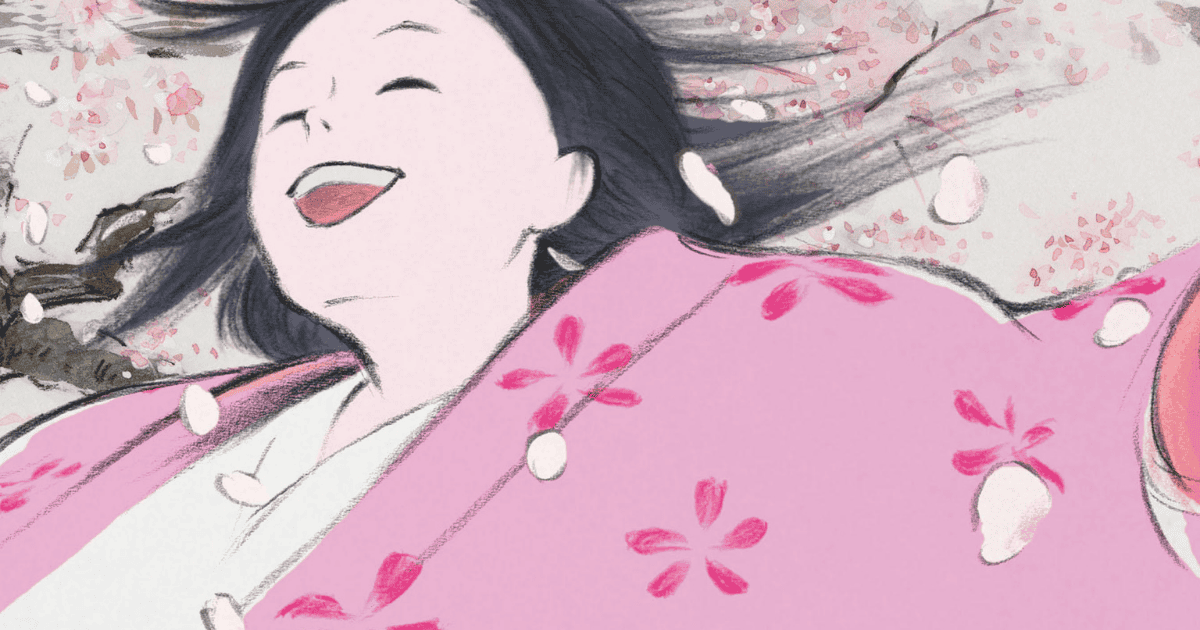
Isao Takahata’s final masterpiece, The Tale of The Princess Kaguya (Official), hides a dark and complex mystery beneath its breathtaking watercolor visuals. Released in 2013, the film’s haunting tagline teases “the crime and punishment committed by the princess,” yet the movie refuses to spoon-feed audiences the answer. Experiencing this cinematic triumph in theaters was unforgettable, but it left a lingering question in the minds of many viewers.
While the original 10th-century folklore, The Tale of the Bamboo Cutter, vaguely mentions Kaguya’s celestial sin, it barely scratches the surface. The Moon simply casts her down as a penalty, leaving the actual crime completely unspoken.
Producer Yoshiaki Nishimura explicitly stated that Takahata’s 2013 adaptation was crafted to answer this millennia-old question: What unforgivable crime did Princess Kaguya commit to warrant her exile to Earth? The film meticulously buries the answer in subtext, demanding a close, analytical viewing. Let’s dive deep into the true nature of her celestial sin, her earthly suffering, and the tragic karma that sealed her fate.
*This is a translated version. The original (Japanese) is available here.
- The Original Folklore Remains Ambiguous:
In the classic The Tale of the Bamboo Cutter, heavenly beings merely state that Kaguya was banished due to a “karmic connection from a previous life.” Her specific crime is never clearly defined. - The Human World ITSELF is the Punishment:
The Moon curses Kaguya with a supernatural allure that attracts men against her will. Forced into a stifling, male-dominated society, her very existence on Earth becomes a living hell. Only by reaching her breaking point and wishing to return to the Moon is she finally “liberated.” - Her Sin Stems from Earthly Desire and Ancestry:
Kaguya’s fatal mistake was harboring feelings for Earth—sparked by the tears of a banished celestial maiden. The film heavily implies that Kaguya is the descendant of this very maiden from the famous “Hagoromo Legend,” making her mere existence an offense to the Moon.
On this pageContents
The Tale of The Princess Kaguya (2013): Decoding the Original Folklore’s Mystery
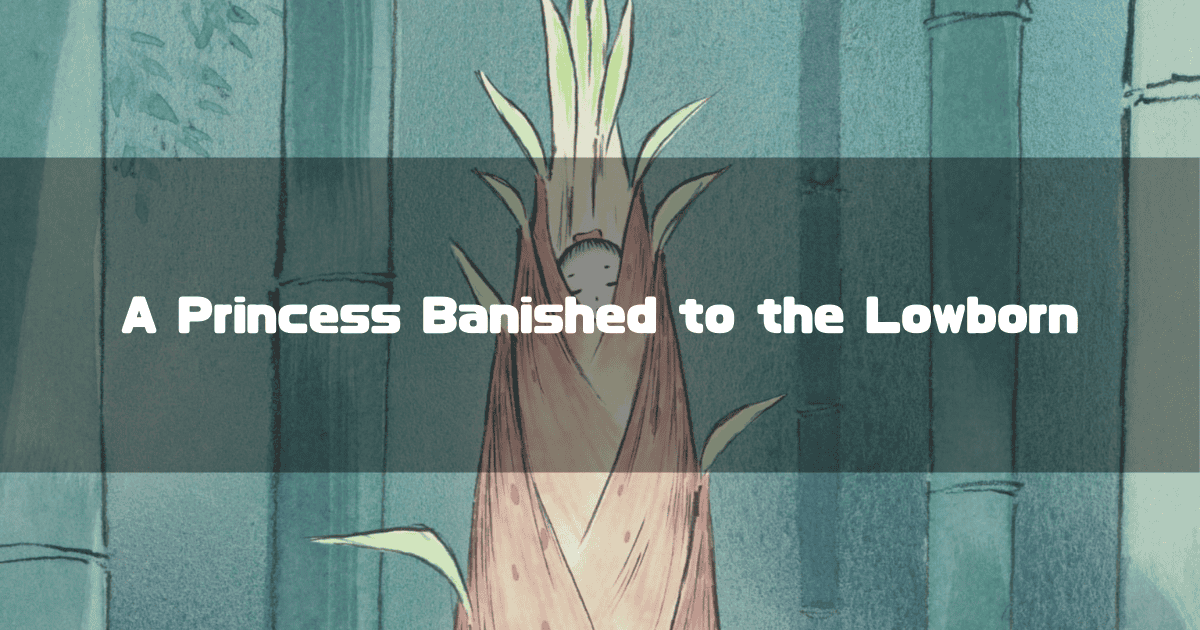
To understand the film, we must first examine how the original The Tale of the Bamboo Cutter handles Kaguya’s descent. Early in the tale, Kaguya offers a vital clue about her origins:
I do not belong to the people of this land. I am of the Capital of the Moon. Due to a karmic connection from a past life, I have been brought into this world.
(Original Text, in classical Japanese)
おのが身は、この国の人にもあらず。月の都の人なり。それをなむ、昔の契ありけるによりなむ、この世界にはもう出来たりける。
The text points to a mysterious “karmic connection.” Later, as the lunar emissaries arrive to reclaim her, they declare:
Princess Kaguya, having committed a crime, was sent to reside for a time with a lowly one such as you. Now that the term of her punishment has ended, we have come to welcome her back, yet you weep and lament.
(Original Text, in classical Japanese)
かぐや姫は、罪を作り給へりければ、かく賤しきおのれがもとに、しばしおはしつるなり。罪の限りはてぬれば、かく迎ふるを、翁は泣き嘆く。
The celestial beings state Kaguya committed a crime and was cursed to live with a “lowly” bamboo cutter as punishment. Yet, the narrative stubbornly refuses to elaborate on the crime itself. However, another crucial detail emerges during her final ascension:
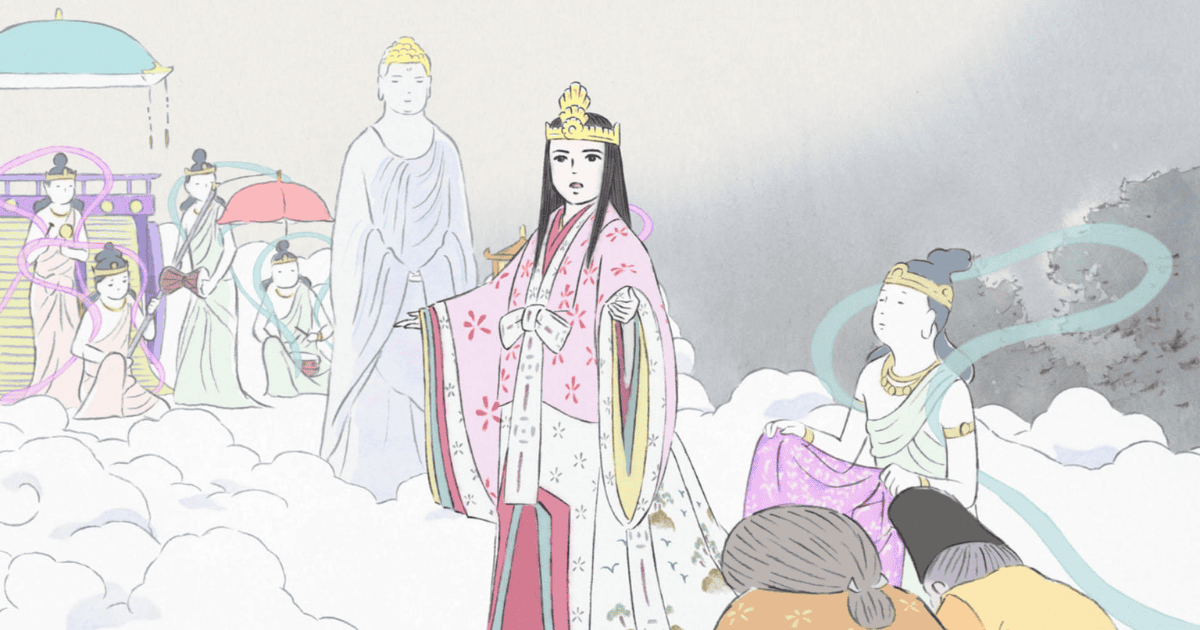
……When they draped the celestial robe over her shoulders, Princess Kaguya’s feelings of pity and affection for the old man instantly vanished. Because those who wear this robe no longer feel earthly attachments or sorrow, she boarded the carriage and ascended to the heavens.
(Original Text, in classical Japanese)
・・・・・・ふと天の羽衣うち着せ奉りつれば、翁を「いとほし、愛し」と思しつることも失せぬ。この衣着つる人は、物思ひなくなりにければ、車に乗りて、百人ばかり天人具して、昇りぬ。
This passage reveals a chilling truth: the Moon is a realm completely devoid of human emotion. The celestial robe actively erases “worry” and emotional attachment.
If we synthesize the original folklore’s clues, we arrive at this baseline:
The Folklore’s Verdict: Princess Kaguya, hailing from a cold, emotionless Moon, committed an unspoken crime tied to a “past life’s karma.” As punishment, she was banished to suffer among lowly humans.
Because the classic tale leaves the details entirely up to the reader’s imagination, Director Isao Takahata seized the opportunity to fill in the blanks. Let’s explore how the 2013 cinematic masterpiece defines her suffering.
The Tale of The Princess Kaguya (2013): The Film’s Devastating Vision of Punishment
The Earthly Hell: Kaguya’s Ultimate Punishment
Let’s tackle the “punishment” first, as the film lays it out with agonizing clarity.
While the folklore views living with a “lowly person” as the penalty, Takahata’s film argues something far more profound: Being forced to exist in the human world is the punishment itself.
As earthly viewers, we might struggle to see our world as a prison. However, the Moon world actively sets psychological traps to turn Kaguya’s life into a living nightmare. The first victim of this celestial manipulation is her adoptive father, the Bamboo Cutter.
Initially, Kaguya lives a blissful, feral life in the mountains. But soon, the bamboo grove begins spitting out gold, silver, and exquisite silk robes. The old man interprets this as divine instruction to transform Kaguya into a noblewoman. Audiences naturally feel infuriated by the father’s blatant disregard for Kaguya’s happiness, but his blind ambition is fueled entirely by the Moon’s intoxicating “gifts.”
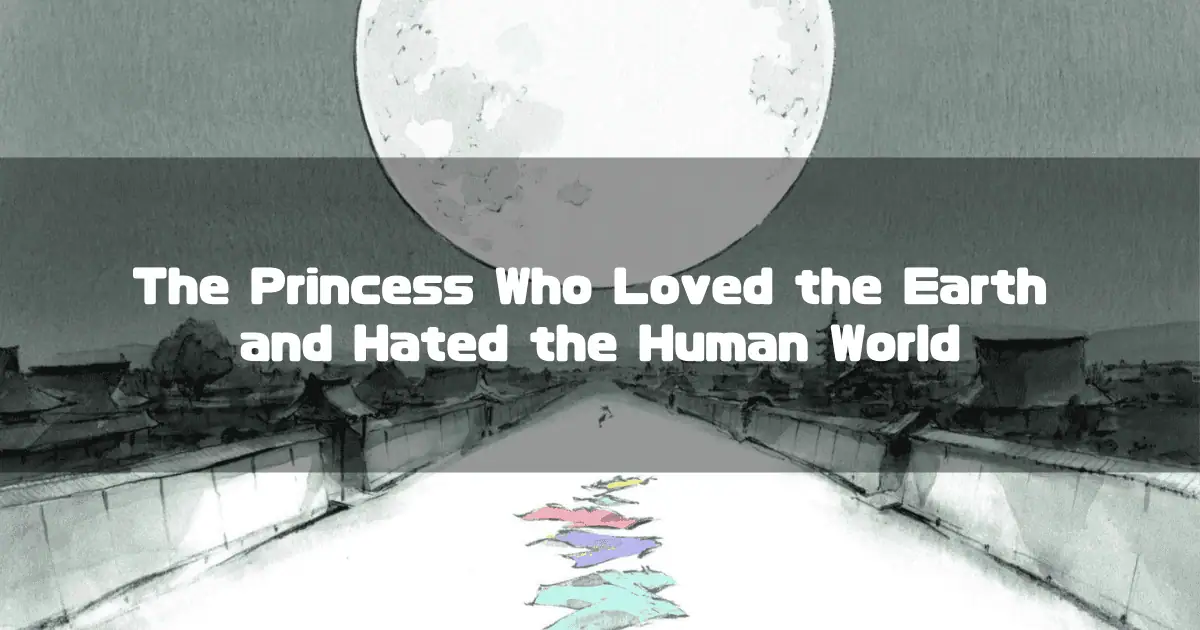
This sudden influx of wealth is the Moon’s first trap. It violently rips Kaguya from her rural paradise, thrusting her into the suffocating constraints of high-society Kyoto. Consumed by despair and trapped in a life she loathes, Kaguya eventually shatters. In one of the most visually stunning sequences in animation history, she violently bursts through her garments and sprints wildly into the night, desperate to escape.
During her frantic flight, an impossibly large moon dominates the sky—a terrifying reminder that she is always being watched. She runs until she physically collapses, seemingly dying in the snow. Yet, in the very next frame, she wakes up perfectly fine back in her stifling mansion.
The horrifying implication? The Moon will not even allow her the mercy of death on Earth. She is trapped. Her punishment is to endure the suffocating human experience.
As the story progresses, five noblemen—and eventually the Emperor—aggressively pursue her. She fends them off with impossible tasks, but we must ask: why is she subjected to this relentless harassment?
This is the Moon’s second trap. The celestial realm cursed Kaguya with a supernatural aura that drives men mad with desire. While some might view extreme beauty as a blessing, for Kaguya, it is an absolute curse she never asked for.
Through this lens, Takahata transforms a medieval fairy tale into a biting modern commentary. The Tale of The Princess Kaguya exposes the hellish reality of a woman forced to survive in a patriarchal society that views her merely as an object to be conquered. She did not ask to be born a woman in this world, nor did she ask for the male gaze that constantly hounds her.
We see a similar thematic struggle in Disney’s Frozen. Elsa spends her life terrified of the “magic” she was born with. While magic sounds wonderful, for Elsa, it is a dangerous burden she desperately wishes she could discard. Kaguya suffers the exact same fate. Endowed with a “curse” of irresistible charm by the Moon, she is relentlessly tormented by aristocratic men.
The punishment only ends when the Emperor physically violates her personal space, prompting Kaguya to instinctively cry out for the Moon to save her. The Moon’s sadistic plan succeeds: they tortured her with the human world until she begged to come home. But what could she have possibly done to deserve this?
The Celestial Sin and the Echoes of a Past Life
Her True Crime: Bringing Emotion to a Static World
To uncover her crime, we must analyze the condition of her release. Kaguya is forgiven the exact moment she thinks, “I want to return to the Moon.”
By reversing this logic, her original crime becomes obvious: Kaguya must have believed that Earth was superior to the Moon. But why would the heavenly beings consider that a sin?
Recall the celestial robe from the original text. Putting it on erases all “worry.” The Moon is portrayed as a realm of absolute tranquility—a Buddhist state of enlightenment where pain, grief, and longing do not exist. However, a world without sorrow is also a world completely devoid of joy. The inhabitants of the Moon feel nothing. They play music and drink, but they experience no passion. It is a sterile, static existence.
Kaguya herself expresses this contrast between joy and grief in one of her most important speeches near the end of the film. I examine that line in both Japanese and English in my guide to The Tale of the Princess Kaguya quotes.
Kaguya’s crime was introducing emotional “fluctuation” into this dead world. She brought passion, joy, and longing to a society that demanded absolute emotional flatness.
Her intense emotions were sparked by the chaotic beauty of Earth. Kaguya didn’t love human society; she loved the raw, unfiltered cycle of life, perfectly captured in the film’s haunting nursery rhyme:
…Birds, bugs, beasts, grass, trees, flowers. Even if they bloom, bear fruit, and scatter. Even if they are born, grow, and die. The wind blows, the rain falls, the waterwheel turns. Lives are revived one after another…
(Original Text, in Japanese)
・・・鳥 虫 けもの 草 木 花 咲いて実って散ったとて 生まれて育って死んだとて 風が吹き雨が降り水車まわり せんぐりいのちがよみがえる・・・
Earth is a world of constant flux, defined by the messy cycle of life and death. The Moon, in stark contrast, is stagnant and eternal.
The Final Verdict on Her Sin: Kaguya committed the ultimate heresy by infecting the emotionally sterile Moon with raw, human passions like joy and sorrow. Intoxicated by the vibrant, ever-changing nature of Earth, her intense emotions threatened the perfect, static order of the celestial realm.
Yet, a paradox remains. If the Moon is truly devoid of emotion, how could its inhabitants feel the “anger” required to punish her? Furthermore, why was Kaguya the only celestial being captivated by Earth? The answer lies in her bloodline.
The Dark Karma: The Celestial Maiden of the Hagoromo Legend
The folklore vaguely attributes Kaguya’s banishment to a “karmic connection from a past life.” Takahata’s film brilliantly physicalizes this karma through a devastating cameo.
Late in the film, Kaguya reveals to her adoptive mother that she learned the earthly nursery rhyme back on the Moon. She explains:
Long ago, I heard a person who returned from this land humming this song in the Capital of the Moon.
(Original Text, in Japanese)
遠い昔 この地から帰ってきた人が この歌を口ずさむのを 月の都で聞いたのです
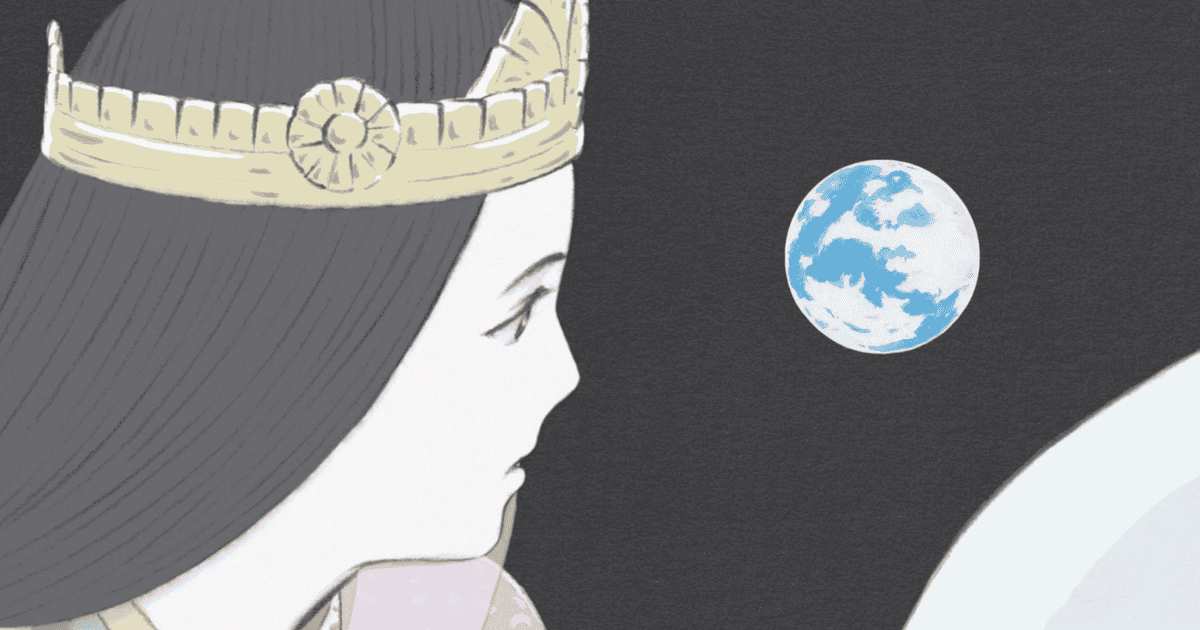
Kaguya describes a celestial maiden who, despite wearing the memory-wiping robe, wept uncontrollably every time she unconsciously hummed the earthly tune. The film visually shows this maiden gazing longingly at Earth, her arms cradling an invisible infant. She has forgotten her trauma, but her body remembers the child she lost.
This tragic figure is a direct reference to the “Hagoromo Legend” (The Legend of the Celestial Robe), specifically the version native to Miho no Matsubara in Shizuoka Prefecture (hinted at by the visual inclusion of Mount Fuji and pine groves).
The Hagoromo Legend passed down in Miho no Matsubara roughly goes like this:
Hakuryo, a local fisherman, discovers a breathtaking celestial robe hanging on a pine tree. When he tries to steal it, a celestial maiden appears, begging for its return, as she cannot fly home without it. Hakuryo blackmails her, demanding she perform a celestial dance in exchange for the garment. Once she complies, she immediately escapes back to the heavens.
(Original Text, in Japanese)
三保の村の漁師である伯梁(白龍、はくりょう)は、ある日、海岸にある一本の松に美しい羽衣がかかっていることに気がつく。その美しい羽衣を手にとり持ち帰ろうとすると、どこからともなく美しい天女が現れて「その羽衣は天女の羽衣、それがないと天に帰れません。どうかお返しください」と頼んだ。それを聞いた伯梁は「それでは天女の舞を舞ってください、そうすればお返ししましょう」と答えたが、天女は「その羽衣がなくては天女の舞は踊れません、どうかお返しください」と更に懇願する。伯梁は羽衣を返したらそのまま帰ってしまうのではないかと疑いを掛けたが、「天の世界には嘘というものがございません。どうか信じてお返しください」という天女の言葉を信じ羽衣を返すと、天女は見事な舞を披露してくれた。そうこうしている内に、天女は空へと帰っていった。
However, many regional variations of this myth are far darker, detailing how the mortal man forces the trapped maiden into marriage, impregnates her, and hides her robe until she accidentally discovers it years later and flees.
When I originally wrote this theory in July 2021, I hadn’t yet read the official storyboards. I later discovered that Director Takahata explicitly noted which version of the Hagoromo myth he adopted. According to his notes:
A fisherman secretly hides the robe. Unable to return, the celestial maiden becomes his wife and bears a child. One day, she finds the hidden robe, realizes her husband’s betrayal, puts it on in a fit of rage, and abandons her earthly family to return to heaven.
(Original Text, in Japanese)
羽衣伝説にはいろいろあるが、天女がまいおりる。あそぶめに羽衣を松にかける。漁師がそれをこっそり隠す。帰れなくなった天女は漁師と夫婦になり、子までもうける。が、ある日、押し入れに隠されていた羽衣を見つけ、夫の裏切りをしり、ついかっとなって羽衣をまとい、天に帰ってしまう-というのを採用。
The weeping woman in the Moon Capital is this exact celestial maiden. She lost her memories upon returning, but her soul remains fractured by the loss of the child she abandoned. Witnessing this profound, unspoken grief is what sparked Kaguya’s obsession with Earth.
But wait—if all the Moon’s inhabitants saw this weeping maiden, why was Kaguya the only one who cared? The answer is terrifyingly simple.
Princess Kaguya is the forgotten child.
She carries the blood of the Earth. Kaguya is the biological daughter of the celestial maiden and the mortal fisherman. Because she possesses earthly DNA, she is biologically hardwired to long for the human world.
Let’s look at the brief flashback of the Hagoromo legend in the film. We see the fisherman running after the fleeing maiden, dragging a young child by the hand. While logic dictates that the child on screen is the maiden’s offspring, I propose a darker theory: Kaguya was a second child, born on Earth, but somehow taken back to the Moon before the maiden fully succumbed to the robe’s amnesia.
Look at the thematic parallels with Sutemaru, Kaguya’s childhood love. In the film’s climax, a married Sutemaru instantly decides to abandon his wife and child to run away with Kaguya. He is utterly intoxicated by her presence. Hakuryo, the fisherman, suffered the exact same supernatural intoxication. Hakuryo likely already had a family (the child seen in the flashback) when he found the maiden, yet he destroyed his life to possess her.
As mentioned in my previous note, the official storyboards confirm that the child the fisherman is holding is the maiden’s child. Therefore, my Sutemaru parallel is technically debunked by the director’s notes. However, from a pure cinematic analysis standpoint, viewing Kaguya as a child born of this tragic, toxic earthly union makes the narrative infinitely more compelling. I stand by the idea that Kaguya is directly tied to the maiden’s earthly trauma.
When the celestial maiden weeps in the Moon Capital, she is mourning the gaping void left by Kaguya. And Kaguya, driven by her earthly blood, looks down at the planet that destroyed her mother’s life and feels an irresistible pull.
Now, put yourself in the shoes of the Moon’s pure, emotionless inhabitants. They look at Kaguya and see a monstrous anomaly. She is a half-breed carrying the tainted blood of humanity—the very species that traumatized their celestial sister. Kaguya represents grief, betrayal, and chaotic passion.
Therefore, her true crime was simply being born.
The “pure” Moon world is not enlightened; it is deeply prejudiced. Desperate to protect their emotional sterility, they exile the half-breed Kaguya back to the mud of Earth, sadistically ensuring she relives the exact same patriarchal trauma her mother endured.
Far from a simple fairy tale adaptation, The Tale of The Princess Kaguya is a blistering critique of systemic oppression. Director Isao Takahata unearthed the silent trauma buried in classical mythology and forced modern audiences to confront it. Much like his legendary Grave of the Fireflies, it is a profoundly heavy film that demands to be seen.
This is my current understanding of the tragic “crime and punishment” woven into this masterpiece. By treating the Hagoromo legend not as a whimsical myth, but as a devastating human tragedy, the true horror of Kaguya’s existence comes into focus.
Takahata used an ancient canvas to highlight the silent suffering of women—a suffering that texts like The Tale of the Bamboo Cutter historically gloss over.
However, one paradox still haunts me: How could an emotionally “pure” Moon world harbor the malice required to issue a punishment in the first place? I’ve summarized my further thoughts on this contradictory dynamic in our deep-dive analysis: The Shocking Truth—Was She Never Actually Punished?.
Perhaps Kaguya never committed a crime at all. What do you think?
The images used in this article are from “Studio Ghibli Works Still Images”.
Can you name the movie before the scene comes into focus?
Put your visual memory to the test with a blurred Studio Ghibli scene.

Reader Comments