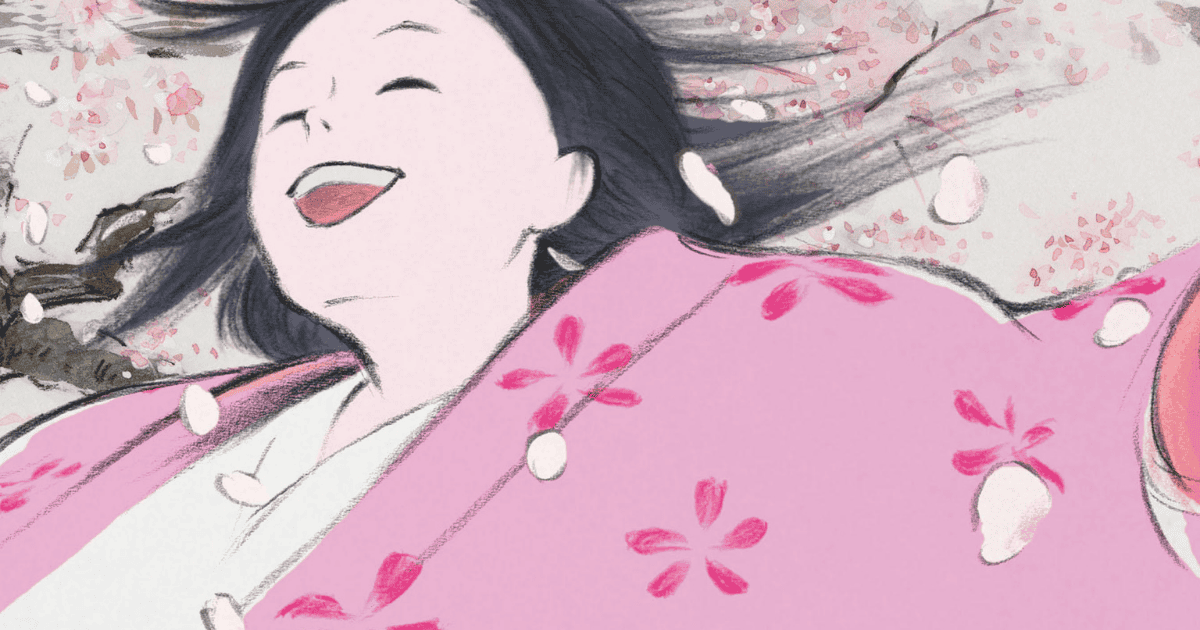
Isao Takahata’s The Tale of the Princess Kaguya (Official) is an animated feature released in 2013.
Here I want to collect some production stories and trivia about The Tale of the Princess Kaguya. They are not essential to understanding the film, but I think some are rather interesting.
*This is a translated version. The original (Japanese) is available here.
On this pageContents
The Tale of the Princess Kaguya: Production Stories and Trivia
Before Kaguya: The Heike, Yanagibashi, and a Lullaby
When The Tale of the Princess Kaguya was released in 2013, Takahata’s previous Ghibli film had been My Neighbors the Yamadas in 1999. More than a decade had passed, but he had neither been idle nor spent all that time making Kaguya.
After My Neighbors the Yamadas, the first proposed project was The Tale of the Heike. Animating it would mean drawing large quantities of armor and weapons, as well as battles. Finding staff capable of doing that was difficult.
In Ghibli Textbook 19, Toshio Suzuki recalls Miyazaki saying that if anyone could draw the Heike’s battle scenes, it would have to be him.
More importantly, Osamu Tanabe, a crucial member of the Kaguya team, was reluctant to draw violent scenes for The Heike.
Tanabe is an exceptional animator who has worked on Ghibli films since Grave of the Fireflies, though his career began earlier. He handled storyboards and direction on My Neighbors the Yamadas, and Takahata seems to have trusted him so much that the next film was planned around his participation. With Tanabe saying no, advancing The Tale of the Heike appears to have been difficult.
Around 2005, Suzuki proposed adapting The Tale of the Bamboo Cutter. Takahata had already been saying for some time that someone should bring it to the screen.
That should have been the happy beginning of The Tale of the Princess Kaguya. Instead, the proposal stalled.
After Tales from Earthsea was released, a proposal to adapt Shugoro Yamamoto’s The Story of Yanagibashi also fell through. Takahata then proposed Norio Akasaka’s academic study The Birth of a Lullaby, but that too was rejected.
In spring 2008, Takahata finally settled on Kaguya. The film had already been through quite a journey before production began.
- Ghibli Textbook 19: The Tale of The Princess Kaguya (ジブリの教科書19 かぐや姫の物語)
A Simultaneous Release Falls Through—and Miyazaki Announces Retirement
After that long planning period, The Tale of the Princess Kaguya opened on November 23, 2013. Miyazaki’s The Wind Rises had opened on July 20, while Kaguya was still in production. The two films had originally been intended for simultaneous release.
Production on The Tale of the Princess Kaguya began first. As The Wind Rises progressed, a simultaneous release seemed possible, but repeated delays to Kaguya meant The Wind Rises eventually opened first.
Near the end of production on The Tale of the Princess Kaguya, Isao Takahata, Making ‘The Tale of the Princess Kaguya’ shows producer Yoshiaki Nishimura reading Miyazaki’s retirement statement to the Kaguya staff. Miyazaki had made it at a meeting of Ghibli’s senior management:
“This year marks fifty years of working in animation. What once took me two days now takes a week. Only thanks to the terrifying, relentless pressure from Sankichi—Yumiko Miyoshi, the production desk on The Wind Rises—did I finally finish. But at this point, I am giving up directing features. I will step down as head of Studio Ghibli. I will remain head of the museum, but retire from making films. With this, I am retiring from features. I very much wanted to make three films for the museum, but the reality is that I can no longer do it. It feels as though a week has only two days. We put two young directors in charge of Arrietty and From Up on Poppy Hill, then made The Wind Rises: that took five years. In another five, I will be seventy-seven. I think it is better to make a clear decision now, so I am retiring from feature-length animation. I will muddle along as chairman of the museum.”
(Original Text, in Japanese)
「今年で50年間、アニメーションをやってきたことになるが、昔の2日間が今の1週間、恐怖、猛烈なサンキチ(「風立ちぬ」の制作デスクの三吉弓子)の追い上げがあってようやくできたが、もうここに来て長編の演出を断念する。スタジオジブリの所長をやめます。美術館の館主は続ける。ただ、映画作りはリタイアします。これをもって、長編映画を引退します。美術館作品3本は是非ともと思っていましたが、現実はもうできない。1週間が2日しかないというのが実感です。若手の演出を2人たてて、『アリエッティ』と『コクリコ』、そして『風立ちぬ』とやって5年。次の5年後は77歳になる。これはもうすっきり結論を出したほうが良いのではないかと考えて、長編アニメーション映画制作からリタイアします。美術館の理事長はぐだぐだと続けていきます。」
The documentary also shows Takahata watching the retirement press conference on television with the Ghibli staff.
Whether that announcement spurred the team on, I cannot say. Somehow, The Tale of the Princess Kaguya reached completion.
- Ghibli Textbook 19: The Tale of The Princess Kaguya (ジブリの教科書19 かぐや姫の物語)
- Isao Takahata, Making ‘The Tale of The Princess Kaguya’ (高畑勲、『かぐや姫の物語』をつくる。)
Some of the Bamboo Cutter’s Lines Were Recorded by Yuji Miyake
Takeo Chii voices the bamboo cutter, Okina, in the Japanese version. When he died in 2012, the film was still in production. Most of his recording was complete, so his is the voice we mainly hear. Yuji Miyake recorded the additional dialogue that was still needed.
I have not identified every scene he covered. But Isao Takahata, Making ‘The Tale of the Princess Kaguya’ shows Miyake recording “Where have you gone? Hey!” Could you tell which parts were his?
- Ghibli Textbook 19: The Tale of The Princess Kaguya (ジブリの教科書19 かぐや姫の物語)
- Isao Takahata, Making ‘The Tale of The Princess Kaguya’ (高畑勲、『かぐや姫の物語』をつくる。)
“The Princess’s Crime and Punishment”: A Tagline the Film Outgrew
The tagline for The Tale of the Princess Kaguya was “The Princess’s Crime and Punishment.” It is striking copy, and I remember being strongly drawn to it.
Yet the tagline caused a dispute between Suzuki and Takahata.
Suzuki devised the crime-and-punishment angle because it appeared in Takahata’s proposal and was mentioned in the original tale. But Takahata was not pleased when shown the copy.
He reportedly replied, “It is true that I thought that way at first. But I abandoned that theme.”
Suzuki insisted on adopting the catchy line anyway. Later in production, Takahata said it was causing him considerable trouble. Because the copy would influence how viewers approached the film, he said he had added dialogue to bring the film closer to it.
I do not know exactly which lines he meant. The following might be among them:
“Long ago, in the Capital of the Moon, I heard someone who had returned from this land humming this song.” “When you wear the Moon’s celestial robe, all memories of this land disappear. There is no sadness or worry. Yet each time they sang, a single tear fell from their eyes. Somehow, that mystery made my heart ache too… Ah, now I understand how that person felt! And why I longed for this land, and why, as punishment, I was sent down to this very land…”
(Original Text, in Japanese)
「遠い昔、この地から帰ってきた人がこの歌を口ずさむのを、月の都で聞いたのです。」「月の羽衣をまとうと、この地の記憶はすべて失ってしまいます。悲しみも、悩みもありません。なのに、歌う度に、涙がひとすじ、その人の目からこぼれるのです。その不思議さに、なぜかわたしの心も締め付けられて・・・ああ、今なら判ります、あの人の気持ちが!そしてなぜ 私が この地に憧れ、その罰として、他ならぬこの地に降ろされたのかも・・・・」
Other lines may have been added for consistency, but this is one that explicitly refers to the punishment. Even if Takahata abandoned it as the theme, the idea is not absent from the film. This passage contains part of it, though it does not explain why descent to Earth is punishment. I offer my own interpretations in the articles below:
https://en.sifrinsight.com/the-sin-of-princess-kaguya/
https://en.sifrinsight.com/the-fake-in-princess-kaguya/
I think he meant that crime and punishment remained in the story but were no longer its central theme. It seems more natural to see a modern drama staged within The Tale of the Bamboo Cutter, with a woman of our own time projected onto Kaguya. From that perspective, a tagline that directs attention only toward crime and punishment would indeed be troublesome.
- Ghibli Textbook 19: The Tale of The Princess Kaguya (ジブリの教科書19 かぐや姫の物語)
Hisaishi Was Asked for “Idiotic Music,” Like Muthu
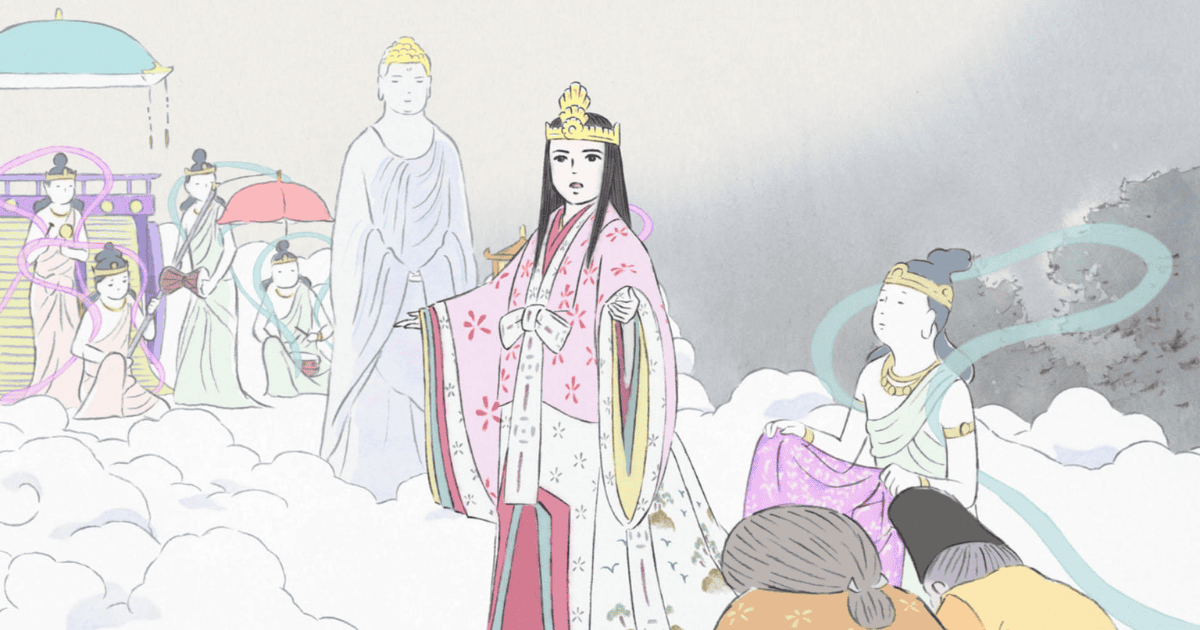
Near the end of The Tale of the Princess Kaguya, strange, mysterious music accompanies the Moon’s inhabitants as they arrive. The piece is “The Procession of Celestial Beings.” I remember feeling overwhelmed by something I could not name and weeping, without quite knowing why.
https://www.youtube.com/watch?v=OlV77t354t8, in Japanese
In Isao Takahata, Making ‘The Tale of the Princess Kaguya’, Takahata gives Hisaishi this description:
“As for the music, what I definitely want you to keep in the back of your mind is… [omitted: a mention of director Kon Ichikawa’s ‘Princess from the Moon’]… For our version, I thought of the ‘Amida Raigo Zu’ (Descent of Amida Buddha): Amida rides a cloud in the center, leading a whole band. (When Joe Hisaishi asks, “Is it heavenly music?”), It’s not heavenly music. Should I just say it? I’ll say it. It’s a band. Extremely carefree, with a rhythm, swaying their bodies ‘chaka-chaka’ as they come down. Pure music, you know, how should I put it, having no worries and being pure is kind of weird, isn’t it? I think the word ‘carefree’ fits perfectly, but musically speaking, it’s like a failed Indian musical. It’s like some kind of stupid music. (Joe Hisaishi replies, “Ah, yes, what was that movie again?”), ‘Muthu (The Dancing Maharaja).’ Something like that, or, um, samba, you know, from Brazil, that kind of thing has that sort of element too, doesn’t it? Their heads are completely empty, and the music goes ‘chaka-chaka,’ but you can bring out pathos (sorrow) sometimes if you want to. That kind of… yeah, that kind of ‘chaka-chaka’ fading in while riding on a cloud. Nobody is expecting it, after all.”
(Original Text, in Japanese)
「音楽も 頭の隅にぜひ置いて頂きたいのは ・・・中略(市川崑監督の「竹取物語」についての言及)・・・ それに対してこっちは これをやる場合 思ったんだけど 「阿弥陀来迎図」って 雲に乗って阿弥陀さんが真ん中にいて みんな楽隊を引き連れているんですよ (これに対して久石譲さんが「天の音楽ですか」と聞くと) 天の音楽じゃないです 言っちゃおうかな 言います 楽隊なんです 極めて能天気で リズムがある チャカチャカ体を揺すって 降りてくる感じで 清浄な音楽ってね なんていうかな 悩みがなくて清らかで なんか変じゃないですか 能天気っていう言葉がぴったりだと思うけど 音楽的なイメージで言うと インドのミュージカルの出来損ないみたいな なんかアホみたいな音楽ですね (久石譲が「ありますね 何だっけあの映画」と返して) 「踊るマハラジャ」 ああいうやつとか それからあの えっとサンバですね ブラジルの ああいうのも そういう所あるんじゃないですか 頭がパーッとすっ飛んじゃってね チャカチャカなってるんだけど 時々ペーソス(哀愁)を出そうと思えば出せる そういう ああいう チャカチャカ雲に乗ってね フェードインしてくる 誰も期待してないですから 」
There must have been other discussions before the piece was finished. Still, I marvel that such music came from a brief invoking Muthu, carefree idiocy, and samba. On reflection, it also seems to fulfill that brief remarkably well.
In any case, a piece unlike any other was born.
- Isao Takahata, Making ‘The Tale of The Princess Kaguya’ (高畑勲、『かぐや姫の物語』をつくる。)
The Mikado Was Meant to Have the Most Beautiful Face
Of the designs in The Tale of the Princess Kaguya, perhaps none caught our attention quite like the Mikado’s.

In The Art of The Tale of the Princess Kaguya, character designer Osamu Tanabe describes it this way:
I wanted to give him the most beautiful face, and at one point considered using a character I had drawn as Prince Ishitsukuri for the Mikado. While I was struggling with it, Takahata said, “He’s handsome, but why not throw the balance off in one place—say, the chin?” That is how we arrived at this design.
(Original Text, in Japanese)
最もきれいな顔にしたくて、一時は石作皇子として描いたキャラを御門にしようかとも考えたのですが、悩んでいたところ、高畑さんが「美男だけど一ヶ所バランスを崩してみたらどうか、たとえばアゴとか」と言われ、このように決まりました。
Without that one suggestion, the Mikado could have had the most beautiful face. Instead, he did not. What can one call it but malice? I consider the chin in more detail in the article below:
The images used in this article are from Studio Ghibli Works Stills, in Japanese.
[pochipp id=”11583″]Can you name the movie before the scene comes into focus?
Put your visual memory to the test with a blurred Studio Ghibli scene.
Reader Comments