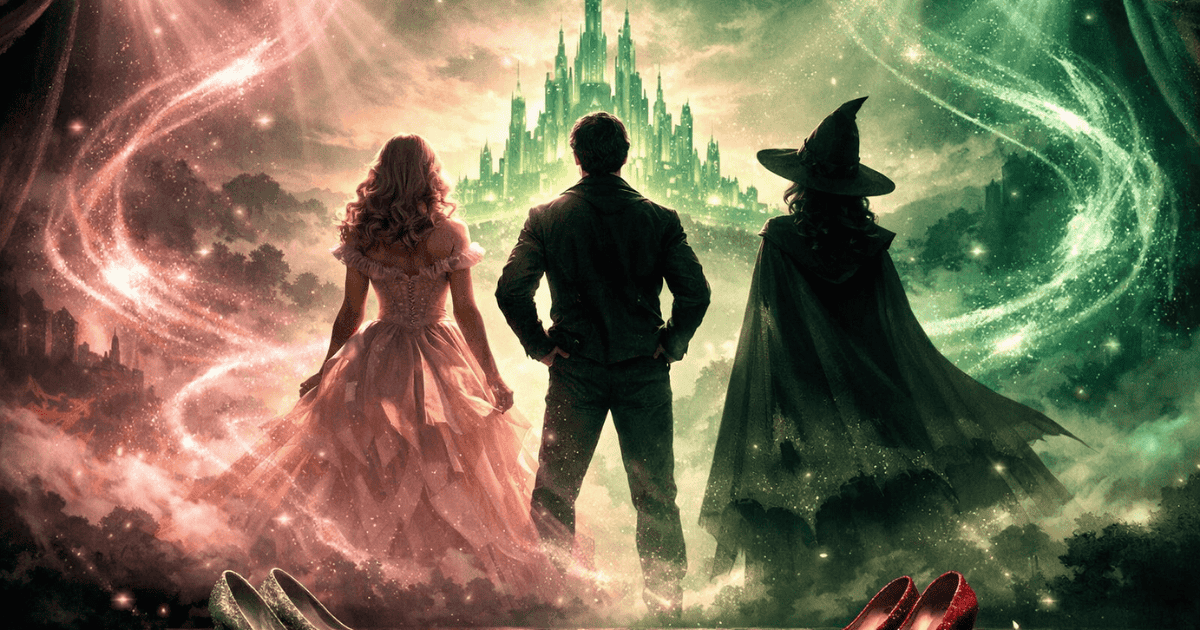
Wicked: For Good (2025) is more than a sequel about thwarted love or a prequel filling in the background to The Wizard of Oz. Through Glinda, Fiyero, and Elphaba’s real desires, and the wickedness that arises from lying to themselves, I think it asks what it means to live as a human being.
Beginning with the poignancy of Glinda’s love, I will consider Fiyero’s betrayal and the unstable foundations of Elphaba’s justice, exploring the meaning of the title Wicked. I will also examine questions connecting it to The Wizard of Oz: the ruby slippers, the witch who melts in water, and how Dorothy gets home.
This analysis makes no attempt to avoid spoilers. If you have not seen the film, proceed with caution.
*This is a translated version. The original (Japanese) is available here.
- What the “Giver” Really Wanted
Glinda has always tried to be good by giving to others. But Fiyero is someone she wants for herself. Her unfulfilled love hurts her, yet that loss makes her recognizably human. - Wickedness as Lying to Oneself
Glinda hides her wish to have something; Fiyero hides his wish for freedom; Elphaba hides her desire to destroy the world. I read their tragedies and conflicts as arising from those concealed desires. - Wickedness as Part of Being Human
Glinda’s hostility, Fiyero’s broken engagement, and Elphaba’s self-deception are hardly admirable. Yet they reveal conflict and desire, making the characters more human. I see the film as affirming life with wickedness, rather than life through goodness alone. - Acknowledging Wickedness and Living On
For me, this is more than a call to live freely. People live with lies, self-deception, and destructive impulses. Acknowledging these while making our own choices is what it means to live as human beings.
On this pageContents
Reading Wicked: For Good
What Glinda Wanted: Something of Her Own
Something about Glinda’s first-film story (Our synopsis and analysis) had already felt slightly incongruous to me: her feelings for Fiyero.
They could have seemed superficial: dating a prince would make her life more dazzling. Yet Wicked: For Good shows her deeply grieving his loss.
That can be read as evidence that her love was real. But against the goodness the first film repeatedly attributes to her, it also takes on another meaning.
Glinda is consistently depicted as a giver, embodying the arrogance that can accompany giving. Even so, she tries earnestly to give.
There are two things she wants to receive: individual instruction from Madame Morrible, and Fiyero. But there is a crucial difference between them.
Magic as a Way to Meet Expectations
The film includes a scene from Glinda’s childhood. Given a magic wand, she tries to meet everyone’s expectations by performing magic, but fails. When a rainbow happens to appear, she insists that she conjured it.
For her, then, magic seems less an inward desire than a way of meeting expectations: another kind of giving.
I think that explains why learning the truth about Morrible does not leave her utterly despondent. Magic was not something she wanted so intensely.
Fiyero, Apart from the Value of Giving
While magic and Morrible’s instruction were not what she truly wanted, Fiyero seems to be her real desire. She wants to have something. Not to give it away.
The giving that seemed slightly arrogant in the first film now looks earnest and painful to watch. She is continually required to be the good person, and keeps playing that part.
It is terribly poignant that her love goes unreturned.
What interests me about Wicked: For Good is that this unfulfilled love makes Glinda more human, bringing the film’s themes into focus.
Acknowledging Our Own Wickedness—and Living On
What might Wicked be trying to depict? I want to revisit the wickedness of Glinda, Fiyero, and Elphaba, looking for what they have in common.
Glinda’s Wicked Hostility toward Elphaba
Glinda is so focused on giving in the first film that she can seem a little inhuman. Yet she becomes wonderfully human when she gives Elphaba that unfashionable witch’s hat.
It is a glimpse of wickedness from someone trying to be good. Watching her scheme, though, makes her feel human—perhaps even more approachable.
In Wicked: For Good, too, don’t we feel her humanity when she gets into a physical fight with Elphaba?
Hostility toward others is normally classified as an undesirable emotion: something wicked. Yet hostility toward Elphaba gives Glinda humanity.
Fiyero’s Wickedness in Breaking the Engagement
Wicked: For Good brings the first film’s romantic entanglement to a resolution of sorts. Fiyero chooses Elphaba over Glinda.
His wickedness is not simply choosing to leave Glinda. It is letting matters drift until he betrays her at the point where a broken engagement—more directly, fleeing the wedding—becomes his only option.
Yet, as with Glinda, that wickedness brings out his humanity. In the first film, he is an empty, thoroughly frivolous man. He has stopped thinking about conflict or worry and lives entirely for the moment.
As conflict and worry arise, what he really wants becomes clear. That, in turn, leads him to act wickedly.
His conduct is hardly praiseworthy. Glinda’s way of announcing the marriage is wicked too, but so is his continuing the relationship until it reaches that point.
But such wickedness is part of being human.
Perhaps he looks so alive after acting wickedly because he has finally acted to get what he really wants.
I imagine being a prince has cost him a great deal of freedom. From outside, he looks like a pampered upper-class boy; in reality, he is a cog that keeps his country going. I read his repeated transfers and his leading the students at Shiz as reactions against that position, driven by something closer to resignation.
Seemingly carefree, he has given up on freedom and even stopped thinking about it. No wonder the wicked act of resisting his circumstances and choosing Elphaba makes him come alive.
Elphaba’s Hidden Wickedness
Glinda and Fiyero seem extreme or somehow out of balance from their first appearances. Elphaba, by contrast, seems remarkably balanced in Part 1, despite being persecuted.
She is also the only character who consciously recognizes the Animals’ mistreatment and expresses anger at it.
In Wicked: For Good, she tries to expose the truth about the Wizard and change things. It seems a thoroughly good way to live. Yet I read her song in the old castle Fiyero shows her as revealing that very life to be her wickedness.
When she first met the Wizard, she wanted the Animals’ mistreatment to end. In this reading, that was self-deception—a great lie.
For Elphaba, this was a world to hate and change from the start, even without the persecution of the Animals.
Yet she concealed that hatred and continued trying to live well. The important point is that her wickedness is not the hidden hatred itself. It is that she wanted to change or destroy the world herself, but used the Animals as her reason.
Here, I think, their forms of wickedness begin to resemble one another.
Lying to Themselves about What They Want
Their common wickedness may be lying to themselves about their own desires. I think the film eventually reaches a happy ending, but everything along the way stems from these lies.
Glinda wanted to have something, Fiyero wanted freedom, and Elphaba wanted to destroy the world. Things went as they did because they hid those desires, lied even to themselves, and lived as though they had never wanted them.
Does that make the message “Live freely!”? There would be nothing wrong with that, but it seems a little dull and familiar.
Glinda’s way of living offers a clue to another message.
Recognize Your Wickedness, and Live On
By the end, Glinda no longer equates simply giving something with being good. For Oz’s future, she conceals the truth and lets the Wizard depart under false pretenses.
Elphaba, too, never denies being the Wicked Witch of the West. If the message were merely “Live freely,” Glinda would have to reveal everything at the end. There never was a Wicked Witch in that sense.
I think the message is this: recognize your own wickedness, and live on anyway.
The film does not seem to condemn the wickedness that unfortunately drives it along. Glinda’s final appearance makes that clear to me. The wickedness these three show may even be necessary to keep living. People:
- Try to find a place for themselves by showing goodness through giving,
- Sometimes empty their heads and accept things as they are,
- And lie by claiming that their own destructive urges are for someone else’s benefit.
Deny all that and say only “Live freely,” and one person’s freedom will simply collide with another’s.
Instead, it may be better to think:
- When giving, “I really want someone to give to me, but I’m giving as a way to survive.”
- When emptying your head, “I really want freedom, but right now I’m playing the fool.”
- When passing off a destructive urge as someone else’s need, “Really, I’m the one who wants to break things.”
We can only keep doing our best to live this way. There may still be lies and conflict. But if we recognize our wickedness, perhaps a genuine sense of self can emerge. At the end, Glinda is neither merely adapting to events nor being tossed about by them. She makes her choices in her own way.
In the first film, the title Wicked seemed to judge the crowd and those leading it. The sequel turns that around: wickedness is a quality the protagonists themselves possess.
That seems a rather impressive achievement.
Sorry, there are no polls available at the moment.An Aside: Strategic Glinda and Impulsive Elphaba
I want to consider something about Elphaba’s behavior that may trouble some viewers. In this film, she can seem a little too impulsive.
Early on, she makes a deal with the Wizard, but merely seeing a caged Animal makes her break it and leave the people at the center of the problem.
Glinda, meanwhile, has chosen to stay close to the person behind it all since the first film. That choice enables her to threaten the Wizard and Morrible at the end. She seems to be acting more strategically.
Watching Glinda, it becomes hard not to think Elphaba had other options. Her impulsiveness can then look like a convenient device to push the plot forward, which may cool our enthusiasm.
But perhaps she is impulsive because she has not recognized her own wickedness. She cannot calmly improve things step by step because she is hiding her personal urge to destroy. Unless she loses herself in anger over the Animals’ plight, she risks losing sight of the justice behind her actions. Read that way, her behavior would be consistent with the film’s story.
An Aside: Why Does Elphaba Stop Fighting?
Near the end, a winged monkey soldier hands Elphaba part of Fiyero’s clothing—he is now the straw Scarecrow—and she decides to stop fighting.
Perhaps we should read this less as giving up the fight than as realizing Fiyero has survived and putting her hopes in his coming to find her.
By then, on my reading, she has escaped the self-deceiving lie that she acts only for the Animals. Her actions are now for herself. If Fiyero has a way to escape, she can stop fighting.
Might that explain her abrupt change of attitude?
The Wizard of Oz: Answers and the Remaining Dorothy Question
Here I want to consider the questions about the 1939 The Wizard of Oz that Wicked: For Good addresses. I thought it found some clever answers.
If you need a quick refresher on the original film’s ending to fully appreciate these connections, be sure to check out our complete synopsis of The Wizard of Oz.
The Obsession with the Ruby Slippers
The Wicked Witch of the West’s obsession with the ruby slippers is a puzzle in the 1939 film. Here, as in the original novel, they are silver shoes. Their magic presumably matters, but the reason for that obsession has never been clear to me.
In Wicked, the answer is wonderfully clear: they are a keepsake of her sister.
In the original film, I had thought of the Witch as simply wicked, so it never occurred to me that she wanted a keepsake of her sister. Yet that is a perfectly natural possibility. It is a small point, but one I thought Wicked handled cleverly.
The Witch Who Melts in Water
The biggest puzzle in The Wizard of Oz is that the Wicked Witch melts when water is thrown over her. We can accept it as a fairy tale, but the moment I think “Surely she drinks water too,” it begins to feel absurd. At least give us some preparation for it.
Wicked resolves it by making the melting a fake. It still feels a little convenient, but here is how I understand the sequence:
- Fiyero’s spontaneous “Bring water!” to help Elphaba escape acquires embellishments, becoming a rumor that water is the Witch’s weakness. He is arrested and then turned into a straw Scarecrow, leaving no way to check the claim with him.
- The public and Dorothy throw water at Elphaba on the strength of that rumor.
- Elphaba takes advantage of it.
There may be another official explanation, but this reading gives the events a reasonable consistency.
How Does Dorothy Get Home?
Wicked answers questions many of us may have had about the 1939 movie. Yet right at the end, it seems to leave a small new one.
How exactly did Dorothy get back to Kansas?
In the classic film, Glinda instructs Dorothy to tap her heels and chant, “There is no place like home.” She wakes up in bed, implying the entire adventure was just a “dream ending.”
But Wicked takes Oz’s existence as its premise, so a dream ending will not do. It seems natural to think of Kansas and Oz as connected worlds—or, at least, as both real.
Then how does she get home?
We can only speculate. Near the end, the Grimmerie opens by itself. Might the magic it offers have allowed Dorothy to return?
If the ending means that Glinda can finally use magic, perhaps that magic also sends Dorothy home. It is only a guess, of course.
Those are my thoughts on Wicked: For Good. Like Maleficent, it retells an old story from the other side, giving it a modern plausibility.
I rather liked Maleficent for its clever construction. I like the Wicked series for a similar reason: it finds explanations for an old story’s convenient devices and builds a new version around them.
What kind of film was Wicked: For Good for you?


Reader Comments