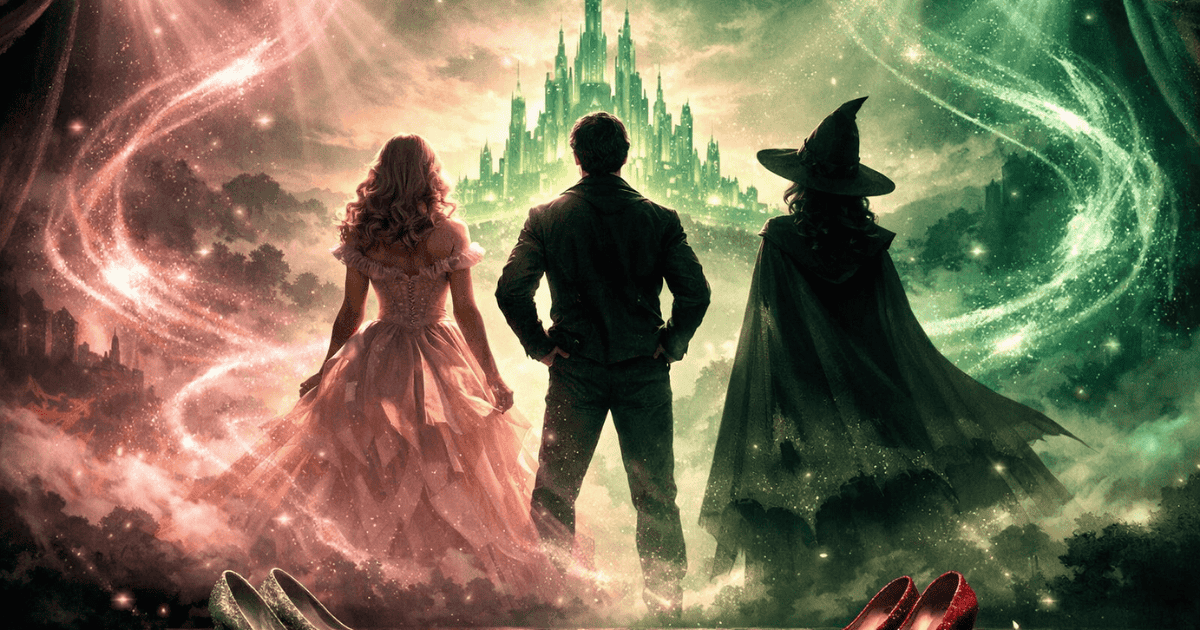
What if the villain you’ve been taught to fear was actually the victim of a systemic smear campaign? Jon M. Chu’s Wicked (2024) masterfully flips the script on one of cinema’s most beloved fairy tales. Long before Dorothy’s house dropped from the sky, a vastly different drama unfolded in the Land of Oz. This hidden history chronicles the tragic rise of Elphaba, the misunderstood “Wicked Witch of the West,” and her complex relationship with Glinda, the so-called “Good Witch of the North.” While the film builds on the foundational lore of L. Frank Baum’s 1900 classic The Wonderful Wizard of Oz and Victor Fleming’s iconic 1939 film adaptation, it dares to ask: who really gets to decide what is “wicked”?
Since this cinematic journey essentially serves as a prequel to the classic The Wizard of Oz, let’s quickly refresh our memory of the original plot:
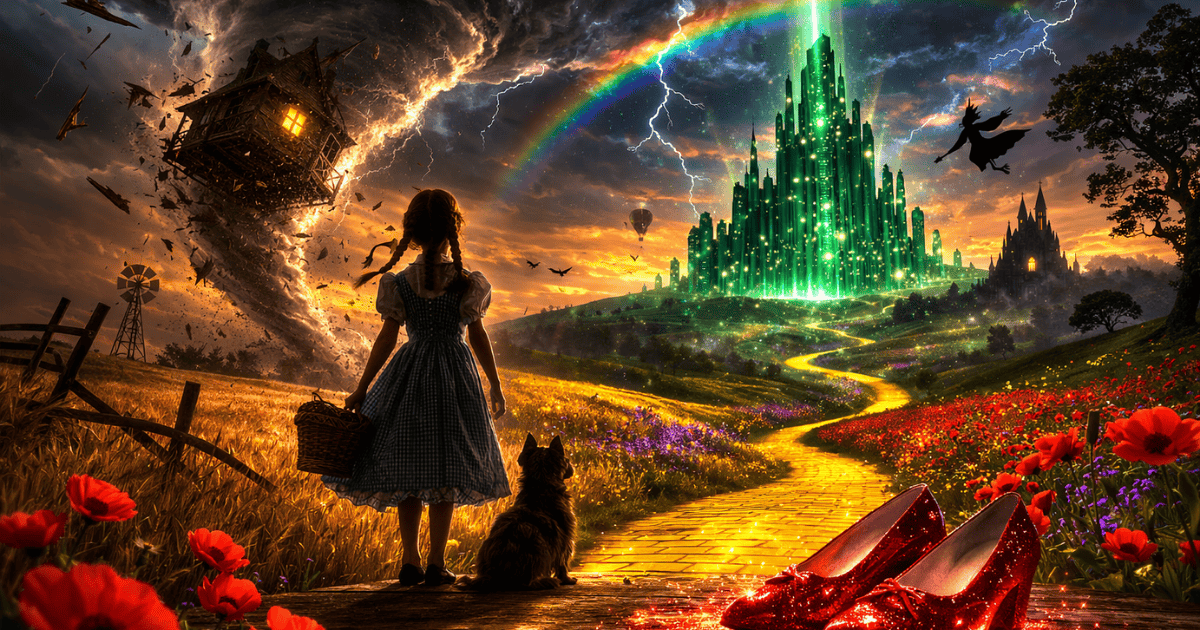
Torn from her home by a massive tornado, a young girl named Dorothy lands in the magical realm of Oz. Desperate to return to Kansas, she sets off down the Yellow Brick Road toward the Emerald City. Along the way, she befriends a Scarecrow longing for a brain, a Tin Woodman searching for a heart, and a Cowardly Lion seeking courage. Together, they petition the Great Wizard, who demands they defeat the Wicked Witch of the West in exchange for his help. After a perilous adventure and the witch’s ultimate defeat, the companions earn their rewards, and Dorothy finally finds her way home.
(For a deeper dive into the original lore and the psychology behind it, check out our comprehensive analysis: The Wizard of Oz: Synopsis (Spoilers) and Analysis – The “Salvation” and “Curse” Brought by the “Magic of Words”).
On the surface, Wicked is a magical school fantasy where two polar opposites clash before forming an unbreakable bond. But dig a little deeper, and it reveals itself as a multi-layered psychological critique. It exposes the unconscious arrogance of the privileged “giver” and the terrifying speed at which society unites when handed a “common enemy.”
In this article, I will walk you through the full synopsis of Wicked while unpacking the story’s core mysteries: Why did Galinda’s attitude suddenly shift? What caused the student body to turn? And crucially, why did the deadly “poppy magic” fail to affect Fiyero? But first, let’s lay out the groundwork.
*This is a translated version. The original (Japanese) is available here.
On this pageContents
Wicked (2024) Essential Movie Facts
Film Overview
| Release Date | November 22, 2024 |
|---|---|
| Director | Jon M. Chu |
| Music | Stephen Schwartz |
| Original Work | Gregory Maguire (Wicked) |
| Production | Marc Platt Productions, Universal Pictures |
| Running Time | 160 minutes |
Main Cast Roster
| Character | Actor | Character Overview |
|---|---|---|
| Elphaba | Cynthia Erivo | The illegitimate daughter of the Munchkinland Governor’s wife. Born with emerald-green skin and raw magical talent, she is destined to become the “Wicked Witch of the West.” |
| Galinda (Glinda) | Ariana Grande | A popular, privileged student at Shiz University. Universally adored as a “good person,” she eventually becomes the “Good Witch of the North.” |
| Madame Morrible | Michelle Yeoh | The authoritative Dean of Sorcery at Shiz University. She recognizes Elphaba’s untapped potential and takes her under her wing. |
| Fiyero Tigelaar | Jonathan Bailey | A rebellious Winkie prince who transfers to Shiz after a string of expulsions from the Royal Academy. |
| The Wonderful Wizard of Oz | Jeff Goldblum | The enigmatic ruler of the Emerald City. |
| Nessarose | Marissa Bode | Elphaba’s paraplegic younger sister. Confined to a wheelchair, she is fiercely overprotected by their father. |
| Doctor Dillamond | Peter Dinklage (Voice) | A brilliant history professor at Shiz University who happens to be a sentient, talking Goat. |
| Boq | Ethan Slater | A lovestruck Munchkin student who harbors a massive crush on Galinda. |
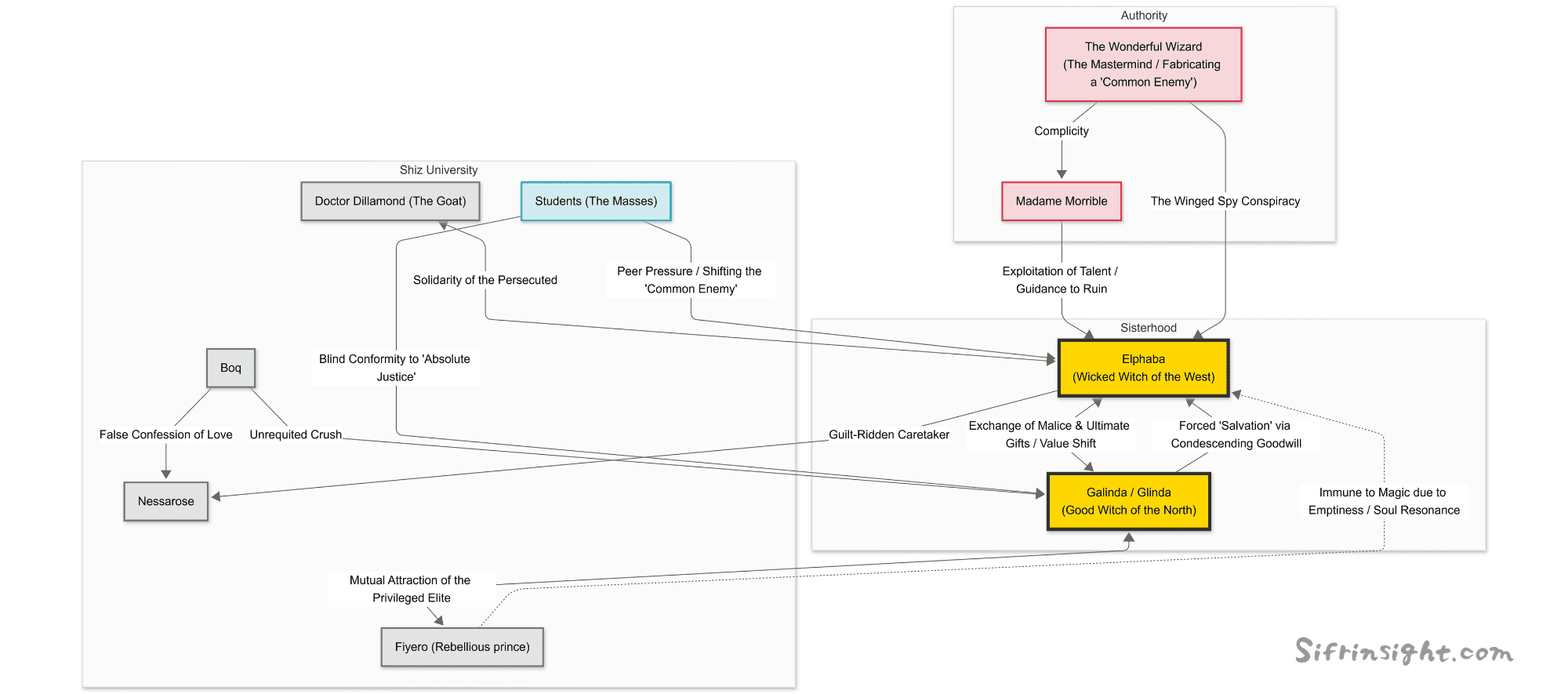
Character Relationship Map
Wicked (2024) Story Setup (Spoiler-Free)
The film opens with a massive celebration in Munchkinland. Glinda, the Good Witch of the North, floats down in her mechanical bubble to confirm the glorious news: the Wicked Witch of the West is finally dead. Amidst the cheering crowds, an innocent child asks a profound question: “Why does wickedness happen?” This prompts Glinda to peel back the curtain and tell the true story of the woman the world knew as a monster.
We flash back to discover that the “Wicked” Witch’s real name was Elphaba. Born out of an affair between the Munchkinland Governor’s wife and a mysterious stranger, Elphaba entered the world with startling green skin and uncontrollable magical abilities. Horrified, her aristocratic parents rejected her, leaving her to be raised by a bear nursemaid. When her younger sister Nessarose was born with a severe disability, their father channeled all his affection into the younger sibling. Alienated by her family and her emerald complexion, Elphaba endured a deeply lonely childhood, relentlessly bullied by her peers.
Years later, a resentful Elphaba is tasked by her father with escorting Nessarose to Shiz University. It is here that Elphaba crosses paths with Galinda, a bubbly, hyper-popular student who will eventually become Glinda the Good. Dripping with condescension, Galinda views Elphaba’s green skin as a tragic “problem” and benevolently offers to fix her out of sheer pity. While the rest of the student body fawns over Galinda’s “kindness,” Elphaba bristles, firing back with biting sarcasm—a reaction that utterly bewilders Galinda and offends her sycophants.
Tensions boil over when the domineering dorm matron attempts to separate the sisters. Desperate to keep her promise to her father to protect Nessarose, Elphaba’s emotions surge, triggering a massive shockwave of untamed magic that tears through the courtyard. While a disappointed Nessarose sighs at yet another magical outburst, Madame Morrible—the formidable Dean of Sorcery—sees gold. Captivated by Elphaba’s raw power, Morrible offers her exclusive private tutoring, hinting that mastering her abilities could earn her a place by the Wonderful Wizard’s side. For the first time, Elphaba feels a spark of hope. But lurking in the shadows of her new academic life is a chilling political conspiracy: a systemic campaign of discrimination against Oz’s talking Animals.
Wicked (2024) Full Plot Breakdown (Spoilers Ahead)
(*Warning: Stop reading here if you want to go in blind. The following section contains major plot spoilers, including the film’s climax and ending.)
Act I: The Bitter Collision at Shiz University
The narrative kicks off with the death of the Wicked Witch of the West. As Munchkinland rejoices, Glinda the Good Witch addresses the crowd. When asked the origin of wickedness, she recounts the tragedy of Elphaba.
Born to the Governor’s wife after a secretive affair, Elphaba was an outcast from day one. Her bright green skin and latent magical talents terrified her aristocratic parents, who discarded her to the care of a bear nursemaid. The arrival of her disabled sister, Nessarose, only widened the gap; their father idolized Nessa while entirely ignoring Elphaba. Stripped of love and mocked by her peers, Elphaba’s early life was a masterclass in isolation.
When Nessarose is accepted into the prestigious Shiz University, Elphaba is sent along purely as a caretaker. Upon arrival, she immediately clashes with Galinda Upland. Galinda, the undisputed queen bee of Shiz, is aghast at Elphaba’s appearance. Assuming a savior complex, she offers to help Elphaba cure her “green problem.” Instead of gratitude, Elphaba delivers a sharp, sarcastic rebuke. This outright rejection of Galinda’s “goodness” shocks the entire student body and instantly makes Elphaba a social pariah.
The friction escalates when the dorm matron aggressively tries to take over Nessarose’s care. Panicking, Elphaba unleashes a violent, telekinetic blast of magic, destroying the surrounding courtyard. While Nessarose is humiliated, Madame Morrible, the Dean of Sorcery, is mesmerized. She aggressively recruits Elphaba for private seminars, promising that the “Wonderful Wizard” himself is always looking for such immense talent.
Through a comical administrative error orchestrated by Morrible, Elphaba and Galinda are forced to share a dorm room. The living situation is a nightmare of mutual disgust, with the entire student body firmly siding with the glamorous Galinda against the “freakish” Elphaba.
Act II: The Animal Purge and an Unlikely Sisterhood
Beyond the petty dorm squabbles, a darker reality is brewing. During a history lecture, the students find a hateful slur scrawled on the chalkboard: “ANIMALS SHOULD BE SEEN AND NOT HEARD.” Their professor, Doctor Dillamond (a sentient Goat), is deeply shaken. Oz is suffering from a massive drought, and the fearful public has begun scapegoating the sentient Animal population.
One evening, Elphaba secretly follows Doctor Dillamond to a clandestine Animal resistance meeting. The truth is horrifying: Animals are being systematically stripped of their careers, their rights, and in some cases, their literal ability to speak.
Amidst this rising fascist tension, Shiz gets a new distraction: Fiyero Tigelaar. A wealthy Winkie prince who has been expelled from multiple academies, Fiyero swaggers onto campus, aggressively rejecting academic rigor. He immediately hijacks the student body’s attention, leading them to an illicit party at the “Ozdust Ballroom.”
In the chaotic build-up to the dance, Boq—a Munchkin desperate for Galinda’s attention—is manipulated by her into taking Nessarose instead. Nessarose, oblivious to the ruse, is ecstatic and credits Galinda for the best night of her life. Wanting to repay Galinda for her sister’s happiness, Elphaba issues an ultimatum to Morrible: include Galinda in the exclusive sorcery seminars, or Elphaba quits. Meanwhile, a malicious Galinda gifts Elphaba a hideous, pointed black witch’s hat to wear to the ballroom, purely to humiliate her.
At the Ozdust Ballroom, the cruelty peaks. Boq, realizing Galinda is busy kissing Fiyero, decides to spare Nessarose’s feelings and lies, telling her he invited her simply because she is beautiful. Just as Morrible arrives to announce Galinda’s inclusion in the sorcery track—crediting Elphaba for the favor—Elphaba walks in wearing the ugly black hat. The room erupts in mocking laughter. Defiant, Elphaba begins to dance alone in silence.
Struck by a sudden wave of guilt after realizing Elphaba had just handed her her greatest dream, Galinda steps onto the dance floor. She joins Elphaba in her awkward dance. Because Galinda commands the social hierarchy, the rest of the school immediately follows suit, validating their newfound alliance.
Later that night in their dorm, the two finally connect. Elphaba confesses her darkest secret: she blames herself for Nessarose’s disability. Terrified of having another green child, their father forced their pregnant mother to chew poisonous “milkflowers.” The toxins induced premature labor, leaving Nessa paralyzed and killing their mother. Elphaba has carried this immense guilt her entire life.
Moved by her trauma, Galinda renames her “Elphie” and gives her a spirited, albeit superficial, makeover. This singular act of friendship completely alters the student body’s perception, bringing Elphaba into the social fold.
Act III: The Train Ride to a Web of Lies
The brief period of peace is shattered when authorities forcefully drag Doctor Dillamond out of his classroom. His replacement introduces a terrifying new curriculum: keeping Animals in cages. He presents a terrified lion cub trapped in a box, claiming this subjugation is for the “greater good.” Enraged by this blatant cruelty, Elphaba’s magic erupts unconsciously, casting a sweeping “poppy spell” that puts the entire class to sleep.
Mysteriously, the spell does not affect Fiyero. Together, he and Elphaba steal the lion cub and release it into the wild. During their escape, an undeniable romantic tension flares between them. Elphaba, acutely aware that Fiyero is Galinda’s boyfriend, violently represses her feelings.
Amidst the chaos, Morrible delivers incredible news: the Emerald City has summoned Elphaba. The Wonderful Wizard wants to meet her. At the train station, a tearful Galinda comes to say goodbye. When Fiyero shows up, deeply changed by the lion cub rescue and clearly harboring feelings for Elphaba, Galinda senses she is losing him.
Desperate to reclaim control of the narrative, Galinda dramatically announces to the crowd that she is changing her name to “Glinda.” She claims this is an act of solidarity with the ousted Doctor Dillamond, who always mispronounced her name as “Glinda” due to his Goat accent. Seeing her friend spiral, Elphaba extends her hand, and Glinda jumps onto the moving train. Together, they head to the Emerald City.
The Climax: The Wizard’s Deception and the Ultimate Betrayal
Upon arriving in the dazzling Emerald City, the duo learns the mythology of the Wizard. According to legend, a massive, unreadable spellbook called the “Grimmerie” awaited a prophesied savior. When a man floated down from the sky in a hot air balloon and successfully “read” a word from it, he was crowned the Wonderful Wizard.
Inside the palace, Elphaba and Glinda are confronted by a terrifying, giant mechanical head. But when Elphaba stands her ground, the illusion drops. Out steps an ordinary, entirely non-magical man. He is the Wizard. Elphaba, refusing personal glory, begs him to use his power to save the Animals.
At that moment, Morrible enters with the legendary Grimmerie. Elphaba approaches the ancient text and, to everyone’s shock, reads it fluently. The Wizard introduces his servant, a winged monkey named Chistery, and laments that the creature wishes it could fly. Eager to help, Elphaba chants a levitation spell from the Grimmerie. Agonizingly, wings violently sprout from Chistery’s back.
To her horror, the spell rips through the palace, forcibly grafting wings onto all the monkey guards. Elphaba frantically tries to reverse it, but Morrible coldly informs her that spells from the Grimmerie are permanent. The Wizard and Morrible drop their facade, gleefully declaring that they now have an army of flying spies.
The crushing truth drops: The “Wonderful Wizard” is the fascist architect behind the Animal purge. He orchestrated the crisis to consolidate his power. Furthermore, Morrible only recruited Elphaba because the Wizard—who is entirely devoid of magic and cannot read the Grimmerie—needed a powerful pawn to cast the spells he couldn’t.
The Wizard explains the dark reality of governance: to unite a fractured populace, you must give them a common enemy. Realizing she has been weaponized, Elphaba grabs the Grimmerie and makes a break for it. Glinda chases after her, pleading with Elphaba to just apologize and play along so they can secure their high-status futures. Elphaba absolutely refuses to compromise her morals.
Morrible takes to the magical amplification system, broadcasting a vicious lie to all of Oz. She brands Elphaba a “wicked witch” who assaulted the Wizard and violently mutilated the monkeys.
Cornered by the guards, Elphaba refuses to surrender. She modifies the levitation spell, enchanting a simple broomstick. She begs Glinda to fly away with her and fight the system. Glinda hesitates, choosing the safety of the institution, and is detained by the guards. Alone, misunderstood, and framed as a terrorist, Elphaba shatters the glass and rockets into the western sky. Thus, the regime gets its perfect scapegoat: The Wicked Witch of the West.
Wicked (2024) Deep Analysis: Unpacking the Psychology of Oz
- The “Savior Complex” of Glinda
From day one, Galinda diagnoses Elphaba’s skin as a “problem” that she, the benevolent elite, must solve. She turns hostile simply because Elphaba rejects her condescending charity. - A Value Shift Triggered by Malice
Galinda intentionally humiliated Elphaba with the witch’s hat, an act of pure malice. In return, Elphaba gifted Galinda her greatest desire (Morrible’s tutelage). This jarring hypocrisy forces Galinda to confront her own internal “wickedness.” - The Anatomy of a Scapegoat
The student body’s hatred follows a clear fascist trajectory: physical disgust (green skin) → ideological enemy (clashing with the elite Galinda) → shifting the target when the anti-establishment Fiyero arrives → immediate blind conformity when Galinda finally accepts Elphaba. - The Hollow Prince and the Poppy Field
Fiyero wasn’t immune to the sleeping spell because of true love. He was immune because he had intentionally hollowed himself out to survive high society—rendering himself literally brainless (the Scarecrow) and heartless (the Tin Man).
The “Good Giver” Complex: Why Galinda’s Worldview Shattered
One of the most fascinating psychological arcs in the film is Galinda’s (Glinda’s) sudden pivot regarding Elphaba. Throughout the first act, she is framed as an aggressive “giver.”
Galinda looks at Elphaba’s green skin and immediately categorizes her as a charity case. Her hostility isn’t born of traditional bullying, but rather the shock of having her “benevolence” rejected. As someone positioned at the top of the social hierarchy, she has likely never been told “no.” Her arrogance is wrapped in genuine, albeit suffocating, goodwill.
So, what actually breaks her worldview? Two specific events collide.
First, Galinda gifts Elphaba the ugly, pointed hat. Unlike her previous charity, this was a calculated act of psychological warfare meant to humiliate. It was a purely “wicked” action.
Second, almost immediately after committing this cruel act, she discovers that Elphaba has selflessly secured her a spot in Morrible’s seminar. Galinda receives the ultimate, life-changing gift from the exact person she just tried to destroy. This cognitive dissonance is violent enough to shatter her reality.
Simply put, Elphaba’s genuine grace forces Galinda to look in the mirror and recognize the profound “wickedness” hiding behind her own bubbly facade.
Mass Psychology and the Need for a Scapegoat: Shifting Loyalties at Shiz
The student body’s volatile relationship with Elphaba serves as a terrifying microcosm for the film’s central theme: the manufacturing of a “common enemy.”
Initially, the students reject Elphaba based on xenophobic instinct—she is green and different. But her status is elevated to a legitimate “enemy of the state” because she dares to oppose Galinda, the embodiment of their societal ideals.
However, notice how quickly their loyalties shift. When Fiyero arrives and actively disrupts the academic ecosystem, the students smoothly pivot their resentment from the individual (Elphaba) to the institution (the school system itself).
Furthermore, the second Galinda validates Elphaba by dancing with her, the entire student body instantly falls in line. The film argues that the “morality” of the masses is entirely hollow, easily rewritten by whoever holds social capital.
This high-school dynamic perfectly foreshadows the terrifying climax: the exact same mechanism the Wizard uses to vilify the Animals is what he uses to brand Elphaba as the ultimate monster.
The Irony of the Poppy Field: Exposing the Empty Prince
Finally, we must examine the “poppy magic” scene—a moment easily misinterpreted as a cliché romantic trope. When Elphaba’s rage puts the entire lecture hall to sleep, why does Fiyero stay awake?
While the romantic reading suggests “the power of love protected him,” a closer look at The Wizard of Oz lore provides a much darker, more brilliant answer.
In the original 1939 film, when Dorothy’s crew walks through the deadly poppy field, the magic fails to affect the Scarecrow and the Tin Woodman. Why? Because they are non-biological entities; one lacks a brain, and the other lacks a heart.
In Wicked, Fiyero is flesh and blood. However, to survive the crushing expectations of his royal status and the stifling conformity of Oz, he has aggressively shut down his own mind. He intentionally gets expelled, refuses to care about politics, and avoids forming genuine attachments. He has psychologically lobotomized himself to cope with reality, effectively degrading into an empty vessel—a man without a brain (straw).
Simultaneously, by floating through life as a playboy without any real emotional investments, he functions as a man without a heart (tin).
Elphaba’s spell neutralized the students who were fully plugged into the fascist system. It had no effect on Fiyero because he had already hollowed himself out. It is a bleak, devastatingly ironic twist, but it perfectly explains the mechanics of the magic.
That wraps up my deep dive into Wicked. At its core, the film acts as the ultimate “official fan fiction,” brilliantly colliding the emotional sisterhood of Frozen with the dark, revisionist magic of Maleficent. It’s a formula that works flawlessly, and I absolutely loved it.
The absolute standout moment is, without a doubt, the breathtaking finale. Watching Elphaba finally take flight on her broom, propelled by that powerhouse of a vocal performance, is pure cinematic magic.
For lifelong fans of The Wizard of Oz, this ending leaves you begging to know how the rest of the puzzle pieces connect. You don’t have to wait to find out—we break down every shocking twist and hidden secret of the sequel in our full analysis of Wicked: For Good (Part Two).
Now that the Wicked cinematic saga has officially wrapped, I want to hear from you. How did this spectacular journey back to Oz make you feel? Drop your thoughts and theories in the comments!




Reader Comments