
Weathering With You (Official Website) is a spectacular feature-length animated film directed by Makoto Shinkai, released in 2019. Following the record-breaking, global phenomenon of his previous work, Your Name., this film was unleashed into theaters under the weight of astronomical expectations. Although it did not quite shatter the box office records set by Your Name., it was undeniably a massive commercial hit, grossing 14.1 billion yen (cementing Shinkai as the second director in Japanese history, after Hayao Miyazaki, to have two consecutive films exceed 10 billion yen).
Having already cemented myself as a massive “Makoto Shinkai fan,” I vividly remember rushing to the theater on opening day. The ending of this film sparked intense, polarizing debates across the internet, but what kind of story was it truly trying to tell?
In this article, I will provide a comprehensive, chronological synopsis of Weathering With You, followed by an in-depth analysis decoding three of the film’s most controversial mysteries. However, because I will be breaking down the entire plot, including the highly debated climax, those who wish to avoid major spoilers should stop halfway and watch the film first!
*This is a translated version. The original (Japanese) is available here.
- Detailed Synopsis and Character Map
To summarize the plot: “Runaway boy Hodaka meets ‘Sunshine Girl’ Hina in a constantly flooded Tokyo. They bring joy to the city with her power to clear the sky, but that magic demands a horrific physical toll. To save her life, Hodaka makes a devastating, selfish choice that permanently alters the world. Upon reuniting years later, the two fiercely declare, ‘We’re gonna be okay.'” Below, we provide a detailed plot breakdown and character correlation chart. - In-Depth Thematic Analysis
We decode the film’s deepest lore, including “The true, ancient role of the Weather Maiden,” “The psychological meaning behind ‘We’ll be okay’,” and “The symbolic weight of the scar on Hodaka’s cheek.” Dedicated deep-dive articles are linked for further reading.
On this pageContents
Weathering With You (2019): Full Synopsis (Spoilers Ahead)

A Quick Summary of the Plot
Here is a rapid breakdown of the key narrative beats in Weathering With You:
-
The Runaway Arrives in Tokyo
Sixteen-year-old Hodaka Morishima flees his suffocating island hometown, arriving in a perpetually rainy Tokyo with absolutely no money, shelter, or prospects. -
Meeting the “Sunshine Girl”
Starving on the streets, Hodaka is shown a moment of kindness by a McDonald’s employee named Hina Amano. He soon discovers she possesses a miraculous ability: she can temporarily clear the rain by praying to the sky. -
Working for Keisuke Suga
Desperate for survival, Hodaka is taken in by Keisuke Suga, a shady occult magazine editor. Hodaka secures room and board by acting as a live-in assistant and pseudo-journalist. -
The “Sunshine Girl” Business
Capitalizing on Hina’s divine power, the duo launches an underground business, offering to clear the sky for special events. Their service brings immense joy to the depressed citizens of Tokyo. -
The Price of Magic
As Tokyo endures historically relentless rain, Hina uses her powers continuously. However, a terrifying toll emerges: every time she clears the sky, her physical body slowly transforms into water. -
The Siblings in Crisis
Hina lives alone with her younger brother, Nagi, acting as the sole breadwinner after their mother’s death. Because they are minors living without a guardian, they become targets for Child Protective Services. -
The Fugitives
With the police actively hunting Hodaka as a runaway (and for illegally discharging a firearm), and child services closing in on Hina, the trio is forced to flee into the flooded streets of Tokyo. -
The Human Sacrifice
Ancient folklore dictates that the Weather Maiden is destined to act as a “human sacrifice,” fully surrendering her body to the sky to permanently restore the weather’s balance. Hina accepts her fate and vanishes. -
A Desperate, World-Altering Choice
Refusing to accept a world without Hina, Hodaka violently shakes off the adults trying to “protect” him. He breaches the sky realm and makes a terrifyingly selfish choice to save the girl over the stability of the climate. -
Reunion in a Drowned City
Because Hodaka pulled the sacrifice from the sky, the rain never stops. Three years later, much of Tokyo is permanently submerged underwater. Hodaka returns to the drowned city, reunites with Hina, and the film concludes on a fiercely unapologetic note.
Character Map
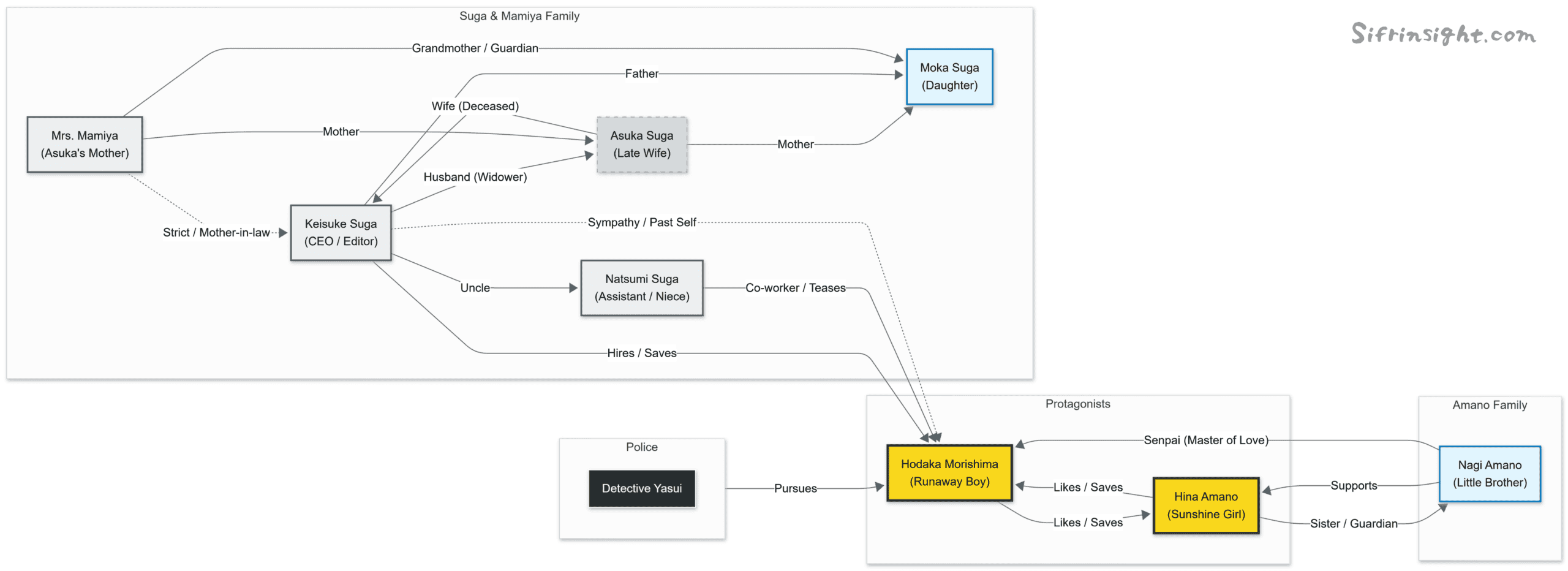
▼ Looking for English Voice Actor details and character profiles? Click Here:
Weathering With You: Main Characters and English Voice Cast
Detailed Synopsis & Ending (Spoilers Ahead)
Let’s dive into the detailed narrative of this boy-meets-girl tragedy set against a drowning Tokyo, exploring the controversial choice that permanently alters the world, and the shocking final scene that left audiences reeling.
Act I: The Runaway, the Drowned City, and the Sunshine Girl
The story opens with 16-year-old high school freshman Hodaka Morishima standing on the deck of a commercial ferry. He is covered in facial bandages, having run away from his suffocating island hometown to chase a beam of light toward Tokyo.
Suddenly, the sky turns violent. While other passengers flee inside, Hodaka recklessly runs toward the storm, reveling in a sudden rush of absolute freedom. However, a localized, localized deluge—more like a solid wall of water—smashes onto the deck. Hodaka is nearly swept into the raging ocean, but a middle-aged man grabs him by the collar, saving his life.
The man introduces himself as Keisuke Suga. He is unshaven, perpetually hungover, and undeniably shady. Despite having no money, Hodaka feels obligated to treat his savior to a meal and expensive beer, completely draining his meager savings.
Upon arriving in Tokyo, they part ways, but Suga hands Hodaka a business card reading: “K&A Planning CEO: Keisuke Suga.”
With no money, no ID, and no connections, Hodaka lives out of a squalid internet cafe, desperately searching for a job that hires undocumented minors. The massive, unforgiving metropolis of Tokyo aggressively rejects him. Eventually, he finds himself starving and sleeping in the doorway of a seedy host club in Shinjuku. Awakened by a hostile club bouncer who violently kicks him into a trash can, Hodaka discovers a heavy object wrapped in a paper bag among the garbage. Opening it, he finds a real, loaded handgun. Driven by paranoia and desperation, he hides the gun in his bag.
Starving, Hodaka seeks refuge in a McDonald’s. For three consecutive nights, he buys nothing but a cheap cup of hot soup just to stay warm. A kind teenage employee, noticing his desperate state, secretly slips him a free Big Mac. To the starved, isolated boy, it is the warmest human interaction he has experienced in Tokyo, and the most delicious meal of his life.
Out of options, Hodaka calls the number on Suga’s business card. He tracks down “K&A Planning,” expecting a corporate office, but finds a filthy, basement-level apartment doubling as a low-rent editorial office. Suga runs a struggling tabloid agency specializing in occult and urban legend articles for magazines like Mu. Suga lives and works alongside his fiery, energetic niece (or “mistress,” as Hodaka initially suspects), Natsumi.
Hodaka is essentially hired as an indentured servant—cooking, cleaning, and acting as an investigative reporter in exchange for a tiny stipend and a spot on the floor to sleep. Their current assignment: investigating the urban legend of a “100% Sunshine Girl,” a mythical figure capable of clearing the endless, oppressive rain plaguing Tokyo. An occult fortune teller warns them that such powers always come with a horrific drawback: if the maiden abuses her power, she will eventually disappear into the sky.
One afternoon, while running errands in Shinjuku, Hodaka spots the McDonald’s girl being aggressively cornered by the same club bouncers who assaulted him earlier. Assuming she is being trafficked into the sex industry, Hodaka blindly charges in, grabs her hand, and runs. The bouncers catch him and brutally beat him. In a moment of blind, terrified instinct, Hodaka pulls the handgun and fires a warning shot. The thunderous crack of the bullet shatters the street light, freezing everyone in terror.
Capitalizing on the shock, Hodaka grabs the girl and escapes into an abandoned building. Believing he acted heroically, Hodaka is stunned when the girl furiously berates him for firing a lethal weapon in public, screaming, “You’re creepy!” Hodaka, realizing the gravity of carrying a real gun, is paralyzed by his own capacity for violence.
After the adrenaline fades, the girl softens. She leads the shaken boy to the roof of the ruined building, where a small, ancient Shinto shrine sits surrounded by puddles. She looks at the stormy sky, clasps her hands, and whispers, “It’s going to clear up now.”
To Hodaka’s absolute shock, the heavy clouds fracture, and a blinding pillar of sunlight illuminates the rooftop. She is the mythical “Sunshine Girl” he had been hunting. She introduces herself as Hina Amano, claiming to be 18 years old.
However, the miracle is temporary. That very night, the heavy rains return to drown Tokyo once again.
Act II: Monetizing Miracles and the Price of Magic
Ignoring the apocalyptic warning signs occurring in the atmosphere—such as bizarre, semi-transparent water-creatures falling from the sky like rain—Hodaka comes up with a highly capitalistic plan: they will monetize Hina’s divine power.
Hodaka visits Hina’s tiny apartment. He learns that following their mother’s tragic death the previous year, Hina has been living alone, acting as the sole guardian for her younger brother, Nagi. Needing money to survive without triggering child welfare services, they agree to Hodaka’s plan. They set up a website offering to clear the weather for specific events, setting the incredibly low price of 3,400 yen.
Their first gig is a flea market. The organizers are highly skeptical, but when Hina prays, the sky parts beautifully. Word of mouth explodes across social media, and their business goes viral. They are flooded with requests: clearing the sky for weddings, kindergarten sports days, and massive fireworks festivals. For the first time in their lives, both Hodaka and Hina feel truly needed and validated by society.
However, the magic is taking a toll. Hina begins experiencing severe fatigue, prompting the trio to announce their retirement from the “Sunshine Girl” business after fulfilling their final requests.
Meanwhile, Suga and Natsumi interview an elderly Shinto priest to uncover the deep lore of the “Weather Maiden.” The priest delivers a chilling history lesson: humans are inherently arrogant, temporary guests allowed to live between the heavens and the earth. The “Weather Maiden” acts as a fragile, tragic mediator, tasked with carrying humanity’s selfish desires to the sky. He implies that the role inevitably demands a devastating sacrifice.
Hodaka and Hina’s final client is none other than Keisuke Suga. Suga is trying to secure a sunny afternoon so he can spend a few precious hours with his asthmatic daughter, who lives with his strict mother-in-law following the death of his wife. The gig is a success.
Walking home that evening, Hodaka plans to present Hina with a ring for her upcoming birthday. Just as he nervously attempts to confess his feelings, a horrifying phenomenon occurs: Hina’s physical body involuntarily levitates off the pavement, hovering weightlessly in the air.
Hina tearfully confesses the truth she had been hiding. A year ago, desperate to bring one final day of sunshine to her dying mother’s hospital room, she prayed at the rooftop shrine. By walking through the Torii gate, she formed a divine contract, inextricably linking her biology to the sky. She pulls back her sleeve, revealing that portions of her flesh are physically turning into transparent water. She is slowly evaporating.
Before they can process this nightmare, the real world violently intrudes. The police arrive at Hina’s apartment; they have tracked down Hodaka via security footage regarding the discharged firearm.
Act III: The Fugitives and the Human Sacrifice
Hina manages to bluff the police, but the officers note that two minors are living without adult supervision. They warn her that Child Protective Services will arrive the next morning to place her and Nagi in separate foster homes. Terrified of having her family torn apart by the state, Hina prepares to flee.
Simultaneously, the police visit Suga’s office looking for Hodaka. The situation has escalated from a simple runaway case into “suspicion of kidnapping.” Fearing that harboring a fugitive will destroy his chances of regaining custody of his daughter, Suga makes a cold, adult decision. He meets Hodaka, hands him a wad of severance cash, and fires him, gruffly telling the boy to “grow up” and go back to his parents.
Feeling entirely abandoned by the adult world, Hodaka returns to Hina’s apartment. He finds Hina and Nagi packing bags, preparing to disappear to “somewhere not here.” Refusing to let her go, Hodaka insists they run away together.
That night, Tokyo is slammed by a near-apocalyptic, freak summer snowstorm, paralyzing all public transportation. Hunted by the police and freezing to death, the three children are repeatedly rejected by hotels because they lack ID. In a desperate final move, they manage to secure an exorbitant room in a garish Love Hotel in Kabukicho.
For a few hours, the three of them experience pure, unadulterated joy. They eat junk food, sing karaoke, and pretend the terrifying reality outside doesn’t exist. It is a fragile, beautiful illusion.
After Nagi falls asleep, Hina reveals the full extent of her curse to Hodaka. Her body is almost entirely transparent. She tells him the folklore is true: she is the designated human sacrifice. If she surrenders her life to the sky, the catastrophic weather will end, and Tokyo will be saved.
Hodaka, terrified, begs her not to do it, praying only that the three of them be allowed to stay together. But as Hodaka falls asleep, Hina quietly slips out of bed. She accepts her cruel destiny, offering her final, ultimate prayer to the heavens to save the boy she loves.
The next morning, Hodaka wakes up alone. Hina is gone. He glances out the window; the apocalyptic storm has vanished, replaced by a flawless, blindingly clear blue sky. He realizes with absolute horror that Hina has martyred herself for the city.
Ending (Spoilers): The Rejection of the World
The police raid the hotel room, arresting Hodaka. As he is violently shoved into a patrol car, he looks up at the sunny sky that the entire city is celebrating, disgusted by the fact that society’s comfort was bought with Hina’s life.
During his interrogation, a detective casually reveals a crushing truth: Hina wasn’t 18. She was only 15—a year younger than Hodaka. She had falsified her age to get jobs to support her brother. Hodaka’s self-loathing explodes; he had forced a younger, traumatized girl to carry the weight of the world.
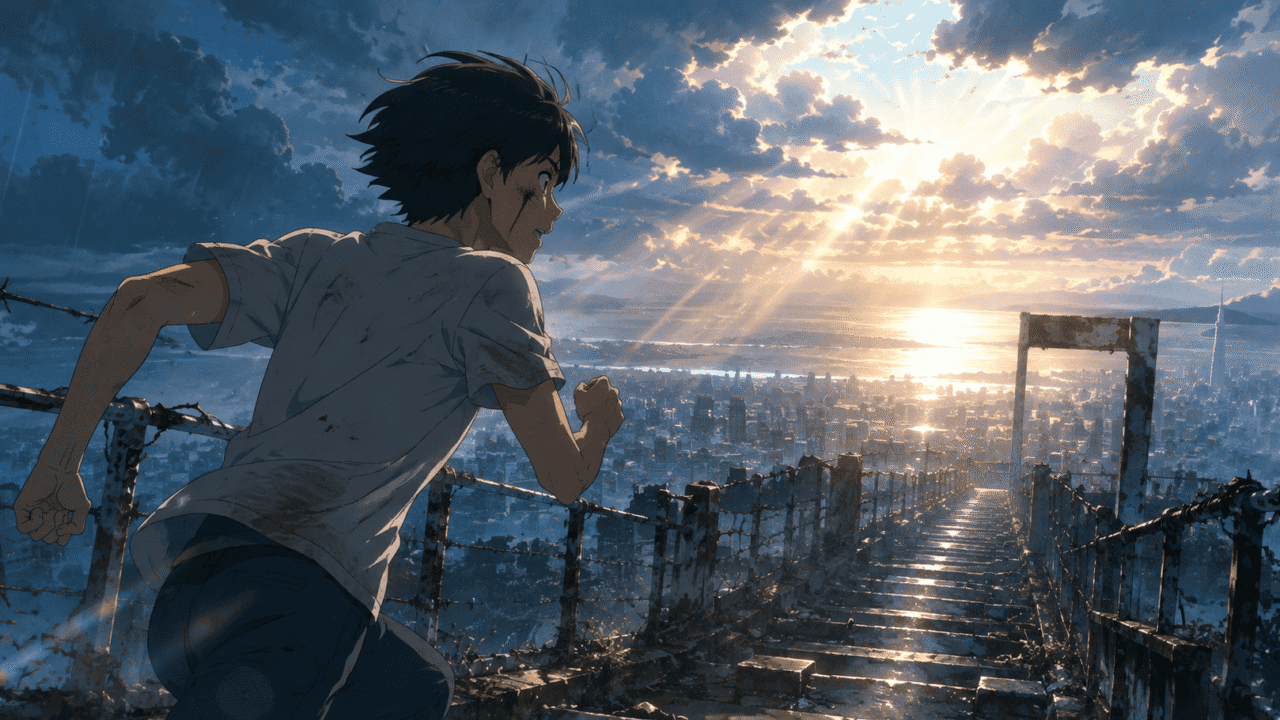
Screaming that he has to save her, Hodaka violently escapes the police station. He embarks on a desperate, agonizing sprint across Tokyo, dodging police blockades and running across live train tracks to reach the abandoned rooftop shrine—the only portal to the sky realm.
He is cornered at the building by Suga, who initially tries to stop him to protect himself from the police. But after witnessing Hodaka’s raw, broken determination, Suga finally remembers his own suppressed grief over his dead wife. In a violent rejection of “adult logic,” Suga tackles the pursuing police officers, buying Hodaka the time he needs.
Hodaka reaches the rooftop and dives through the Torii gate. He is instantly teleported into the terrifying, magnificent “Sky World” above the cumulonimbus clouds. He spots Hina trapped in a state of stasis. Plunging through the atmosphere, he screams for her to take his hand.
Hina hesitates, knowing that if she returns, Tokyo will drown. But Hodaka rejects the concept of sacrifice. He screams, “Who cares if we don’t see the sun again? I want you more than any blue sky!”
Hina grabs his hand. In that exact second, the contract is broken. As they plummet back to earth, the apocalyptic rains instantly resume over Tokyo.
Three years later.
Hodaka, having been sent back to his island to finish high school on probation, graduates and immediately returns to Tokyo.
The city has been fundamentally altered. The rain has not stopped for a single second in three years. Most of Tokyo’s eastern wards are permanently submerged underwater, turning the metropolis into a dystopian Venice.
Meeting with Suga and an elderly client, the adults try to absolve Hodaka of guilt, claiming that “Tokyo was originally a bay anyway, it just returned to its natural state,” and assuring him that the world “was always crazy.”
But as Hodaka walks through the drowned streets, those excuses ring hollow. He finally spots Hina standing on a flooded viewing platform, wearing her Sunshine Girl choker, praying silently into the unending rain.
Seeing her, Hodaka’s internal conflict shatters. He rejects the adults’ comforting lies. He realizes: “No. We didn’t just return things to normal. We definitely, permanently changed the world.”
He runs to her. Hina turns, crying, and asks if what they did was okay. Hodaka takes her hands, embraces the weight of their selfish, catastrophic choice, and delivers the film’s final, defiant declaration:
“Hina… I’m sure… we’re gonna be OK!”
In-Depth Analysis: Decoding the Themes of Weathering With You

What is the Core Theme? (Youth Rebellion vs. Adult Intervention)
Beneath the supernatural romance, Weathering With You operates on a singular, fiercely political axis: the explosive, desperate desire of youth to “live on their own terms,” clashing violently against “Adult Society,” which insists on intervening for their “own good.”
During the volatile period of adolescence, society imposes suffocating restrictions. Hodaka and Hina’s agonizing struggle to escape the rules of adults (poverty, child protective services, police mandates) and carve out a tiny, private world “just for the two of us” is the ultimate symbol of teenage rebellion.
Conversely, the adults in the film—the police, welfare workers, and even Suga—operate entirely on logic, social norms, and “good intentions.” They believe they are “protecting” the kids. Yet, from the teenagers’ perspective, this institutional “protection” is exactly what is ripping their family apart and driving Hina to suicide.
By writing an ending where the teenagers actively choose to drown a major metropolitan city rather than submit to the system, Makoto Shinkai delivers a terrifyingly bold statement. He is firmly validating the raw, selfish desires of youth, prioritizing individual bonds over the sterile, “correct” harmony of society.
What is the True Mythology of the “Weather Maiden”?
Hina’s power is not a simple “sunshine generator.” Historically, the “Weather Maiden” was a sacred diplomat tasked with negotiating balance between the Earth and the Sky. The fact that she summons a massive lightning strike proves she commands all weather. However, as modern humanity grew arrogant and demanded constant sunshine, they severed their dialogue with nature. Consequently, the Maiden’s diplomatic role was violently corrupted, downgrading her into a disposable “human sacrifice” to force the weather into submission.
The entire film pivots on the existence of Hina’s powers. While the public only utilizes her to clear the rain, she is not a one-trick pony. The scene where she calls down a lethal lightning bolt to destroy a truck proves she has the capacity to weaponize the atmosphere.
So, what was the original purpose of this power? Why does it slowly kill her? To understand the deep, forgotten lore of the Shinto weather gods operating in the background of this film, I highly recommend reading our dedicated mythological deep-dive.
Read the full mythological analysis here:
Weathering With You: The True Role of the Weather Maiden
The Psychological Meaning Behind “We’re Gonna Be OK!”
Hodaka’s final line is not an apology, nor is it naive optimism. It is a radical declaration of self-worth. By refusing to let the adults dilute his guilt, Hodaka takes absolute ownership of his choice. He realizes that by choosing to save Hina, he finally “seized his own destiny.” This ending serves as a battle cry from Director Shinkai to his audience: “If these kids can unapologetically affirm a choice that drowned a city, you must unapologetically affirm your own choices in life.”
On the surface, Weathering With You fits perfectly into the “Sekai-kei” (World-Type) anime genre—stories where the intimate relationship between a boy and a girl is directly tied to an apocalyptic global crisis. (Think Evangelion or Saikano).
However, traditional Sekai-kei stories usually end in agonizing tragedy or forced compromise. Weathering With You violently subverts the genre by having the protagonist explicitly choose the girl, destroy the world, and then refuse to apologize for it.
Why did Shinkai write such a highly controversial, borderline sociopathic ending? We explore the profound psychology of Hodaka’s final monologue in our ending explanation article.
Read the full ending breakdown here:
Exploring the Deep Meaning of the Final Scene: “We’re gonna be OK!”
The Symbolic Purpose of the Scar on Hodaka’s Cheek
The bloody gash Hodaka receives while sprinting across the train tracks is not just a visual marker of physical exertion. It is a profound literary metaphor indicating a complete paradigm shift in his soul. In the beginning, Hodaka was a selfish runaway operating solely on his “own rules.” But after witnessing Hina’s sacrifice, his ego shatters. For the first time, he runs purely for the sake of another human being. The scar is the permanent, physical branding of this spiritual awakening—directly echoing the classic Japanese story, “Run, Melos!”
During the climax, Hodaka takes a brutal fall, slashing his left cheek on a piece of barbed wire. Visually, it adds grit to the sequence. But from a narrative architecture standpoint, if he hadn’t gotten cut, the plot would have resolved exactly the same way.
So why did Shinkai mandate that specific injury? I believe it is a brilliant homage to classical Japanese literature, specifically Osamu Dazai’s Run, Melos!, representing the exact moment a selfish boy transforms into a selfless man.
Read the full literary comparison here:
Why Did Hodaka Get a Scar? A Comparison with “Run, Melos!”
What did you think of the film’s controversial climax? Were you cheering for Hodaka to save Hina, or were you horrified that he drowned the city? Let us know your thoughts on this modern masterpiece!


Reader Comments