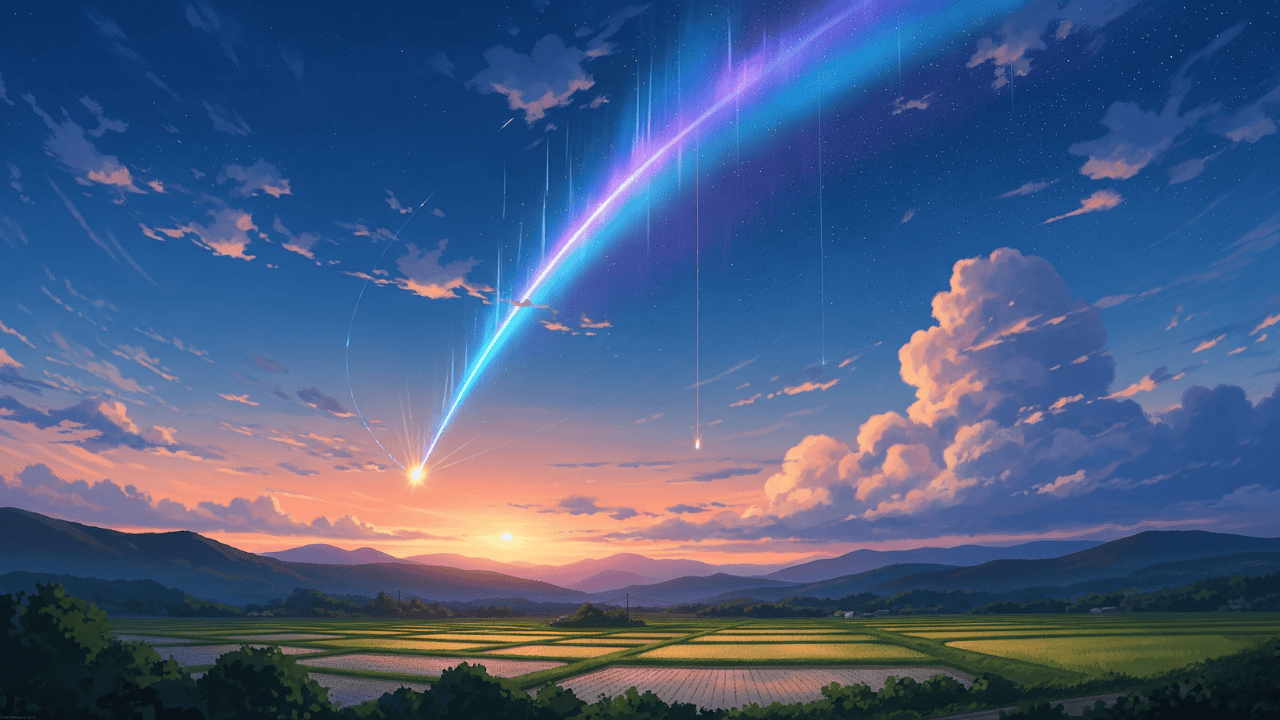
Makoto Shinkai’s Your Name. (Official) isn’t just a simple teen romance—it’s a breathless race against time, memory, and cosmic tragedy. When the first trailers dropped in 2016 teasing a lighthearted “body-swapping” comedy, even hardcore Shinkai fans (myself included, having devoured everything from Voices of a Distant Star to The Garden of Words) felt a wave of skepticism. Convinced that a body-swap trope wouldn’t carry the profound emotional weight I expected from the auteur, I stubbornly skipped opening day.
I couldn’t have been more wrong. As Your Name. exploded into a global cultural phenomenon, my contrarian resistance finally crumbled. Walking out of the theater a month later, I was completely floored by the sheer scale and emotion of the narrative. It taught me a vital lesson: never judge a cinematic masterpiece by its surface-level premise.
In this deep dive, we will untangle the complete narrative arc, explore the complex character web, and break down the profound mysteries embedded in the film. A quick warning: this comprehensive guide contains massive spoilers. If you haven’t experienced the magic of the film yet, turn back now and watch it first!
*This is a translated version. The original (Japanese) is available here.
- Complete Story Breakdown & Character Web
The core premise sounds straightforward: Tokyo high schooler Taki and rural shrine maiden Mitsuha mysteriously swap bodies. But the stakes skyrocket when Taki discovers that Mitsuha’s timeline is completely different, and her hometown of Itomori was obliterated by a comet three years prior. We break down how Taki miraculously breaches the boundaries of time and space to rewrite history, and how two souls bound by destiny fight to find each other despite losing their memories. - Unlocking the Deep Analysis Points
We dissect the biggest lingering questions, including the true reason behind the mayor’s sudden evacuation order and the thematic necessity of that miraculous final reunion, linking out to our dedicated deep-dive articles for the ultimate Shinkai breakdown.
On this pageContents
Your Name. (2016) Complete Story Outline: A Defiance of Fate
Quick Summary: The 5 Core Plot Points
-
Two Worlds, Worlds Apart
Mitsuha suffocates in the traditions of her rural mountain town of Itomori, while Taki navigates the concrete jungle of Tokyo. Despite having zero connection, both yearn to escape their current realities. -
The Dream Swap Phenomenon
Without warning, Taki and Mitsuha begin hijacking each other’s bodies in their sleep. Overcoming their initial panic, they establish ground rules and start leaving digital footprints to guide each other through their respective lives. -
A Deepening Bond and a Devastating Revelation
As they pilot each other’s daily routines, a profound intimacy blossoms. But abruptly, the swapping ceases. Desperate for answers, Taki embarks on a physical journey to Itomori, only to uncover a horrifying temporal paradox. -
The Cosmic Tragedy of Itomori
Taki discovers the crushing truth: three years ago, a splintering comet annihilated Itomori, claiming Mitsuha’s life. Clinging to the ancient spiritual traditions of Mitsuha’s family, Taki seeks out the “Kuchikamizake” (mouth-chewed sake) to force one final, desperate connection to the past. -
Remembering “Your Name.”
Successfully slipping back through time, Taki races against the cosmos to orchestrate a mass evacuation. Years later, having survived the disaster but lost their memories of the miracle, the two wander Tokyo with a haunting sense of emptiness—until destiny intervenes one last time.
Character Map
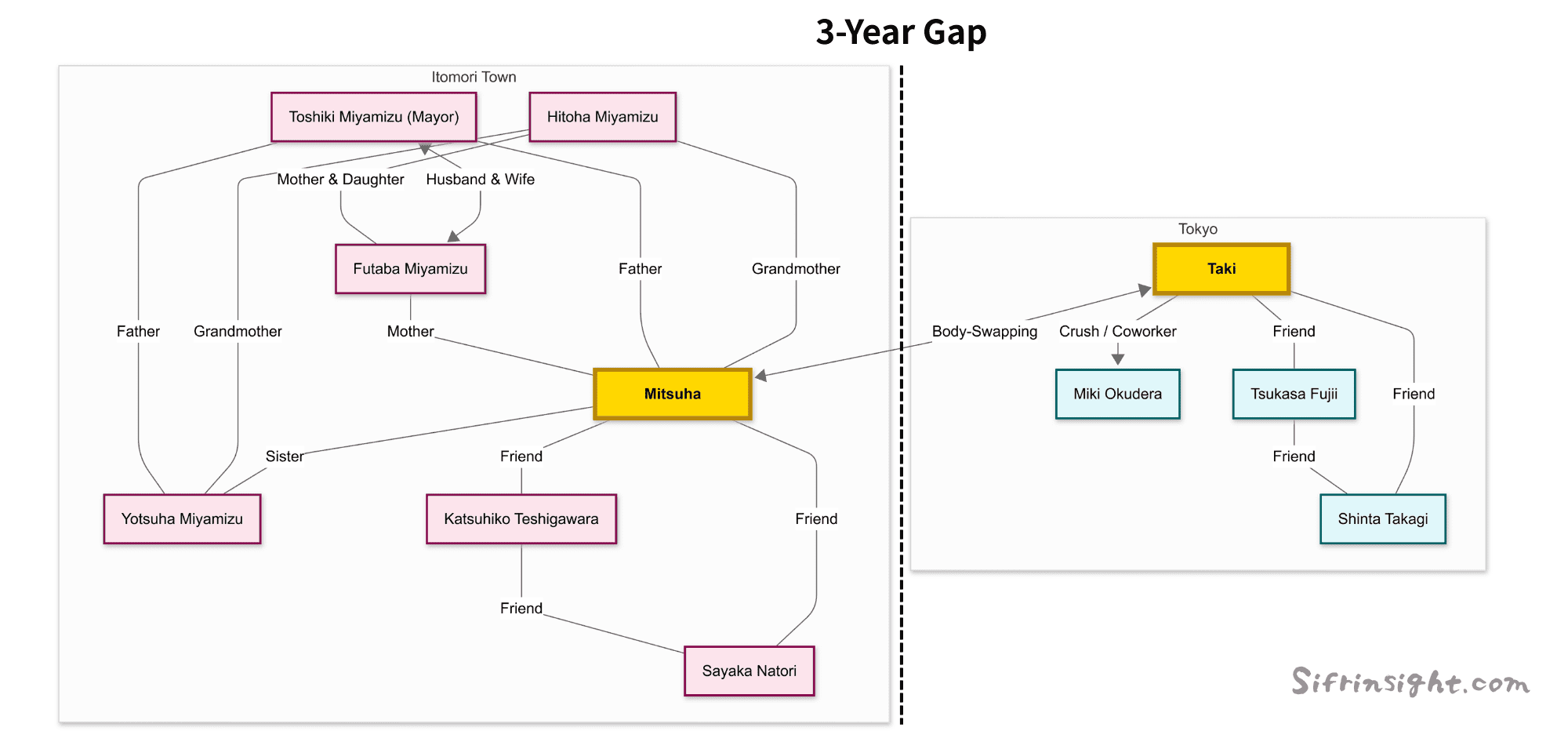
▼ Curious about voice actors and hidden character details? Dive in here:

Detailed Synopsis: The Journey to the Twilight
How does a whimsical body-swapping comedy evolve into a life-or-death battle against cosmic destiny? Let’s walk through every critical plot point, unraveling the three-year time gap and that emotionally devastating finale driven by the sheer will to remember.
The Body-Swapping Mystery
The chaos kicks off in 2016 when Tokyo high school sophomore Taki Tachibana jolts awake in a radically unfamiliar bedroom. The mirror reveals a shocking truth: he is trapped in the body of an unknown teenage girl. For Taki, the day dissolves into a hazy, surreal blur that straddles the line between a lucid dream and terrifying reality.
Simultaneously, Mitsuha Miyamizu wakes up inhabiting the body of a Tokyo teenage boy. While entirely disoriented, she seizes the opportunity to explore the bustling metropolis she’s always dreamed of. Embracing the “it’s just a dream” mentality, Mitsuha gleefully drains Taki’s wallet at stylish cafes and completely upends his dynamic at his restaurant job. There, she bonds with Taki’s elegant senior coworker, Miki Okudera, successfully defending her from unruly patrons and discovering that Taki harbors a massive crush on her.
When the dust settles and they awake in their own bodies, the fallout is immediate. Taki’s friends are bewildered by his sudden amnesia regarding his job, and a coworker accuses him of making bold moves on Ms. Okudera. A glance at his phone reveals bizarre diary entries he never wrote. Meanwhile, back in Itomori, Mitsuha is bombarded with rumors of her uncharacteristic “heroic” outbursts at school, finding the frantic scribbling “Who are you?” etched into her notebook.
The undeniable truth sets in: they are hijacking each other’s lives.
To survive the temporal whiplash, the duo lays down strict ground rules, communicating via smartphone memos. What starts as a chaotic crisis morphs into an exhilarating collaboration. Taki’s assertive nature earns the usually timid Mitsuha a wave of popularity (and even love letters) at her rural school. Conversely, Mitsuha’s feminine charm works wonders for Taki in Tokyo, culminating in her securing a highly coveted date with Ms. Okudera for him.
As their bond tightens, Taki (in Mitsuha’s body) partakes in a deeply spiritual journey. He accompanies her younger sister, Yotsuha, and grandmother, Hitoha, to the Miyamizu Shrine’s sacred body—an ancient stone altar hidden deep in the mountains. Hitoha explains that this secluded peak represents “Kakuriyo,” the underworld. To return to the world of the living, one must leave behind “half of themselves.” Taki respectfully offers the “Kuchikamizake” (the mouth-chewed sake Mitsuha previously prepared) to the gods before descending.
The next time Taki wakes up as himself, he is completely unprepared. It’s the day of the date with Ms. Okudera that Mitsuha orchestrated. Relying entirely on Mitsuha’s digital cheat sheet, he fumbles through the afternoon. The chemistry, however, is dead. Ms. Okudera astutely points out, “You used to like me, right? But now… there’s someone else on your mind.” Rattled by the revelation, Taki instinctively dials Mitsuha’s number.
Miles away, Mitsuha attends her town’s vibrant autumn festival. It’s a night of celestial wonder, as the brilliant Tiamat Comet is scheduled to make its closest approach to Earth. But as the magnificent comet streaks across the sky, dragging a glittering tail, Mitsuha never picks up the phone.
And just like that, the body-swapping permanently stops.
The Devastation of Itomori
Driven by an inexplicable sense of loss, Taki resolves to find Mitsuha. Armed only with his memories, he sketches the breathtaking landscape of her town—a town he knows only from his dreams. Accompanied by a skeptical Tsukasa and Ms. Okudera, Taki scours the rural Hida region. Hope dwindles until a local ramen shop owner recognizes the sketch: the town is Itomori.
The name strikes a horrifying chord with Tsukasa and Okudera. Only Taki remains blissfully, painfully unaware. When they finally reach the coordinates, Taki’s world shatters.
He isn’t looking at a town; he’s looking at a massive, flooded crater. Three years ago, during the festival, a colossal fragment of the Tiamat Comet unexpectedly splintered off and obliterated Itomori, wiping out a third of its population. Mitsuha’s name sits tragically on the victim registry.
The sickening paradox clicks into place: Taki hadn’t just been crossing distances; he had been crossing time, connecting with a girl who had already been dead for three years. Faced with an inescapable historical tragedy, Taki refuses to surrender.
At the break of dawn, he abandons his friends and treks to the ruined sacred body of the Miyamizu Shrine. He seeks out the only remaining physical connection to Mitsuha’s timeline: the Kuchikamizake. Swallowing the fermented sake—consuming “half of her soul”—Taki triggers a violent, psychedelic temporal slip. He hurtles backward through the ancestral memories of the Miyamizu bloodline, finally snapping awake inside Mitsuha’s body on the morning of the disaster.
The mission is terrifyingly clear: rewrite history. Teaming up with Mitsuha’s loyal friends, Tessie and Saya, Taki engineers a radical plan to hijack the town’s emergency broadcast system and detonate the local power substation, forcing the citizens to evacuate to safety. But can a teenager truly outmaneuver the cosmos?
Defying Fate: The Final Reunion
The hijacking plan hits an immediate brick wall when Taki (as Mitsuha) attempts to convince the town’s stubbornly pragmatic mayor—Mitsuha’s estranged father—to initiate an evacuation. Dismissed as a hysterical child, Taki realizes he cannot do this alone. He needs the real Mitsuha. Trusting instinct, he sprints toward the mountain’s peak, the boundary of Kakuriyo.
Simultaneously, the real Mitsuha awakens inside Taki’s body at the shrine’s altar in the desolate, future timeline. Stepping outside, she is paralyzed by the sight of her annihilated hometown. Yet, amidst the ruins, she senses Taki’s echo.
Racing along the rim of the crater, the two call out to nothingness. Suddenly, the sun dips below the horizon, ushering in “Katawaredoki” (the twilight hour where the boundaries of reality blur). For a fleeting, miraculous moment, the timelines merge. They see each other.
Taki warns her of the impending strike, passing the torch to save her town. Before they can properly write each other’s names on their hands to anchor their memories, the sun vanishes. The connection snaps. Taki is left alone in the ruined future, and Mitsuha plunges back into the doomed past, her memory of his name already dissolving like mist.
Fuelled by pure adrenaline and the fading echo of a boy she can no longer remember, Mitsuha executes the explosive blackout. Still, the townspeople hesitate. Bleeding and exhausted, she storms her father’s office for one final, desperate confrontation.
…… Fast forward to October 2021. Taki is navigating the grueling Tokyo job hunt. While his peers secure lucrative offers, Taki feels entirely adrift, anchored only by a suffocating sense that he is missing something—or someone—vital.
A reunion with Ms. Okudera reignites fragments of a bizarre trip to Hida five years prior. Taki recalls his obsessive fascination with the “Itomori Miracle,” where a spontaneous evacuation drill saved the town from a catastrophic meteor strike. He had scoured every news article, inexplicably moved by the survival of absolute strangers.
Seasons change. Taki transitions into a mundane corporate life, the ache in his chest dulling but never disappearing. Then, on a completely ordinary spring commute, his train pulls parallel to another. Through the glass, his eyes lock onto a woman. The recognition is instantaneous, visceral, and mutual.
Taki abandons his routine, sprinting through the streets of Tokyo. The woman does the same. Drawn by an invisible thread, they converge on the sun-drenched steps of Suga Shrine. Fearful of making a mistake, they slowly pass each other, hearts pounding. But Taki shatters the silence, spinning around.
“Haven’t we met before?”
Tears well in her eyes. “I thought so too.”
In that triumphant moment, the universe aligns, and they ask for the one thing they fought so desperately to remember: “Your Name.”
Names, memory, and forgetting are carried throughout the film by its dialogue. For the original Japanese lines, English subtitles, and my interpretation of them, see 12 Your Name. quotes in Japanese and English.
Your Name. (2016) Deep Analysis: Unlocking the Mysteries

The Mayor’s Secret: Why Did He Finally Issue the Evacuation Order?
The mayor ultimately ordered the evacuation because he, too, had experienced the Miyamizu body-swapping phenomenon with his late wife, Futaba. His harsh comments about “Miyamizu delusions” stem from the tragic guilt of encountering Futaba’s “future memories” during a swap, yet failing to save her from her illness. When Mitsuha confronts him with the apocalyptic truth, the pieces of his own supernatural past click into place, forcing him to act.
If you strip away the romance, Your Name. operates as a thrilling sci-fi heist to save a timeline. But the entire operation hinges on one nearly impossible bottleneck: convincing Mitsuha’s estranged, cynical father to evacuate the town.
We know that when Taki (inside Mitsuha) first pitches the meteor theory, the mayor laughs him out of the room. Yet, history records that the mayor did issue the order, saving thousands of lives. So, what exactly changed his mind in those final, critical moments?
The answer lies buried in the generational trauma of the Miyamizu family. To discover exactly how the Mayor’s heartbreaking past shaped this ultimate decision, dive into our dedicated analysis of his hidden backstory right here.
The psychological layers behind his choice completely recontextualize his character. Have you spotted the clues during your rewatches?
A Paradigm Shift: Why Taki and Mitsuha Had to Reunite
Taki and Mitsuha’s reunion isn’t just fan service; it is the thematic climax of the story. For 1,200 years, the Miyamizu ancestors failed to pass down the critical warning of the comet, leading to tragedy born of “forgetting.” Taki and Mitsuha break this cycle. Written in the wake of the 2011 Great East Japan Earthquake, Shinkai purposefully crafted an ending that rejects nihilism, offering a powerful message of hope: we must fight to remember, and we must fight to connect.
If you followed Makoto Shinkai’s career before Your Name., the ending probably gave you severe anxiety. Historically, Shinkai’s narratives are anchored by agonizing themes of “separation” and “inevitable loss” (looking at you, 5 Centimeters per Second). When Taki and Mitsuha initially walked past each other on those stairs, every veteran Shinkai fan collectively held their breath, expecting the screen to cut to black.
But they turn around. They reunite.
While some purists argue that an unresolved ending might have felt more “traditionally Shinkai,” I firmly believe the film achieves legendary status precisely because they find each other. But why did Shinkai break his own stylistic rules to deliver this happy ending?
We break down the profound cultural and psychological reasons behind this directorial shift in our deep-dive essay on the film’s ending—click here to explore the brilliant mind of Makoto Shinkai.
Thematic Core: Time, Memory, and the Miracle of Connection
To truly grasp the genius of Your Name., you must look beyond the romance and focus on the narrative triad: the “temporal gap,” the “curse of forgetting,” and the “miracle of reunion.”
First, Shinkai subverts the tired “Freaky Friday” trope by injecting a lethal three-year time gap. This asymmetry transforms a lighthearted comedy into a race against a locked, devastating history, wrapping the narrative in a thick layer of existential suspense.
Secondly, the film heavily leans into the tragedy of “forgetting.” In the Miyamizu lore, dreams are fleeting, and waking life violently erases spiritual truths. This mirrors Shinkai’s older works, where time naturally erodes passion. However, Your Name. weaponizes this concept. The true antagonist isn’t the comet; it’s the fading memory. Taki and Mitsuha’s desperate rebellion against the natural law of forgetting is what gives the film its raw, emotional horsepower.
Finally, the triumphant “reunion” shatters the melancholic mold of the director’s past. By allowing characters who have been brutally severed by time, disaster, and memory to finally grasp each other, Shinkai delivered a masterclass in cinematic catharsis, elevating Your Name. from a great anime to an immortal piece of global cinema.


Reader Comments