Hideaki Anno’s Shin Godzilla (Official) isn’t merely a monster movie; it is a terrifyingly bureaucratic nightmare that holds a mirror up to a nation paralyzed by an unprecedented, evolving disaster. Released on July 29, 2016, and co-directed by Shinji Higuchi, the film became a monumental cultural phenomenon, grossing a massive 8.25 billion yen at the box office (Reference: “Motion Picture Producers Association of Japan, Inc. ‘2016 National Film Industry Statistics’“, in Japanese).
For die-hard fans of Anno, this film arrived exquisitely positioned between Evangelion: 3.0 You Can (Not) Redo and Evangelion: 3.0+1.0 Thrice Upon a Time. As an aficionado of both the Godzilla franchise and Hideaki Anno’s visionary storytelling, missing this theatrical event was simply not an option.
Today, I want to dive deep into the thematic core of Shin Godzilla.
Specifically, we must unravel the psychological mystery of Professor Goro Maki—the phantom architect who left behind a chilling final testament: “I did as I pleased. Now you do the same.”
What exactly did he do as he pleased, and what terrifying burden was he passing on to the rest of us?
Before we dissect the philosophy of the film, let’s briefly recap the chaotic events that brought Japan to its knees.
Please consider this your official warning: this comprehensive synopsis holds nothing back. We will be revealing every major plot twist, so if you strongly dislike spoilers, bookmark this page, watch the film, and come right back.
*This is a translated version. The original (Japanese) is available here.
- The Enigma of Goro Maki and Godzilla’s Genesis
While harboring a deep-seated hatred for Japan and humanity, Goro Maki aggressively advanced research into detoxifying radioactive materials. It is heavily implied that he guided the evolution of a mutated marine organism into Godzilla. The film subtly suggests a horrifying, almost fantastical reality: Maki himself merged with the beast, becoming Godzilla to act as a living symbol of atomic vengeance. - Echoes of Eiichi Hoba from Patlabor: The Movie
Goro Maki’s apocalyptic methodology mirrors that of Eiichi Hoba from Mamoru Oshii’s masterpiece, Patlabor: The Movie. Hoba committed suicide to unleash a catastrophic virus upon Tokyo; similarly, Maki effectively turned himself into a god of destruction. This striking narrative parallel serves as a brilliant, undeniable homage to Oshii’s work. - The Strategic Casting of Kayoko Ann Patterson
The character of Kayoko, played by Satomi Ishihara, is intentionally designed as an “outlier.” Accurately casting and writing a realistic Japanese-American political envoy would have required exhaustive background exposition, destroying the film’s relentless pacing. Thus, she exists as a highly convenient, necessary “lie” to seamlessly advance the plot.
On this pageContents
Shin Godzilla (2016) Full Synopsis (Spoilers Ahead)
Quick Summary: A Nation Under Siege
- The Breach and the Birth of a God
Following a massive, unexplained steam explosion in Tokyo Bay, a colossal tail breaches the surface. The giant creature makes landfall in Kamata, evolving before the eyes of a paralyzed government. The Prime Minister’s office establishes a rogue task force, determining the beast is a rapidly mutating organism fueled by nuclear waste. They officially name the terror “Godzilla.” -
The Annihilation of the Cabinet
Godzilla returns, larger and practically invincible. Japan’s conventional military forces are utterly useless. When the U.S. military intervenes with heavy airstrikes, Godzilla retaliates by unleashing a devastating radioactive heat beam, vaporizing the bombers and incinerating the political heart of Tokyo. The entire top tier of the Japanese government is wiped out in a mid-air evacuation, leaving an unprepared minister to assume the role of acting Prime Minister. - Operation Yashiori: The Final Gambit
With a U.N.-sanctioned nuclear strike against Tokyo looming, the rogue task force scrambles to execute “Operation Yashiori”—a desperate plan to inject a coagulant directly into Godzilla’s bloodstream to shut down his internal nuclear reactor. Aided by rogue supercomputers worldwide, the operation succeeds. Godzilla is frozen solid, but the haunting reality remains: humanity must now learn to coexist alongside a sleeping god.
Character Map: The Bureaucrats vs. The Beast
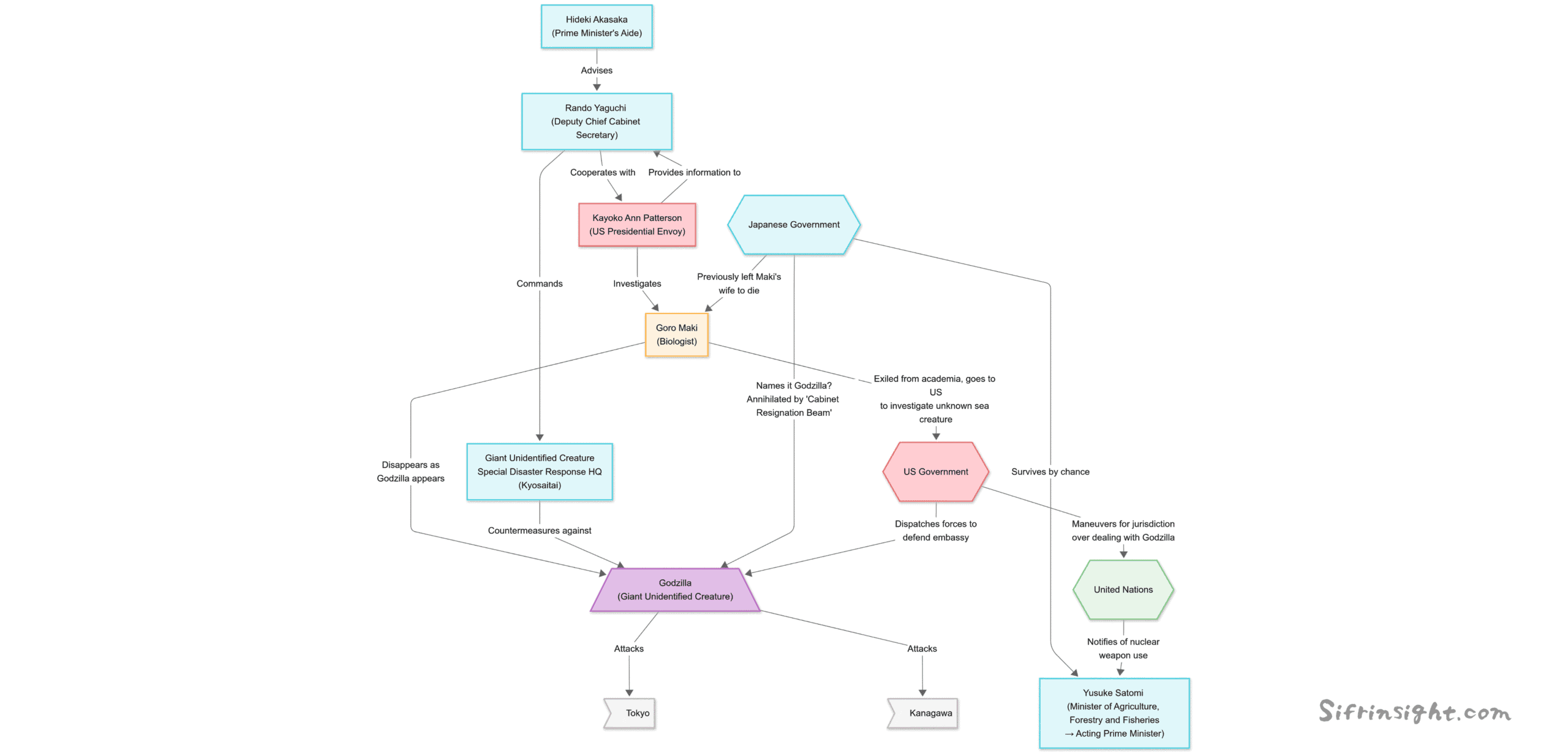
Now, let’s break down the relentless momentum of Shin Godzilla step by step.
Detailed Synopsis: The Evolution of Terror
The Appearance of a Giant Creature
The nightmare begins on November 3rd at 8:30 AM. An abandoned pleasure boat is found drifting aimlessly in Tokyo Bay. As the coast guard investigates, a massive, violent steam explosion erupts from the depths, instantly compromising the Aqua-Line tunnel and flooding it with seawater.
While the bureaucratic machinery of the Japanese government sluggishly prepares to announce a “submarine volcanic eruption,” a gargantuan tail violently breaches the surface. The disaster is not geological; it is biological.
Rando Yaguchi, the sharp, forward-thinking Deputy Chief Cabinet Secretary, had immediately suggested the possibility of a giant living creature, only to be mocked by his superiors. His terrifying theory is quickly validated.
As cabinet members endlessly debate the legalities of capturing versus exterminating the anomaly, the creature aggressively navigates the bay and forces landfall in Kamata, Ota Ward.
This early form of the beast is grotesque—a quadrupedal horror dragging itself through the streets, crushing residential neighborhoods beneath its weight. Evacuation orders are frantically issued, but the death toll begins to mount.
Pushed to the brink, the Prime Minister finally authorizes a “defense operation” for the Japan Self-Defense Forces (JSDF).
But the creature refuses to play by the rules of biology. As the JSDF prepares to engage, the writhing mass stops, roars, and violently forces itself onto two legs. It isn’t just standing up; it is rapidly mutating and “evolving.”
Just as JSDF attack helicopters lock onto the newly bipedal monster, the strike is aborted to avoid civilian casualties. In that brief window of hesitation, the creature abruptly turns and plunges back into the sea, leaving a stunned nation in its wake.
Naming the Terror: Godzilla
To combat the unprecedented threat, the government forms the “Giant Unidentified Lifeform Task Force,” operating directly out of the Prime Minister’s Office.
Led by the ambitious Yaguchi, the task force bypasses standard seniority protocols, pulling together a brilliant but eccentric team of social outcasts, described as the “misfits of Kasumigaseki, heretics of academia.”
Simultaneously, terrifying environmental data rolls in: abnormal, lethal radiation levels are detected across Tokyo.
The radioactive trail perfectly matches the creature’s path of destruction. The task force realizes the horrifying truth: the beast is essentially a walking nuclear reactor, generating energy through biological nuclear fission.
The crisis quickly goes global. The United States demands action, dispatching Kayoko Ann Patterson, a special envoy of the U.S. President, to contact Yaguchi directly.
Kayoko offers a crucial trade: intelligence on the monster in exchange for Japan locating a missing scientist named Professor Goro Maki. Maki, a brilliant biologist exiled from the Japanese academic community, had been working for an energy research institute in the U.S. and had accurately predicted the creature’s arrival years in advance.
Maki had vanished immediately after re-entering Japan a week prior.
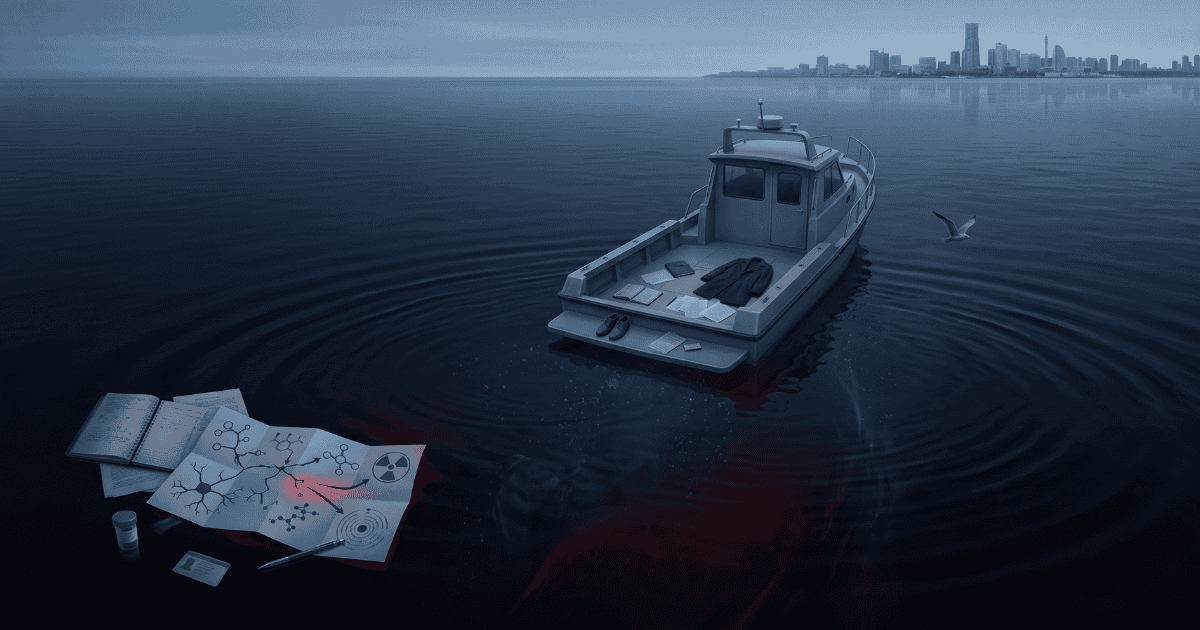
Yaguchi agrees to the deal and quickly uncovers a chilling fact: Goro Maki was the man who abandoned the pleasure boat found in Tokyo Bay on the day of the eruption.
On that boat, Maki left behind his personal effects and a haunting, final note: “I did as I pleased. Now you do the same.” Yaguchi trades these belongings to Kayoko and receives the classified U.S. data on the creature.
The files reveal that the U.S. Department of Energy (DOE) had been tracking an ancient aquatic organism that was actively feeding on illegally dumped nuclear waste. Maki’s hypothesis was terrifying: the organism had rapidly evolved to survive the radiation, transforming into an unstoppable, radioactive apex predator.
Maki had already named the beast after “Gojira,” a legendary sea god from his hometown on Odo Island. The Japanese government officially adopts the English phonetic translation: Godzilla.
The Cabinet’s Annihilation
Working against the clock, Yaguchi’s team struggles to decipher a highly complex, origami-like structural diagram left behind by Maki. Its meaning remains completely locked.
Before they can crack the code, Godzilla returns, rising from the waters of Sagami Bay.
The creature has evolved again. It is now massively larger, towering over the skyline with a hardened, sinister armored shell.
This time, the JSDF does not hesitate. They unleash the full might of their conventional artillery, tanks, and attack helicopters. The barrage is deafening, but it is completely useless. The weapons bounce off Godzilla’s hide as it marches relentlessly toward the political heart of Tokyo.
Realizing Japan’s military is outmatched, the U.S. forcibly intervenes, deploying stealth bombers from Guam under the pretense of “embassy defense.”
The Japanese government is forced to retroactively authorize the strike under the U.S.-Japan Security Treaty. Knowing the capital will become a warzone, the top-tier government officials initiate a desperate helicopter evacuation.
The U.S. bombers manage to draw blood using massive penetrating ordnance. But the pain triggers Godzilla’s ultimate defense mechanism. The creature’s jaw unhinges, unleashing a blinding, apocalyptic radioactive heat beam that slices through the sky, instantly vaporizing the American bombers.
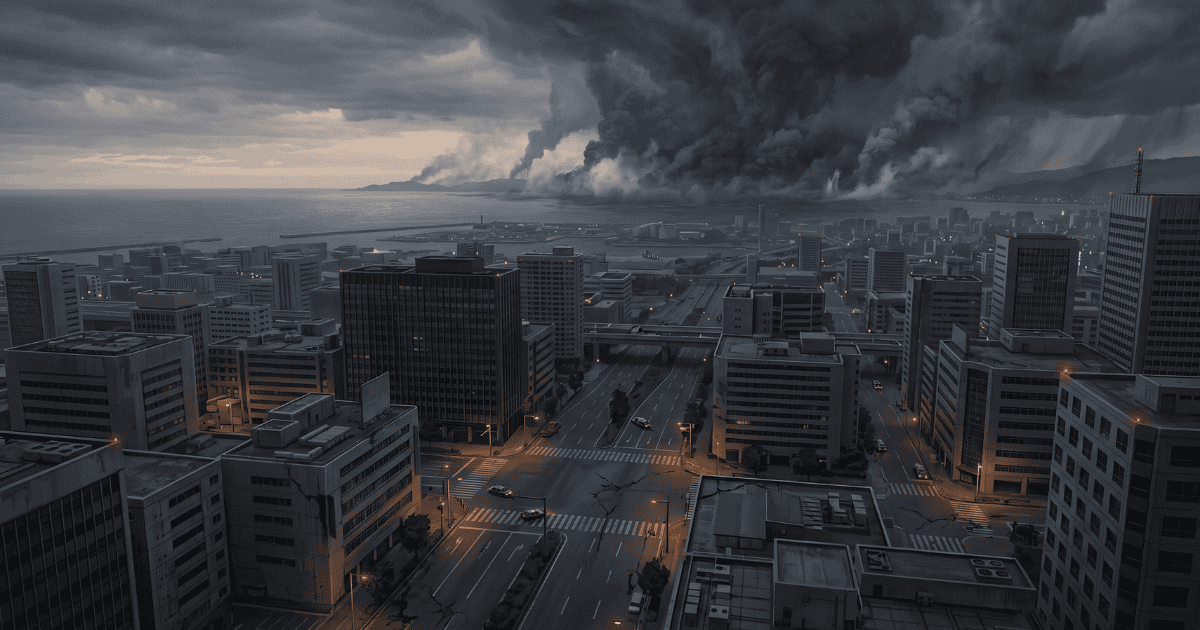
Godzilla then lowers its head, sweeping the beam across the city, incinerating Kasumigaseki and reducing Tokyo to a sea of fire. In a shocking, devastating blow, the Prime Minister’s evacuation helicopter is caught in the beam and completely vaporized, instantly decapitating the Japanese government.
Exhausted by the massive energy output, Godzilla eventually powers down, freezing in place like a macabre statue directly in front of Tokyo Station.
Operation Yashiori: The Freeze
In the ashes of the capital, the government scrambles to maintain order. Yusuke Satomi, the Minister of Agriculture, Forestry and Fisheries—and one of the few surviving high-ranking officials—is hastily sworn in as the acting Prime Minister.
Before the attack, Yaguchi’s task force had theorized that since Godzilla operates like a nuclear reactor, it must have a biological cooling system that could be compromised.
Ironically, the tragic annihilation of the original, cautious cabinet removes the bureaucratic red tape, giving Yaguchi the absolute authority to execute a wild, unprecedented counter-attack based on this theory.
But the clock is ticking. The United Nations, led by the U.S., decides that Godzilla is an existential threat to the planet. They vote to drop a thermonuclear bomb directly on Tokyo to vaporize the beast before it wakes up, forcing the decision onto the fragile Japanese government.
Desperate to save their capital from a third nuclear strike, Yaguchi and his team race to finalize their alternative strategy: the “Yaguchi Plan.”
By finally cracking Maki’s cryptic diagram, they discover the molecular structure required to synthesize a massive amount of blood coagulant. If they can force-feed this chemical into Godzilla’s mouth, it will shut down the beast’s internal cooling system, triggering a scram and freezing it solid.
However, running the complex molecular simulations in time requires unimaginable computing power. In a beautiful moment of global solidarity, brilliant researchers and allied nations around the world illegally hijack their own supercomputers to run the calculations for Japan, risking everything to stop the nuclear strike.
Yaguchi officially dubs the doomsday maneuver “Operation Yashiori.”
Using a fleet of unmanned bullet trains packed with explosives, waves of drones, and heavy construction equipment, the JSDF executes the operation. After staggering sacrifices and a brutal, chaotic battle amidst the ruins of Tokyo, the mission is a success.
The coagulant takes effect. Godzilla is frozen solid in the center of the city.
However, it is not a victory; it is a stay of execution. A towering, radioactive god now permanently sleeps in the heart of the metropolis. The film leaves us with a haunting question: How will humanity learn to coexist with the monster it created?
Shin Godzilla (2016) Deep Analysis: Unlocking the Mysteries

What Did Goro Maki Ultimately Do as He Pleased?
Professor Goro Maki is the absolute gravitational center of Shin Godzilla, despite the fact that we never once see his face. He orchestrated the apocalypse and checked out, leaving behind a chilling manifesto: “I did as I pleased. Now you do the same.”
Given the meticulously arranged shoes on the deck of his abandoned boat, it is almost a certainty that he committed suicide by throwing himself into the dark waters of Tokyo Bay.
To understand the terrifying scope of what he “pleased” to do, we must piece together the fragments of his life:
- He was shunned and exiled by the rigid Japanese academic establishment.
- He was hired by the U.S. DOE to research the anomalous marine organism.
- He had accurately predicted Godzilla’s catastrophic landfall years in advance.
- His beloved wife died a painful death due to radiation exposure.
- Driven by grief, he dedicated his life to researching methods to neutralize radioactive isotopes.
- He fiercely believed that the Japanese government abandoned his wife to die.
- Consequently, he developed a profound, simmering hatred for humanity itself for its reckless proliferation of nuclear materials.
The most compelling, heartbreaking mystery here is the claim that “Japan left his wife to die.” How exactly did the nation abandon her?
To answer this, we must look at the timeline. According to the dossier Yaguchi receives from Kayoko, Maki’s academic milestones are listed as “1957,” “1959,” and “1962.” Below the year 1962, the file notes:
Teito University
Department of Integrative Biology, Graduate School
Faculty of Molecular Cell Biology
Assuming 1962 is the year he secured his doctorate, he would have earned his bachelor’s in 1957. Following a standard academic track, Maki would have been around 27 or 28 years old in 1962, placing his birth year somewhere around 1935.
If his wife was of the exact same generation, she would have been a child during the atomic bombings of Hiroshima and Nagasaki. It is highly probable that Maki’s wife was a survivor (Hibakusha) who was coldly denied official government certification and medical support for her radiation sickness.
If the state let his wife rot away due to bureaucratic technicalities, his blinding rage against the establishment is entirely justified.
References
- About Atomic Bomb Disease Certification (Ministry of Health, Labour and Welfare), in Japanese
- Atomic Bomb Disease Lawsuits (Ministry of Justice), in Japanese
- The Atomic Bomb Disease Certification Lawsuits and the Facts Revealed Within Them (Japan Anti-Nuclear Lawyers Association), in Japanese
Trapped in this agony, Maki continued his genius research into neutralizing radiation, all while harboring a venomous hatred for both his homeland and the human race.
It is a paradox of staggering ambivalence.
Because his wife was already gone, his groundbreaking research could only serve to save the very humanity he so deeply despised.
Realizing this, Maki relinquished control. He threw the problem back into the lap of the species that caused it.
What he actually did on that boat was likely catalyze the final, monstrous evolution of the marine organism the DOE was tracking, effectively birthing Godzilla.
Yet, the film deliberately omits the exact scientific mechanism of how a single scientist triggered this biological apocalypse.
While Shin Godzilla excels at grounding its political and military responses in hyper-realistic, hard science fiction, the absolute origin point of the monster remains shrouded in darkness.
Perhaps, this omission implies that Godzilla’s creation defies pure science. Maki’s actions cross the boundary into dark fantasy; Godzilla is the literal, physical manifestation of Maki’s grief and rage.
If we accept this slightly supernatural premise, the possibilities are chilling. Did Maki genetically merge his own DNA with the organism? Did he somehow become the soul of the beast?
While a physical merger aligns with the film’s evolutionary themes, it begs the question: how did a dying scientist guide the creature directly to Tokyo Bay?
The most poetic, terrifying theory is that Goro Maki threw himself into the abyss and, through sheer force of will and scientific heresy, became Godzilla—a towering, unstoppable symbol of vengeance against humanity’s nuclear hubris.
Consumed by this ambivalence, Maki became the destroyer. But by leaving behind the cryptic blueprints to defeat him, he offered humanity a brutally fair fight: solve the puzzle, or face extinction.
The fact that he chose Tokyo as Ground Zero is a damning indictment of his despair toward his homeland. Yet, by giving Yaguchi the tools to win, one cannot help but feel a profound, terrifying respect for Dr. Goro Maki.
The Ghost of Eiichi Hoba: Oshii’s Influence
While watching Shin Godzilla, it is impossible to ignore the stylistic and thematic echoes of another legendary anime director: Mamoru Oshii. From the rapid-fire political dialogue to the overarching atmosphere of impending doom, Anno clearly draws inspiration from Oshii’s playbook.
Nowhere is this more apparent than in the character of Goro Maki.
Consider the nomenclature: Maki purposefully added the English word “God” to the creature’s name. Godzilla is literally a “God.” Therefore, by committing suicide and triggering the beast’s arrival, Maki achieved a twisted form of apotheosis—he became a god.
If you are a fan of 1980s anime, this exact modus operandi should sound incredibly familiar. It perfectly mirrors the actions of Eiichi Hoba, the phantom antagonist of Mamoru Oshii’s Patlabor: The Movie.
In that masterpiece, the genius programmer Eiichi Hoba commits suicide in the opening minutes of the film. However, his death is merely the catalyst; he leaves behind a dormant computer virus hidden within a new operating system, designed to cause thousands of giant mechs (Labors) to go berserk and tear Tokyo apart from the inside out.
Hoba didn’t just die to escape prosecution; he sacrificed his mortal body to be resurrected as an omnipotent virus, allowing him to destroy the city as a digital god. (Discover more about this striking parallel in our deep dive into Patlabor: The Movie).
The narrative architectures of both films are virtually identical. Both Maki and Hoba are brilliant, deeply disturbed phantoms who manipulate the destruction of Tokyo from beyond the grave, serving as the ultimate, inescapable nuisance to the bureaucratic protagonists trying to stop them.
In many ways, the foundational plot of Shin Godzilla feels like Hideaki Anno’s grand, loving homage to Mamoru Oshii.
While Goro Maki is the unseen villain, we must also examine one of the film’s most controversial visible characters.
The Mystery of Kayoko Ann Patterson
Any deep analysis of Shin Godzilla must address Kayoko Ann Patterson, the U.S. envoy played by the charismatic Satomi Ishihara.
As a character intended to be a third-generation Japanese-American, her portrayal immediately raised a glaring question among audiences: Why didn’t they just cast an actual Japanese-American actress?
While criticisms of her heavily accented English and acting style are common, I want to reframe her casting as a deliberate, brilliant narrative utility.
Point 1: The Necessary Illusion of Kayoko
The most defining trait of Kayoko’s character is the profound sense of “uncanniness” she projects whenever she is on screen.
She operates as an undeniable “outlier” within the hyper-realistic, drab halls of the Japanese government.
But why is she designed this way?
Look at her actions: Kayoko works with a fervent, almost illogical devotion to save Japan. Yes, Japan is the homeland of her grandmother. But it is not her homeland. Kayoko is a proud American politician aiming for the Presidency.
The true reason she bends over backwards to assist Yaguchi is because Kayoko’s existence is a fundamentally necessary “lie” required to make the movie work.
To tell a story about Godzilla attacking modern Tokyo, Anno absolutely needed a conduit to the United States military and political machine. However, for the plot to progress toward “Operation Yashiori,” this U.S. liaison had to possess a highly irrational, deep-seated bias toward protecting Japan at the cost of her own career.
In the ruthless reality of international geopolitics, such a conveniently sympathetic American envoy simply does not exist.
Yet, without her, Yaguchi’s team would never have received the DOE data, and Tokyo would have been nuked. Because her role is essentially a massive, convenient plot device, the character herself needs to feel slightly detached from reality.
Her slightly exaggerated, uncanny presence signals to the audience that she is a functional narrative “lie.”
Point 2: The Burden of Realism
To fully understand this casting choice, ask yourself: “What would have happened if they actually cast a native English-speaking, Japanese-American actor?”
The answer is simple: Shin Godzilla would have been at least an hour longer.
The concept of identity for any “hyphenated-American” is incredibly nuanced, deeply personal, and socially complex. If Anno cast an authentic Japanese-American and directed them to betray the U.S. government to save Japan, he would be culturally obligated to deeply explore her psychological background, family history, and internal racial conflicts to make her treason believable.
Dedicating that much screen time to her backstory would have completely destroyed the relentless, rapid-fire pacing of the disaster narrative.
As a hardcore cinephile and Anno devotee, I would happily sit through a five-hour cut of Shin Godzilla. But the general public—and the studio executives financing the film—would not.
Therefore, Anno couldn’t afford the heavy burden of authentic representation for a character whose sole purpose is to serve as a fast-paced, convenient bridge to the American military.
When viewed through the lens of strict narrative efficiency, casting a famous Japanese actress to play an exaggerated, slightly surreal American envoy was a highly calculated, necessary decision. And within those specific constraints, Satomi Ishihara delivered exactly what the film demanded.
Why Can’t We Ever Defeat Godzilla?
As the credits roll on Shin Godzilla, humanity has achieved a ceasefire, not a victory. The beast is frozen, but it is not dead.
However, this is not a unique phenomenon. Throughout the legendary franchise’s history, Godzilla is rarely definitively killed after tearing a city apart. He always returns, retreats to the ocean, or enters a terrifying slumber.
What is the philosophical reason behind his immortality?
I have explored the profound, existential reasons why we are doomed to co-exist with the King of the Monsters in a dedicated deep-dive article.
Read our full analysis on Why We Can Never Truly Kill Godzilla in Shin Godzilla.
Why must the monster always survive?


Reader Comments