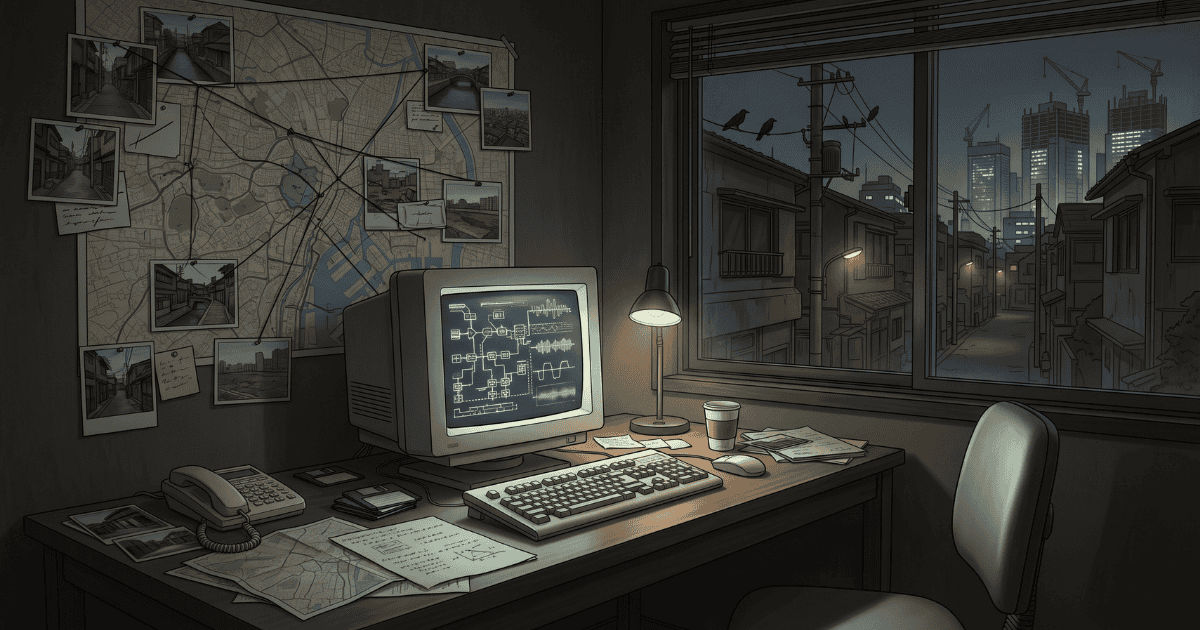
Mamoru Oshii’s animated feature Patlabor: The Movie opened on July 15, 1989, between the original OVA series and the television series. It still has a devoted following.
It is one of my favorite films. The more time passes, the more I am struck by how well it is made and how far ahead of its time the story feels.
Here, I want to explore the message of Patlabor: The Movie by examining the motives of Eiichi Hoba, the man behind the chaos.
First, let’s look back at the story. Why did Hoba set these events in motion? A warning before we begin: the synopsis and analysis below contain spoilers. If you would rather avoid them, watch the film before reading on.
*This is a translated version. The original (Japanese) is available here.
- Grief for a Vanishing Landscape
I read Hoba’s trail through Tokyo’s disappearing neighborhoods as an expression of anger at a city that renders its past worthless in the name of development. The places he shows the investigators embody memories and attachments that progress has trampled. - Chasing Godhood Through Death and Resurrection
Another possible motive is his desire to become a god through ‘death and resurrection.’ His delight at learning that ‘Jehovah’ was an incorrect pronunciation, together with his suicide and the crime designed to unfold after it, suggests this reading. - The Vengeful Spirit of Tokyo
If we revisit Oshii’s discarded idea that Hoba was a god rather than a man, we can read him as a vengeful spirit: the accumulated resentment of people whose past has been trampled by change. Either reading leads me to see the film as a warning against accepting development without question.
On this pageContents
Patlabor: The Movie (1989) Full Synopsis (Spoilers Ahead)
Quick Summary: A City on the Brink
- The HOS Suspicions
A Self-Defense Forces Labor goes berserk, followed by incidents involving unmanned construction Labors around Tokyo. Asuma Shinohara investigates independently and finds that every affected machine is running the new operating system, HOS. - The Black Box and the Low-Frequency Trigger
HOS is a black box even to Shinohara Heavy Industries, and there may be a virus-like element hidden in it. Asuma develops the hypothesis that low-frequency sound triggers the rampages, then becomes convinced he is right. - Tracing Eiichi Hoba
HOS’s lead developer, Eiichi Hoba, has already killed himself. His trail leads through landscapes being left behind by Tokyo’s development. Although the investigators find no evidence, his thoughts and actions suggest a plan to take revenge on the changing city. - The Decisive Battle at the Ark
Realizing that a typhoon could generate resonance that would send the capital’s Labors berserk, Special Vehicles Section 2 raids the Ark, the huge offshore facility. They destroy it and avert the disaster, but Tokyo’s development continues, and Hoba’s ideas have not entirely disappeared.
Character Map: The Players of Section 2
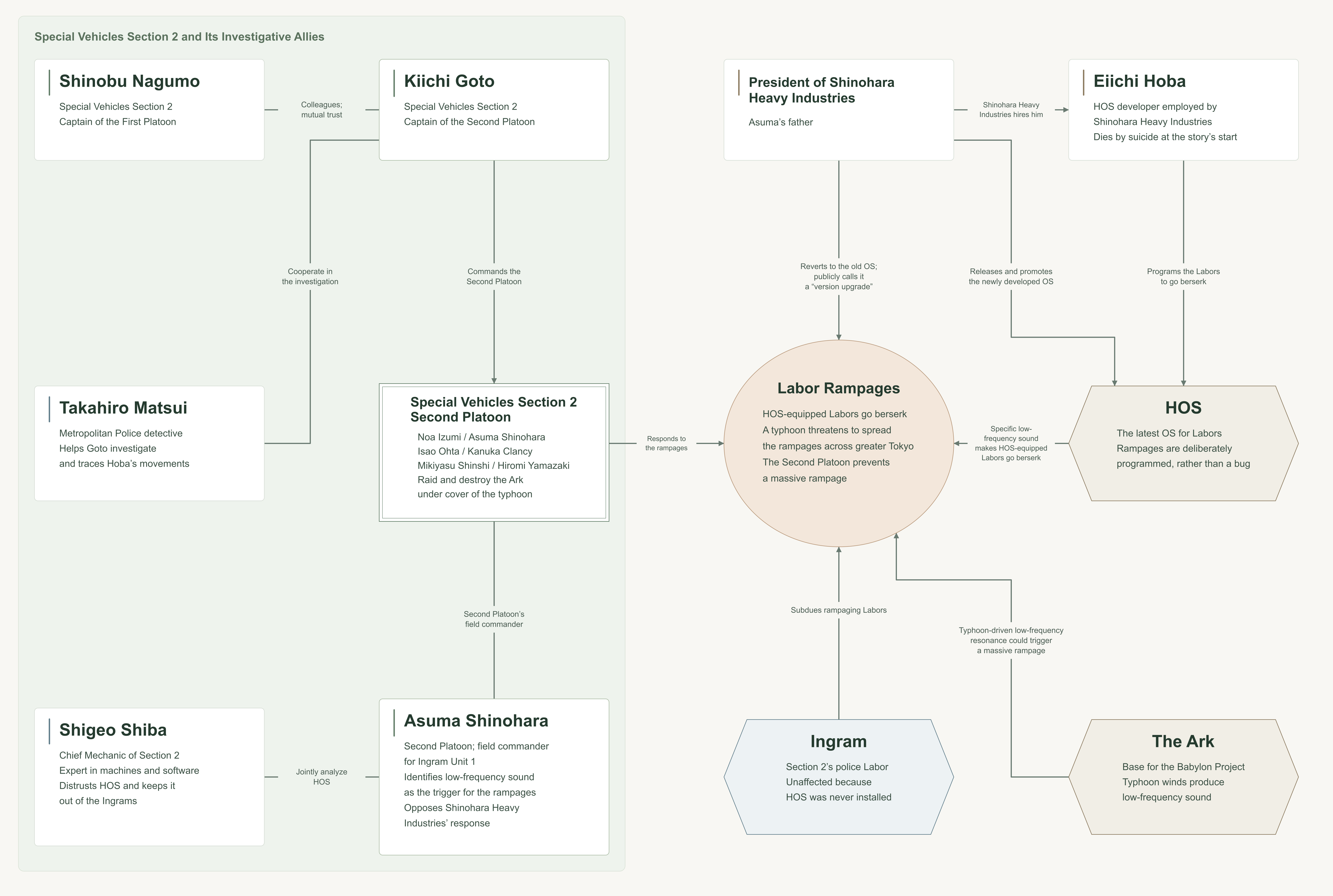
Let’s now look more closely at the story of Patlabor: The Movie.
Detailed Synopsis: From the First Rampage to the Ending
The First Rampage
One day in 1999, a Self-Defense Forces Labor suddenly goes berserk. The military sends in its prized airborne troops to subdue it, only to discover that there is no one inside.
Around the same time, construction Labors begin going berserk at sites across Tokyo. Their operators all report that the machines suddenly started moving on their own while they were working.
Troubled by what is happening, Asuma Shinohara begins investigating the incidents himself.
HOS: The Low-Frequency Trigger
He discovers that every Labor involved is running Shinohara Heavy Industries’ latest OS, HOS (Hyper Operating System). The incidents began shortly after it was introduced.
When Asuma reports this to Captain Goto, Goto says it is not enough, on its own, to establish that HOS has a bug. He also raises another possibility: perhaps there is no bug at all, and the rampages were programmed into it from the beginning.
To find out, Asuma and Chief Mechanic Shigeo Shiba visit Shinohara Heavy Industries.
While Shiba questions Jitsuyama about HOS, Asuma finds its master copy. As he examines it, he learns that the OS is a black box even to Shinohara Heavy Industries: the company does not fully understand it.
Now convinced that HOS is responsible, Asuma looks for the trigger. He hypothesizes that it is low-frequency sound produced at places such as construction sites, detectable only by the Labors’ sensitive sensors. Jitsuyama’s response when Asuma puts the theory to him convinces Asuma that low-frequency sound is indeed the trigger.
Meanwhile, the government and the Metropolitan Police, having received a similar report from Shinohara Heavy Industries, decide to replace HOS with the previous OS under the guise of a free version upgrade.
Asuma is furious that Shinohara Heavy Industries will face no consequences, but he thinks this will bring the matter to a close.
Goto, however, believes the case is not over.
Eiichi Hoba: Tracing a Dead Man
Separately from Asuma, Goto and Detective Matsui from police headquarters have been investigating HOS’s lead developer, Eiichi Hoba. He had broken into various systems to erase information about himself, making him highly suspicious. They discover that, shortly before their investigation began, he jumped to his death from the Ark, the base for offshore development.
Matsui continues investigating, but the only trail he can follow is Hoba’s birthplace and the 26 addresses he occupied over two years. All lie amid landscapes disappearing under Tokyo’s development, hardly the places one would expect a well-paid programmer to live.
Matsui finds no evidence, but his detective’s intuition tells him Hoba is guilty. Goto agrees.
The Decisive Battle at the Ark: Racing the Typhoon
Asuma investigates whether traces of the HOS virus might remain in various parts of a Labor’s system even after the OS has been replaced, allowing another rampage. He arrives at a frightening possibility: if typhoon-strength winds hit the Ark, the resulting resonance could send Labors across the capital berserk.
There is no guarantee that the virus is still in the systems. But a typhoon is approaching Tokyo.
Goto arranges for the senior officers at headquarters to turn a blind eye. He then orders the Second Platoon of Special Vehicles Section 2 to use the typhoon as cover while dismantling the Ark.
Despite having to fight the Ark’s guard robots and the Type Zero Labor intended for the First Platoon, the Second Platoon succeeds in dismantling the facility.
Hoba’s plan for a massive crime has failed.
Yet losing the Ark, the base for the Babylon Project’s large-scale offshore development, means a substantial delay to that project. Hoba did not win, but perhaps he did not lose either. And Tokyo, destined to keep changing, continues its development nonetheless.
That is my summary of Patlabor: The Movie. From here, let’s consider what Hoba’s motives might tell us about the film’s message.
Patlabor: The Movie (1989) Analysis: Eiichi Hoba’s Motives
To explore Hoba’s motives in Patlabor: The Movie, I think the most important place to start is what Goto and Matsui say.
What Goto and Matsui Say
At Goto’s request, Matsui uses Hoba’s residence records to visit the places where he seems to have lived. Everywhere, new development is replacing the old landscape. It is as though Hoba has deliberately led Matsui there to show him what is being lost.
After his investigation, Matsui says:
“Familiar landscapes from just the other day are rotting away over there, becoming ruins over here, and if you look away for a moment, they’re gone without a trace. Faster than you can think about what it all means. Maybe the past isn’t worth a damn here.”
Goto replies:
“This very place where we’re talking was the sea not too long ago. In a few years, a huge city will be born on the sea right in front of us. But I’m sure that too will become a worthless past in the blink of an eye. It’s like we’re playing along with a bad joke. Maybe that’s what Hoba wanted to show us.”
The memorable sequence in which Matsui and his subordinate visit Hoba’s former homes, together with this conversation, points toward Hoba’s motive. But why would the loss of a landscape become a motive for such a crime?
Hoba’s First Motive: Tokyo as a Hometown
I come from outside Tokyo, so its landscapes hold no childhood memories or nostalgia for me. That makes it easy to forget the obvious: Tokyo is someone’s hometown too.
But Tokyo, as the capital, is expected to change, and its appearance changes dramatically fast. People may barely have time to wonder why the places they knew as children now look entirely different.
Elsewhere, many people would sympathize with sadness at the loss of a beloved landscape, whether or not they lived there themselves. In Tokyo, however, I suspect grief for a disappearing landscape is less likely to receive much attention. Removing it will make life more convenient, and Tokyo is generally thought of as that sort of place.
To put it bluntly: “The provinces sell a today that is the same as yesterday, while the capital sells a tomorrow that is different from today.”
The ‘worthless past’ Hoba deliberately shows those tracing him is, in this reading, the feelings and attachments of people trampled in the name of growth.
Put in terms of a motive, it is anger and sadness at the loss of a landscape he loved. I think that anger itself carries the message of Patlabor: The Movie.
Oshii himself is from Tokyo, so I suspect there is a good deal of his own feeling in this portrayal of Hoba.
This does explain a motive. Still, anger at the loss of a beloved landscape does not seem enough to explain a plan that would kill so many people. Hoba even kills himself to carry it out.
There is a little more we need to consider about his motives.
Hoba’s Second Motive: Achieving Godhood Through Resurrection
One important piece of the puzzle is Kanuka Clancy’s report on Hoba. Goto describes it this way:
“I had Kanuka in New York look into his time at MIT, and apparently, they called him Jehovah (E. Hoba) over there. But there’s a follow-up to this. The correct pronunciation is actually Yahweh. Jehovah is a name that spread by mistake. When Hoba heard that, he was apparently ecstatic.”
Why would Hoba be ecstatic? That is a strange response to learning that his nickname, ‘Jehovah,’ was an incorrect form of God’s name. He was delighted to discover that he was not God. The English subtitles on my Blu-ray use the word ‘delight,’ too, so his happiness does seem clear.
If his delight is genuine, we somehow have to make sense of the fact that he was happy to be human.
The clues, I think, are his repeated biblical quotations and the extreme act of suicide. My proposal is that he wanted to become a god through ‘death and resurrection.’
Hoba was talented enough to create HOS himself, and I imagine that talent also took him to MIT. He probably went through life well aware of his own brilliance. He also knew that ‘Jehovah’ was hidden in his name.
But discovering the etymological error of “Jehovah” was likely his first tangible taste of failure.
Perhaps he thought along these lines:
Not knowing that ‘Jehovah’ was an incorrect pronunciation was a major failure: disappointing proof that I am not perfect, not a god. Until now, I could only think of myself as godlike. But if I am human, I can actually become a god through ‘death and resurrection,’ like Jesus Christ.
Everyone may have recognized his brilliance and flattered him with the name ‘Jehovah,’ but no one actually thought he was a god. Only Hoba thought that. Making other people accept such a belief would be extraordinarily difficult, usually impossible.
If he was human, however, he could make his divinity something others could recognize. Utterly deranged, of course, but this reading explains why he went to the trouble of killing himself: to become a god, he had to be resurrected; to be resurrected, he first had to die.
The story seems to present his suicide as a way to perfect his criminal plan, but that is not enough of an explanation for me. Once HOS was complete, he could have escaped somewhere, or stayed silent even if he was arrested, until the typhoon arrived. Death as a prerequisite for resurrection makes more sense to me.
So, what was his version of a “resurrection”?
It would be an extraordinary event that ensured the name ‘Eiichi Hoba’ would be remembered forever. A god is remembered across the ages.
In this reading, the heart of Hoba’s motive is to become a god by choosing death, then being resurrected through a crime that gives his name a place in history.
In that context, the biblical words he left in his childhood home (Psalm 18:9)—‘He bowed the heavens also, and came down: and darkness was under his feet’—read as a declaration that he would descend again as a god. In other words, they amount to his claim of responsibility for the coming crime.
That gives us one way to understand Hoba’s motives. But a comment by Yutaka Izubuchi, who handled planning and mechanical design, on the program BS Anime Yawa suggests another way to make sense of the film.
Hoba’s Third Motive: The Vengeful Spirit and the Red-Eyed Birds
On BS Anime Yawa, Izubuchi described how the producer and the other people involved had stopped Oshii from pursuing an idea: Eiichi Hoba had never existed as a human being; he had been a god all along.
That is quite different from the reading in the previous section, in which a human Hoba seeks to become a god. In this discarded version, he really is a god.
It is a rather far-fetched idea, but I think the story is easier to make sense of if Hoba is a god.
So far, I have considered two motives: grief and anger at the loss of Tokyo’s familiar landscapes, and his desire to have others recognize him as a god. Somehow they feel mismatched, as though two different things have been forced together.
But if Hoba was a god from the beginning, that mismatch disappears.
Hoba repeatedly quotes the Christian Bible, so the immediate association would be the Christian God. In a Japanese context, however, I am thinking of a raging deity, or an Onryo (a vengeful spirit)—and, more fundamentally, perhaps a formless presence associated with nature worship. If Hoba is such a spirit, he becomes the accumulated resentment of people trampled in the name of growth and dismissed as a ‘worthless past’.
Read this way, Patlabor: The Movie can also be a story about dispelling a curse.
This reading also explains why Hoba dies at the beginning and never appears again: he had no tangible form to begin with. His disappearance would express that, rather than merely perfecting his criminal plan.
It also gives meaning to the many red-eyed birds in the Ark’s uppermost sub-control room. In this reading, they embody the resentment of the people who were trampled. On the night the typhoon strikes, they wait quietly for the new landscape built at those people’s expense to fall apart.
In that sense, we might say that ‘ID: 666 E.HOBA,’ which Asuma and Shinshi see on the control-center screen, really is there. Of course, the display has only responded to an ID Hoba assigned to a crow. Yet, in this interpretation, the spirits are there too. Shinshi’s word ‘ghost’ is not entirely wrong; it may be exactly right.
Perhaps leaving Oshii free to pursue the idea that Hoba had never existed would have been another option. Entirely a thought in hindsight, of course.
Summing Up Hoba’s Motives
My conclusions are these:
If we consider Hoba as a human being, I see two intertwined motives: anger and grief at the loss of Tokyo’s familiar landscapes, and the desire to have others recognize him as a god. Behind his suicide, alongside the aim of perfecting his crime, there may have been the hidden purpose of dying so that he could be resurrected.
If we deliberately revive Oshii’s discarded idea that Hoba had never existed as a person, we can instead see him as a vengeful spirit: the collective anger and grief at the loss of that landscape. His actions become a curse, and his ‘suicide’ at the start expresses the absence of a human Hoba in the first place.
Whichever reading we take, I see the message of Patlabor: The Movie as a criticism of a society that accepts development and change as good without question.
I have written down all sorts of thoughts, but my most honest reaction to Patlabor: The Movie is simply: ‘It’s so good.’ Thinking about it matters, but so does remembering how much I enjoyed it the first time. I don’t think I will ever forget that. Patlabor really is wonderful. As for the two readings, I lean toward the combination of human motives. The vengeful-spirit reading is appealing too, but it depends on reviving a discarded idea. Still, I do like it.





Reader Comments