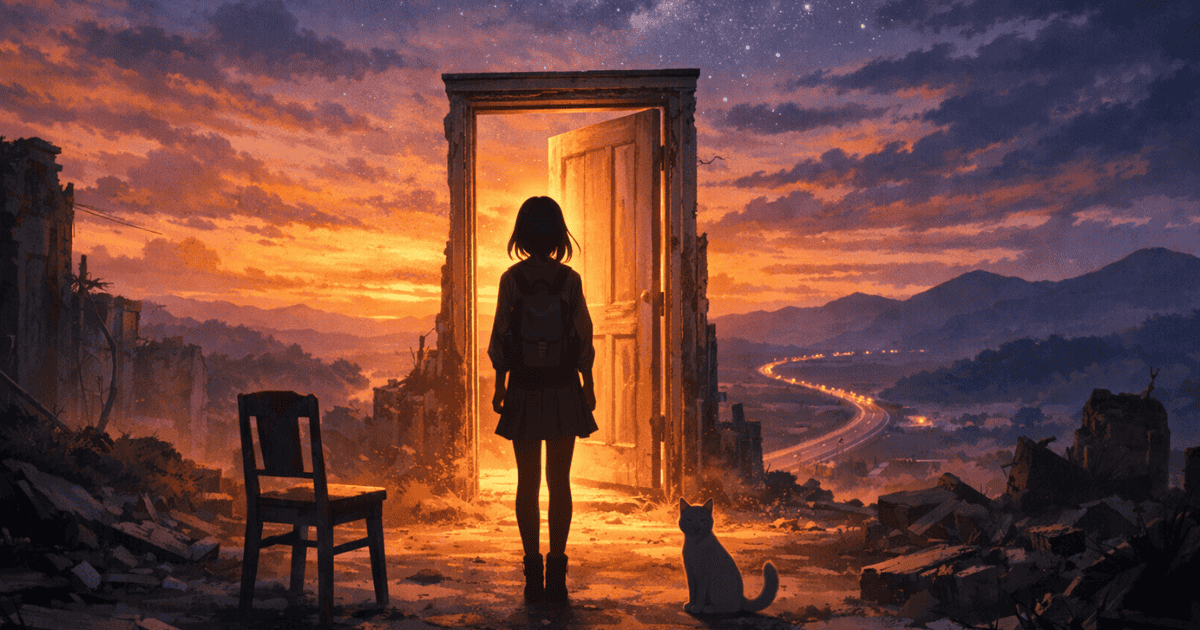
Suzume(Official) is a theatrical animated film directed by Makoto Shinkai, released on November 11, 2022. It was his first new film in three years since his previous work, Weathering with You.
I have been a fan of Shinkai’s work since The Place Promised in Our Early Days, but this time I had a slight lingering fear that “maybe I’m getting tired of Shinkai’s works.” The biggest reason was probably that the protagonist was a high school girl, but more than anything, I was terrified of becoming a painfully cringeworthy old man muttering “Makoto Shinkai is finished” after going out of my way to see his new movie.
However, as it turned out, that wasn’t the case at all, and I was able to leave the theater thinking, “Ah, that was a good movie.”
This time, while looking back on the synopsis of Suzume, I would like to think about what makes it so interesting. However, even though I say “synopsis,” I will write everything down to the end, so please be careful.
*This is a translated version. The original (Japanese) is available here.
- A Story Depicting the Ideal and Reality of Parent-Child Relationships
Suzume depicts the nature of parents and children and their growth through the conflict between the ideal adults who watch over without interfering, and the aunt who actually raised Suzume. A head-on parent-child quarrel becomes the key to mutual understanding. - The End of the “Secret of This World Trilogy” and the Approach to the Earthquake
This work is the final installment of the “Secret of the World Trilogy” following Your Name. and Weathering with You, and it finally depicts the Great East Japan Earthquake directly. With this, the series comes to a full stop, marking a work where the director himself has crossed a “mountain pass.” - Connections to Past Works and the Role of Music
Music like “Rouge no Dengon” and tracks by RADWIMPS color the story, making us feel a resonance with past Studio Ghibli films and Shinkai’s works. The use of music is also restrained, serving as a direction that maintains the balance of the work. - The Structure of the Absent Father and Selective Depiction
The fact that Suzume’s father is not depicted at all is due to the directorial intent to focus entirely on the “story of a woman taking back her mother,” and is a structure that forms a pair with the absence of the mother in Castle in the Sky.
On this pageContents
Suzume (2022) Full Synopsis to the Ending (Spoilers Ahead)
Key Points of the Synopsis and Character Map
-
A Mysterious Door Found in the Ruins
Suzume Iwato, a 17-year-old girl living in a rural town in Kyushu, chases after a young man she meets on her way to school one morning and discovers a single door in an abandoned hot spring resort. From there, a mysterious story surrounding the “door” begins to move. -
Encounter with the “Closer” Souta Munakata
The young man’s true identity is Souta Munakata, a “Closer” who travels around closing doors that invite disasters appearing in various parts of Japan. Suzume takes an interest in him and learns of the existence of the world beyond the door. -
The Mysterious Cat, Daijin, and Souta Turned Into a Chair
The “Keystone” necessary to seal the door changes its form into a white cat, Daijin, and Souta is turned into the shape of a small chair by him. Daijin’s mysterious actions cause further chaos. -
A Journey Across Japan to “Lock Up”
To prevent disasters, Suzume and Souta, in his chair form, embark on a journey to close the doors in ruins scattered across the country while chasing after Daijin. The help and warm interactions with the people they meet on their journey support Suzume’s heart. -
Suzume’s Past and Her Feelings for “What Was Lost”
As she continues her journey, Suzume comes face to face with her memories of the mother she lost in her childhood and her feelings for her aunt, Tamaki, who raised her. Ultimately, Suzume reaffirms her connection with her loved ones and returns to her daily life.
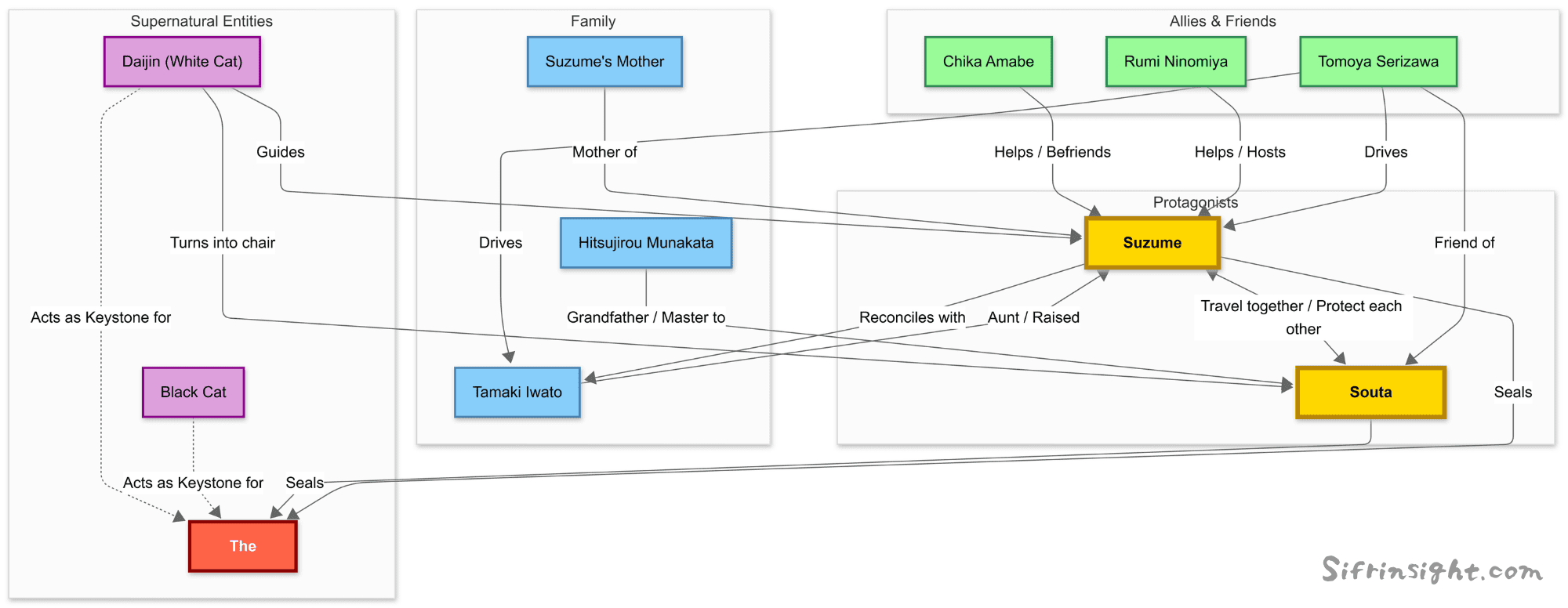
Character Map
Explanation of the Story
The main feature of Suzume is the first road movie among Makoto Shinkai’s works, starting from Miyazaki in Kyushu, passing through Shikoku, traveling longitudinally across Honshu, and reaching all the way to Iwate Prefecture.
Also, following Your Name. and Weathering with You, it is a story set against the backdrop of “3.11” and deals with the theme of “disaster.”
It can also be said that there was a new aspect different from his previous works in that it tackled the theme of “parent and child” within that context.
From here, let’s take a closer look at the synopsis of Suzume.
Until the Ending of the Story: Detailed Synopsis
From here, I will explain in detail the events from the encounter with the door in the ruins, the journey vertically traversing the Japanese archipelago, to confronting the memories of the earthquake and opening the door to the future in the ending (last scene).
Early Stages: The Encounter Between Suzume and the Closer, Souta
The protagonist of the story is 17-year-old high school student Suzume Iwato. She lives with her aunt in a quiet port town in Miyazaki Prefecture.
One morning, which was supposed to be like any other, Suzume meets a beautiful young man, Souta Munakata, on her way to school.
He asks her a strange question: “Are there any ruins nearby?” and Suzume honestly tells him the location of an abandoned hot spring town over the mountain.
Although they part ways there, Suzume, curious about Souta, follows him to the ruins. She is unable to find Souta there, but she discovers a mysterious door. When she pulls out an incomprehensible “stone” that is pierced into the ground as if watching over the door, it instantly changes shape into some sort of white creature and runs away.
Confused by the situation, Suzume nevertheless opens the door as if guided by something. A different world spreads out beyond the door. However, she cannot enter that world. Feeling something ominous, Suzume leaves the place and heads to school.
The Appearance of the Worm and Souta Turned Into a Chair
After arriving at school, Suzume feels a strange “premonition.” Immediately after, an earthquake occurs. Suzume notices an ominous object emerging from the vicinity of the hot spring town ruins.
Suzume is the only one who can visually perceive its existence.
Suddenly thinking that the beautiful young man might be there, Suzume heads to the ruins once again.
When she reaches the ruins, the ominous presence is overflowing from the door Suzume had left open. As expected, the source of that entity was this door.
And there was the figure of the young man desperately trying to close the door.
Despite struggling, Suzume, along with the young man, succeeds in closing the door. Suzume invites the injured young man to her home…
While treating his wounds, it is revealed that the young man’s name is Souta Munakata, that he works as a “Closer” while being a university student, and that a “Closer” is someone whose job is to check the condition of the “Rear Doors” located all over Japan and close them if necessary. At the same time, it also becomes clear that the entity (the Worm) that emerged from the door is the true cause of the earthquakes occurring across Japan. Past major earthquakes have occurred when the Worm emerging from the door maximizes in size and falls to the ground. Furthermore, the “Keystone” that was originally supposed to exist to seal the door was missing for some reason.
Just then, a scrawny white creature appears outside the window.
Upon hearing Suzume say, “Cute,” the scrawny creature quickly regains its vitality and takes back the form of an energetic white cat.
Souta immediately becomes wary of the strange entity, but by the power of the cat, who finds him a nuisance, he is sealed inside a chair. That chair missing one leg was something Suzume’s mother had made for her when she was little.
The white cat, showing its mysterious ability, quickly runs away, and Souta chases after it—in the form of a chair. Souta tries to attempt the pursuit alone, but Suzume, unable to leave him be, decides to chase the white cat along with Souta.
Suzume names the cat “Daijin” based on its demeanor.
Middle Stages: The Locking Up Journey Chasing Daijin (Ehime/Kobe)
Making full use of SNS, the two track the sighting information of the white cat and head straight for Ehime by ferry.
On a mountain path while tracking Daijin, Suzume meets a high school student of the same age, Chika Amabe. The two quickly hit it off, but Suzume notices that the “Worm” is appearing from the mountains once again. She is told that the location is where an abandoned school is.
When they head to the abandoned school, the entrance door has turned into a “Rear Door,” and the Worm is blowing out from inside. And there, they find Daijin.
Although they finally close in on Daijin, they must close the “Rear Door.”
Souta, who has been turned into the form of a chair, entrusts this mission to Suzume. The most important element for closing a “Rear Door” is the thoughts and memories of the people accumulated in that land. Suzume listens to those thoughts and succeeds in closing the “Rear Door.”
Although Suzume and Souta finish the big job, they ultimately let Daijin escape.
The two had rushed out of the house without any plan, but that night, they are allowed to stay at the guesthouse run by Chika’s parents. While thinking, “There must be some reason,” both Chika and her parents stay close to Suzume without asking anything.
The next morning, Suzume and Souta resume their journey to chase Daijin, but by chance, they get a ride in a car returning to Kobe. The owner of the car is Rumi Ninomiya, who runs the snack bar “Haabaa.” She was on her way home with her son and daughter.
Upon arriving in Kobe, Suzume is allowed to stay at Rumi’s house on the condition that she works behind the scenes at the snack bar. Here too, Suzume is not interrogated about anything and is given a warm place to stay.
That night, the “Worm” appears from an abandoned amusement park. Suzume and Souta head toward the amusement park.
According to Director Shinkai, the amusement park that appears here is “fictional,” but thanks to the hard work of volunteers, it is said to be a mix of Washuzan Highland, Otoginokuni Amusement Park, Roadside Station Fruit Flower Park, and Nasukawa Highland Park.
Here, the door of a Ferris wheel carriage has become a “Rear Door.”
Entrusting the “Rear Door” to Suzume, Souta tracks Daijin. While struggling, he closes in on Daijin and pleads, “Turn back into the Keystone!” but receives a mysterious reply from Daijin: “I’ve passed that role onto you.”
Meanwhile, Suzume is not only struggling with the “Rear Door” but is on the verge of being swallowed by the world beyond the door. Left with no choice, Souta opts to save Suzume, and they somehow succeed in closing the “Rear Door.”
However, Daijin gets away once again.
Fierce Battle in Tokyo: The Giant Worm and Souta as the Keystone
To track down Daijin, to protect the other Keystone that should be in Tokyo, and to meet his master/grandfather who is hospitalized, Suzume and Souta head to Tokyo.
Upon arriving in Tokyo, before meeting the grandfather, the two investigate the documents in Souta’s apartment. They search for the whereabouts of the Keystone that should be in the city, but even though they know it exists, they cannot find its location.
At that time, Souta’s friend Tomoya Serizawa visits the apartment. Unable to interact with him in the form of a chair, Suzume deals with him instead.
He looks a bit flashy, but like Souta, he belongs to the Faculty of Education and aims to become a teacher. He came all the way to the room worried about Souta, who hadn’t shown up for the teacher employment exam.
He had a slightly foul mouth, but seemed to be a trustworthy person.
After finishing dealing with Serizawa, the two head to Souta’s grandfather. However, on the way there, they encounter Daijin once again.
The two desperately give chase, determined to catch it this time, but Daijin escapes into a train tunnel under a bridge, making pursuit difficult.
And finally, the “Worm” emerges from the “Rear Door” in Tokyo. Its size is a giant one that vastly exceeds anything they’ve seen before, and it is assumed that the eastern “Keystone” located in the city has also been pulled out.
Suzume and Souta attempt to use Daijin as the “Keystone” to seal the “Worm,” but… the role of the “Keystone” had already been transferred to Souta, and to seal the “Worm,” there was no choice but for Souta to become the “Keystone.” Forced to make a desperate choice, Suzume and Souta have no option but to choose Souta as the “Keystone.”
The “Worm” that covered Tokyo disappeared. However, it required the great sacrifice of Souta. Devastated by the loss of Souta, Suzume still manages to discover the “Rear Door” located in the city.
In the world beyond the “Rear Door,” there is the figure of Souta, who has become the “Keystone,” but no matter what, she cannot enter that world.
Daijin appears there.
Daijin, who thought it had been playing with Suzume all this time, speaks to her affectionately, but Suzume rejects Daijin for causing her to lose Souta. Then, rapidly, Daijin becomes scrawny, reverting back to the state it was in when they first met.
Not knowing the method but unable to give up on Souta, Suzume decides to go see Souta’s master, his grandfather.
Souta’s grandfather, Hitsujirou Munakata, is in a severe medical condition, but to Suzume asking for help, he advises, “You should know where you need to go.”
Resolving herself, Suzume decides to embark on a journey to her hometown in the Tohoku region, her roots.
Journey to Tohoku: The Road Trip with Serizawa and Tamaki, and Their Reconciliation
Deciding to head north, Suzume meets Serizawa once again. Forcibly persuading Serizawa that it is a matter of life and death for Souta, Suzume is about to head straight north in a car driven by Serizawa… but then, her aunt Tamaki, who had finally caught up with Suzume, appears.
Tamaki tries to bring Suzume back immediately, but giving in to Suzume’s stubbornness, Tamaki allows Suzume’s journey on the condition that she accompanies her.
The scrawny Daijin appears there. Suzume accepts Daijin without particularly rejecting it.
With no right to refuse, Serizawa takes on the two troublesome passengers and one animal, and drives the car toward Suzume’s hometown.
Amid an awkward atmosphere, the group arrives at a highway rest area.
Although there had been small arguments along the way, the pent-up emotions they had accumulated finally explode here. In particular, her aunt Tamaki screams out her dissatisfaction with their life together so far, as if losing herself, and hurls it at Suzume.
For Suzume, it was a dissatisfaction she suspected Tamaki might be feeling, even if unspoken, but having it actually put into words is a massive shock.
However… behind Tamaki was the figure of a large black cat. Tamaki’s scream might have been partly her true feelings, but it could also have been the doing of the mysterious black cat.
Regardless, the group must head north. The heavy journey of three people and two animals, including the mysterious black cat that appeared, continues.
Just before reaching their destination, Serizawa’s clunky used car tumbles down a bank. The car, which had desperately driven north on the Tohoku Expressway, finishes its duty here.
Suzume tries to reach the destination on foot, but Tamaki decides to give Suzume a ride on an old bicycle she found nearby.
Although the two exploded with emotion at the rest area, it actually seemed to have improved their relationship and dissolved the “grudge” they had been turning their eyes away from. It seemed the two were able to make a fresh start as mother and daughter.
Climax: The Door to the Ever-After and Saving Souta
Suzume’s destination was the place where her home, where she once lived with her mother, used to be. For Suzume, who lost her mother in the earthquake, this land was a hometown she had no choice but to turn her eyes away from, but in order to save Souta, Suzume decided to confront herself.
At that time, Daijin starts walking as if to guide Suzume. At the destination Daijin headed to was a “Rear Door.”
Up until now, Suzume thought Daijin was opening the “Rear Doors” all over Japan, but only now does she realize that “Daijin was guiding us to the location of the next ‘Rear Door’ to open.”
Passing through this “Rear Door,” which is the “Door to the Heart” for Suzume, she departs for the world beyond to get Souta back.
In that world, like a volcanic zone, Suzume finds Souta. Prepared for the risk of the sealed “Worm” starting to move again, she rescues Souta, who had become the “Keystone.”
Then the giant “Worm” starts to move.
The “Worm” tries to crawl out into the present world through the “Rear Door” Suzume passed through.
Suzume and Souta succeed in sealing the “Worm” by using Daijin and another black cat as the “Keystones.” In fact, that black cat was the entity that had been the “Keystone” in Tokyo.
In the world where the “Worm” is sealed, Suzume encounters her childhood self. It was the figure of Suzume searching for her mother in the rubble of the earthquake during her childhood. Suzume had once wandered into this world.
Suzume hugs her past self. That was what the person she mistakenly thought was her “mother” in her childhood had done for her. And just as that person had done for her, Suzume hands the three-legged chair to her past self…
Late Stages/Ending (Spoilers): Sealing the Worm, Confronting the Past, and Returning to the Future
Having finished the big job, Suzume and Souta return to the present world.
Souta says he will set out on a journey once again to check the condition of the “Rear Doors” all over Japan.
Reluctant to part ways again, Suzume returns to Miyazaki with Tamaki. Along the way, Suzume and Tamaki reunite with the people who helped them and express their gratitude as mother and daughter.
Suzume, back in Miyazaki, has regained her daily life. Then, the beautiful young man searching for “ruins” appears there.
The above is the synopsis of Suzume. Since I am writing this based on the memory of seeing it once in the movie theater, I think there are many inaccurate parts, but I think it was generally a story like this.
So, what was so interesting about this film, Suzume?
Suzume (2022) Analysis and Explanation
The Theme of “Parent and Child” and “Parent-Child Quarrels”
As a road movie, Suzume depicts the kindness of the people Suzume meets along her journey. Chika in Ehime and Rumi in Kobe do not meddle deeply in Suzume’s circumstances, showing an extremely ideal figure of adults who think, “There must definitely be something going on, but let’s support her first.”
This might be the very “ideal image of a parent that adolescents wish for.” During the period when the ego to “decide for oneself” sprouts, interfering parents tend to appear as “entities that do not trust them.”
However, a “parent” in reality is an entity that has seen everything since the child was born. The desire to respect the child is mixed with doubts of “Not again” and the desire to “be relied upon,” which conflicts with the child’s growth.
The role of the “realistic parent” in this work is borne by her aunt, Tamaki.
Suzume’s journey to Tokyo was somewhat accidental, but the journey to Tohoku to confront her own past after losing Souta, the “journey from Tokyo,” is the true beginning of her road movie. And this journey also became an important journey for Tamaki, who raised Suzume, to face herself.
Tamaki’s ghostly monologue that explodes at the rest area along the way. That was the “true feelings” smoldering within her, and it was also something Suzume vaguely sensed.
This intense “parent-child quarrel” was a shocking “answer check” for Suzume, and at the same time, it was essential for dissolving the grudge the two had turned away from and normalizing their relationship. In this moment, Suzume essentially became an adult, and Tamaki could finally become a “true parent.”
This is not something necessary just because of the special relationship of a foster parent and child, but likely applies to all parent-child relationships.
The only solution mankind has discovered to overcome parent-child conflicts—that is the “parent-child quarrel.”
If there is a clear message embedded in Suzume, isn’t it “Have a head-on parent-child quarrel at least once in your life“?
The End of the “Secret of This World Series” and the Earthquake
I think Suzume will come to be spoken of as part of a Makoto Shinkai trilogy alongside Your Name. and Weathering with You.
One reason for this is that these three works are fantasy films that use the “secrets of the world” unknown to us as the propellent for the story. While they contain exquisitely sci-fi elements, I think they are fundamentally fantasies.
In that sense, these three works are, for me, “Makoto Shinkai’s Secret of This World Trilogy.”
So why is it a trilogy and not a tetralogy? Of course, it sounds better, but the decisive factor is probably the Great East Japan Earthquake.
Suzume is explicitly a story about the Great East Japan Earthquake. However, Your Name. and Weathering with You were definitely stories of that kind as well. Until now, he has spun stories in the form of “disasters” while somehow concealing that fact.
But this time, without hiding anything, he tackled the Great East Japan Earthquake head-on.
After the release of Weathering with You, I believe Director Shinkai stated, “There will probably be pros and cons regarding the ending,” but Suzume seems far more likely to generate pros and cons.
In other words, the fact that Director Shinkai directly depicted the Great East Japan Earthquake this time probably means he felt he had crossed a “mountain pass” in some sense. In fact, in the “Makoto Shinkai Book” distributed at movie theaters, he says the following:
In the case of Your Name., I could only touch upon it using dreams as an intermediary. However, my feeling that I could now touch it directly with my hands, that I *should* touch it directly, grew stronger. Or perhaps somewhere inside me was the feeling that I couldn’t delay touching it any longer.
Original Text in Japanese
「君の名は。」のときは、夢を媒介にして触れていくみたいなことしかできなかったんです。でも、今なら直に手で触れることができるんじゃないか、直に触れるべきなんじゃないかという気持ちが強くなっていった。あるいは、これ以上、そこに触れるのが遅くなってはいけないという気持ちもどこかにありました。
Your Name., Weathering with You, and Suzume form “The Secret of This World Trilogy” for me, but in reality—as everyone has noticed—it was the “Great East Japan Earthquake Trilogy.” And as can be seen from the quote above, Suzume marks a major “paragraph break.”
The scene at the end of the story where Suzume and Souta strike down the Keystone must have been the “full stop” declaring the end of the series.
Thinking this way, Director Shinkai’s next work will likely be something entirely different from the trilogy starting with Your Name.. Furthermore, it will not have the “COVID-19 pandemic” as a theme either. Because that has already been depicted in Suzume.
Now, what kind of work will Director Shinkai’s next project be?
Well, let’s wait patiently. That is all we can do.
Connection to “Kiki’s Delivery Service” and “Castle in the Sky”
In the latter half of Suzume, during the journey from Tokyo to Tohoku, Yumi Arai’s “Rouge no Dengon” plays. For many people, this song probably intensely evoked Kiki’s Delivery Service.
In the film, the reasons given are “the start of a journey” and “a cat,” but that’s probably not all. Kiki’s Delivery Service was also a story where the protagonist Kiki is supported by “ideal people who don’t ask questions.” This work also follows that structure, and perhaps “Rouge no Dengon” was a mandatory song choice to provide the elements of a woman, a cat, and a departure to serve as entities that conveniently support an impossible story.
And if we simplify Suzume to the extreme, it is a “story of saying goodbye to one’s biological mother and reclaiming one’s foster mother as a mother,” and it is a story of women through and through. As proof of this, Suzume’s father does not appear at all in this work.
We know of a situation similar to this. The absence of the mother in Castle in the Sky.
In Castle in the Sky, the father of the protagonist Pazu is spoken of, but his mother is not mentioned at all. That is probably because Castle in the Sky is a “story of taking back the father.”
A film must end in about two hours, and everything cannot be depicted. What is important is to make a choice about “what not to depict” rather than “what to depict.”
In Suzume as well, to focus entirely on Suzume’s growth and the “story of taking back her mother,” the story of her father was intentionally not depicted. It can be said that it was a strategic choice in terms of the narrative, forming a pair with the fact that Castle in the Sky did not depict the mother.
The Role Played by RADWIMPS’ Music
Since Your Name., what must never be ignored in Shinkai’s works is the music of “RADWIMPS,” or rather, Yojiro Noda.
When comparing Your Name., Weathering with You, and Suzume, I think the affinity or chemical reaction with that music stood out the most in Your Name.. Didn’t you all get goosebumps when “Sparkle” played?
Personally, I felt there was too much music in Weathering with You. They were all wonderful songs, and I like the songs themselves, but as a “movie,” there was almost enough sound to make you burp.
Located on the complete opposite side is Suzume.
The songs played were as wonderful as ever, but their usage was extremely restrained. Some people might find that lacking, but personally, I think that amount is just right. Perhaps Your Name. simply worked out *too* well, and that’s not something that can be done so easily.
I hope the duo of “Makoto Shinkai + RADWIMPS” will continue from now on, but I imagine the balance from here on out will be around the level of Suzume.
The above are my personal thoughts on Suzume. I’m sure there are other things to analyze, such as the mythological elements, but for now, this is about as far as “analyzing the story” goes.
What kind of film was Suzume for all of you?
Reader Comments