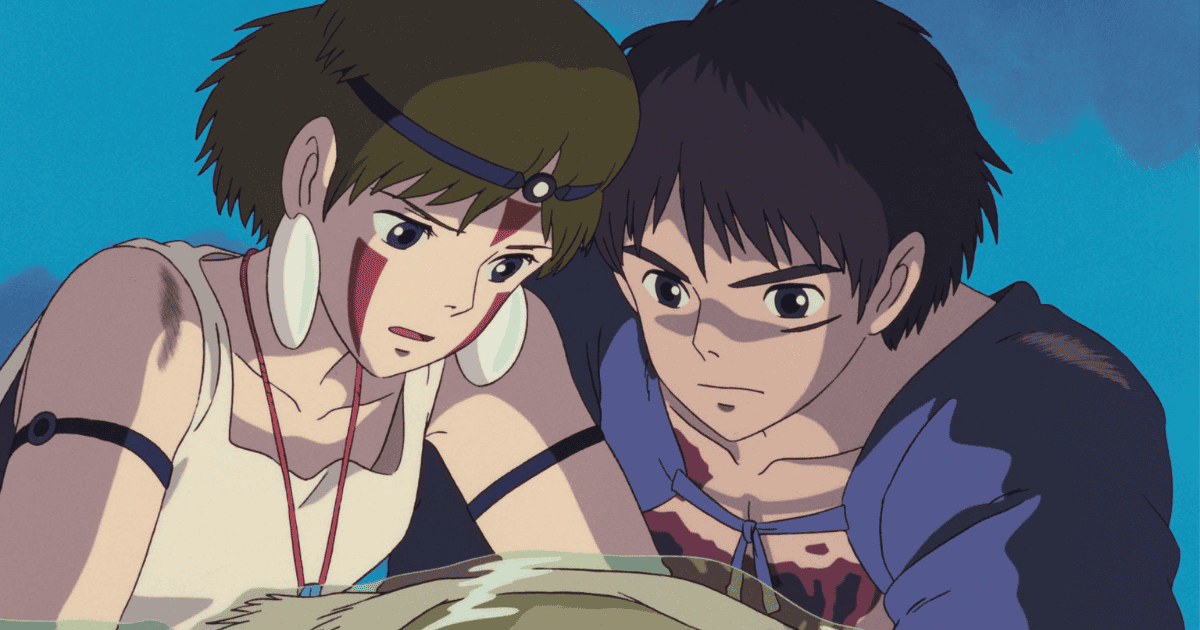
Princess Mononoke(Studio Ghibli Official) is a 1997 animated film directed by Hayao Miyazaki. In an earlier article, I considered why its end credits appear against a black background.
Read the full analysis: Why Are the End Credits of Princess Mononoke Black?
That article touched on the film’s content, but here I want to ask: “What was Princess Mononoke ultimately about?” I will approach the question through “deicide,” or the killing of a god. First, let us revisit the Forest Spirit’s physical form.
*This is a translated version. The original (Japanese) is available here.
- The Changing Form of God
Miyazaki’s Forest Spirit combines human, animal, and plant features rather than taking a human form. I read it as a symbol of a pure place people must not enter, and of the fear of night. The film captures a decisive change in how ordinary people imagine the divine. - Deicide and a Change in Values
In this reading, shooting off the Forest Spirit’s head destroys both sacred purity and fear. It marks a turn toward seeing nature as something to manage: a spiritual and religious shift, beyond environmental destruction alone. - Returning the Head with Human Hands
The healing of the bandaged people offers a little hope. I connect it with Ashitaka’s wish not to forget what humans themselves have done. The message I find here is less one of perfect righteousness than of living humbly with that awareness. - An Ending Connected to Our Present
Ashitaka’s future recalls our modern habit of consuming nature. Yet San keeps him connected to the forest. Perhaps his promise to live in Irontown and visit her is an encouragement to live sincerely while bearing those contradictions.
On this pageContents
Why Does the Forest Spirit Not Have a Human Form?
If someone asked you to draw a god, what would you draw? That may be too abstract; try a mountain god instead. I suspect many of us would give it a human shape, rather like the figures below.
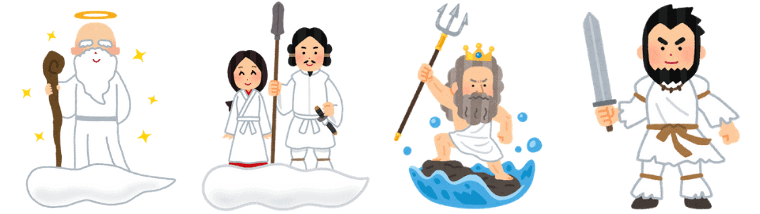
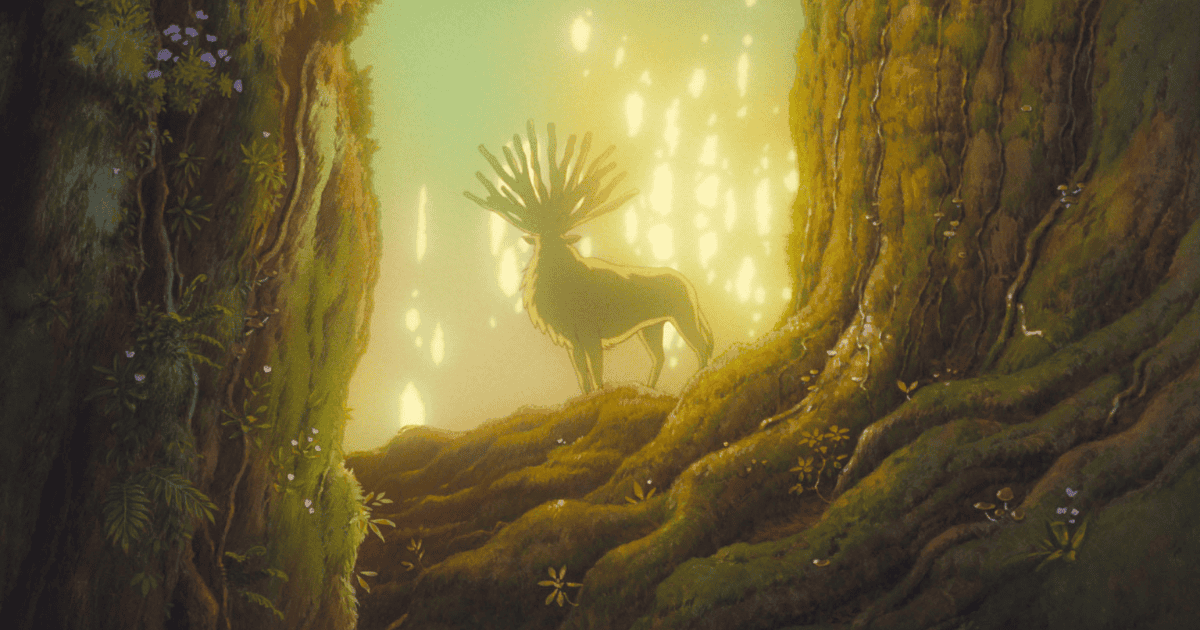
Having seen Princess Mononoke, we might deliberately avoid that shape. Left to ourselves, though, we tend to fall back on it. Miyazaki’s Forest Spirit, shown below, is not something our rather limited imaginations would readily produce.
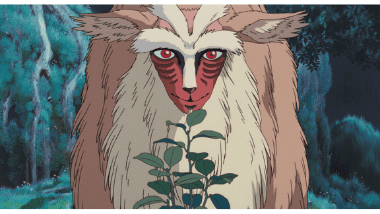
It is not simply a nonhuman shape: it brings several kinds of features together. In The Ghibli Textbook 10: Princess Mononoke (ジブリの教科書10:もののけ姫, in Japanese), Miyazaki describes it as follows:
“The Forest Spirit, which is the cornerstone of the story, is a completely imaginary animal with a human face, a beast’s body, and tree-like antlers.”
(Original Text in Japanese)
「物語のかなめのとなるシシ神とは、人面と獣の身体、樹木の角をもつまったく空想上の動物である。」
Its shape seems to symbolize the forest itself. For my reading of deicide, that striking form, beyond the ordinary imagination of people like us, is especially important.
The Changing Form of God and the Meaning of Deicide
When the Form of God Changes
To answer the question of what Princess Mononoke is about, I will state my conclusion first. Within the argument of this article, I see Princess Mononoke as:
a film depicting the moment when the image of god takes on a human shape in the minds of ordinary people.
Historically, I would place that change around the compilation of the Kojiki and Nihon Shoki, well before the Muromachi period in which the film is set.
But Princess Mononoke is not addressing that historical question so much as a folkloric one: how ordinary people’s way of thinking changes. The Muromachi period is often seen as an age when forms of culture that continue into the present began to flourish. People’s image of god probably changed gradually, almost unnoticed. What makes the film dramatic and interesting to me is that it captures a moment within that change.
What Does It Mean to Kill a God?
What, then, does it mean for the form of god to change? Here is another passage from Miyazaki’s interview in The Ghibli Textbook:
“There is a feeling that still remains strong as a religious sentiment among many Japanese people. It is the belief that deep within our country, there is a very sacred place where people should not set foot, from which abundant water flows and protects the deep forest. I strongly hold the religious sense that it is most wonderful for humans to return to such a place of sanctity.”
(Original Text, in Japanese)
「今も多くの日本人の中に宗教心として強く残っている感情があります。それは自分たちの国の一番奥に、人が足を踏み入れてはいけない非常に清浄なところがあって、そこには豊かな水が流れ出て、深い森を守っているのだと信じている心です。そういう一種の清浄感があるところに人間は戻っていくのが一番素晴らしいんだという宗教感覚を、僕は激しく持っています。」
If the Forest Spirit symbolizes the forest itself, it may also symbolize that pure place people must not enter. We must also remember its night-time form, the Night-Walker, or Didarabotchi.
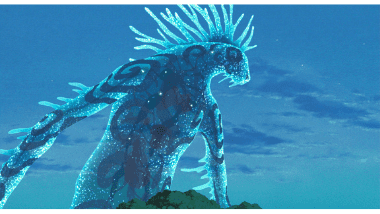
In the making-of documentary How Princess Mononoke Was Born (「もののけ姫」はこうして生まれた、in Japanese), the Night-Walker is described as a symbol of the darkness of night itself. Many of us remember feeling afraid of the dark as children. In that sense, it also symbolizes the fear within us.
Recall Eboshi’s shot. She cannot kill the god while it is in its Forest Spirit form. I suspect she could not shoot it down in its fully transformed Night-Walker form either. She strikes during the transition between them: in my reading, she destroys the pure place and the fear at once.
Deicide, then, means destroying both that pure place and that fear. In this reading, the god’s form becomes human because everything in the world is brought under human control.
How, then, does Miyazaki think people should live in a world where humans have become gods? I do not think he simply wants to say “Recover our fear!” or “Cherish the greenery!”
The interview above does speak of returning to such a place. Yet the film makes me think the answer is less straightforward. One reason is Ashitaka’s wish to return the head with human hands.
The Significance of “Returning It with Human Hands”
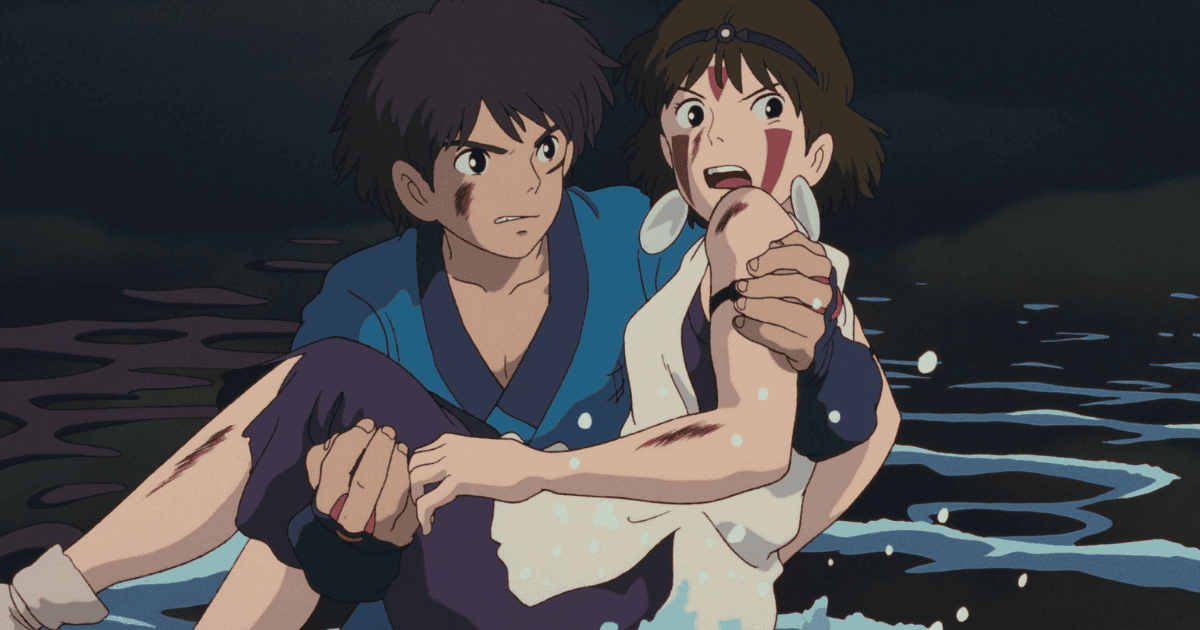
At the climax, Eboshi shoots off the Forest Spirit’s head. Jigo’s party tries to carry it away, but cannot escape the headless Night-Walker pursuing it. Jigo still refuses to surrender the head until Ashitaka and San persuade him. It is here that Ashitaka says he wants to return it with human hands.
Perhaps those words mean:
“At the very least, let us not forget that we are the ones who did this.“
Irontown is central to the film. Its ironworks require an enormous amount of wood. Yet that is not presented simply as a reason to condemn the town, which also shelters people rejected elsewhere. I see it as another part of human life that cannot easily be put right.
We make mistakes while believing we are doing good, and go on living all the same. But we must not forget those mistakes. Perhaps all we can do is carry that awareness and live a little more humbly.
At the end, the Forest Spirit regains its head, but too late: it falls to the earth. The forest engulfed in its collapse undergoes a little renewal. It does not return to its former state; it is on the way to becoming satoyama, woodland shaped by human use.
Yet an extraordinary miracle occurs: the wounds of the bandaged people have healed. It is almost the film’s only wholly affirmative scene.
Why does that miracle happen at the very end? Perhaps because Ashitaka and San return the head with human hands.
I think the bandaged people symbolize those with leprosy whose lives were taken from them through unjust isolation. That did not simply happen: it was something we did. Perhaps their healing is Miyazaki’s rare affirmative message—that a little awareness might allow a slightly better future.
Why Ashitaka Rides Yakul to Visit San
Finally, consider the last scene between Ashitaka and San. I was in sixth grade when Princess Mononoke was released, and as a child I found that ending terribly poignant.
Looking at it again as an adult, I see a scene in which deicide has set them on a path that continues into our present.
We take a bullet train to see a river, board a plane to see a forest, and take a boat to consume Yakushima. We live in an age of going to consume nature, without a continuous life alongside it or a sense of fear. Ashitaka has joined the path that leads to that present. Like us, he will live in Irontown and ride Yakul to visit San—the forest.
But he will not simply consume nature as we do: San is there. Caught between her and Irontown, he faces days of anguish. Miyazaki talks about this future to Joe Hisaishi in the making-of documentary, sounding rather pleased. After thinking it over, I begin to see another possibility.
Perhaps the scene might just be read as an encouragement from Miyazaki to the children of that time—my own generation:
“Children, things will not be simple. But live as fully as you can, even in anguish, just as Ashitaka does!“
Drawing the Threads Together
To bring these ideas together:
I read Princess Mononoke as a dramatic portrayal of the moment when ordinary people’s image of god becomes human. It presents deicide as the occasion for that change: we ourselves destroy our fear of what is sacred.
Ashitaka and San’s wish to return the head with human hands reminds us, in this reading, that the destruction of fear did not occur by itself. It is something we did, and of which we should at least remain aware.
Their inability to live together at the end resembles our own modern condition. For Ashitaka, who has stepped into that age, it marks the beginning of a “beautiful hardship.”
That, at least, is how I see it.
Princess Mononoke has many more facets than I have discussed here. Some readers will disagree, or find my thinking shallow. Still, perhaps saying this much would at least let me pull the wool over a few youngsters’ eyes.
An Additional Reading: Why Did Nago Flee East?
Nago is the force that sets Princess Mononoke moving and gives Ashitaka his curse. If the curse god symbolizes something we cannot do anything about, asking exactly why it attacks his village may miss the point.
But perhaps there is something to consider in its flight to the east.
Heading east brings to mind Emperor Jimmu’s eastern expedition and the campaigns against the Emishi. Much of the Japanese history we learn is the Yamato regime’s success story: beginning in Kyushu and extending its power eastward. Perhaps Princess Mononoke treats that success story ironically, as a process of losing fear.
In that reading, Nago falls victim to the guns of people who have lost their fear and seeks a way out in the east, where that fear remains.
For the descendants of the Emishi, who still know that fear, Nago appears “correctly” as a curse god.
Ashitaka’s cry for the god to calm its fury is the response of an Emishi descendant who knows that fear. Yet once he decides to strike back with an arrow, he too commits himself to the path we now follow. That is how I read the turn his life takes.
Sad, poignant, perhaps simply beyond remedy—Princess Mononoke remains a film that resists an easy reading.
The images used in this article are from Studio Ghibli Works Still Images.
Can you name the movie before the scene comes into focus?
Put your visual memory to the test with a blurred Studio Ghibli scene.
Reader Comments