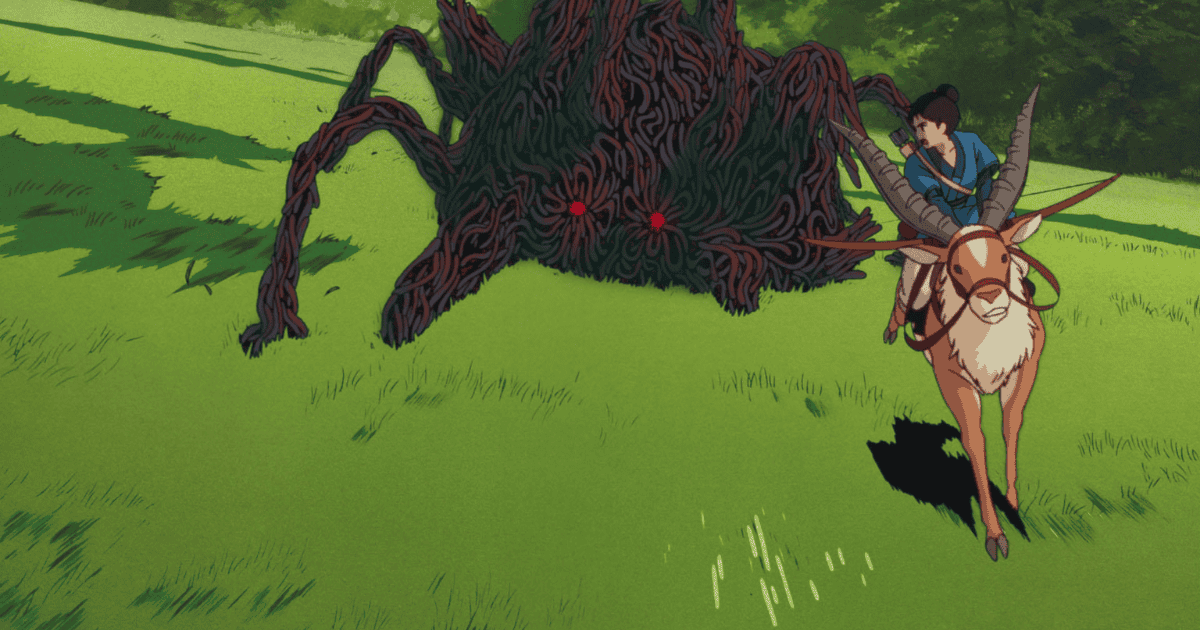
Hayao Miyazaki’s Princess Mononoke (Official Studio Ghibli Website) is an animated film released in 1997. Here, I want to consider a connection I see with the original 1954 Godzilla.
I will look at the Godzilla-like aspects of Miyazaki’s film, then consider why the curse mark on Ashitaka’s right arm does not disappear completely.
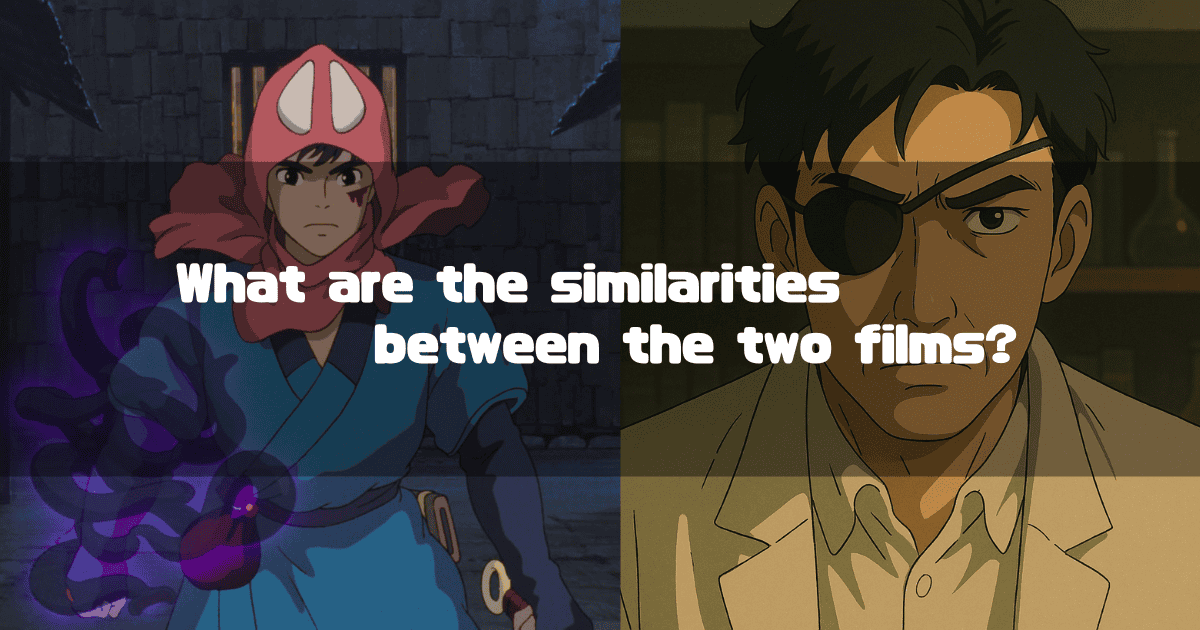
An important starting point is the resemblance between Dr. Serizawa’s eyepatch in the original Godzilla and the mark on Ashitaka’s arm.
First, let’s revisit the ‘absurdity’ and ‘unsolvable problems’ at the heart of Princess Mononoke.
*Note: References to Godzilla here mainly concern the original 1954 Godzilla.
*This is a translated version. The original (Japanese) is available here.
- Princess Mononoke as Miyazaki’s Version of Godzilla
The Tatarigami in Princess Mononoke is a disaster brought about by human actions, yet it strikes people who seem to have no connection to its origins. I see a close resemblance to the first Godzilla, and read the films together through their themes of absurdity and unsolvable problems. In this sense, the film can be viewed as a reinterpretation of Godzilla. - Ashitaka and Dr. Serizawa: Wounds of Absurdity
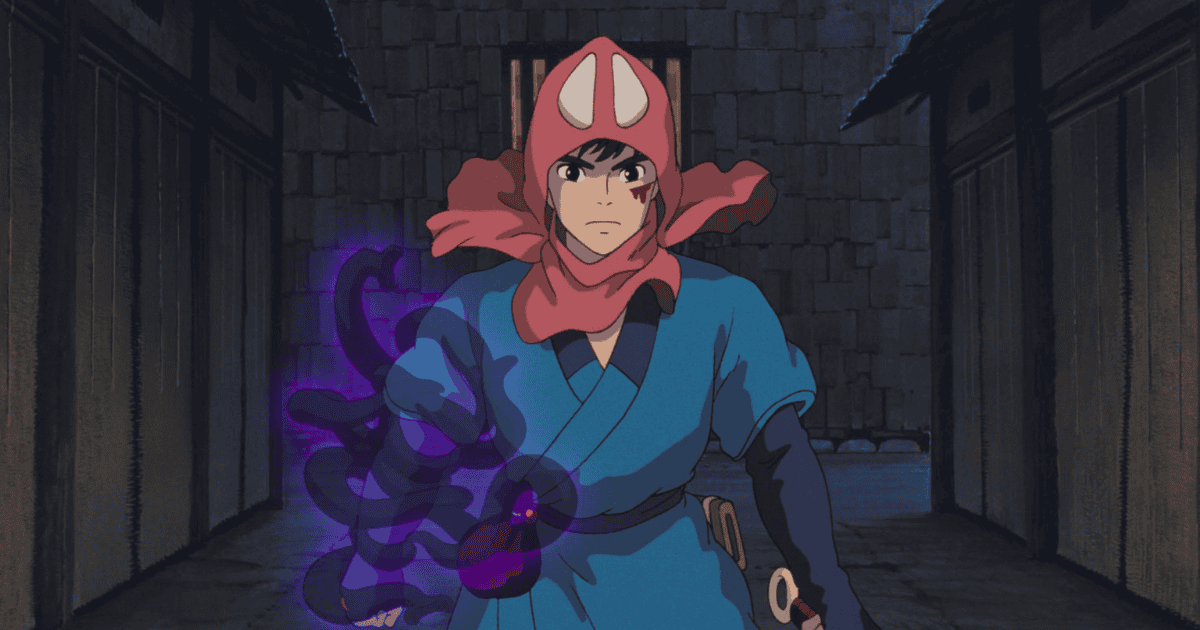
Ashitaka’s curse mark recalls Serizawa’s wartime injury and eyepatch. In my reading, both mark an unjust wound and can also express a destructive impulse. The parallels even extend to their losing the women they expected to marry. - Why Ashitaka’s Curse Mark Remains
The remaining mark can symbolize problems that do not disappear from the world. But we can also read Ashitaka’s survival as a response to Serizawa’s decision to die: live on, even with an unjust wound. Seen this way, Ashitaka is given the future Serizawa abandoned.
On this pageContents
Reading Princess Mononoke as Miyazaki’s Godzilla
The Curse: A Symbol of Absurdity and the Will to Survive
The story of Princess Mononoke begins with absurdity.
A Tatarigami attacks Ashitaka’s village for no particular reason the villagers can understand. Ashitaka defeats it and ought to be welcomed as a hero. Instead, he is cursed and made to leave his home in the name of ‘custom.’
This is the sort of absurdity that ought to make him want to scream. Yet Ashitaka leaves home with a broad smile for Kaya, his betrothed, as she sees him off.
Living with these contradictory things—absurdity and a broad smile—is something the people of Princess Mononoke share. I think their determined efforts to live are an important theme of the film.
More on this reading: Why Ashitaka Smiles Through the Pain
But can our modern society ever truly eliminate such “absurdity”?
The absurdity in Princess Mononoke appears through things we cannot control: the qualities we are born with, our birthplace, or natural disasters such as earthquakes. Technology might someday allow us to remove some of these difficulties. But then another question would arise: should we remove them through technology? Think, for example, of ‘designer babies.’
In other words, we can recognize the absurdities in our world, but we cannot offer a fundamental solution to them. Conversely, if we could offer a definitive solution, they would no longer be absurdities in this sense.
Depicting absurdity therefore also means presenting a problem that cannot be solved. I think this is why the ending of Princess Mononoke does not feel as though anything has truly ended: it has depicted something unresolved.
And whenever I reflect on cinematic keywords like “absurdity” and “unsolvable problems,” my mind immediately gravitates toward Godzilla.
The Demon and Godzilla: Twin Symbols of the Unstoppable
Godzilla was released in 1954, and new films in the monster series are still being made.
The explanations for Godzilla’s strange appearance and enormous power vary between films. In the 1954 original, as I understand it, he is a creature surviving from the Jurassic and Cretaceous periods, driven from his habitat by repeated hydrogen bomb tests at Bikini Atoll and altered by radiation.
Basically, then, Godzilla symbolizes the fear of nuclear weapons. In that sense, I think the original can be called an anti-nuclear and anti-war film.
But another important point is that we cannot clearly explain why Godzilla comes to Japan.
That is the case in the original, and I think films inheriting its spirit—The Return of Godzilla (1984), Shin Godzilla, and Godzilla Minus One—largely follow that pattern.
Whatever the reason, people have no choice but to respond to the threat. Doing so is extremely difficult: they only just manage to repel him, and suffer badly in the process.
Although Godzilla symbolizes the fear of nuclear weapons, I think he also becomes a symbol of disasters we cannot control, such as earthquakes and typhoons.
If we look at Godzilla this way, could we not say that the Tatarigami in Princess Mononoke is essentially Godzilla?
Consider these features of the Tatarigami in Princess Mononoke:
- It came into being through human actions: the use of an Ishibiya firearm.
- There is no explanation for why it attacked Ashitaka’s village.
- Humans brought it upon themselves, but those facing the immediate threat still have to remove it.
- Yet, after executing the “demon,” the villagers respectfully build a burial mound to enshrine its spirit.
We could read the Ishibiya as the hydrogen bomb, and the Tatarigami’s arrival is as inexplicable as Godzilla’s. I think building a mound and enshrining it also suggests guilt about killing it. A hard-to-explain sense of guilt similarly remains after the monster is defeated in Godzilla and The Return of Godzilla (1984).
It does not seem unreasonable, then, to read the Tatarigami as Miyazaki’s version of Godzilla.
As we return to the question of why Ashitaka’s curse mark remains, there is someone in the original Godzilla who suffered a similarly unjust fate.
Dr. Serizawa’s Eyepatch: The Scars of an Unforgiving War
Dr. Daisuke Serizawa is an important character in the original Godzilla. Though not the leading man, he is an exceptionally gifted scientist whose invention, the Oxygen Destroyer, ultimately defeats Godzilla. During the operation, however, he chooses to die alongside the monster, taking the weapon’s secret with him.
Serizawa lost his right eye in the war and always wears an eyepatch.
But his physical wound is only a fraction of his tragedy.
His mentor is Dr. Yamane, and he is regarded as engaged to Yamane’s daughter, Emiko. The film does not explain the details, but I imagine they would have married if nothing had intervened.
But Emiko is in love with Hideto Ogata and treats Serizawa as a friend. In the film, Ogata says:
“I know I shouldn’t hesitate, but when I think of Serizawa, I lose my nerve. If it hadn’t been for the war, he never would have suffered that terrible wound.”
Do you see what Ogata means? I hear him saying, ‘I took Emiko from Serizawa,’ and did so by taking advantage of the disadvantage Serizawa felt because of his injury.
For Emiko, being with the man she loves is a good thing, as is avoiding a marriage she does not want. She may have liked Serizawa as a person, but romance and marriage are another matter. In that sense, Ogata need not feel guilty, though he probably recognized Serizawa’s feelings for her.
But imagining Serizawa’s perspective is painful. His life had unfolded like this:
- He was a promising researcher,
- With Emiko as his de facto fiancée,
- Then he lost his right eye in the war,
- Perhaps partly for that reason, he stepped back from Emiko,
- And saw her become close to Ogata.
Losing his right eye was bad enough; he also lost the woman he loved. No wonder he ended up making an Oxygen Destroyer. The postwar world did not offer him much hope.
In this reading, the Oxygen Destroyer symbolizes the destructive impulse within Serizawa. We could even see Godzilla himself as an expression of that impulse. Godzilla becomes Serizawa’s other self.
I read Serizawa’s decision to die with Godzilla, using the Oxygen Destroyer, as an acknowledgment of both that destructive impulse and the end of his love for Emiko.
He seals away his hatred along with Godzilla.
What do you think? Do you see a resemblance to the Tatarigami and Ashitaka in Princess Mononoke?
Ashitaka’s Curse Mark and Serizawa’s Eyepatch
Serizawa’s eyepatch symbolizes the wounds of war. Yet there is no reason he, of all people, should have had to bear that wound. Both the war and the injury it inflicted on him are absurdly unjust.
To me, it has a striking resemblance to Ashitaka’s curse and the mark left on his arm.
The connection deepens when we examine the theme of the “destructive impulse.”
In Irontown, Eboshi tells Ashitaka that she shot Nago with the Ishibiya. His right arm begins to move violently, drawing his sword as though to attack her. They have the following exchange:
How did you read this scene? Perhaps you thought that Nago’s resentment, lodged in Ashitaka’s arm, was trying to kill Eboshi.
But if we take Ashitaka’s suffering into account, might it not be more natural to read it this way: Ashitaka wanted to kill Eboshi, using the curse’s power as an excuse, but held himself back through force of will?
The mark is certainly a sign of the curse. But it can also be read as an expression of Ashitaka’s own destructive impulse after suffering an unjust wound.
In that sense, Ashitaka’s mark and Serizawa’s eyepatch can be seen as the same thing: symbols of a destructive impulse.
Think back to the beginning of Princess Mononoke: just as Serizawa lost Emiko, Ashitaka lost Kaya. Is that not a striking parallel?
Princess Mononoke (1997) Ending Explained: Why the Scar Remained
A Point of Comparison: The Little Mermaid and Ponyo
To understand the ending of Princess Mononoke, we must take a brief detour and look at Miyazaki’s later work, Ponyo on the Cliff by the Sea.
In an interview in Ghibli Textbook 15: Ponyo (ジブリの教科書15 崖の上のポニョ, in Japanese), Miyazaki says:
“When I was nine, I read Andersen’s The Little Mermaid. In that story, the little mermaid turns into foam at the end because she has no soul. I just couldn’t accept that, and even now, I feel like I can’t forgive that kind of Christian thinking.
~Omitted~
So this time, I thought I would try to depict that kind of love with a happy ending. Whether it’s a happy ending or not might be perceived differently by each viewer, though.”(Original Text in Japanese)
「九歳の時にアンデルセンの『人魚姫』を読んだんです。あの話は、最後に人魚姫は魂がないからと言って、泡になってしまうでしょう。それがぜんぜん納得できなくて、いまだああいうキリスト教的な考え方は許せない気がしていたんです。 ~中略~ だから今回はそういう愛をハッピーエンドとして描いてみようと思いました。ハッピーエンドかどうかは見る人にとって受け取り方は違うでしょうけれども」
At the end of Ponyo, Ponyo does not turn into foam. She and Sosuke are brought together instead.
I am not claiming that Miyazaki habitually changes endings this way. But Ponyo gives us one example.
Could Miyazaki have done something similar in Princess Mononoke?
Why the Mark Remains: The Serizawa Who Lived On
The Inescapable Weight of Unsolvable Problems
One reason the mark remains, I think, is that it symbolizes the unsolvable problems that are a theme of Princess Mononoke.
The mark symbolizes absurdity. If it disappeared at the end, the conclusion would amount to: ‘I don’t really know why, but trying hard made it better!’ What a foolish, irresponsible ending that would be. If that were the point, why depict an unsolvable problem in the first place?
Yet the mark fades. Perhaps that expresses Miyazaki’s hope for the future: we cannot see a solution now, but someday we may find one. Until then, let’s believe in that possibility and do our best to live.
Miyazaki’s Cinematic Redo of the Original Godzilla
Thinking that the mark ‘did not disappear’ is discouraging. Thinking that it ‘faded’ reveals a small hope.
When I consider the resemblance between Ashitaka and Serizawa, that hope also begins to look like a forceful statement. It is as though Miyazaki were saying:
Serizawa! Why did you die? Why did you give up on this world? Live on, even so! I won’t kill Ashitaka! I’ll let him see the future you gave up on!
That is, of course, my own imagining. I have no statement from Miyazaki to support it. More than anything, it expresses a deeply personal feeling of my own.
Still, I think the comparisons above explain why such a feeling might have been present.
It is not a good idea to assume we know what Miyazaki was thinking. But I hope this comparison offers another way to enjoy both Princess Mononoke and the original Godzilla.
That is what I believe. And that’s that!
The images used in this article are provided by the Studio Ghibli Still Images collection.
Can you name the movie before the scene comes into focus?
Put your visual memory to the test with a blurred Studio Ghibli scene.

Reader Comments