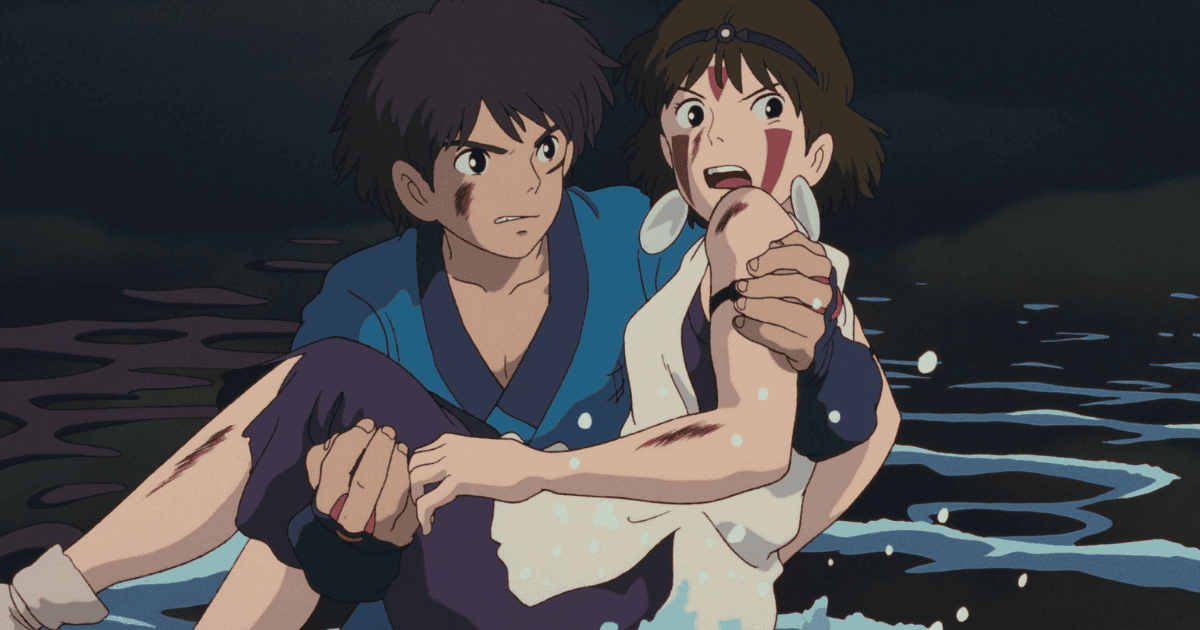
Princess Mononoke(Official Studio Ghibli Website) is an animated feature directed by Hayao Miyazaki, released in 1997.
Here, I want to revisit the film’s characters and English voice cast, and consider their lives, their appeal, and the stories they carry. What sort of people inhabit the world of Princess Mononoke?
The discussion below contains spoilers, sometimes without warning.
*This is a translated version. The original (Japanese) is available here.
On this pageContents
Princess Mononoke (1997) Main Characters & Voice Actors
| Name | Age | Voice Actor (English Dub) |
|---|---|---|
 Ashitaka | 17 | Billy Crudup |
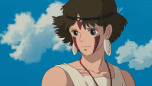 San | 15 | Claire Danes |
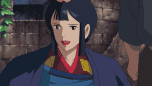 Lady Eboshi | Unknown[1] | Minnie Driver |
 Moro | 300 | Gillian Anderson |
 Okkoto | 500 | Keith David |
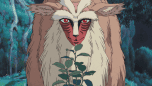 Forest Spirit | Unknown[1] | – |
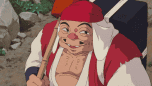 Jigo | Unknown[1] | Billy Bob Thornton |
- [1]
- No definitive ages are given for these characters.
Princess Mononoke (1997) Character Map
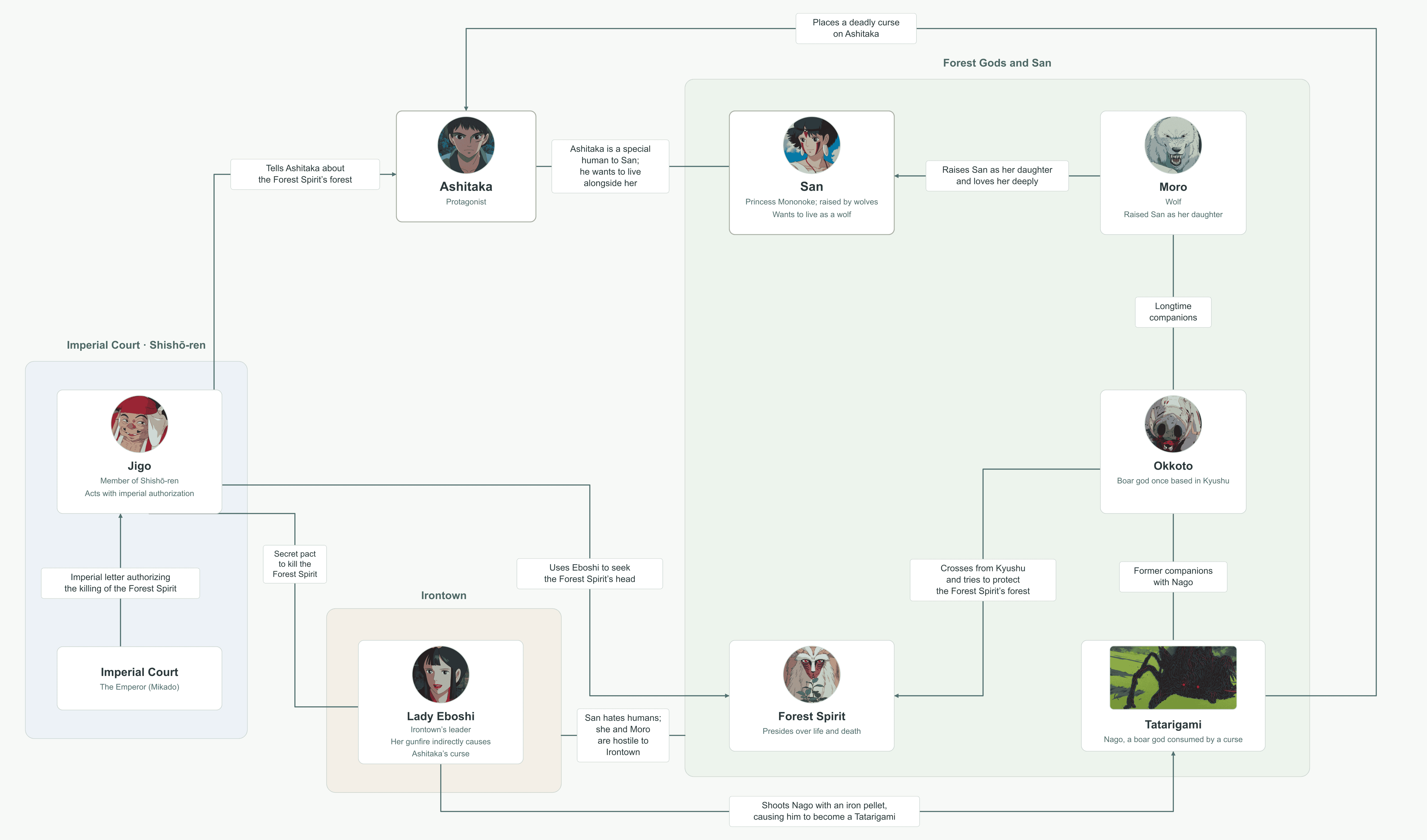
The story begins when a Tatarigami—a god consumed by a curse—attacks Ashitaka’s village. Ashitaka defeats it, but the curse he receives sends him on a journey in search of a cure.
After Jigo tells him about the Forest Spirit, Ashitaka heads toward its forest and encounters Lady Eboshi, who leads the ironmaking settlement of Irontown.
Character Profiles and Interpretations
Ashitaka | Voiced by: Billy Crudup
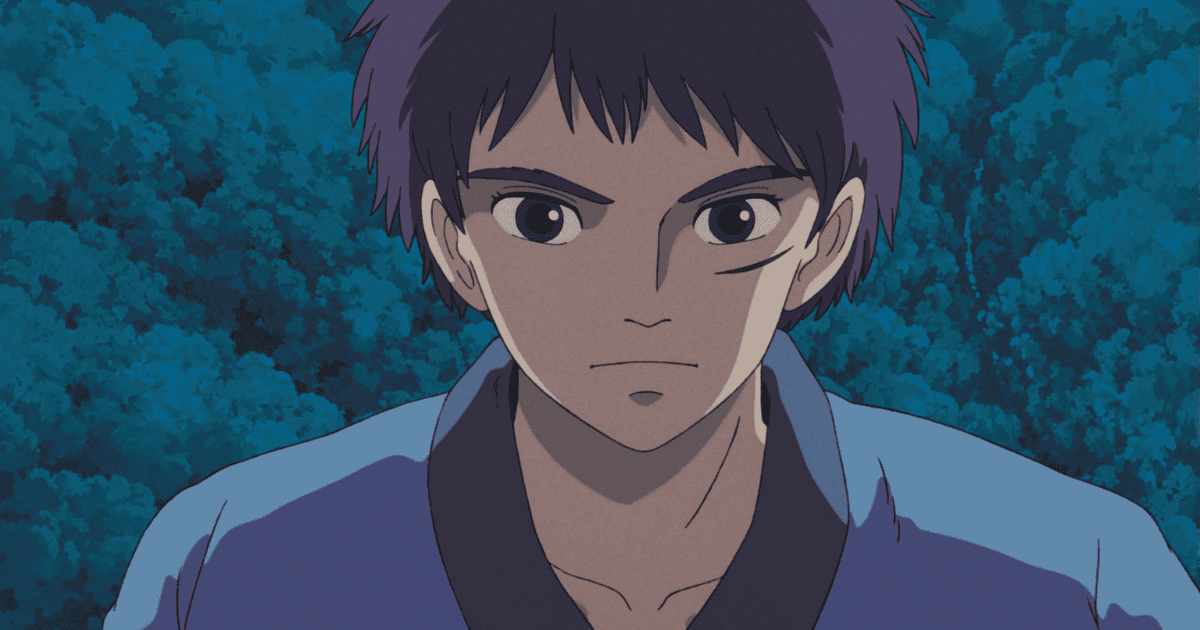
Ashitaka’s Basic Information
Ashitaka is the protagonist, aged seventeen. He lives among descendants of the Emishi in a mountain village in Tohoku. Princess Mononoke begins with a Tatarigami attacking his home.
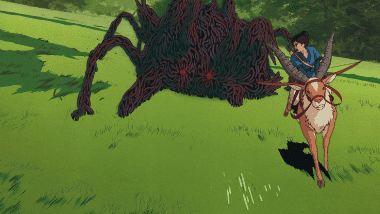
Ashitaka defeats the god, but receives its curse on his right arm and is exiled from his home because of it. That exile may be one of the things we most easily overlook when watching the film.
The villagers deeply regret losing their future leader. Yet Ashitaka leaves so resolutely that we may not fully grasp how harsh his situation is: he can never return to that village.
● Ashitaka’s Single Tear: A Turning Point
To someone traveling west without a destination or any hope of a cure, the Forest Spirit must have sounded like salvation. To put Jigo’s story in the language of an imaginary doctor’s referral:
“By the way, Ashitaka, much farther west there’s a place called the Forest Spirit Clinic. Dr. Forest Spirit is supposed to be a wonderful doctor. Perhaps he could cure your illness.”
The Forest of the Forest Spirit became the first destination Ashitaka had found on his otherwise aimless journey.
But the Forest Spirit does not lift his curse. In the terms of that same imaginary consultation, it is as though the doctor says:
“Ashitaka… well, perhaps the important thing isn’t whether your illness can be cured. Perhaps you need to think about how you’re going to live from now on.”
It is hard not to feel for Ashitaka at that moment. Faced with the fact that the Forest Spirit has not lifted his curse, he sheds his only tear in the film.
And the purpose of his life changes clearly on either side of that tear.
Before it, he is traveling for himself. After it, he is traveling for someone else.
We could give that a more respectable name—a journey for peace in the world—and that is how his actions appear on the surface. But I see a much more personal motive beneath them: “I will live for San.”
Seen as Ashitaka’s journey, the story begins with the tragedy of exile, then gives him a reason to live in San and a new home in Irontown. From his point of view, then, perhaps Princess Mononoke just barely has a happy ending.
● Kaya’s Dagger
We can feel almost limitless sympathy for Ashitaka when we focus on what he has endured. Yet he does one thing that leaves a little unease behind: he gives San the dagger Kaya gave him.
I still remember seeing it in the cinema as a child and thinking, “Wait—you’re giving that away?”
San’s delighted acceptance of it—and the way she makes it into a necklace—only adds to that unease.
Now that I am older, I feel I can make sense of Ashitaka’s decision. I have even come to think it is a good scene. I explore that in the article below:
Read the full analysis: Why Did Ashitaka Give Kaya’s Dagger to San?
What do you make of Ashitaka’s decision? His “You are beautiful” line can leave a similar unease: does it somehow imply that people who aren’t beautiful should die? I don’t think that is a fair conclusion, though the suspicion has lingered, almost like a curse, since the film’s release.
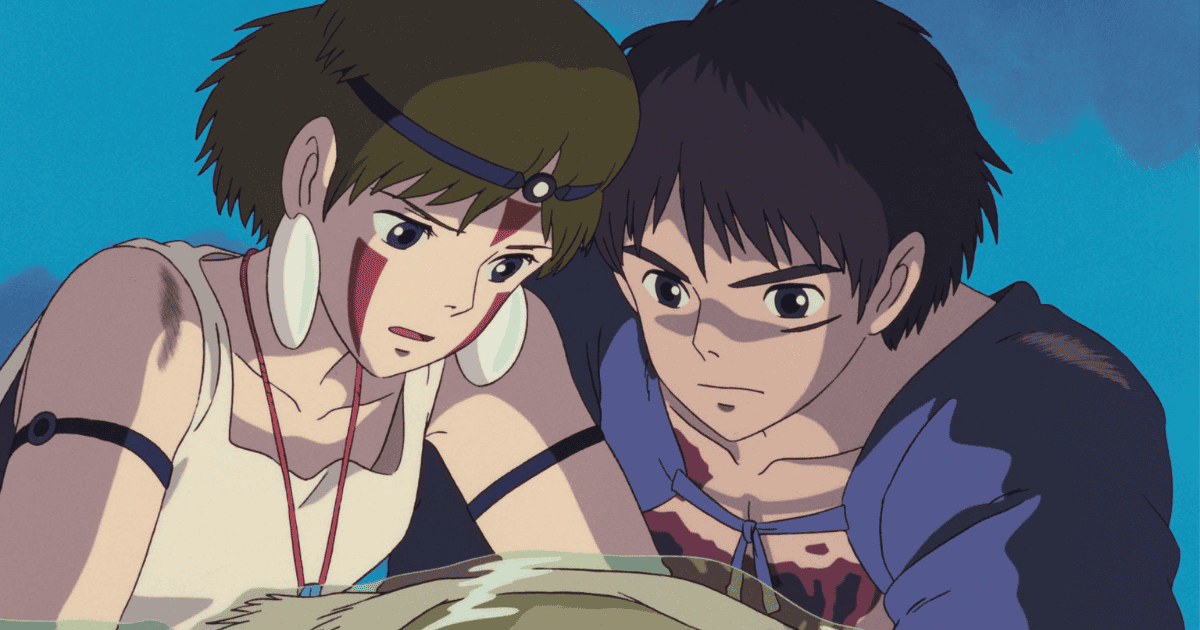
San | Voiced by: Claire Danes
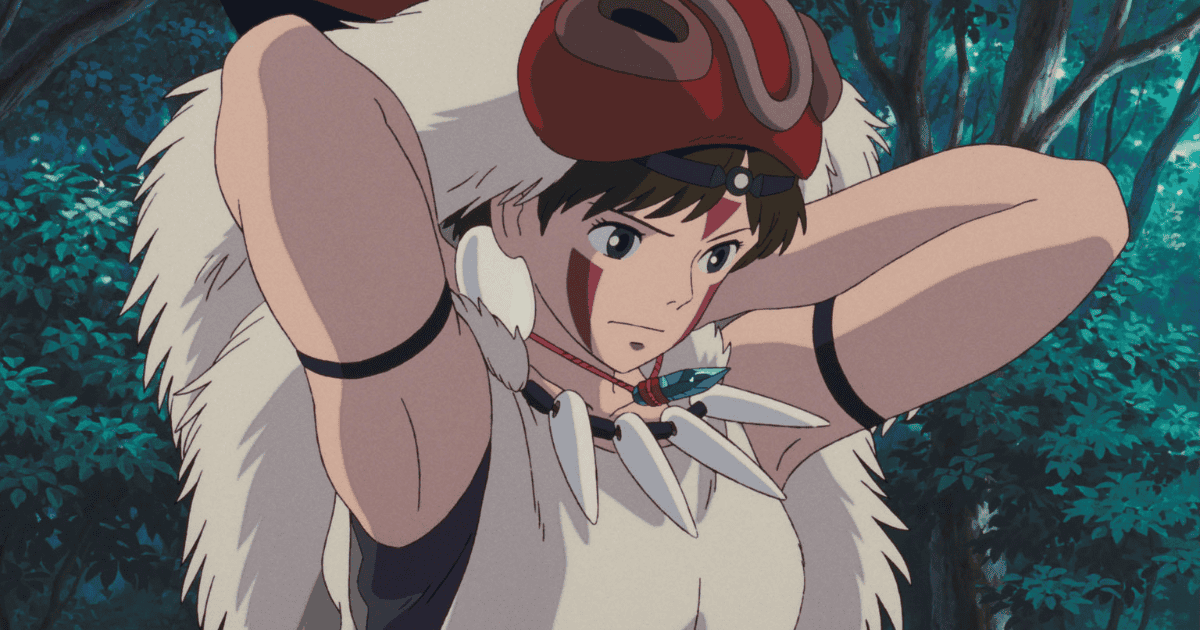
San’s Basic Information
San is the heroine, aged fifteen: a human girl raised by the wolf god Moro. Moro tells Ashitaka how she came to adopt her:
“I caught her human parents defiling my forest. They threw their baby at my feet as they ran away.”
San directs a fierce hatred toward humans and seeks Lady Eboshi’s head in order to protect the forest.
Yet she becomes remarkably friendly toward Ashitaka. She says it is because the Forest Spirit saved him, but her decision to carry him there in the first place seems unusual.
Had someone else stopped her attack on Irontown, she might have killed them rather than taken them to the Forest Spirit. No—she probably would have killed them.
In the end, doesn’t it come down to this: Ashitaka won her over by telling her, “You are beautiful”?
It is tempting to think she falls for him far too easily. But perhaps nobody had ever said anything like that to her before. Put yourself in her place, and the reaction is not so hard to understand. She is fifteen.
● What the Ending Means for San
Earlier, I described Ashitaka’s story as just barely reaching a happy ending. But what does the ending mean for San?
The ancient forest San fought so hard to protect suffers a devastating blow at the end of the film.
Some life does return. Yet we know how few places in Japan still have primeval forest—places such as Yakushima, Shirakami-Sanchi, and Shiretoko. In that sense, the Forest of the Forest Spirit really has been lost.
Might San’s own story begin after that ending?
Ashitaka’s story is about overcoming the ordeal of being cursed and driven from home. San, too, suffered abandonment as a baby before Moro raised her. But I cannot help feeling that her real ordeal begins at the end of the film. Afterward, she must:
- Live with the loss of the Forest of the Forest Spirit,
- Remain unable to let go of her hatred of humans,
- Remain unable to let go of her affection for Ashitaka,
- And live with the wolves in a forest that has lost its gods.
She will now face the kind of loneliness Ashitaka endured when he set off west with Yakul, with nowhere to go.
In the end, asking whether San gets a happy ending or a bad one may itself be meaningless.
I can only hope that Ashitaka becomes a source of salvation for San, just as she was for him.
Princess Mononoke really is a hard story to live through.
● San’s Red Markings Are Tattoos
The red markings on San’s forehead and cheeks are striking. They are tattoos, rather than paint.
The narration of the production documentary How Princess Mononoke Was Born explicitly calls them “crimson tattoos.”
What we do not have is any clear indication of when she received them. When did that happen?
Lady Eboshi | Voiced by: Minnie Driver
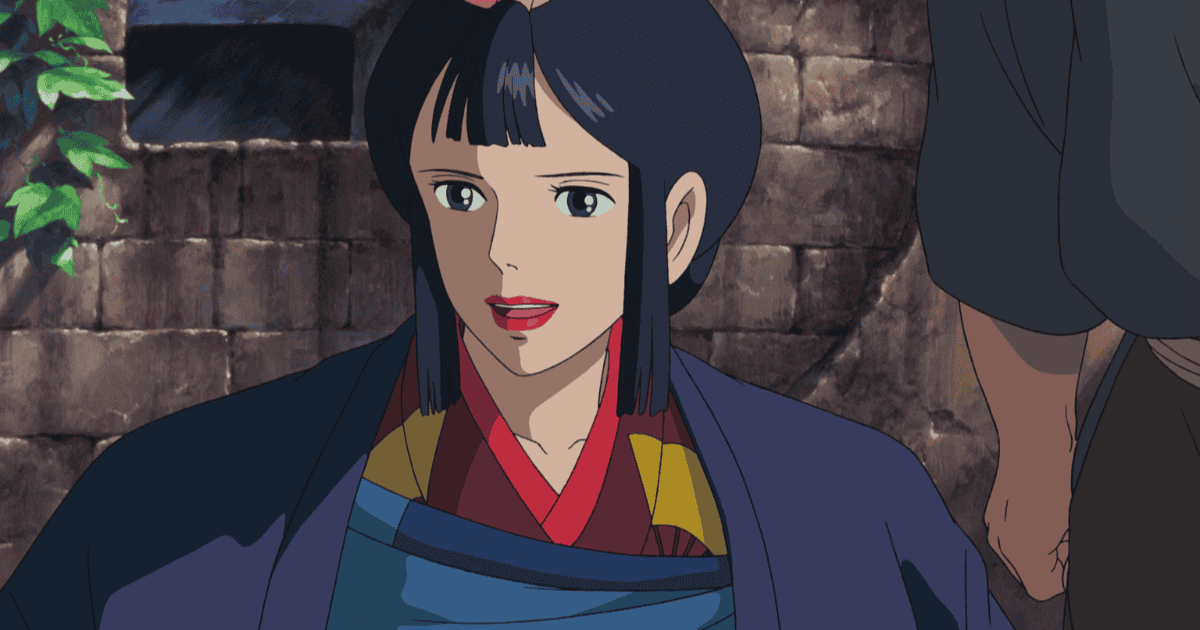
Lady Eboshi’s Basic Information
Eboshi leads Irontown, where Ashitaka arrives after being told to leave the very village he saved. She is also the person who tells him not to make a show of his little misfortune.
That may sound harsh, but Eboshi herself was made the wife of a Wakō pirate chief, then escaped after conspiring with Gonza to kill him.
Considering those humiliating days and the struggle to escape them, perhaps her words to Ashitaka are not so surprising.
● Lady Eboshi’s Dream
Besides directing iron production, Eboshi develops and manufactures firearms in her “secret garden.” The weapons she brought from Ming China were already effective, but she is determined to refine them further.
What is she trying to achieve?
There may be several answers. Personally, I think she is working to realize a dream of her own. I explore that possibility below:
Read the full analysis: What Is Lady Eboshi Trying to Achieve?
● The Mystery of Her Sympathy for San
Eboshi makes decisions that seem to combine cruelty with compassion. Early on, she readily abandons the men who fall into the ravine, yet she shows a curious sympathy toward San.
What does she see in this girl who is trying to kill her?
I consider the reasons for that strange sympathy in the following article:
Read the full analysis: The Psychological Mystery of Eboshi’s Sympathy and Moro’s Contradiction
Moro | Voiced by: Gillian Anderson
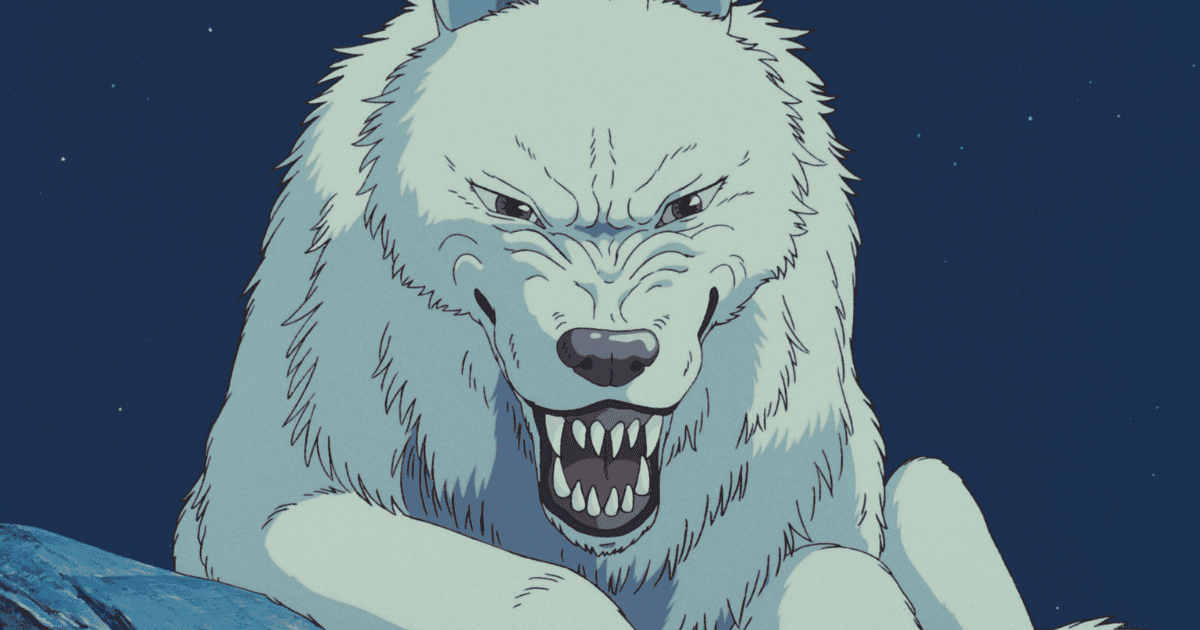
Moro’s Basic Information
Moro is a mountain god, roughly three hundred years old, who lives in the forest and seeks Lady Eboshi’s head.
Yet while fighting humans, she also lovingly raises San, the baby they abandoned out of fear of her.
Opposing humanity and raising a human child are not easy things to reconcile. We might reasonably call them contradictory. How has Moro felt about raising San?
Read the full analysis: The Psychological Mystery of Eboshi’s Sympathy and Moro’s Contradiction
● The Incredible Restraint of Moro
Moro’s most famous scene may be the one in which she tells Ashitaka, “Silence, boy!”
Just before that, Ashitaka urges her to set San free because she is human. It sounds like a fine line from him—until you think about it from the perspective of the wolf who raised a child abandoned by her own parents.
From Moro’s side, I imagine the response is something like: “What on earth are you talking about?”
Perhaps her restraint—stopping at “Silence, boy!”—comes from knowing that San has feelings for Ashitaka.
Watching San carefully nurse him, Moro may have thought, “San really is human, after all.”
It is a sad possibility: that roar may be her last resistance to a fact she does not want to accept.
The scene looks like an outburst of her true feelings, but perhaps it also reveals her generosity. This kind of double-sidedness seems to me one of the film’s themes.
● Lore Detail: Moro and Okkoto Were “Close”
One detail almost impossible to work out from the film alone is that Moro and Okkoto were once “close”—in other words, lovers.
Hard as that may be to believe, Miyazaki discusses their relationship during the recording of their reunion scene in the production documentary.
I am curious about what their romance was like, but even more curious about where it happened. Okkoto comes from Kyushu, across the sea. Where did they meet?
Okkoto | Voiced by: Keith David
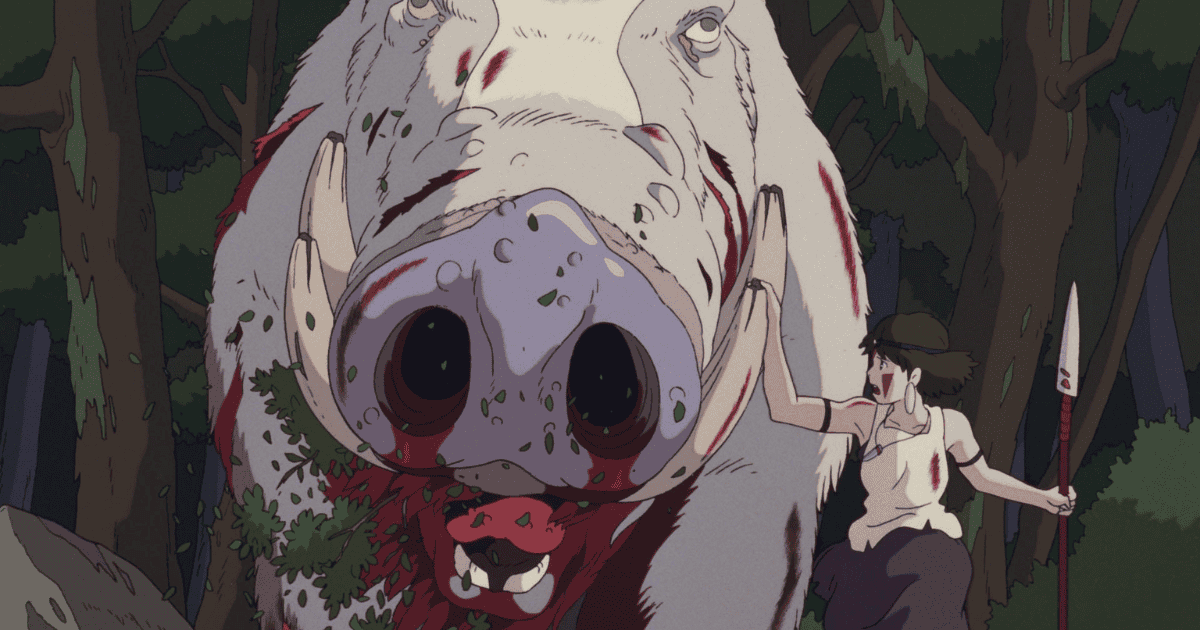
Okkoto’s Basic Information
Okkoto is a boar god who comes to the forest from Kyushu, bringing his clan with him.
His arrival with the whole clan, and his vow to make the humans pay even if every last boar dies, suggest to me that the boars had already lost their struggle against humans in Kyushu.
The boars seem to regard protecting the mountains as their responsibility. Perhaps that is why they cannot accept Nago’s retreat and transformation into a Tatarigami.
● Okkoto as Ashitaka’s Opposite
As mentioned, Okkoto and Moro were once lovers. But how did the lord of Kyushu meet her across the sea?
This is more fantasy than a serious reconstruction, but I imagine something like this:
Young Okkoto had a parent ruling Kyushu, but still had a little freedom left. He used it to travel. In the renowned Forest of the Forest Spirit, he met young Moro, and they fell in love. Then he had to return home to rule, leaving her behind.
Perhaps they had a romance along those lines. In a sense, Okkoto lived the very opposite of Ashitaka’s life.
Ashitaka lost the days he should have spent with Kaya and met San in the forest. In my imagined version, Okkoto enjoyed his days with Moro, returned home to have the family he was expected to have, and came back to see his old flame at the end of his life.
If Ashitaka had reason to resent anyone’s good fortune, surely it was Okkoto’s.
Forest Spirit (Night-Walker)
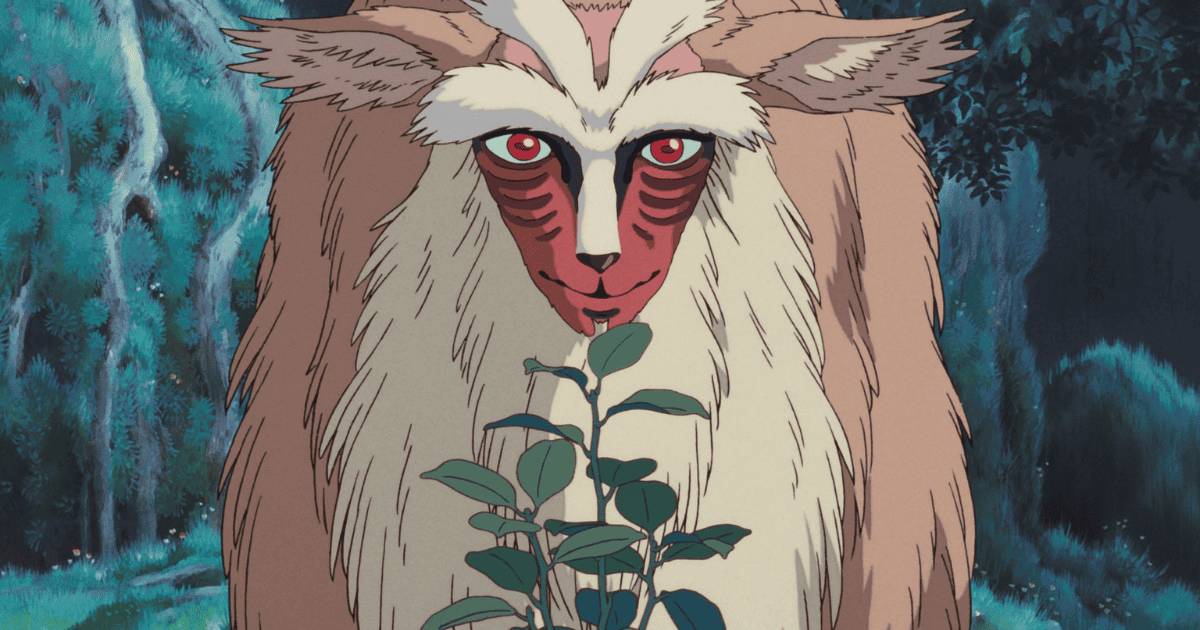
Forest Spirit’s Basic Information
The god who inhabits the forest has branching, tree-like antlers, a face resembling a monkey’s—or a human’s—and an animal’s body. It looks like an embodiment of the many forms of life in this world.
It has the extraordinary power to give life and take it away.
Ashitaka travels to the forest hoping it will remove the curse on his arm, but the curse is not completely healed there.
Jigo seeks its head on behalf of the Emperor, who desires immortality. Eboshi helps him under an agreement with the imperial court.
At night, the Forest Spirit becomes the enormous Night-Walker, or Daidarabotchi. Miyazaki depicts it as night itself: its huge form seems like the night sky moving.
Jigo | Voiced by: Billy Bob Thornton
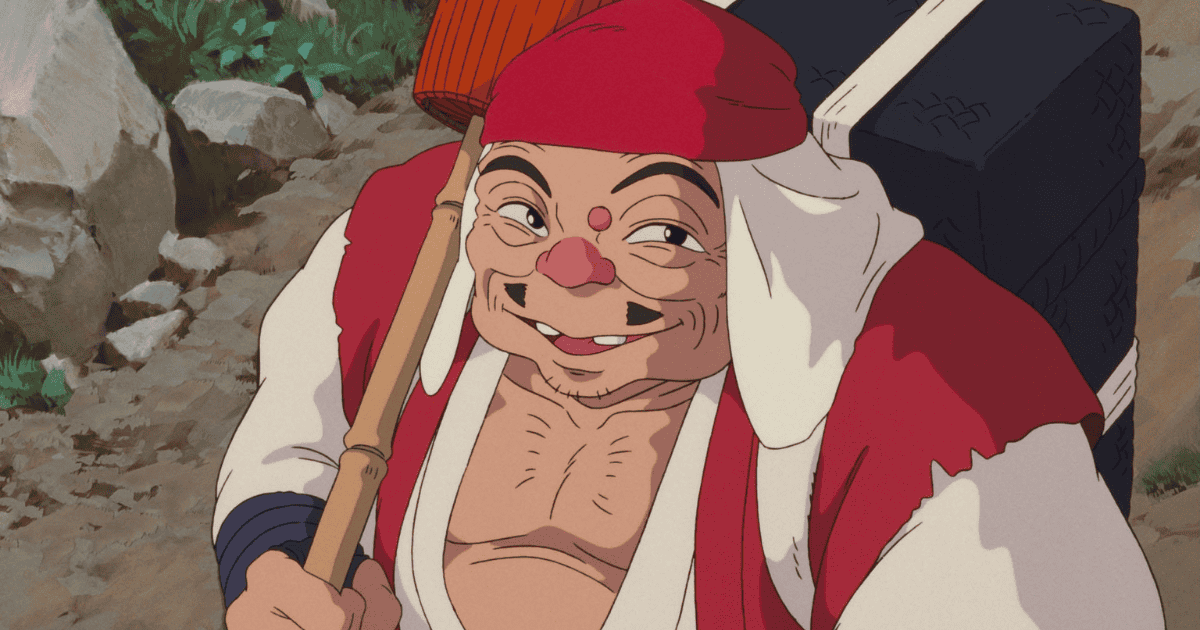
Jigo’s Basic Information
Jigo gives Ashitaka the first hint about the Forest Spirit after seeing the iron pellet that turned Nago into a Tatarigami.
Ashitaka does not get the cure he hoped for, but he finds a new home in Irontown and meets San. In that sense, Jigo may give him the greatest helping hand of anyone in the film.
Still, Jigo is a crafty fellow. I suspect that, when he first meets Ashitaka, he already knows the forest holds an answer of some kind. He gives only a hint, keeping the rest to himself.
● The Mysterious Shishō-ren
Jigo belongs to the mysterious Shishō-ren and displays astonishing agility. His imperial commission makes the group seem like an organization directly under the Emperor, but the film gives us too little information to be certain.
In the production documentary How Princess Mononoke Was Born, a concept painting shows figures who appear to belong to the Shishō-ren carrying a Ming monk in a palanquin.
Perhaps, in an early version of the story, the organization was based in Ming China.
Kohroku | Voiced by: John DeMita
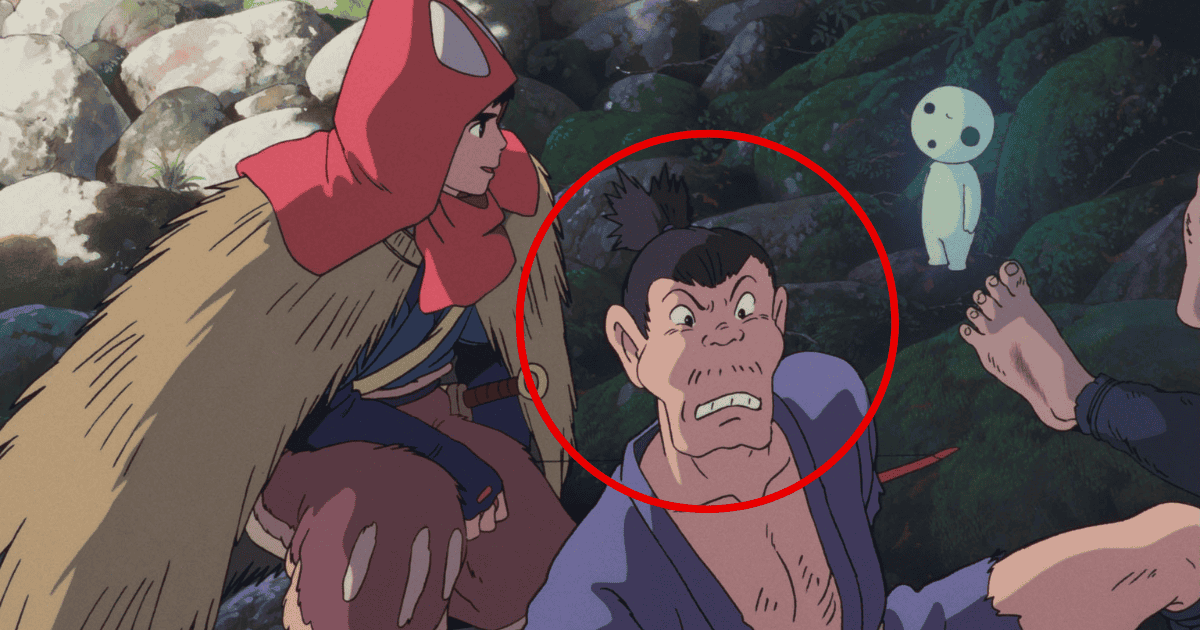
Kohroku’s Basic Information
Kohroku falls into the ravine during Moro’s attack early in the story. Ashitaka finds him and saves his life.
That heroic act helps make the people of Irontown warmly disposed toward Ashitaka.
When Ashitaka finally decides to live in Irontown, he will probably be welcomed with open arms.
Gonza | Voiced by: John DiMaggio
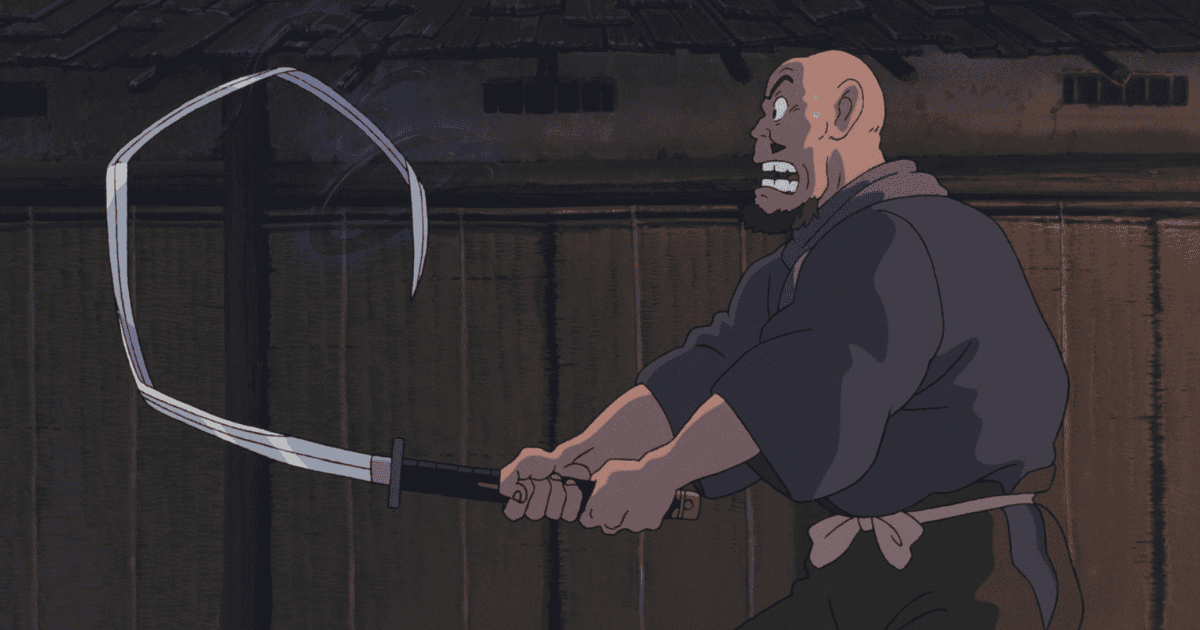
Gonza’s Basic Information
Eboshi’s imposing, stern-looking attendant also serves as comic relief. Somehow, his appearances give us a moment to relax amid the tension.
He has served Eboshi since her days among the Wakō pirates, and is clearly devoted to her.
He is probably a capable swordsman, too. I would have liked to see him get a chance to show it.
Toki | Voiced by: Jada Pinkett Smith
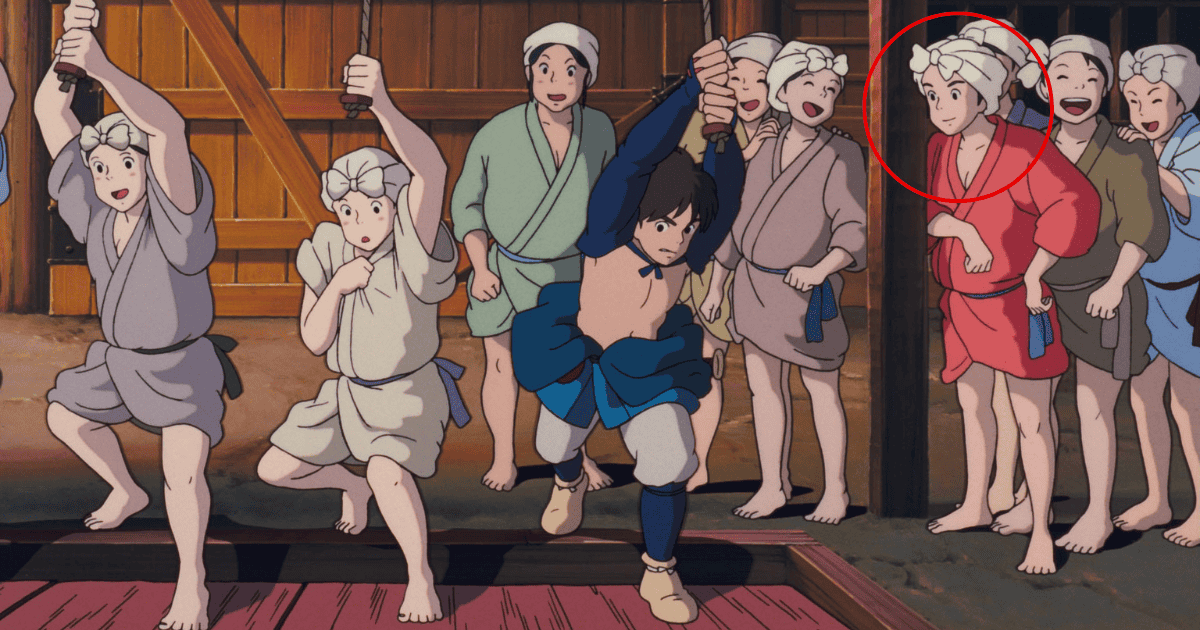
Toki’s Basic Information
Kohroku’s strong-willed wife has the air of a formidable working mother. Whether that comes from her own temperament or from life among the women of Irontown is hard to say.
The way she directs the women shows that she is an excellent leader.
The Wolves
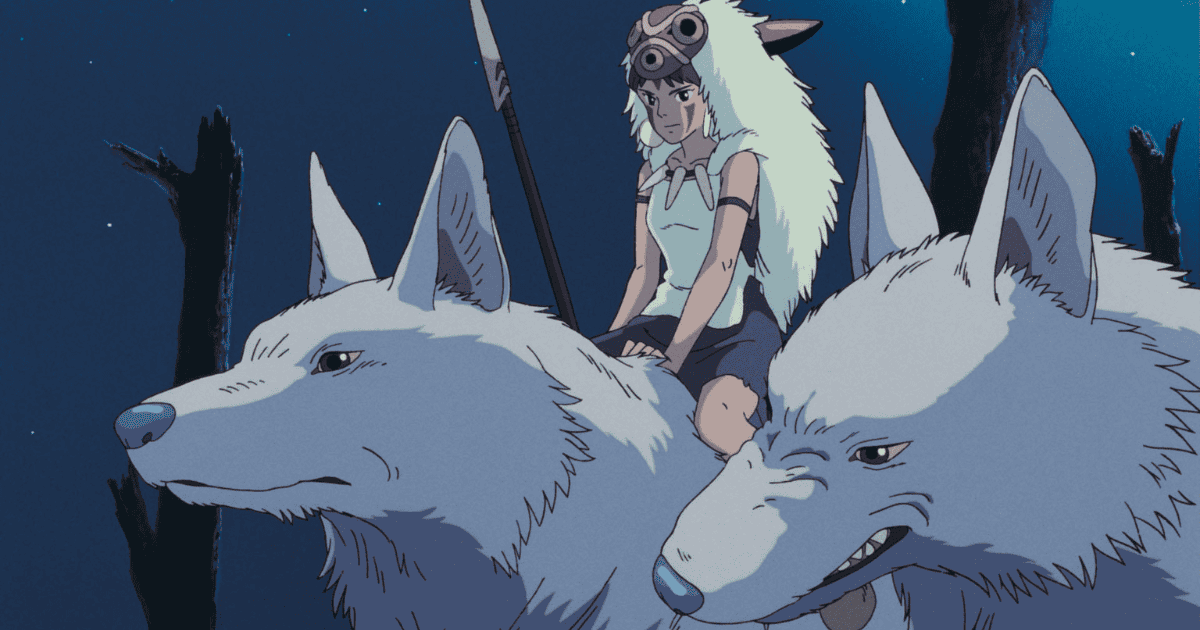
Wolf Clan’s Basic Information
Moro’s biological children are San’s brothers, although they are not related to her by blood.
They are clearly smaller than Moro. Is that an example of the shrinking generations Okkoto describes, or will they grow larger with time? I do not know. Personally, I think they have reached their full size.
The line I cannot forget is one wolf’s question: “Can I eat him?”
I was in the upper years of primary school when I saw the film in the cinema, so I only chuckled. The younger children around me laughed properly. That is one of Miyazaki’s gifts: when he means to make us laugh, he does.
Hii-sama | Voiced by: Debi Derryberry
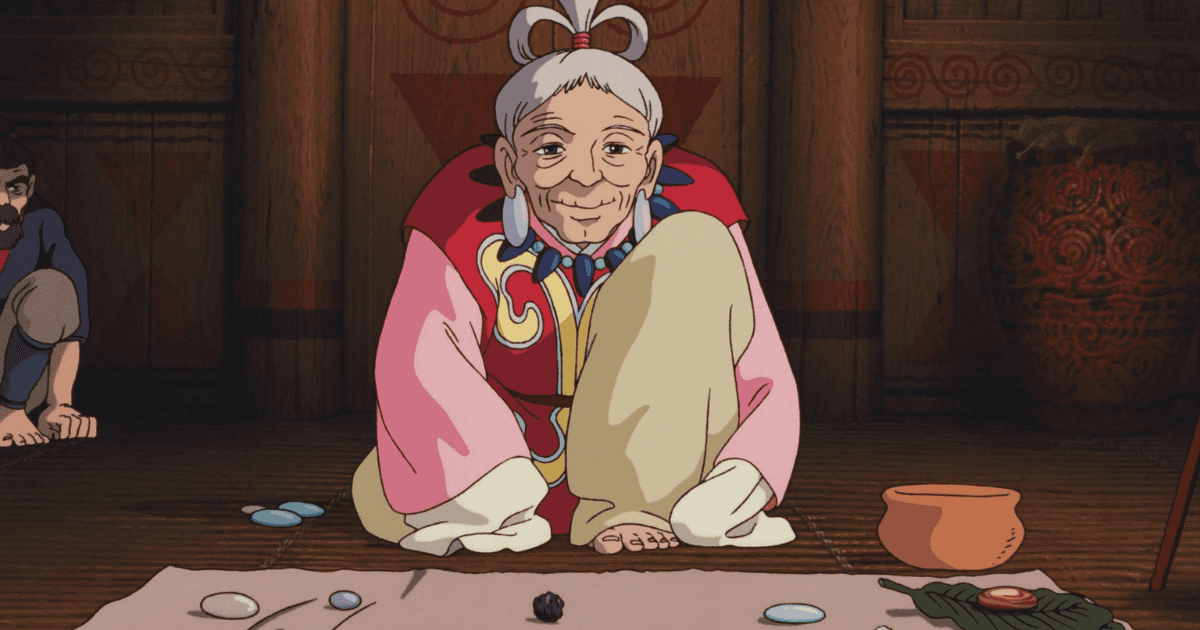
Hii-sama’s Basic Information
The village’s oracle appears to be its leader in practice, too.
Her manner is gentle, but she is also the person who effectively tells Ashitaka to leave.
There is something curious in the scenes leading up to his exile: Hii-sama and the old watchman somehow already know what a Tatarigami is.
The watchman reacts especially quickly. To me, he looks like someone who has seen one before.
Could the village, or the surrounding region, have faced such an attack in the past?
That is only speculation; the film gives us no way to settle it.
Nago | Voiced by: John DiMaggio
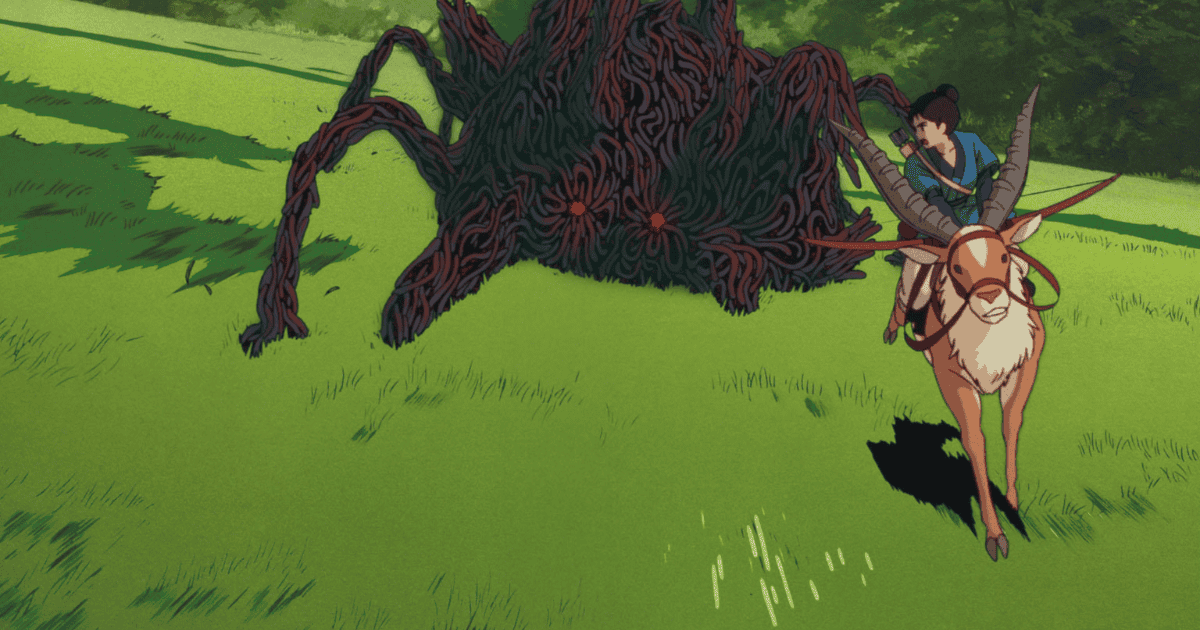
Nago’s Basic Information
The Tatarigami that attacks Ashitaka’s village was originally Nago, a mountain god who led boars in the forest. Killing him and receiving his curse sets Ashitaka’s story in motion.
Eboshi drove Nago into retreat. The shot from her firearm filled him with despair and fear of death. Judging by the remarks of Okkoto’s boars, retreat may have seemed a greater disgrace to him than dying.
That humiliation, the grief of being driven from the forest, and the fear of death turned the proud god into a Tatarigami.
As Eboshi herself observes, she should have been the target of his hatred. Instead, he fled east, where she was not, directing it at humanity itself. Perhaps other villages were destroyed on the way.
It looks like irrational hatred, but perhaps that is what hatred is. Someone consumed by it unwittingly draws others into their suffering, exhausts themselves, and brings about their own destruction.
Perhaps Ashitaka understood that, and so struggled to keep his own hatred from erupting. Without San, he might have lost his reason to confront it and eventually become a Tatarigami that destroyed Irontown.
Again and again, San proves to be a source of salvation for Ashitaka.
Head Ox-Driver
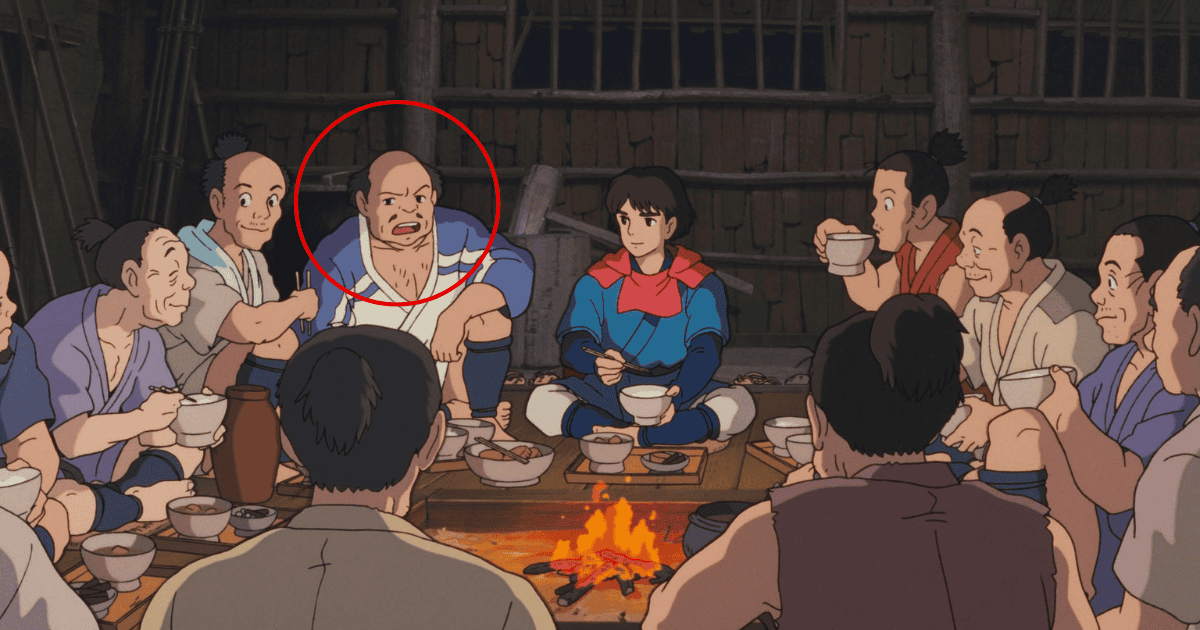
Head Ox-Driver’s Basic Information
The leader of Irontown’s ox-drivers is friendly toward Ashitaka after he rescues Kohroku and the others from the ravine. He looks intimidating, but seems a warmhearted man.
Leader of the Patients
The Patients’ Leader: Background and Interpretation
A bedridden man in Eboshi’s “secret garden,” he leads the other people who work on her firearms while living with illness.
He explains that Eboshi has done more than shelter them: she washes their bodies and cares for them. For people who have probably been despised because of their illness, she must mean a great deal.
They live apart from the ox-drivers and the bellows workers, yet the others do not seem prejudiced against them. At least Toki appears to have a straightforward relationship with one patient when the local samurai attack near the end.
In the final moments, exposure to the power of the Forest Spirit after its head is restored seems to heal their illness.
It is deeply moving within such a difficult story. Perhaps it is not emphasized because our own society has yet to heal every kind of “illness.”
Kiyo
Kiyo’s Basic Information
The name Kiyo may not ring a bell, but she is the woman who accidentally shoots Ashitaka as he carries San out of Irontown.
Jibashiri
Jibashiri’s Basic Information
These hunters wear animal skins and smear themselves with blood so the creatures of the mountains will not recognize them as human.
They join Jigo’s attempt to take the Forest Spirit’s head, yet their warning that looking at the god will blind you suggests a kind of piety, too.
That may look contradictory. But hunters also pray to mountain gods; perhaps such faith helps them live within certain limits.
Their movements as they run through the mountains in boar skins seem superhuman. I have no idea how anyone could move that way. Would somebody like to try?
The images used in this article are from Studio Ghibli Works Still Images.
Can you name the movie before the scene comes into focus?
Put your visual memory to the test with a blurred Studio Ghibli scene.

Reader Comments