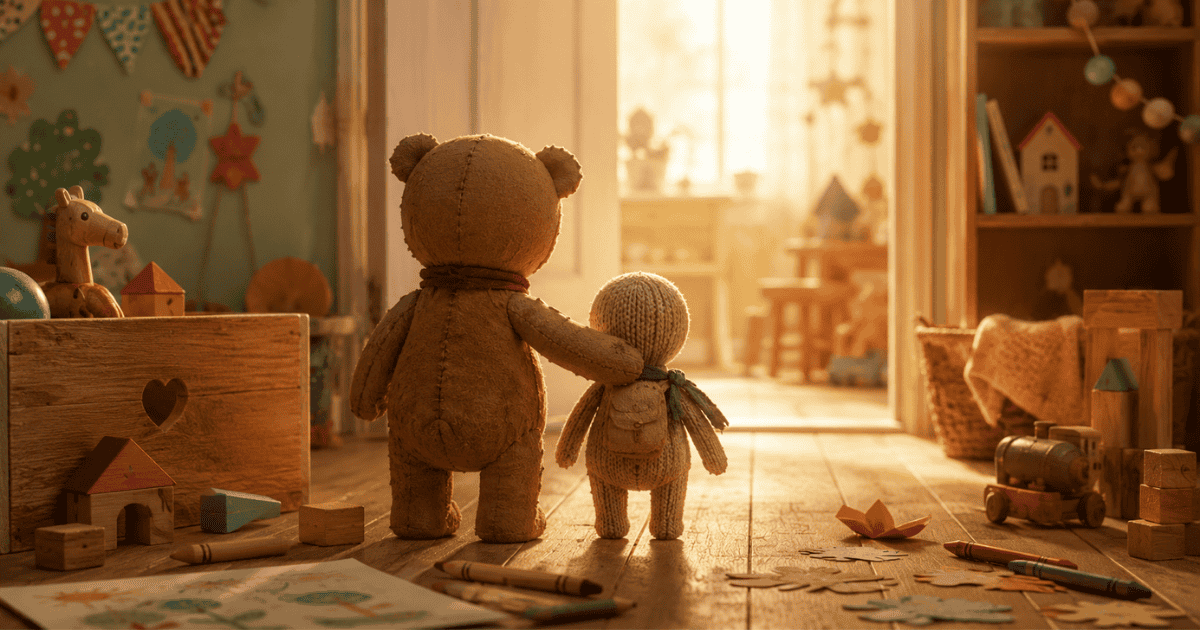
The toys in the Toy Story series do more than wait for children to play with them. Even when the children are out of the room, the toys care about their safety and happiness and look forward to playing with them again.
They never grow tired, never reject a child’s world, and never ask for anything in return. As long as a child needs them, they will repeat the same game as many times as necessary. Even after they are no longer needed, their love does not disappear.
They resemble the parents children wish they had—and the perfect parents real parents wish they could be.
This quality remains unchanged in Toy Story 5. Jessie and Lilypad clash over how they should relate to Bonnie, but both are concerned about her loneliness and try to make her happy using their own abilities.
Seen across the series as a whole, Woody’s position also changes. He begins as something like a parent watching over Andy, completes the task of raising him in Toy Story 3, and becomes a grandfather-like figure in Toy Story 4, passing his experience on to the next generation.
In Toy Story 5, he does not try to reclaim his former place as Bonnie’s favorite toy. Instead, he helps Jessie and the others fulfill the roles they now hold. This shows that the transformation that began in Toy Story 4 was not temporary.
In this article, I want to examine the ideal form of parental love embodied by the toys and the process through which Woody matures from a parent into a grandfather.
If you have not yet seen Toy Story 5 and would like to check its overall quality and whether it is worth watching without encountering spoilers, see my spoiler-free review of Toy Story 5.
The discussion below makes no attempt to avoid spoilers, so please proceed with caution if you have not seen the films.
*This is a translated version. The original (Japanese) is available here.
- Toys as ideal parents: They never reject a child’s world, never grow tired, ask for nothing in return, and remain by the child’s side.
- Unconditional love for children: Dolls and devices alike actively wish for a child’s happiness and try to be useful.
- The end of parenting: A child’s growth requires toys to let go and marks the completion of their role as caregivers.
- Woody as a grandfather: From Toy Story 4 onward, he becomes an elder who uses his experience to support children and younger toys.
- Watching over the next generation: He ultimately moves from caring for one particular child to supporting relationships between many children and toys.
On this pageContents
Toys as the Perfect Parents Real Parents Wish They Could Be

There Are Moments When Real Parents Cannot Respond
When a child wants to play with a parent, the parent cannot always say yes. They may have just returned from work and be exhausted. They may need to prepare a meal or do the laundry. If the family has an early morning ahead, the parent may have to end the game and tell the child to go to sleep.
This does not mean the parent does not love the child. Human beings have limited time and energy, and maintaining a family requires work that cannot always be done while standing directly in front of the child.
For a young child, however, these circumstances can be difficult to understand fully.
The child wants to play, but the parent will not play. The child wants to be heard, but is told to wait. A parent’s practical circumstances can sometimes reach the child as a feeling of personal rejection.
Parents love their children. Even so, they cannot always express that love in precisely the form the child wants at precisely the moment the child wants it.
Toys Never Reject a Child’s World
Toys, by contrast, never reject the world a child creates.
A doll who is a sheriff today may become the captain of a spaceship tomorrow. A dinosaur toy might play the villain in one game and become a doctor who saves an injured friend in the next.
Children do not necessarily play according to the official character or product descriptions assigned to their toys. Within their imaginations, they give the toys new roles again and again.
An adult may grow tired of repeating the same game. They may struggle to follow a child’s wildly imaginative premise and try to bring the conversation back to reality.
But toys enter the child’s world and continue obeying its rules.
To a child, a toy is like a parent who never once rejects the world the child has created.
Bonnie and Blaze do the same in Toy Story 5. Rather than being restricted by the roles assigned to the toys as commercial products, they freely invent new parts for Jessie, Bullseye, Smarty Pants, and the others.
Smarty Pants and the other devices, which have never experienced this kind of imaginative play, are thrilled to be welcomed into a child’s world. Even for newer devices, the joy of becoming something else through a child’s imagination is no different from what traditional toys experience.
Loving a Child Without Asking for Anything in Return
In the world of Toy Story, it is simply assumed that toys love their children.
Even when Andy cannot see them, Woody and the others worry about his birthday and the family’s move and work to ensure that none of their friends are left behind. They receive no praise for rescuing others from danger. Andy never even learns what they have done.
Even so, they continue working to make sure he can live safely and happily.
Real parents become tired and sometimes emotional. They may also wish that someone would recognize how hard they are trying. Toys experience almost none of that emotional fluctuation.
They never grow tired, never become angry, ask for nothing in return, and remain by a child’s side for as long as the child needs them.
They represent a kind of perfect parent that no human being can ever become.
Lilypad, who appears in Toy Story 5, is fundamentally the same. Worried that Bonnie has been unable to make friends, she tries to use her communication features to connect Bonnie with children her own age.
Her methods differ from Jessie’s, and her decision ultimately hurts Bonnie. Yet in wishing for the child’s happiness and trying to make herself useful, she is no different from the other toys.
Smarty Pants, Atlas, and Snappy also treasure their memories of playing with Blaze long after she stops using them. Although they are devices powered by batteries, the love they direct toward their child is the same.
However, never growing tired or asking for anything in return is not the same as always making the right decision.
Jessie believes that what Bonnie needs is to play with someone in person. Lilypad believes that online interaction will rescue Bonnie from loneliness.
Because they both love the child, each tries to anticipate her needs and give her the form of happiness she already understands.
Although they possess idealized parental love, they also resemble parents who impose their own values on a child while insisting that it is “for your own good.”
A Child’s Growth Marks the End of the Toys’ Role as Parents

Jessie Was Hurt Because She Loved So Deeply
In Toy Story 2, Jessie is afraid to form another relationship with a child.
She was once deeply loved by a girl named Emily. They always played together, and Emily took Jessie everywhere she went.
But Emily grew up. Her interests changed, and Jessie was left beneath the bed and forgotten for years. When Emily finally took her outside again, what awaited Jessie was not another chance to play but a farewell as she was placed in a donation box.
Jessie was not hurt simply because her owner abandoned her.
She was hurt because the child she had loved as deeply as a parent would had moved on to a life without her.
If Jessie had felt nothing for the child, being forgotten would not have wounded her. Her fear is also proof of how deeply she loved Emily.
In Toy Story 5, Jessie returns to the house where Emily once lived. From the objects left beneath the tree associated with their memories, she learns that Emily gave her daughter the same name as Jessie.
Emily grew up and continued into a life without Jessie. But that does not mean the time she spent with Jessie disappeared.
The love a child receives from a parental figure remains within that child even after the figure’s role has ended.
Emily’s decision to give her daughter Jessie’s name shows that what she received from Jessie was passed on to the next generation in a different form.
Choosing to Love Another Child Instead of Remaining Safely Preserved
If Jessie and the others go to a museum, they will be carefully preserved. They will never be broken or stained, and no child will ever grow tired of them.
But no child will ever hold or play with them, either.
The museum is both a safe place and a place where they will never have to love another child. Without forming a relationship, they cannot be forgotten and hurt again.
Even so, Jessie and Bullseye ultimately choose to go to Andy.
They choose the possibility of playing with and loving another child over the safety of being preserved.
The choice in Toy Story 2 is not simply between whether a museum or a child’s bedroom would be more enjoyable.
It is a choice about whether they can love another child even while knowing that a final separation will eventually come.
Jessie faces the same test again in Toy Story 5.
Because Bonnie is worried about how her classmates see her, she tries to give Jessie and Bullseye to Blaze despite not truly wanting to do so. After Emily, Jessie feels that she has once again been rejected by a child she loved.
Even so, Jessie ultimately tries to find a solution that will allow both Bonnie and Blaze to be happy.
Although she has been hurt again, she does not resent the child. Instead, she tries to create the relationship that the child needs. Jessie, too, is a parental figure who continues loving a child while accepting the possibility of separation.
Parting with Andy Is Woody’s Process of Letting Go as a Parent
A parent’s role is not to keep a child by their side forever.
One goal of caregiving is to help the child grow, think independently, and build a life of their own. In other words, if caregivers fulfill their role properly, the child will eventually stop needing them.
In Toy Story 3, Andy is old enough to leave for college. Woody and the other toys, once at the center of his life, are no longer part of his daily play.
Andy’s growth is something to celebrate. Yet that growth also brings the toys’ role to an end.
At the conclusion of the story, Andy gives Woody and the others to Bonnie. From the child’s perspective, this is the moment when he outgrows his toys.
From the toys’ perspective, however, it is also the moment when they send off a child whom they have loved, protected, and watched over for many years.
Woody and the others will not be able to remain at Andy’s side as he encounters new people and experiences. Even so, they must accept that he is moving forward into a life without them.
Parting with Andy marks the completion of Woody’s first experience of raising a child—and his first time letting one go.
Letting go does not mean that love disappears. It means accepting a child’s growth even after the child no longer needs you.
Andy retains the time he spent with Woody, just as Emily retains her memories of Jessie. Even after the toys’ parental role ends, the influence of their love on the child’s life does not end with it.
Bonnie undergoes a similar change in Toy Story 5. As she becomes more conscious of her relationships with children her own age, she begins to feel embarrassed by the toys she loves.
She has not stopped loving Jessie. Even so, as she tries to expand her world, she attempts to separate herself from her relationship with the toys.
For the child, this is part of growing into human society. For the toys, it becomes another moment when their role as parents comes to an end.
How Woody Became a Grandfather in Toy Story 4

He Has a Generation’s More Experience Than Bonnie’s Other Toys
In Toy Story 4, Woody occupies a somewhat different position from the other toys in Bonnie’s room.
Jessie, Buzz, and the others also care deeply about Bonnie. Most of them, however, are focused on what Bonnie needs in the present.
Woody has already watched Andy grow from a small child into someone who no longer needs his toys.
From experience, Woody knows that children feel anxious in new environments, that what they need changes as they grow, and that they will eventually leave their toys behind.
If Bonnie’s other toys resemble parents supporting the child they have now, Woody has become more like a grandfather who has already finished raising one child.
He understands forms of childhood pain the other toys have not yet encountered and tries to act in advance based on that experience.
Woody retains this position in Toy Story 5.
After Jessie contacts him, he returns to Bonnie’s house because he believes his friends need help. He does not return in an attempt to become Bonnie’s favorite toy again.
Jessie stands at the center of the story, while Woody joins Buzz in supporting her.
An earlier version of Woody might have insisted on placing himself at the center. The present Woody appears when his experience is needed and helps the toys who are currently supporting the child.
His position is now closer to that of a grandfather or an experienced adviser than a parent.
Understanding Bonnie’s Pain Before Anyone Else
On Bonnie’s first day of kindergarten, Woody slips into her bag even though she has not chosen to take him.
From the perspective of the other toys, if their child has not taken them along, the natural thing to do is wait in the room. Woody’s behavior may appear to exceed the position assigned to him as a toy.
But his experience with Andy has taught Woody how anxious a child can feel when entering a new environment.
The child must separate from their parents, enter a room filled with strangers, and find a place where they belong. Woody anticipates this pain before the other toys do.
That is why, when Bonnie has to complete a craft project alone, he helps her by giving her discarded materials. His intervention leads to the creation of Forky.
Woody understands before anyone else that Forky is not merely a craft project. He is the figure who emotionally supports Bonnie when she feels alone at kindergarten.
His actions resemble those of an elder who has learned through long experience what hurts children and what they may depend on for comfort.
In Toy Story 5, Jessie and Lilypad try to resolve Bonnie’s loneliness through different methods.
Rather than insisting that only one of them is right, Woody helps create a way for Bonnie and Blaze to meet while also making use of Lilypad’s functions.
Playing together in person and using a network to connect people can both help a child when used appropriately. Woody’s accumulated experience is also visible in his ability to bring these different approaches together.
For a closer examination of why the conflict between Jessie and Lilypad is not simply a matter of “toys versus devices,” see my Toy Story 5 analysis centered on Lilypad’s isolation.
Teaching Forky the Joy of Being Needed
Forky does not consider himself a toy. He believes that he is trash and that returning to the trash can is his natural destiny.
Woody repeatedly explains that Bonnie needs him.
Woody has spent years supporting Andy. He understands how much it can mean for a child to have a toy nearby during moments of anxiety.
That is why he prioritizes Forky’s importance to Bonnie over what Forky himself says he wants.
Woody is not merely teaching Forky that he has an obligation to live as a toy.
He is trying to show him that being needed by someone and supporting that person can become a source of happiness in one’s own life.
In Toy Story 5, Jessie stands at the center of the story as someone who has inherited that set of values.
Jessie is deeply hurt when Bonnie rejects her again. Even so, she does not try to seize back the place where she was once needed. Instead, she searches for a way for Bonnie and Blaze to become friends.
Although Jessie understands the joy of being needed by a child, she prioritizes what will make the child herself happy. Her actions carry forward the way of life Woody demonstrated over many years.
The Values Imposed by a Loving Grandfather
At the same time, Woody’s behavior can undeniably be seen as imposing his values on Forky.
Being needed by a child brings happiness. Living for a child is a toy’s purpose. Woody tries to make Forky accept the way of life he himself has believed in for many years.
Experienced elders often try to pass their hard-earned wisdom on to younger generations. This comes from love: they want to protect younger people from hardship and prevent them from making the same mistakes.
Yet they can also begin treating their own experience as a universal answer and become unable to understand the younger generation’s different values.
Because Woody wants to help Forky, he imposes his own understanding of happiness on him.
Woody’s kindness and his tendency to impose his values both arise from his experience of raising Andy.
This duality may show that Woody is no longer simply an attentive toy. He has become something like a loving but slightly stubborn grandfather.
The same issue appears in the conflict between Jessie and Lilypad in Toy Story 5.
Jessie believes that playing together in person is what will help Bonnie. Lilypad believes that connecting Bonnie with children her age through a network will save her.
Both care deeply about the child. But because their love is so strong, they become overly determined to give her the form of happiness they already understand.
Wanting what is best for a child does not necessarily lead to understanding what the child truly feels. This is another danger contained within the love of parents and grandparents.
In Toy Story 5, the paint on Woody’s head is also more faded than before, and changes around his stomach suggest his advancing age.
Although these details are played for humor, they show that the once-young sheriff has visibly become an elder. Woody’s grandfatherly qualities now appear not only in his role but also in his appearance.
Bo Peep Is Also an Elder Who Offers a Different Answer
Bo Peep is another older toy with a wealth of experience.
However, the answers Woody and Bo draw from their experiences are different.
From his time with Andy, Woody learns the value of being needed by one particular child and supporting that child until the end.
After losing her owner, Bo learns that a toy’s life does not have to end when its relationship with one particular child ends.
But Bo has not rejected the act of playing with children.
At the carnival, she helps toys without owners find their way into children’s hands. What she has abandoned is not her love for children, but the belief that being owned by one particular child is the only possible source of happiness for a toy.
Woody and Bo are both elders guiding the next generation. One teaches the value of supporting a single child, while the other shows that toys can continue loving children even when the form of that relationship changes.
It is important that when Woody returns to Bonnie’s house in Toy Story 5, he does not return to a life of being owned by one particular child.
He temporarily returns to help friends in need while maintaining the life he chose with Bo. Leaving a particular owner behind is not the same as ceasing to love children or fellow toys.
From Caring for One Particular Child to Watching Over the Next Generation

Woody Did Not Choose Freedom
At the end of Toy Story 4, Woody does not return to Bonnie. He remains at the carnival with Bo Peep.
Looking only at the outcome, it may seem that he abandons the life of being owned by a particular child and chooses his own freedom.
But Woody does not choose the freedom of being needed by no one.
Bonnie’s room contains many toys, including Jessie and Buzz. Even without Woody, they can continue supporting her.
At the carnival, however, some toys have never even been given an opportunity to meet a child.
Woody completes his role as a toy directly loved by one child and moves into a position where he helps other toys form relationships with children.
Instead of placing himself at the center of a child’s life, he helps the next generation support children.
He has not abandoned the role of a parent. He has transformed it into that of a grandfather-like supporter.
When Woody returns to Bonnie’s house in Toy Story 5, he is not trying to become Bonnie’s toy again.
He is trying to help Jessie and Buzz, who currently support Bonnie; the isolated Lilypad, Smarty Pants, and the other devices; and beyond them, Bonnie and Blaze themselves.
Woody does not try to make Bonnie choose him again. He helps Jessie and Lilypad reconcile and assists Bonnie and Blaze in meeting each other.
Instead of making himself the center of a child’s relationship, he supports the relationship between the child and someone else.
This shows that the life he chose in Toy Story 4 was not temporary. It has become Woody’s new role.
A Story That Follows a Caregiver’s Entire Life
Woody loved Andy, supported his growth, and ultimately sent him out into the world.
In Toy Story 4, that experience allows Woody to anticipate Bonnie’s pain and try to teach Forky the values he has learned.
Finally, he moves from supporting one particular child to helping connect a larger number of children and toys.
This progression resembles the life cycle of a caregiver moving from parent to grandparent.
There is a period of directly caring for a child, a period of sending the grown child into the world, and a later period of passing one’s experience on to the next generation.
Toy Story 5 does not add an entirely new answer to this transformation.
Instead, it confirms that Woody, who shifted from a parental role to a grandfather-like one in Toy Story 4, continues supporting his friends from that same position.
As Jessie takes the central role and tries to create a relationship between Bonnie and Blaze, Woody does not demand to become the protagonist again.
He appears when needed, shares his experience, and helps the current generation support their child. Woody is no longer the parent raising one particular child.
Toy Story does more than portray toys as ideal parents.
It depicts the joy of being needed, the loneliness of watching a child leave, the kindness of passing on experience, and the danger of an elder imposing their values on someone younger.
Real parents cannot remain endlessly energetic, never become angry, or respond to every request whenever a child asks. Toys, however, never reject a child’s world. Their love remains after playtime ends, and they stay beside the child until the day the child no longer needs them.
Toy Story depicts an ideal form of love that is impossible for human beings while also tracing the caregiver’s growth from a parent raising one child into a grandfather who passes his experience on to the next generation.
Perhaps that is why Toy Story is not only an adventure for children. It also moves adults who were once children themselves and those who have since become parents or grandparents.



Reader Comments