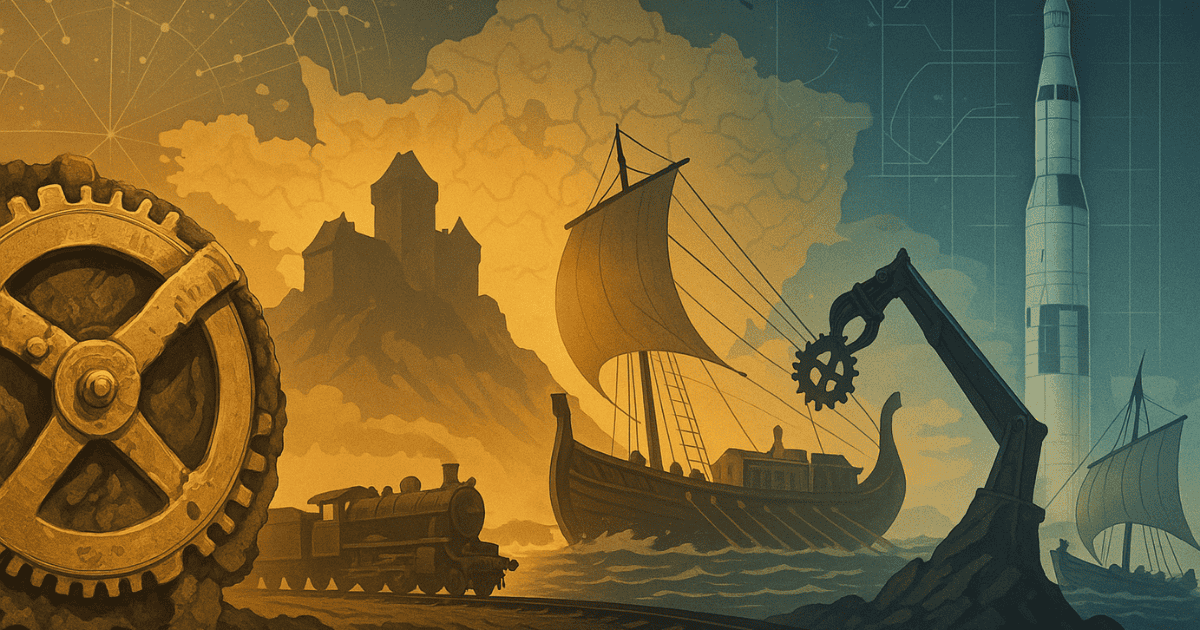
Indiana Jones and the Dial of Destiny is a 2023 feature film directed by James Mangold. Like earlier entries in the series, it skillfully blends historical events and urban legends into its story.
You can enjoy the film without knowing this history, but some background knowledge may help you follow it without puzzling over the details. Here, I explain the points I think are most useful.
The article covers four subjects:
- The war in France in 1944, when the opening sequence takes place.
- The historical models for Dr. Schmidt.
- The Siege of Syracuse, the ancient battle Indy reaches near the end.
- The Antikythera mechanism, the model for Archimedes’ Dial.
*This is a translated version. The original (Japanese) is available here.
On this pageContents
The War in France in 1944

At the beginning of the film, Indy and his colleague enter a castle in the French Alps. The castle is fictional; the exterior scenes were filmed at Bamburgh Castle in the UK (see the castle’s official website).
The German troops are hurriedly removing artworks from the castle. That scene has a historical basis. During World War II, Nazi Germany systematically looted cultural property across occupied Europe. In France, vast numbers of paintings, sculptures, manuscripts, and other objects were seized from wealthy Jewish families, private collectors, and museums.
The works were intended for the “Führermuseum,” which Hitler dreamed of building in Linz, his hometown, or for the private collections of Nazi officials such as Hermann Göring.
Remote castles and monasteries in France were used to store and sort looted art before it was sent to Germany. Their isolated locations and solid construction helped protect the collections from Allied bombing and attempts by the French Resistance to recover them.
A castle turned into a large storehouse for Nazi plunder, as shown in the film, fits this historical background.
The opening sequence is set in 1944, a year when the war in France changed dramatically:
- June 6: D-Day—the Normandy Landings
Allied forces landed in northern France, opening a new front and putting German forces in France under pressure from the north and west. - August 15: Operation Dragoon
Allied forces also landed in Provence in southern France, near the film’s setting. German troops around the French Alps risked being caught between forces advancing from the north and south.
Moving Looted Art During the Retreat
By the latter part of 1944, German forces in France were retreating toward the German border under the Allied advance.
The withdrawal was chaotic, and units were frequently cut off. German forces tried to rush the looted art stored in France back to Germany by rail before it fell into Allied hands.
The film’s train loaded with plunder reflects these hurried attempts to move stolen collections during the retreat. Transporting the “Lance of Longinus” and the dial from the castle shows German troops trying to take valuable spoils home as Allied forces close in.
The Historical Models for Dr. Schmidt

In the film’s main timeline, Jürgen Voller works on NASA’s rocket program under the name “Dr. Schmidt.” Schmidt is fictional, but I see both an individual and a group as possible historical models for him.
After World War II, the United States sought German scientific expertise, especially rocket technology, as it prepared for the Cold War with the Soviet Union.
The U.S. government set up a secret program called Operation Paperclip. It brought German scientists and engineers to America, overlooking their collaboration with Nazi Germany. More than 1,600 specialists are said to have come through the program. This is the broader historical background I see behind Voller.
The most famous among them was Dr. Wernher von Braun, who seems a likely individual model for Voller/Schmidt. During the war, he was a central figure in developing the V-2 ballistic missile. Its production relied on enslaved labor under the Nazi regime.
After moving to the United States, von Braun became director of NASA’s Marshall Space Flight Center and led the development of the Saturn V rocket, which carried the Apollo astronauts to the Moon.
Voller is fictional, but his background—a former Nazi scientist concealing his past while working on the American space program, particularly Apollo—has a strong basis in history.
The Siege of Syracuse
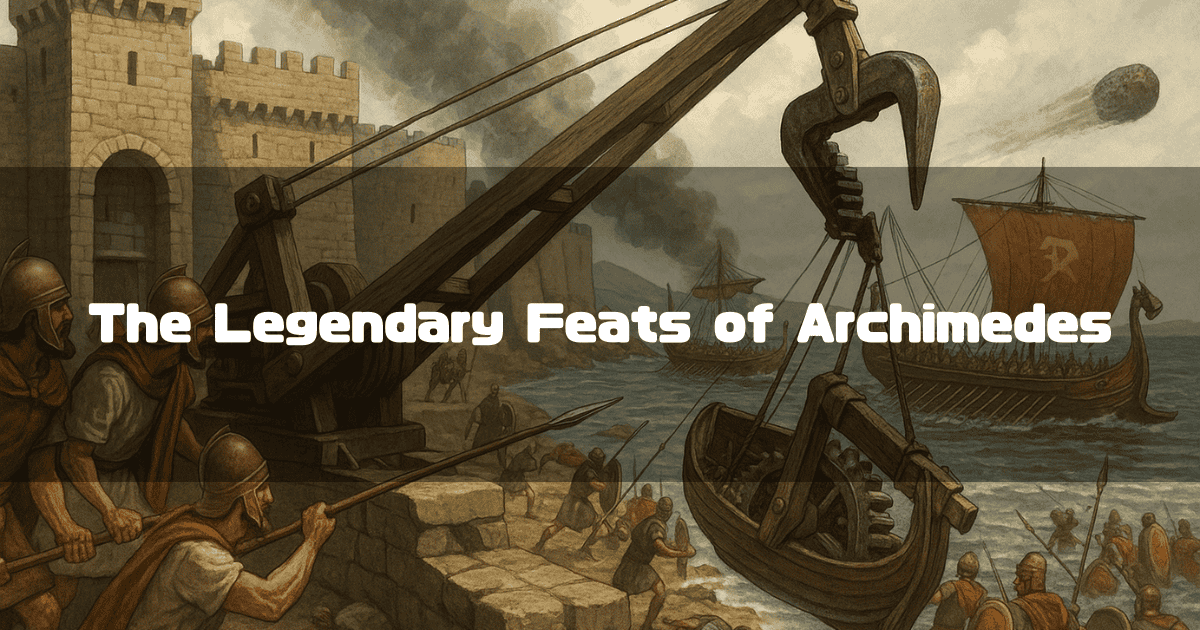
The battle Indy reaches at the film’s climax is the Siege of Syracuse, a famous ancient conflict in which the scientist Archimedes put his extraordinary skills to use.
Why Was Syracuse Besieged?
The siege took place from 214 to 212 BC during the Second Punic War, when the Roman Republic and Carthage fought for control of the Mediterranean.
Syracuse, a powerful Greek city-state on Sicily, had been allied with Rome. After Rome’s defeat by Hannibal at Cannae, however, Syracuse changed sides and allied with Carthage.
Fearing that this strategically important city would be used by its enemies, Rome sent an army and fleet under Marcus Claudius Marcellus to besiege Syracuse by land and sea.
Archimedes’ Defensive Machines
Rome had superior military strength, but Syracuse had Archimedes, an outstanding mathematician and physicist. To defend his home city, he applied his knowledge to machines that kept the Romans at bay for a long time.
- The Claw of Archimedes
This weapon is described as a huge crane-like arm extending from the walls. Its hook could catch approaching Roman ships, lift them, and capsize them or dash them against the rocks. - Powerful Catapults
Archimedes is credited with developing catapults of remarkable range and destructive power. They hurled large stones and lead weights at Roman positions and ships, causing serious damage. - Archimedes’ Heat Ray (Legend)
A famous legend holds that Archimedes used large mirrors or polished shields to concentrate sunlight and set Roman ships on fire. Whether this was possible is still debated, but the story conveys the fear inspired by his inventions.
The Romans are said to have become afraid even to approach the walls, such was the effect of these weapons.
The Fall of Syracuse and the Death of Archimedes
Despite Archimedes’ defenses, Syracuse eventually fell to a surprise Roman attack after a prolonged siege. The Romans entered while the inhabitants were occupied with a religious festival.
Marcellus respected Archimedes’ abilities and wanted him taken alive, without harm.
Archimedes is said to have been absorbed in a geometrical problem when a Roman soldier found him. In the familiar story, he protested, “Do not disturb my circles” (Noli turbare circulos meos), and the angry soldier killed him. The accounts of his death differ; the words are part of the story handed down, not a verified transcript.
The climax of Indiana Jones and the Dial of Destiny imagines a different possibility: what if Archimedes, facing the fall of his city, had built a device to call for help from the future?
The Antikythera Mechanism

The model for “Archimedes’ Dial,” the artifact at the center of the film, is an ancient Greek object that really exists: the Antikythera mechanism.
Often called the “world’s oldest analog computer,” the device was far more sophisticated than people once expected from its period. That made it a famous example of an OOPArt—an “out-of-place artifact.”
What Research Has Revealed
The mechanism was discovered in 1901 in a Roman-era shipwreck off the Greek island of Antikythera, along with objects including marble statues.
Research using X-rays and CT scans has revealed much about how it worked. The following outline reflects current understanding, although research continues and some conclusions may change:
- Date of Manufacture: It is often dated to around 150–100 BC.
- Structure: A complex bronze mechanism with at least 30 precisely made gears.
- Functions:
- It calculated and displayed the positions of the Sun, Moon, and planets.
- It predicted solar and lunar eclipses using the roughly 18-year, 223-month Saros cycle.
- It also displayed the four-year cycle of athletic competitions, including the ancient Olympic Games.
Work on understanding and reconstructing the mechanism is still continuing.
Was Archimedes Involved?
The film presents the dial as Archimedes’ work. Historically, there is no direct evidence that he made the Antikythera mechanism himself, though his inventions and ideas may have been connected with its development.
Archimedes died in 212 BC, before the commonly proposed date for the mechanism. Yet the Roman statesman Cicero (106–43 BC) recorded two devices attributed to Archimedes that reproduced the movements of heavenly bodies.
One possible explanation is that later makers inherited techniques or ideas associated with Archimedes and built the mechanism after his death. Rhodes, where astronomy flourished, has been suggested as a place of manufacture.
Indiana Jones and the Dial of Destiny takes this historical background as a starting point for fiction: what if Archimedes himself had built the ultimate astronomical calculator—and it could locate fissures in time?






Reader Comments