When Hayao Miyazaki’s Ponyo(Official Studio Ghibli) hit theaters in 2008, many older fans initially dismissed it as a simple, colorful fairy tale strictly for young children. As a university student at the time, I remember feeling a bit embarrassed walking into the cinema, buying a ticket simply because it was the latest Hayao Miyazaki film. Yet, beneath the pastel watercolor waves and innocent wonder lies a shockingly dark biological metaphor.
Today, we are concluding the final chapter of our special three-part series, “The Melancholy of Men,” where we psychoanalyze the quiet tragedies and emotional surrenders of Hayao Miyazaki’s male characters. Following our deep dives into the stubborn pride of Porco Rosso and the captured heart in Howl’s Moving Castle, we turn our analytical lens to the majestic Goddess of Mercy, Gran Mamare. What profound “sorrow” could possibly be lurking in such a cheerful children’s movie?
*This is a translated version. The original (Japanese) is available here.
- Gran Mamare’s Terrifying True Form
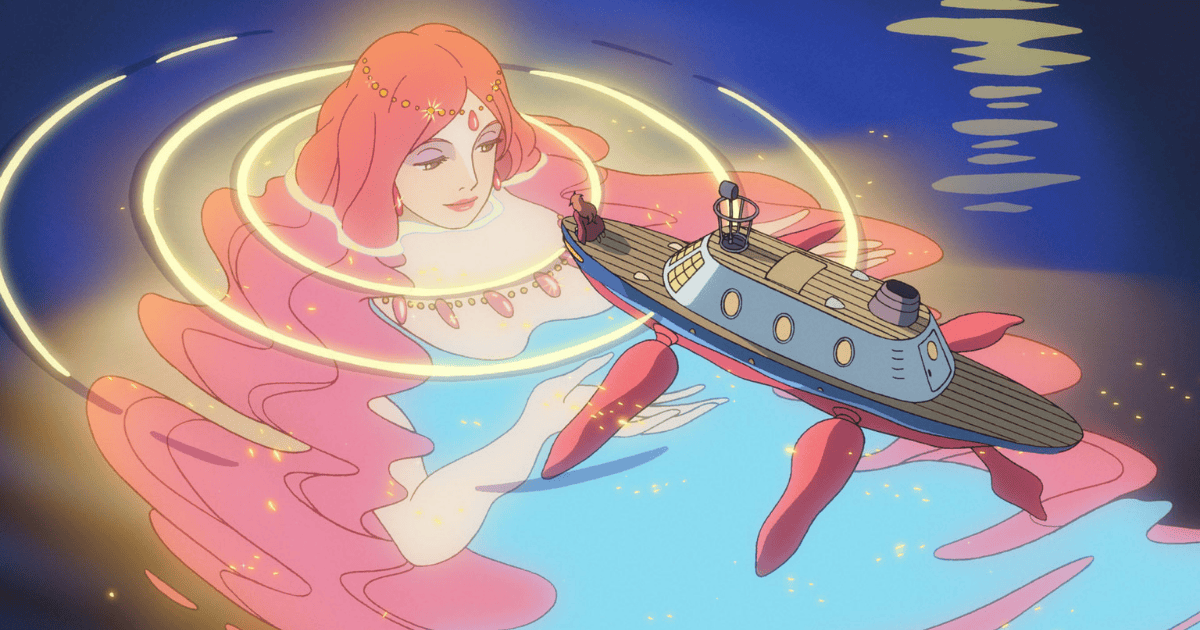
Gran Mamare represents “the sea itself,” a divine entity operating beyond human comprehension. Miyazaki revealed her true form is actually a giant deep-sea anglerfish. The biological fate of the male anglerfish—being permanently absorbed into the female—serves as a brilliant, haunting metaphor for male sorrow. - Fujimoto and the Ultimate Male Surrender
Fujimoto embodies this “melancholy of men” by being utterly consumed and spiritually fused with Gran Mamare. This perfectly aligns with the themes of Porco Rosso and Howl’s Moving Castle, depicting men who fall helplessly in love and are ultimately absorbed by the sheer gravity of a woman. - Sōsuke’s Escape from the Curse
Unlike Fujimoto, it is heavily implied that Sōsuke will not be biologically or spiritually absorbed by Ponyo. By highlighting the sorrow of the “captured man,” Miyazaki simultaneously delivers a message of freedom and hope for the next generation of boys.
On this pageContents
Ponyo (2008) Analysis: The Truth of Gran Mamare and Male Sorrow

The Divine Anglerfish: A Goddess in the Deep
The Hidden Identity of Gran Mamare
Within the vibrant world of Ponyo, Gran Mamare is undeniably the most powerful, untouchable entity in existence.
As Ponyo’s mother and the literal embodiment of “the sea itself,” Gran Mamare operates on a celestial plane where human logic and common sense simply do not apply. Her sense of time and morality is completely alien to ours.
Towards the climax of the film, the earth is swallowed by a catastrophic, apocalyptic flood. Yet, for Gran Mamare—who is the ocean—such a world-ending event is likely nothing more than a minor, passing ripple.
However, this majestic goddess possesses a highly specific, hidden “true form.” Her actual biological identity is a giant “anglerfish.” Miyazaki explicitly confirmed this fascinating detail in his interview book, The Place Where the Wind Returns, Continued (続・風の帰る場所, in Japanese). Here is his exact quote:
Miyazaki: “But there are many tales of interspecies marriage in Japan. Like, that mother is actually a giant anglerfish. We talked about that among the staff. But even if a one-kilometer-long anglerfish appeared, we wouldn’t know how to fit it on the screen (laughs), so she can also take human form, and her size is freely adjustable. It’s the world of Sun Wukong, essentially. In the story of Sun Wukong, there’s a part where a goldfish from the celestial realm escapes to the mortal world for about three days and rampages as a monster. That was three years in mortal time. In the end, I think it gets taken away by the Bodhisattva Guanyin (laughs). That’s the kind of story it is, basically.”
(Original Text in Japanese)
宮崎「でも異種婚礼っていうのは日本には数々あるからね。あのお母さんだって本当は巨大なアンコウなんだとかね。そういうことは、スタッフの中で話してたんですよ。でも差し渡し1キロのアンコウが出てきても画面の中にどう入れていいかわかんないから(笑)、ちゃんと人間の姿を取ることもできて、その代わり大きさは自由自在っていう。要するに孫悟空の世界ですね。孫悟空の中に、天界にいた金魚が3日間ほど地上に逃げて、化けものになって暴れるっていう話があるんですよ。それが地上では3年間だったとか。最後は観音様だったかに連れていかれちゃうんですけど(笑)。そういう話ですよ、要するに」
This is a brilliant piece of lore, but a natural question arises: “Okay, she’s an anglerfish. So what?” To understand the terrifying brilliance of this metaphor, we have to look at the horrifying biological fate that awaits the male anglerfish.
The Tragic, Biological Fate of the Male Anglerfish
When discussing deep-sea anglerfish, we must confront the incredibly bleak reality of the dynamic between the male and the female.
The female deep-sea anglerfish is a massive, dominant predator, growing to about 40 centimeters in length. The male, however, is a microscopic fraction of that size. To put it bluntly, the male is physically insignificant.
Furthermore, these tiny males are born destined for a remarkably sad fate.
When a male deep-sea anglerfish finally locates a female to mate with, he bites into her flesh. Over time, his mouth completely fuses with her skin, his internal organs dissolve, and he is literally absorbed into the female’s body. He becomes nothing more than a permanent, parasitic appendage providing sperm. Moreover, these females are fiercely polyandrous, carrying multiple absorbed males at once. The male is ultimately reduced to a mere “statistical figure.”
I vividly remember first learning this horrifying biological fact as a child watching the Japanese TV program Sekai Marumie! TV Tokusōbu. I believe that same episode highlighted the equally tragic mating deaths of certain squids, but the absolute, ego-destroying surrender of the anglerfish struck a profound chord in my young heart.
It is a biological reality that forces you to ponder the nature of relationships as you age. But if you think about it scientifically, a massive question arises: why doesn’t the female deep-sea anglerfish’s body reject the male?
If this were a human body, a foreign entity attempting to physically fuse with us would trigger a massive immune system response, violently rejecting the host. We possess immune systems precisely to destroy “foreign invaders” (thank goodness!).
So, what is the secret of the deep-sea anglerfish? Astoundingly, scientists discovered that they simply lack the specific immune system genes required to trigger a rejection response.
This incredible evolutionary quirk is explained in an article by ScienceNews titled, “An immune system quirk may help anglerfish fuse with mates during sex.”
For a moment, you might marvel, “Wow! How efficient!” But think about the dark philosophical implications: instead of evolution simply granting the male a shred of bodily autonomy and “rights,” nature completely stripped away their immune defenses just to facilitate this total physical and spiritual surrender.
Regardless of how you view it, men cannot help but feel a deep, existential sympathy for the males of the anglerfish species.
Now, let’s bring this biology lesson back to Ponyo.
If Gran Mamare is fundamentally a deep-sea anglerfish, then her human husband, Fujimoto, has metaphorically suffered this exact fate. He has been completely, spiritually absorbed by her overwhelming presence. This is the very essence of male sorrow. It suggests a deeply cynical reality: “It is the inescapable nature of man to be captured by the woman he loves, and to be entirely spiritually fused (or rather, consumed) by her.”
This identical theme pulses beneath the surface of Porco Rosso (a man resisting capture) and Howl’s Moving Castle (a man finally surrendering to it).
Watching the film, it is easy to assume that Sōsuke, the young boy chosen by Ponyo, is doomed to suffer this exact same fate. But is he really?
Breaking the Cycle: The Free Future Entrusted to Sōsuke
A common, slightly cynical takeaway from adult viewers watching Ponyo is: “It’s a pity that a small child like Sōsuke is suddenly forced to bear the heavy, lifelong burden of Ponyo’s existence.”
Indeed, that assessment makes sense if you don’t know the “Gran Mamare is an anglerfish” lore. But once you apply that biological metaphor, the entire ending shifts.
At the climax of the story, following a “secret negotiation” between Gran Mamare and Sōsuke’s mother, Ponyo permanently gives up her magic and becomes completely human.
By becoming a human girl, she loses the terrifying, divine traits of the anglerfish. She becomes a being who can no longer absorb and consume a man.
The final test is also where Sōsuke delivers one of the film’s most important declarations of love. I examine that line in both Japanese and English in my Ponyo quotes guide.
Therefore, an infinite, unburdened future still awaits Sōsuke. He will not be spiritually absorbed by Ponyo the way Fujimoto was by Gran Mamare.
I believe this is Director Miyazaki’s ultimate message—a heartfelt blessing for the next generation: “Sōsuke! You can still fly! You are free!” In many ways, it is a thematic return to the defiant skies of Porco Rosso, but with a crucial emotional shift. There is a massive psychological difference between an exhausted older man screaming, “We are free!” and an older generation gently telling a young boy, “You are free.”
It acts as a profound cheer for young “males” who are still children, like Sōsuke.
It is as if Miyazaki is saying: “We older men are always on the verge of being captured. Ultimately, we are captured. But you don’t have to be a deep-sea anglerfish!“
However, much like the conclusion of Howl’s Moving Castle, all this talk of the “sorrow of being captured” is ultimately just the smug bragging of a man lucky enough to be loved. For someone who has never been captured, their response is likely: “I don’t care if she’s an anglerfish, just capture me already!”
Regardless of where you stand, viewing Porco Rosso, Howl’s Moving Castle, and Ponyo as a continuous, thematic Trilogy of Male Sorrow adds a breathtaking layer of depth to Miyazaki’s legacy.
At least, that is how I choose to see it.
The images used in this article are from “Studio Ghibli Still Images“.
Can you name the movie before the scene comes into focus?
Put your visual memory to the test with a blurred Studio Ghibli scene.



Reader Comments