
Ponyo (Official Studio Ghibli Website) is a 2008 animated feature film directed by Hayao Miyazaki.
When I first watched it, I admit it didn’t leave a massive philosophical impact on me compared to Miyazaki’s earlier works. However, there was one glaring, highly specific detail that immediately caught my attention: Sōsuke, a five-year-old boy, calls his mother by her first name, “Lisa,” dropping all honorifics. He also refers to his father as “Kōichi.”
In Japanese culture, this is incredibly rare and often viewed as socially shocking. Today, I want to explore exactly why Miyazaki chose this specific family dynamic.
However, before we psychoanalyze Sōsuke, we must address a common misconception about Lisa. Because her son calls her by her first name, and because she drives like a maniac, some viewers rush to judge her as a negligent or flawed parent. First, I will establish that Lisa is actually an incredibly capable, admirable adult. Once we establish her competence, the true meaning behind the name “Lisa” will make perfect sense.
*This is a translated version. The original (Japanese) is available here.
- Lisa is a fierce, brilliant, and deeply responsible mother.
Operating essentially as a single parent while her husband is at sea, Lisa balances raising a child with demanding care work at the Himawari House. During the catastrophic storm, she exhibits flawless, heroic decision-making. Sōsuke’s courage is a direct reflection of her parenting. - First names as a symbol of Sōsuke’s profound independence.
By allowing Sōsuke to call her “Lisa” rather than “Mom,” she removes the hierarchical barrier of childhood dependency. This treats him as an independent individual, fostering the exact type of maturity a five-year-old needs to protect a magical creature and survive an apocalyptic flood. - A reflection of Lisa and Kōichi’s romantic foundation.
Most couples default to calling each other “Mom” and “Dad” once a child is born. The fact that Sōsuke uses their first names implies that Lisa and Kōichi never stopped referring to each other as romantic partners. Sōsuke grew up bathed in the warmth of a deeply connected, equal marriage. - The “Crayon Shin-chan” and “Totoro” Connection.
Sōsuke shares a fascinating parallel with Shinnosuke from Crayon Shin-chan, who also uses his parents’ first names and exhibits fierce independence. Furthermore, like My Neighbor Totoro, Ponyo reinforces Miyazaki’s core theme: children inevitably experience profound, dangerous magic the moment adults look away.
On this pageContents
Ponyo (2008) Analysis: In Defense of Lisa’s Parenting
Lisa is an Absolute Hero
Let’s address the reality of Lisa’s life: her husband, Kōichi, is a ship captain who is almost never home. She is, for all practical purposes, raising a five-year-old entirely by herself while holding down a highly demanding job caring for the elderly at the Himawari House.
Just on paper, any inclination to criticize her vanishes. She is objectively incredible. But her true brilliance shines during the crisis.
Look at her actions during the apocalyptic typhoon triggered by Ponyo’s return. When Lisa attempts to drive Sōsuke home from the senior center, we witness a masterclass in crisis management:
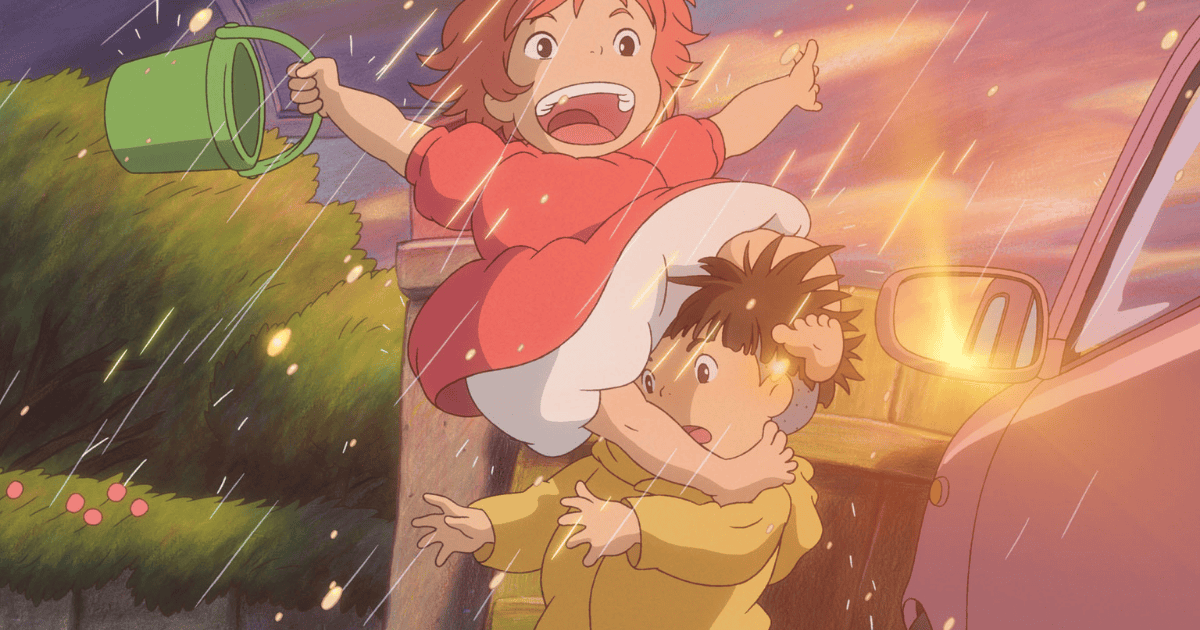
- She places Sōsuke in the car through the driver’s side door to physically shield him from the violent wind.
- When Sōsuke yells, “A little girl fell in the river!”, she immediately stops the car in the middle of a hurricane and rushes out to save a stranger.
- She takes in the soaking wet, magical girl without a single word of complaint or hesitation.
- Despite the power grid failing, she suppresses her own panic to calmly cook a hot meal and make the children feel safe.
- Once the house is secure, she makes the agonizing decision to leave her son to check on the vulnerable elderly residents at her workplace.
Her ability to rapidly assess a situation and take decisive action is staggering. As an adult, she possesses a fierce, instinctual drive to protect the weak.
Still, some viewers love to nitpick. A classic criticism is the opening scene: Sōsuke finds Ponyo on the beach, takes her home, and dumps her into a plastic bucket filled with tap water. Critics argue, “If Lisa was a good parent, she would have taught him that saltwater fish die in tap water!”
To those critics, I say: you are either a delusional parent who thinks you’ve successfully taught your child everything, or you don’t have kids yet. Parents cannot preemptively teach a child every single detail of the universe. Children learn how the world works through trial, error, and messy experiences. (Fortunately, Ponyo is magic, so she survives the tap water!)
A more valid critique centers on the film’s climax. Ultimately, Lisa agrees to Gran Mamare’s staggering proposal, placing the fate of the entire world (and Ponyo’s humanity) squarely on the shoulders of her five-year-old son.
Isn’t that cruel? To place that burden on a kindergartener?
Yes, it is harsh. But Lisa didn’t make that choice because she is negligent; she made it because she is deeply responsible. Sōsuke is the one who brought Ponyo into the human world, triggering the magical imbalance. Lisa likely wanted to bear the responsibility herself, but Gran Mamare’s magic dictates that only the boy’s pure love can seal the pact.
Lisa accepted the agonizing burden of “forcing my son to take ultimate responsibility for his actions.” That is not the choice of a weak parent running away; it is the choice of a profoundly strong mother.
Sōsuke: The Boy Raised as an Equal
Now that we have established Lisa’s brilliance, let’s look at Sōsuke. What happens when we invert the question: What would it mean if Sōsuke called her “Mommy” or “Mama”?
It would be totally normal. But “normal” implies a standard childhood dynamic: absolute dependency on the adult. For an average five-year-old, that is perfectly healthy.
But an “average” five-year-old who is completely dependent on his mother would dissolve into tears the second the tsunami hit. An “average” dependent child could never protect Ponyo, nor would he have the courage to launch a toy boat into a flooded, post-apocalyptic ocean to go search for his missing mother.
The fact that he calls his parents “Lisa” and “Kōichi” removes the hierarchical barrier of childhood. Lisa treats him as an independent individual, and therefore, he acts like one.
Because Kōichi is always at sea, Lisa knew she and Sōsuke would spend most of the year alone. Her core parenting philosophy was clearly to cultivate radical independence. She needed a partner in the house, not just a baby.
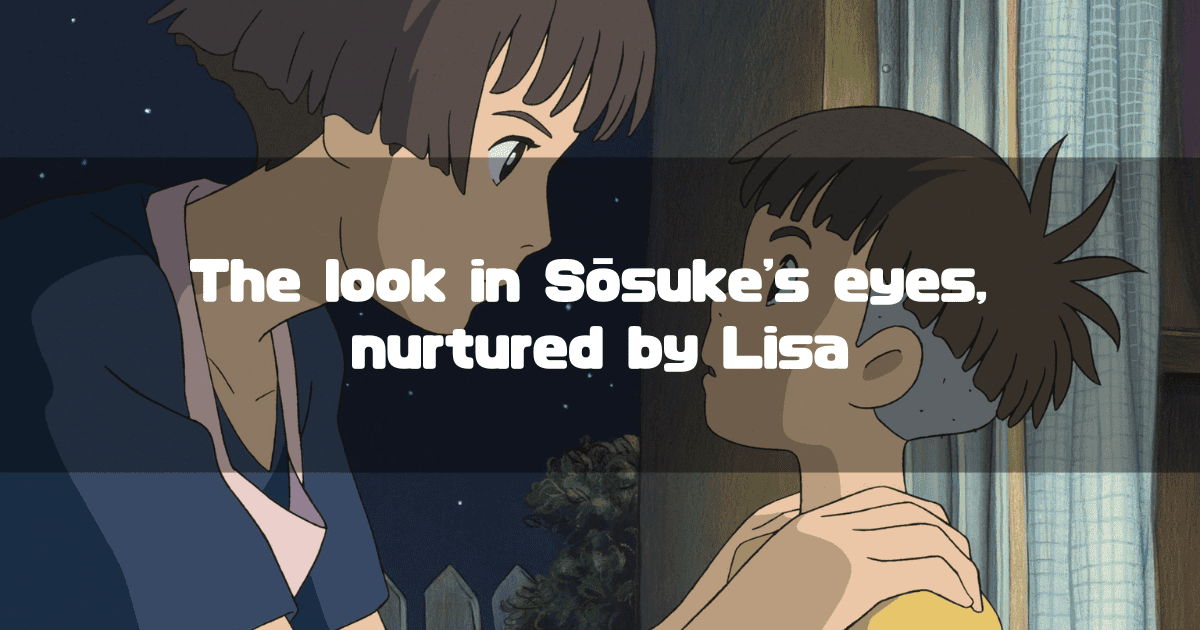
Her strategy worked flawlessly. Sōsuke is wildly independent, emotionally intelligent, and fiercely protective of what he loves. Throughout the film, Sōsuke frequently displays a serious, dignified, almost adult gaze. That beautiful, clear-eyed courage is the direct result of Lisa treating him as an equal, rather than a fragile pet.
That determination also comes through clearly in Sōsuke’s dialogue. Several of his most important lines are examined in Ponyo Quotes in Japanese and English.
The Secret of the First Name: A Romance Unbroken
Finally, let’s explore the psychological origin of the names from a marital perspective.
Before having children, how do couples address each other? Usually by their first names or romantic nicknames. But the moment a baby is born, a massive shift occurs in Japanese culture (and many others): spouses start calling each other “Mom” and “Dad” (Mama/Papa).
Why? Because a baby learns language through observation. If the husband constantly calls his wife “Lisa,” the baby will assume her title is “Lisa.” To ensure the child learns the concept of “Mom,” the husband will start saying, “Go to Mom,” eventually just calling his wife “Mom” full-time.
If Sōsuke calls them “Lisa” and “Kōichi,” it means one beautiful thing: Lisa and Kōichi absolutely refused to stop calling each other by their first names after the baby was born.
We see this in the film. When Lisa is furious with her husband for canceling his shore leave, she aggressively flashes Morse code at his ship, explicitly calling him “Kōichi.”
They didn’t surrender their romantic identities to become generic parental units. They remained Lisa and Kōichi, a man and a woman deeply in love. Yes, she gets frustrated with his job, but her fiery anger is just the flip side of deep, passionate affection.
Sōsuke grew up bathed in the warmth of a household where his parents viewed each other as romantic equals. That is exactly why he is so capable of offering pure, unconditional love to Ponyo.
The Meta-Analysis: Shinnosuke and Totoro Connections
The “Crayon Shin-chan” Parallel
When discussing a young boy calling his parents by their first names without honorifics, any Japanese anime fan will instantly think of one iconic character: Shinnosuke Nohara from Crayon Shin-chan.
Shinnosuke famously calls his mother “Misae” and his father “Hiroshi.” (And just like Lisa and Kōichi, Misae and Hiroshi have a famously strong, passionate marriage).
Is Shinnosuke a bad kid? Absolutely not. While he is vulgar and deeply annoying, when push comes to shove, he is fiercely independent and will risk his life to protect his little sister, Himawari. The core thesis of Crayon Shin-chan is actually a massive validation of the chaotic, modern nuclear family.
In many ways, Sōsuke is essentially the “Miyazaki version” of Shinnosuke.
He lacks the crude, slapstick humor of Shin-chan, replacing it with Ghibli’s trademark sincerity, but the core psychological architecture is identical: a shockingly independent five-year-old forged by a modern, egalitarian nuclear family.
The Shared DNA of Ponyo and Totoro
Finally, it is impossible to watch Ponyo without feeling the spiritual presence of My Neighbor Totoro.
Miyazaki explicitly designed both films for a very young demographic. Lisa even softly sings a line from the famous Totoro theme song (“Watashi wa genki / I’m fine”) while driving.
But the true connection lies in their shared narrative structure:
- A child encounters a massive, ancient magical being solely because no adults are watching.
- That encounter eventually leads the child into mortal danger.
In Totoro, Mei goes missing and nearly drowns in a pond. In Ponyo, Sōsuke is nearly swept away by a sentient tsunami.
Miyazaki isn’t rehashing the same plot; he is hammering home a specific, universal truth about childhood:
Children will always experience the most profound, magical, and terrifying moments of their lives in the exact split-second that adults look away.
Magic and mortal danger are two sides of the same coin, and navigating them is the essence of growing up.
Looking back, my own childhood was filled with reckless, dangerous games in the woods. I survived, but sadly, I never met a Totoro or a magical fish. If I was going to risk my neck, I wish I had gotten a bit of magic out of the deal!
Did you ever encounter anything unexplainable when your parents weren’t looking?
The images used in this article are from the Studio Ghibli Works Still Images collection.
Can you name the movie before the scene comes into focus?
Put your visual memory to the test with a blurred Studio Ghibli scene.




Reader Comments