
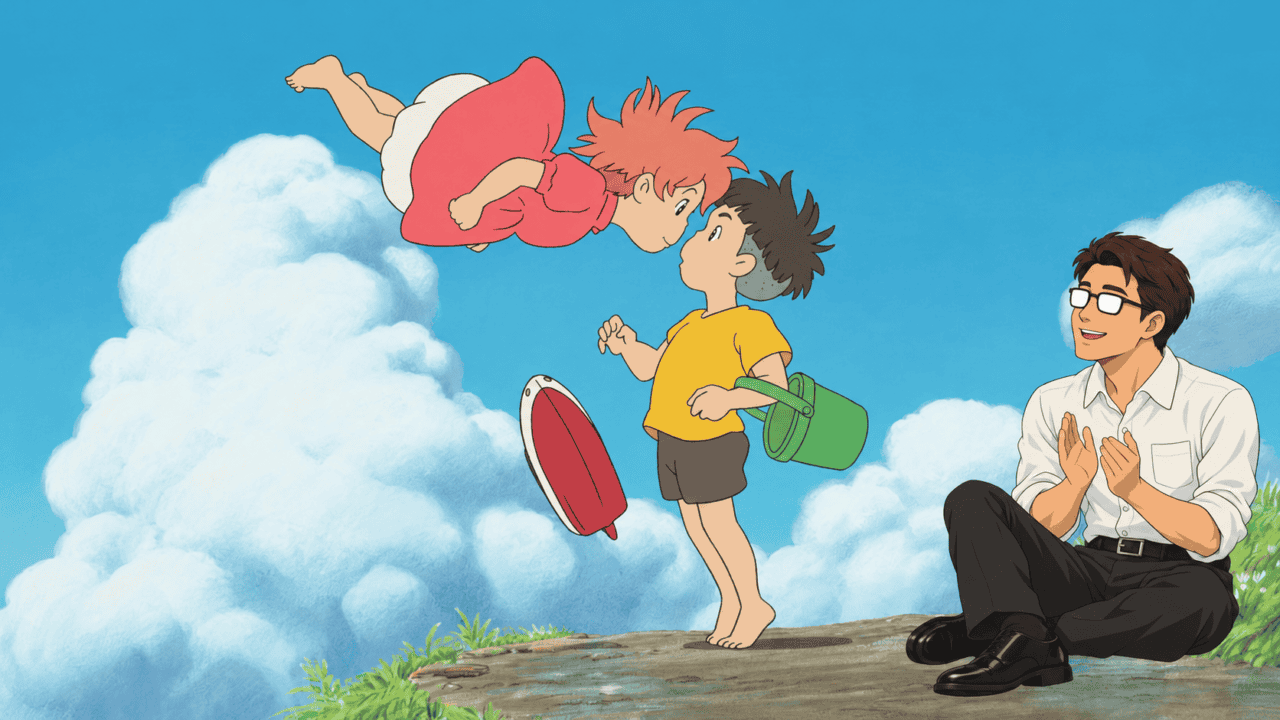
Released on July 19, 2008, Ponyo (Studio Ghibli Official Website) is an animated feature directed by Hayao Miyazaki. Since Princess Mononoke, his films had rarely felt quite so squarely aimed at children; even Howl’s Moving Castle dealt with war. With Ponyo, I could feel his determination to make a film that speaks directly to children.
That was part of why I had drifted away from the cinema, but I finally went on the grounds that seeing a Miyazaki film was practically a civic duty. I also remember that, at the time, I struggled to come away with much of a response to it.
Here, I will revisit the story of Ponyo and bring together my interpretations and explanations. Be warned: a plot summary means I will tell you the whole story. If you want to avoid spoilers, read only the opening, watch the film, and then come back.
*This is a translated version. The original (Japanese) is available here.
- Detailed Synopsis & Character Map
Five-year-old Sōsuke rescues a fish and names her Ponyo. She has magical powers, and as their bond grows, she longs to become human. For that to happen, Sōsuke must show that he loves her as she is. The story ends with a kiss. Below, I explore the events in detail, alongside a character map. - Interpretations & Questions
I examine Ponyo’s determination, Sōsuke’s habit of calling his mother by her first name, and Gran Mamare’s true form, with links to fuller discussions elsewhere on this blog.
On this pageContents
Ponyo (2008): Synopsis and Ending Explained (Spoilers)
Plot Summary and Character Map
Here are the main events in Ponyo:
-
The Great Escape
Ponyo, a curious magical fish and daughter of a sea sorcerer, sneaks away from her underwater home to explore the human world. -
The Boy on the Cliff
Sōsuke, an independent five-year-old living on a high cliff, discovers Ponyo trapped in a glass jar on the beach and rescues her. - Wanting to Be Human
After meeting Sōsuke, Ponyo becomes increasingly determined to become human. - Her Father’s Intervention
Fujimoto, Ponyo’s father, sees her wish to become human as dangerous and forcibly takes her back to the sea. - Transformation and Escape
Ponyo escapes again, uses powerful magic to take human form, and sets off to find Sōsuke. - Nature Out of Balance
Ponyo’s transformation disrupts the balance of nature, bringing a storm and flooding to the town. - A Deepening Bond
Reunited during the storm, Sōsuke and Ponyo grow closer. - Gran Mamare’s Proposal
Ponyo’s mother, Gran Mamare, understands her daughter’s wish. Becoming human will require Sōsuke to accept Ponyo as she really is. - Sōsuke’s Test
Sōsuke must show that he loves Ponyo whether she is a fish or a human. - A New Future
Sōsuke passes the test, Ponyo is allowed to become human, and the balance between the human world and the sea is restored.
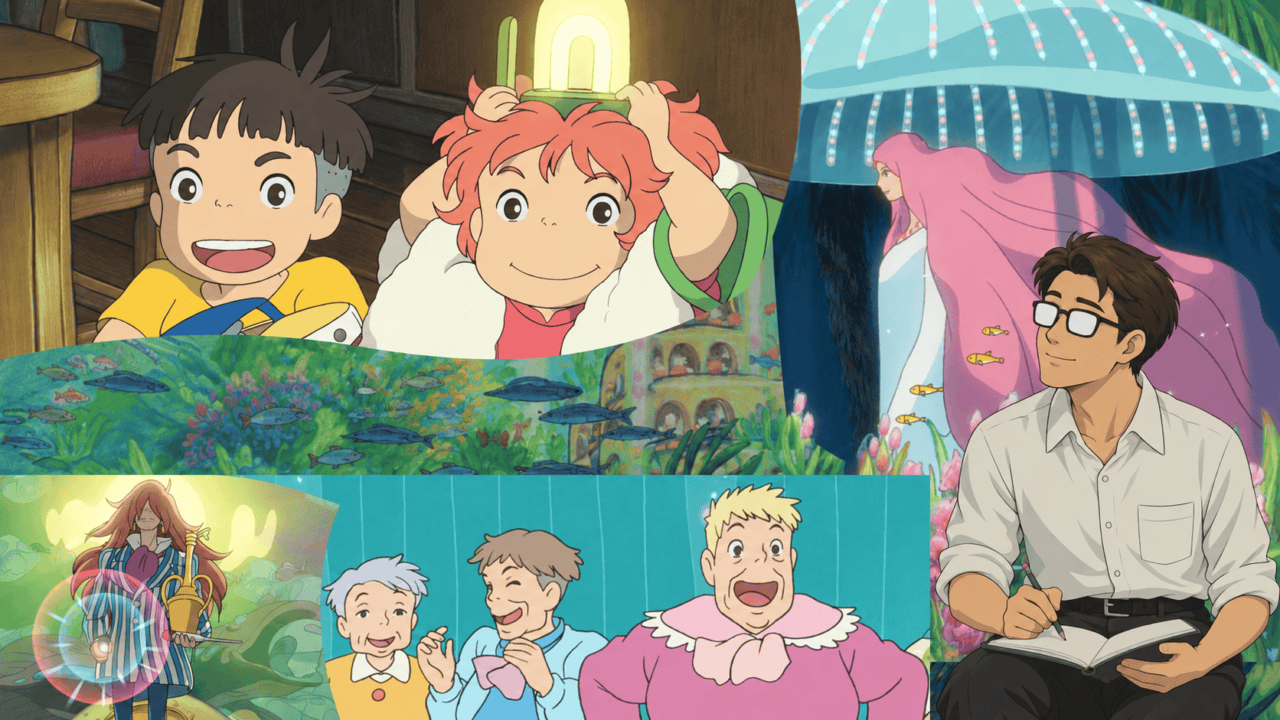
Complete Character Map
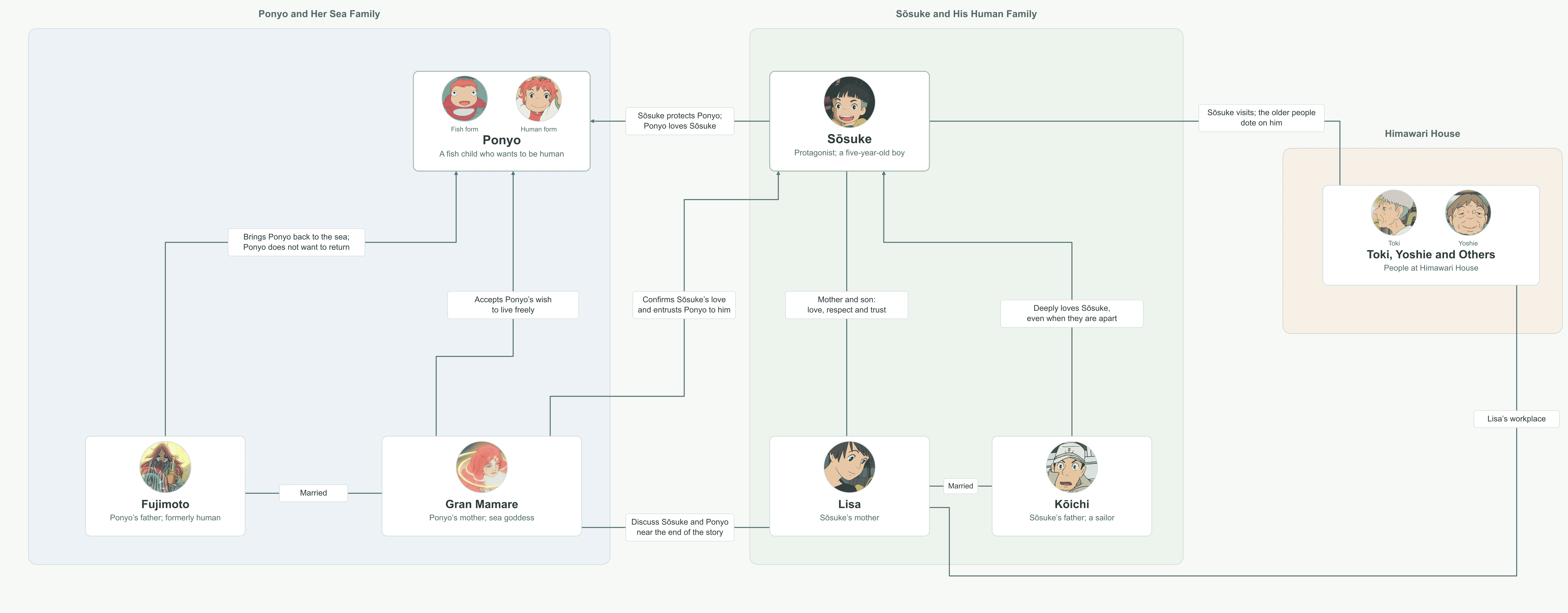
The Deeper Meaning of the Narrative
To put the story of Ponyo in a sentence, I would call it a love story between a boy and a girl. Behind it, though, lies Hans Christian Andersen’s The Little Mermaid.
In the documentary How Ponyo Was Born, Miyazaki discusses The Little Mermaid and says he was dissatisfied with its ending. I see the ending of Ponyo as his own attempt to rework that story—and, in doing so, to question it.
The elderly women at the Himawari House also have a place in the film’s climax. Along with Lisa and the other staff, they are protected beneath the sea by Gran Mamare.
In the underwater dome in Ponyo, the women who normally use wheelchairs can get up and move around. The scene presents a brief release from the limitations of their everyday lives.
That freedom belongs to the film’s magical setting. It does not establish that their illnesses have been permanently cured.
The women running around energetically beneath the sea form part of the gathering that will witness Ponyo and Sōsuke’s test.
With that in mind, let’s follow the story in more detail.
Detailed Synopsis: A Scene-by-Scene Breakdown
Ponyo and Sōsuke Meet
The story begins deep underwater, where a curious, magical fish-child named Brunhilde sneaks away from her father’s submarine to explore the surface. She hitches a ride on a jellyfish, drifting toward a rocky, coastal Japanese town.
Five-year-old Sōsuke lives in a house on a cliff. One day, at the nearby shore, he finds a small red fish trapped in a glass jar.
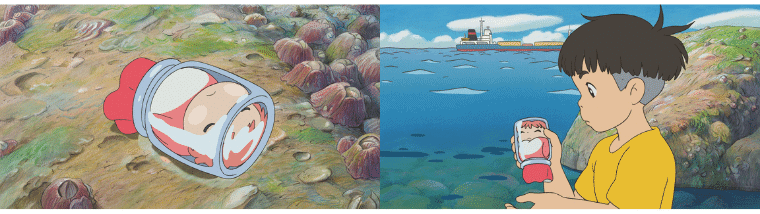
Sōsuke uses a rock to shatter the glass, rescuing the seemingly lifeless fish. In the process, he cuts his thumb. The little fish suddenly revives and licks the drop of blood from Sōsuke’s finger, instantly healing the cut.
Sōsuke drops the fish into a green plastic bucket filled with tap water, dubbing her “Ponyo.”
As Sōsuke and his mother, Lisa, prepare to leave for his nursery school, a suspicious-looking man approaches, spraying water around his feet. This is Fujimoto, Ponyo’s father, who has come up from the sea in search of her.
Lisa drives away, clearly wary of the stranger. At nursery school, Sōsuke hides Ponyo’s bucket in the bushes. When another child discovers her, he takes the bucket next door to the Himawari House, where Lisa works.
Sōsuke gets on well with the elderly women there and introduces Ponyo to them. Toki alone reacts with alarm, calling her a human-faced fish.
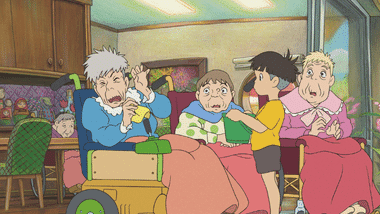
Toki warns that a human-faced fish coming ashore will bring a tsunami. The others take this as another of her barbed remarks, but Ponyo responds by squirting water into her face.
Startled by the commotion, Sōsuke hides with Ponyo among the rocks by the shore. Fujimoto appears and uses his magic to take her back to the sea.
Devastated, Sōsuke weeps on the shore, having broken his promise to protect her.
That promise is one of the lines that defines Sōsuke’s character. I discuss the original Japanese and English translation in my collection of memorable Ponyo quotes.
The Magical Rebellion
That night, Sōsuke’s father, Kōichi, is meant to come home from his work at sea. Then comes the familiar message: he cannot make it after all.
Lisa has put a great deal of effort into dinner and is left feeling both hurt and angry. Sōsuke takes the disappointment more calmly. As usual, he sends Morse-code messages to his father’s ship as it passes nearby.
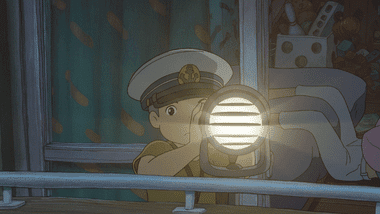
Kōichi replies with apologies and “I love you, Lisa.” Lisa takes her revenge by flashing “BAKA”—idiot—over and over.
Meanwhile, Fujimoto is struggling with Ponyo, who cannot forget the ham Sōsuke gave her and refuses the food her father offers. She prefers “Ponyo” to the beautiful name her parents gave her, Brunhilde, and declares that she wants to be human.
As Ponyo wishes to be like Sōsuke, she suddenly sprouts arms and legs. Licking his blood seems to have awakened the human side she inherited from Fujimoto.
Fujimoto manages to suppress the transformation and put her to sleep, but he knows this is only a temporary solution. He decides to seek help from “that person.”
Fujimoto thinks he has bought himself some time. But Ponyo’s determination to see Sōsuke, together with the help of her little sisters, makes another escape possible. She enters the room containing his magical elixir and takes human form.
Ponyo rushes toward the surface to find Sōsuke. A fierce storm breaks out, as though answering her movements.
As she runs across the enormous fish-shaped waves, Ponyo’s joy and determination seem to become the waves themselves.
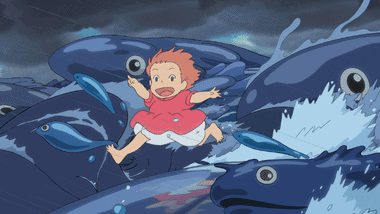
For a town beside the sea, the storm is a disaster. Lisa and Sōsuke’s journey home through it becomes a struggle for survival. On the flooded road, Sōsuke catches sight of a girl running over the waves beside their car.
Once they safely reach their clifftop house, the little girl tackles Sōsuke in a massive hug.
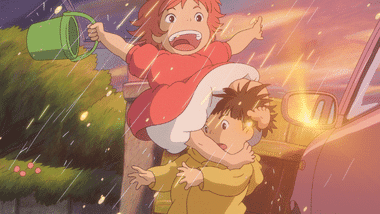
Sōsuke immediately recognizes her as Ponyo. Lisa, however, takes her for a lost child and brings her inside. A soft towel and hot ramen with ham soon help her settle in.
The storm passes, though the sea remains rough. After her brief time in Sōsuke’s house, Ponyo grows drowsy and falls asleep; the waves then begin to settle.
Lisa decides to check on the elderly people waiting at the Himawari House. Sōsuke wants to come, but she asks him to look after Ponyo and their house on the hill, which can serve as a landmark for others. Then she leaves for work.
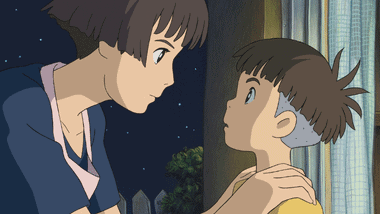
During the quiet night, the sea rises so far that their house on the cliff is left on an island.
The Voyage of the Pop-Pop Boat
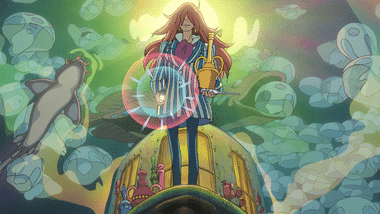
Fujimoto finally meets “that person”: Ponyo’s mother, Gran Mamare. He feels responsible for letting Ponyo escape and changing the world around them. Seeing her in human form, he is desperate to restore things to the way they were.
Gran Mamare makes a startling suggestion: why not let Ponyo become human?
If Ponyo becomes human, she will lose her magic and the world can return to normal. But first, Sōsuke must show that he accepts her as she really is.
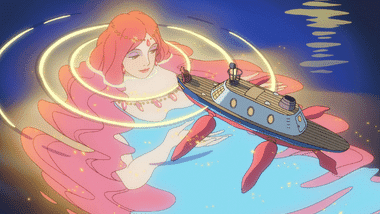
The next morning, Sōsuke wakes to a landscape covered by water and realizes that Lisa has not returned. Ponyo enlarges his toy pop-pop boat with magic so that they can go and find her.
The two set out in the enlarged boat, across a sea that now covers what used to be land.
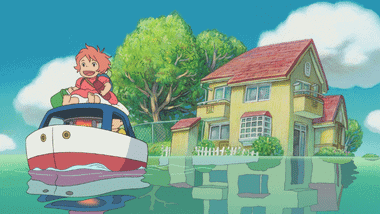
Their journey is not a lonely one. They meet townspeople heading by boat to a hotel on the hill and learn that the people from the Himawari House have gone to Maeyama Park. They hurry there, eventually finding Lisa’s car—but no Lisa. Sōsuke calls for her and gets no answer.
The Final Trial
Lisa, the staff, and the elderly people from the Himawari House are safe inside Gran Mamare’s underwater dome, where they can witness Ponyo and Sōsuke’s important ceremony. Within that magical space, the elderly women enjoy a moment of running freely. Lisa and Gran Mamare are also having a serious conversation.
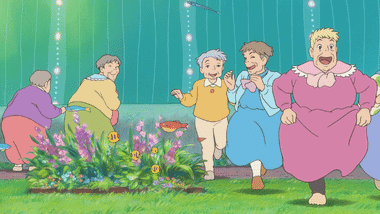
Not knowing any of this, Sōsuke and Ponyo continue hand in hand. Ponyo is growing sleepy, perhaps from using too much magic. When they enter the tunnel toward Maeyama Park, she rapidly returns to her fish form.
Sōsuke struggles to understand what has happened. Fujimoto approaches, looking as suspicious as ever, and more or less carries them off to the underwater dome. At last, Sōsuke is reunited with Lisa.
Then Gran Mamare explains that Ponyo wants to become human. For that to happen, someone must accept her while knowing what she really is.
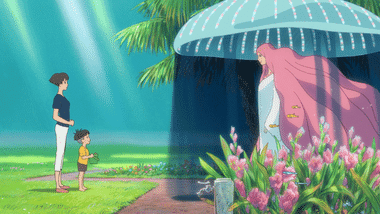
Sōsuke answers without hesitation: he loves Ponyo in all her forms.
With that condition met, Gran Mamare tells Ponyo that she will lose her magic if she becomes human. She places her in a bubble; the final step is for Sōsuke to kiss it.
Sōsuke takes Ponyo, enclosed in the bubble, back to the surface.
Ponyo leaps out in human form and kisses Sōsuke. The story ends with the two together.
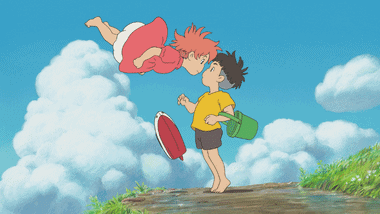
That brings the story of Ponyo to its end. Now for some of the questions—and the slightly more grown-up concerns—that I find beneath this children’s adventure.
Ponyo (2008): Interpretations and Questions
Ponyo’s Determination
What drives this film more than anything is Ponyo’s determination to reach Sōsuke. However innocent she may be, her pursuit is powerful enough to set the sea in motion.
I do not remember such an overt display of determination from earlier Miyazaki heroines. Even so, I feel something connecting them.
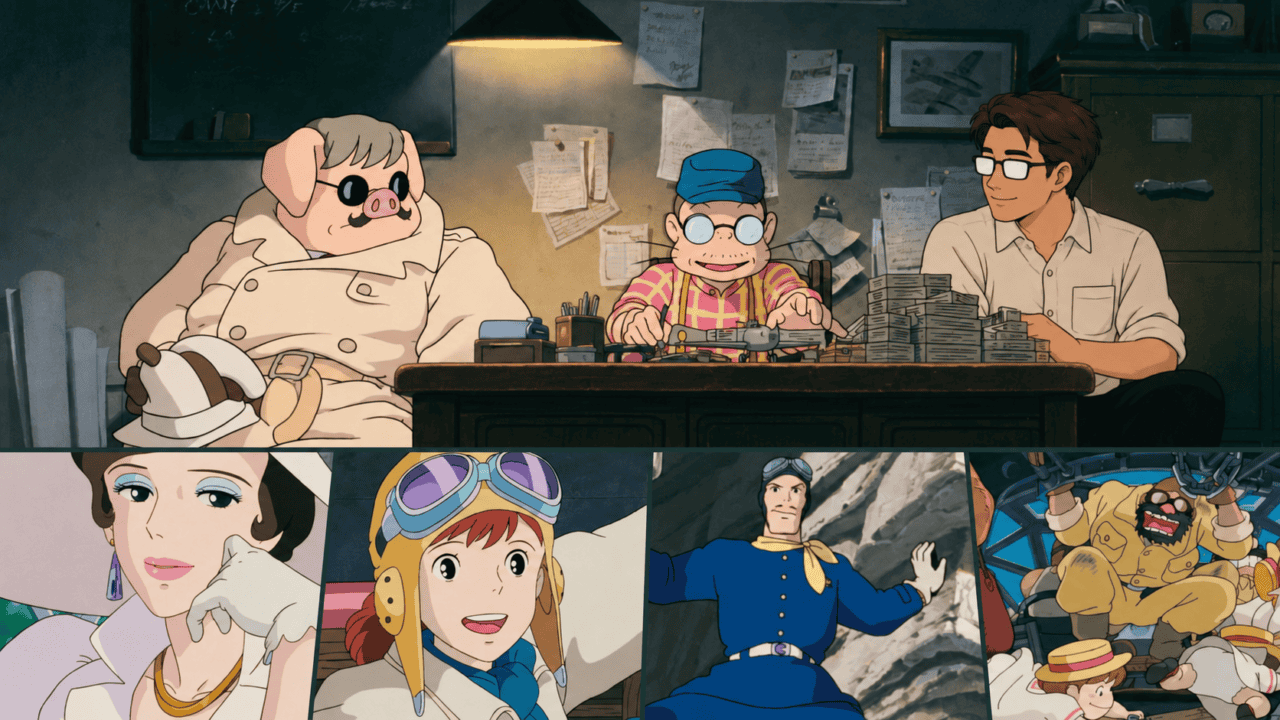
Alongside that determination, I sense a shared theme of “male sorrow” running through Porco Rosso, Howl’s Moving Castle, and Ponyo.
I explore that connection, and what it might mean for the men caught up in these women’s determination, in the articles below. What do you think?
Read the full analysis: Part 1: The Curse of Porco Rosso
Read the full analysis: Part 2: Sophie’s Obsession and the Capture of Howl
Read the full analysis: Part 3: Gran Mamare and Sōsuke’s Possible Future
Why Does Sōsuke Call His Mother “Lisa”?
One detail struck me almost immediately: Sōsuke calls his mother “Lisa” rather than “Mom.” For a Japanese viewer, that can feel decidedly unusual.
It seems unlikely that this detail was included by accident. I suspect there is a reason behind it—but what is that reason?
My own reading concerns the relationship between Sōsuke and his parents. I discuss it in more detail here:
Read my interpretation: Why Does Sōsuke Call His Mother “Lisa”? The Meaning of First Names
Gran Mamare’s True Form
Gran Mamare appears in the film as a beautiful, luminous presence. There is also an intriguing detail about how Miyazaki conceived her.
In the interview collection Zoku Kaze no Kaeru Basho, Miyazaki describes Gran Mamare as an anglerfish.
That detail opens up another way of reading her relationship with Fujimoto—and, in my interpretation, imagining what may lie ahead for Sōsuke and Ponyo.
Read the full interpretation: Gran Mamare: An Anglerfish Romance?
Ponyo Trivia and Production Background
There is more production background to explore, including Miyazaki’s interest in Richard Wagner’s Ride of the Valkyries while developing the film. I have collected related details in the article below.
If you love Ghibli lore, check out the trivia collection below!
Read the trivia collection: Ponyo: Trivia and Production Background
The images used in this article are from the Studio Ghibli Works Still Images collection.
Can you name the movie before the scene comes into focus?
Put your visual memory to the test with a blurred Studio Ghibli scene.

Reader Comments
Have a thought or interpretation? Leave a comment