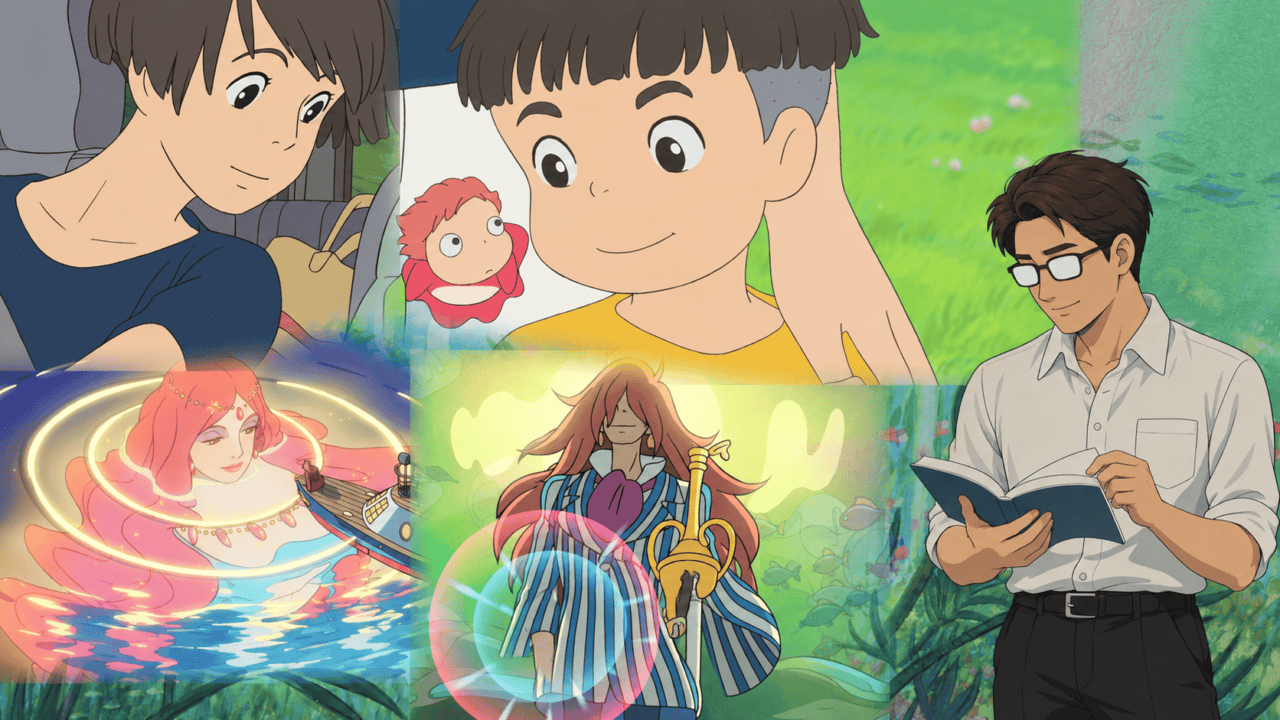
Ponyo (Studio Ghibli Official) is a 2008 animated feature film written and directed by Hayao Miyazaki. It was released in Japan on July 19, 2008.
In this article, I have selected 12 of my favorite quotes from the film.
The dialogue in Ponyo often becomes even more interesting when the original Japanese is compared with its English translation. For each quote, I will look at the Japanese line, its romanization, the English subtitle, a literal translation, and what the dialogue tells us about the characters and the story.
These are not necessarily the 12 most objectively famous lines in the film. This is a personal selection, and some are included simply because they have stayed in my memory.
The film’s official English title is:
Ponyo
Simple and easy to remember.
Translation note: The English subtitle wording in this article is based on the commercially released Blu-ray available to the author. Subtitle wording may vary between releases and territories.
▼ Read the full story and analysis behind these quotes
On this pageContents
Ponyo Quotes in Japanese and English
“Ponyo… loves… Sosuke!”
ポニョ、宗介、好き!
Ponyo, Sōsuke, suki!
Ponyo…loves…Sosuke!
Ponyo loves Sosuke!
Read the Commentary and Analysis
These are the first human words Ponyo speaks while she is still in fish form.
That feeling becomes the driving force behind everything that follows. Ponyo escapes from Fujimoto for a second time and races back to Sosuke on top of a gigantic tsunami.
In other words, this is the line that sets Ponyo on the path toward becoming human.
It also determines Sosuke’s fate along with her own. In that sense, this innocent little declaration of love is almost like a curse that decides the future of both children.
I had always wondered how such childlike Japanese would be handled in English. The subtitle uses essentially the same idea as the original: simple words placed one after another.
That simplicity is exactly what makes the line work.
▼ Read more about Ponyo’s age, voice actor, background, and character analysis
Sosuke Quotes in Japanese and English
“Don’t worry, I’ll take care of you.”
大丈夫だよ、僕が守ってあげるからね。
Daijōbu da yo, boku ga mamotte ageru kara ne.
Don’t worry, I’ll take care of you.
It’s okay. I’ll protect you.
Read the Commentary and Analysis
Sosuke says this to Ponyo after finding her, while she is sitting in a bucket in the car on the way to the Sunflower Home.
Throughout the film, Sosuke stubbornly tries to keep the promise he makes here.
By the end, I read that promise as committing him to protect her for the rest of his life in order to save the world.
That is a rather large consequence for a promise made by a five-year-old, but this line nevertheless tells us something fundamental about Sosuke: when he says he will protect someone, he means it.
The interesting part of the English subtitle is “take care of.”
It is tempting for a Japanese speaker to translate 守る directly as “save” or “protect,” but in this situation “take care of you” sounds far more natural. Sosuke is not simply rescuing Ponyo from immediate danger. He is promising to look after her.
“I’ll always love Ponyo… whether she’s a fish, a human… or in between.”
僕、お魚のポニョも、半魚人のポニョも、人間のポニョもみんな好きだよ!
Boku, osakana no Ponyo mo, hangyojin no Ponyo mo, ningen no Ponyo mo minna suki da yo!
I’ll always love Ponyo…whether she’s a fish, a human… or in between.
I love Ponyo as a fish, Ponyo as a half-fish person, and Ponyo as a human—all of them!
Read the Commentary and Analysis
Sosuke says this during the final test after Gran Mamare asks whether he can accept Ponyo even if she remains part fish.
It is an extraordinarily innocent answer from a five-year-old boy.
And once again, I see that innocent answer as deciding the course of his life.
The interesting English expression is “in between.”
English does have words such as “merman,” while something like “half human, half fish” would describe Ponyo more literally. Instead, the subtitle avoids a direct label and simply says “in between.”
That may be because conventional words for merfolk do not really match the strange intermediate form Ponyo takes in the film.
More importantly, “in between” keeps the emphasis where it belongs. Sosuke does not care what category Ponyo belongs to. Fish, human, or something between the two—she is still Ponyo.
▼ Read more about Sosuke’s age, voice actor, background, and character analysis
Lisa Quotes in Japanese and English
“Maybe it was fate. It just can’t be helped.”
宗介さ、運命っていうのがあるんだよ。辛くても運命は変えられないんだよ。ポニョは海で生きるように生まれたから、海に戻ったんだ~って思うな。
Sōsuke sa, unmei tte iu no ga aru n da yo. Tsurakute mo unmei wa kaerarenai n da yo. Ponyo wa umi de ikiru yō ni umareta kara, umi ni modotta n da tte omou na.
Listen, Sosuke. Maybe it was fate. It just can’t be helped. Ponyo was born in the sea. She went back home, that’s all.
Sosuke, there is such a thing as fate. Even if it hurts, you can’t change fate. Ponyo was born to live in the sea, so think of it as her having gone back to the sea.
Read the Commentary and Analysis
Lisa says this after Fujimoto takes Ponyo back and Sosuke falls into despair.
She could simply have said, “There’s nothing we can do,” and ended the conversation there. Instead, she tries hard to give her five-year-old son a way to understand what has happened.
The line therefore shows Lisa’s kindness surprisingly well.
Her driving becomes somewhat more aggressive immediately afterward, but perhaps that too was part of her attempt to shake Sosuke out of his sadness.
The key English expression is “It can’t be helped.”
Its literal wording may sound strange to Japanese learners of English, but it is a standard expression meaning that a situation cannot be changed and must simply be accepted.
Perhaps the final “that’s all” adds to the sense that Lisa is trying to convey: painful as it is, there is nothing they can do.
Of course, the audience already suspects that things are not going to remain quite that simple.
“Sosuke, our house is a lighthouse in the storm.”
宗介、今この家は嵐の中の灯台なの。真っ暗な中にいる人は、みんなこの光に励まされているわ。
Sōsuke, ima kono ie wa arashi no naka no tōdai na no. Makkura na naka ni iru hito wa, minna kono hikari ni hagemasarete iru wa.
Sosuke, our house is a lighthouse in the storm. Everyone out there is depending on us.
Sosuke, right now this house is a lighthouse in the storm. Everyone out there in the darkness is being encouraged by this light.
Read the Commentary and Analysis
After Ponyo finally reunites with Sosuke and the worst of the storm seems to have passed, Lisa decides to head to the Sunflower Home.
Sosuke wants to go with her, and Lisa uses this line to persuade him to stay behind.
Whether leaving the children there was the right decision is certainly open to debate, but at the very least Lisa is trying to fulfill her responsibilities as a working adult.
Lisa is simply someone who cannot sit still.
The interesting English expression is “out there.”
Depending on context, it can mean something like “outside,” “out in the world,” or “somewhere beyond here.”
The Japanese refers to “people in complete darkness,” while the subtitle converts that idea into “everyone out there.” It is less literal, but perfectly natural English.
This is exactly the sort of phrase that makes someone sound as though they really know English when they use it naturally.
I cannot do it.
▼ Read more about Lisa’s age, voice actor, background, and character analysis
Koichi Quotes in Japanese and English
“It’s Sosuke! He’s a genius. Only five years old!”
宗介だ!あいつは天才だ。まだ5歳だぞ。
Sōsuke da! Aitsu wa tensai da. Mada go-sai da zo.
It’s Sosuke! He’s a genius. Only five years old.
It’s Sosuke! He’s a genius. He’s only five years old!
Read the Commentary and Analysis
Koichi says this excitedly to his crewmates after realizing that the Morse code being flashed from his house is coming from Sosuke.
It may not be the sort of line that immediately comes to mind when people talk about famous Ponyo quotes.
But the sheer delight with which Koichi tells everyone that his son is a genius performs an important job in the story.
Koichi spends a great deal of time away from home, but this tiny moment makes it clear that his absence does not mean that he cares little about his family.
He is simply a very proud father.
“A little girl? She must be Sosuke’s age!”
お、女の子だ。宗介と同じくらいの子だ。
O, onna no ko da. Sōsuke to onaji kurai no ko da.
A little girl? She must be Sosuke’s age!
A girl! She’s about the same age as Sosuke.
Read the Commentary and Analysis
Koichi says this after seeing Ponyo during her second escape from Fujimoto, when she races across the sea toward Sosuke.
At the time, he may simply have assumed that he was seeing things.
Soon afterward, however, he encounters Gran Mamare at sea.
And once he eventually returns home, he will discover that the mysterious girl he saw is now effectively being introduced as his five-year-old son’s future partner.
Seeing her once beforehand may have reduced the shock by at least a little.
▼ Read more about Koichi’s age, voice actor, background, and character analysis
Fujimoto Quotes in Japanese and English
“How could you love such disgusting creatures?”
あんな愚かで忌まわしい生き物のどこが良いのだ!人間は海から命を奪い取るだけだ。私もかつて人間だった。
Anna oroka de imawashii ikimono no doko ga ii no da! Ningen wa umi kara inochi o ubaitoru dake da. Watashi mo katsute ningen datta.
How could you love such disgusting creatures? They rob the sea of life. I was human myself…once.
What do you like about such foolish, detestable creatures? Humans do nothing but take life from the sea. I too was once human.
Read the Commentary and Analysis
Fujimoto says this after finally getting Ponyo back, only for his daughter to announce that she wants to become human.
The line establishes both Fujimoto’s basic attitude toward humanity and the sea, and the important fact that he himself was once human.
And yet his later behavior makes his position surprisingly complicated.
When Ponyo’s actions transform the world and place human civilization in danger, Fujimoto does not celebrate. He panics and desperately tries to fix the situation.
Yet he eventually accepts Ponyo becoming human, perhaps persuaded by Gran Mamare.
He is not exactly a monument to ideological consistency.
But perhaps that contradiction is part of what makes him sympathetic. Fujimoto may despise humanity in theory, but when actual humans are in danger—and especially when his daughter’s happiness is involved—things become much less simple.
The key English expression is “rob A of B.”
It means to take B away from A.
Even when you know the verb “rob,” the instinct for a Japanese learner may be to use “from.” Unfortunately, English has decided that this particular construction uses “of.”
There is no point complaining. We simply have to remember it.
“When I think of meeting her again…!”
あの人に会えるかと思うと胸が苦しくなってきた。
Ano hito ni aeru ka to omou to mune ga kurushiku natte kita.
When I think of meeting her again…!
Just thinking that I might see her again makes my chest ache.
Read the Commentary and Analysis
Fujimoto says this when he realizes that his own magic is no longer enough to suppress Ponyo’s transformation and that he must ask “that person”—Gran Mamare—for help.
The existence of this line tells us something important about Gran Mamare.
She is the sort of presence who completely captivates a man.
Fujimoto certainly loves Gran Mamare, but at times it almost feels more accurate to say that he is under her spell.
The subtitle leaves “my chest is beginning to hurt” as an ellipsis. Perhaps it relies on the performance to convey that feeling within the available space.
I think Fujimoto’s expression conveys what the words leave unsaid.
“Take good care of her.”
ポニョをよろしく頼む。
Ponyo o yoroshiku tanomu.
Take good care of her.
I’m entrusting Ponyo to you.
Read the Commentary and Analysis
Fujimoto says this at the end of the film, when he finally accepts the situation and entrusts Ponyo to Sosuke.
Fujimoto spends almost the entire movie running around in confusion, but when you think about the situation from his point of view, perhaps that is understandable.
His beloved daughter has suddenly become obsessed with some boy he has never met and is doing everything in her power to abandon the world in which she was raised.
A father might reasonably panic.
Perhaps everything that happens in the film is, from Fujimoto’s perspective, an enormous ritual he has to endure before he can finally let his daughter go.
And I think there is something particularly moving about the fact that he does not say, “Take care of Brünnhilde.”
He says, “Take good care of Ponyo.”
I read that choice of name as a poignant sign of his resolve: he entrusts her to Sosuke as Ponyo, not Brünnhilde.
▼ Read more about Fujimoto’s background, voice actor, and character analysis
Gran Mamare Quotes in Japanese and English
“What if Ponyo really becomes human?”
ねえ、ポニョを人間にしてしまえばいいのよ。
Nē, Ponyo o ningen ni shite shimaeba ii no yo.
Listen, dear…what if Ponyo really becomes human?
You know, why don’t we just make Ponyo human?
Read the Commentary and Analysis
Gran Mamare says this to Fujimoto while he is desperately trying to recover Ponyo and restore the world she has thrown out of balance.
This single suggestion determines both the ending of the film and, to a considerable extent, the rest of Sosuke’s life.
She is an extraordinarily bold woman.
The main English expression here is “what if…?”
It is a standard way to introduce a possibility: “What would happen if…?” or “How about if…?”
The Japanese is actually even more direct. Gran Mamare essentially says, “Why don’t we just make Ponyo human?”
For Fujimoto, who has spent most of the film trying to stop exactly that from happening, it is quite a proposal.
▼ Read more about Gran Mamare’s background, voice actor, and character analysis
Toki Quotes in Japanese and English
“Don’t let the wind blow you away!”
風に飛ばされるんじゃないよ!
Kaze ni tobasareru n ja nai yo!
Don’t let the wind blow you away!
Don’t get blown away by the wind!
Read the Commentary and Analysis
Toki calls this out to Sosuke as he prepares to leave by car in the middle of the storm.
From her first appearance, Toki is presented as a somewhat difficult old woman.
But little lines like this quietly tell us, “Oh. She is not simply a mean old lady.”
Before we quite realize what has happened, the film has gradually made us fond of her.
The interesting English structure is “let A + verb.”
For Japanese learners, the instinct may be to build the sentence in the passive voice: “Don’t be blown away by the wind.”
But English naturally expresses it here as “Don’t let the wind blow you away.”
It is one of those constructions that seems perfectly obvious once you see it, yet is surprisingly difficult to produce spontaneously.
▼ Read more about Toki’s background, voice actor, and character analysis
Those are the 12 lines I personally selected from Ponyo.
Which quote from Ponyo has stayed with you?
The images used in this article are from the Studio Ghibli Works Still Image Collection.
Can you name the movie before the scene comes into focus?
Put your visual memory to the test with a blurred Studio Ghibli scene.
Reader Comments