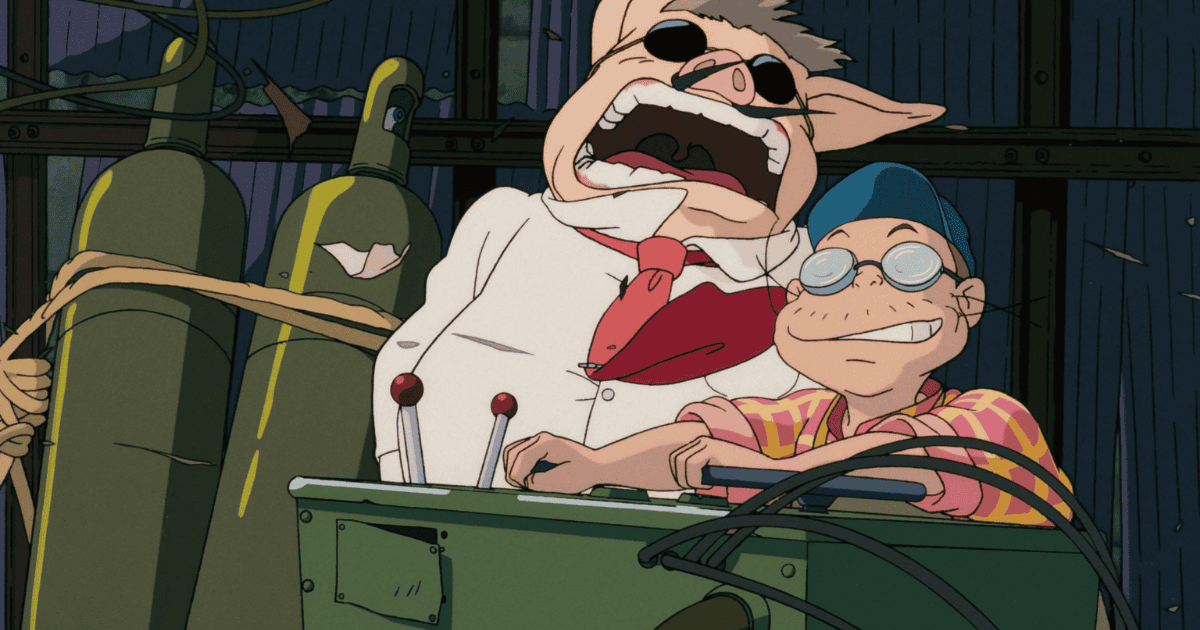
Hayao Miyazaki’s 1992 aviation epic, Porco Rosso(Studio Ghibli Official), is a cinematic love letter to the golden age of flight, wrapped in a cynical, hardboiled critique of war and fascism. But beyond the breathtaking aerial dogfights and stunning Adriatic scenery, the film’s true magic lies in its unforgettable cast.
From a world-weary pig gripping his vanishing pride to a teenage mechanical genius boldly challenging the era’s gender norms, who exactly are the rogues, romantics, and scoundrels cruising the skies of 1920s Italy?
Today, we are looking past the pilot goggles to deeply psychoanalyze the characters and voice actors who brought Porco Rosso to life. Please be warned: this deep-dive character guide contains major spoilers for the entire film.
*This is a translated version. The original (Japanese) is available here.
On this pageContents
Porco Rosso (1992) Main Characters & Voice Actors List
| Name | Age | Voice Actor (English Dub) |
|---|---|---|
 Porco Rosso | 36 | Michael Keaton |
 Madame Gina | Unknown | Susan Egan |
 Fio Piccolo | 17 | Kimberly Williams-Paisley |
 Mr. Piccolo | Unknown | David Ogden Stiers |
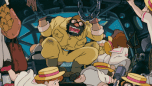 Boss | Unknown | Brad Garrett |
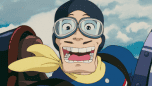 Donald Curtis | Unknown | Cary Elwes |
Porco Rosso (1992) Character Map
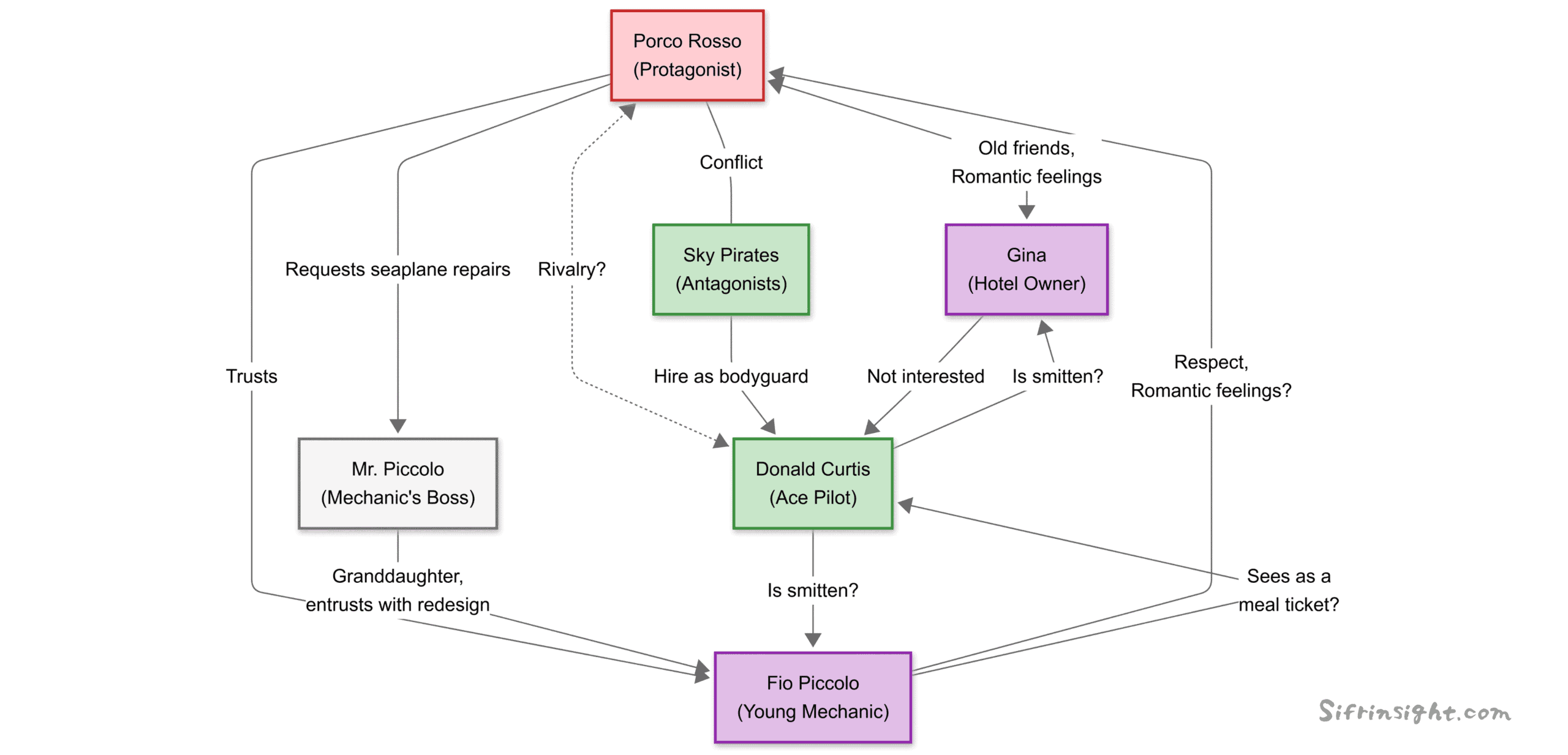
The Sky Pirates make their living through acts of plunder and ransom, while Porco works as a cynical bounty hunter who hunts them for cash. Fio is the granddaughter of Mr. Piccolo, the master engineer Porco hires to repair his seaplane, and she boldly accompanies him to prove the worth of the redesign she engineered.
▼ Discover the lines that define these characters
Porco, Gina, Fio, Curtis, Mr. Piccolo, Ferrarin, and the Mamma Aiuto Boss reveal their personalities through some of the most stylish dialogue in Studio Ghibli’s films. Compare the original Japanese with the English subtitles, literal translations, and dub wording in our guide to 17 memorable Porco Rosso quotes.
Porco Rosso (1992) Deep Character Profiles and Analysis
Porco Rosso | Voiced by: Michael Keaton
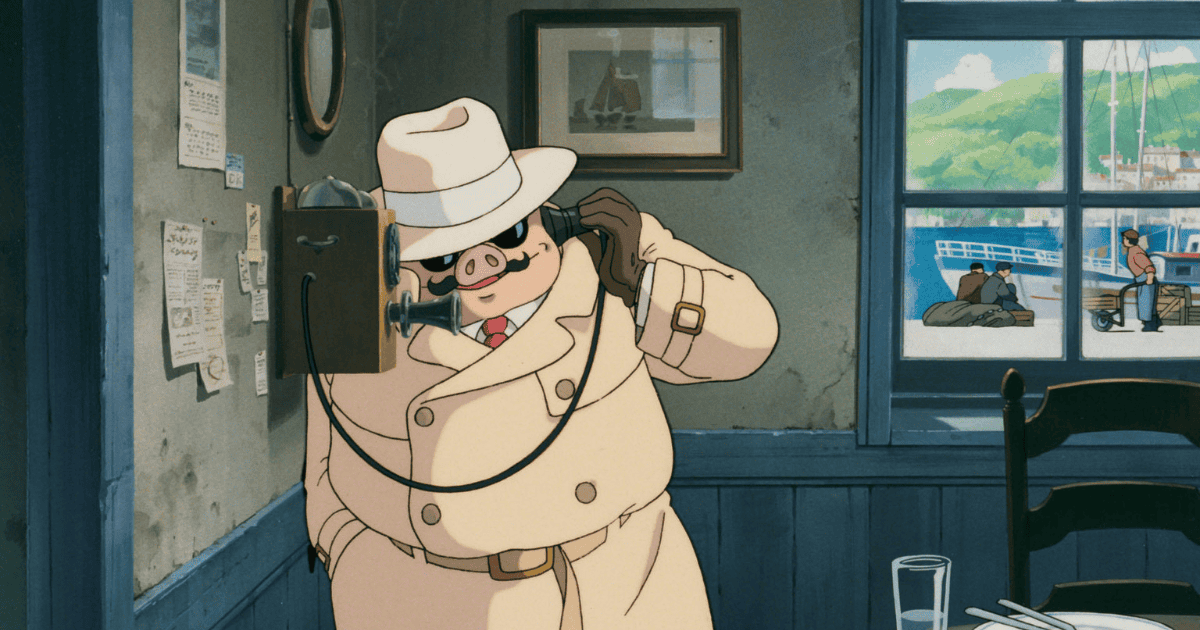
The Cynical Bounty Hunter
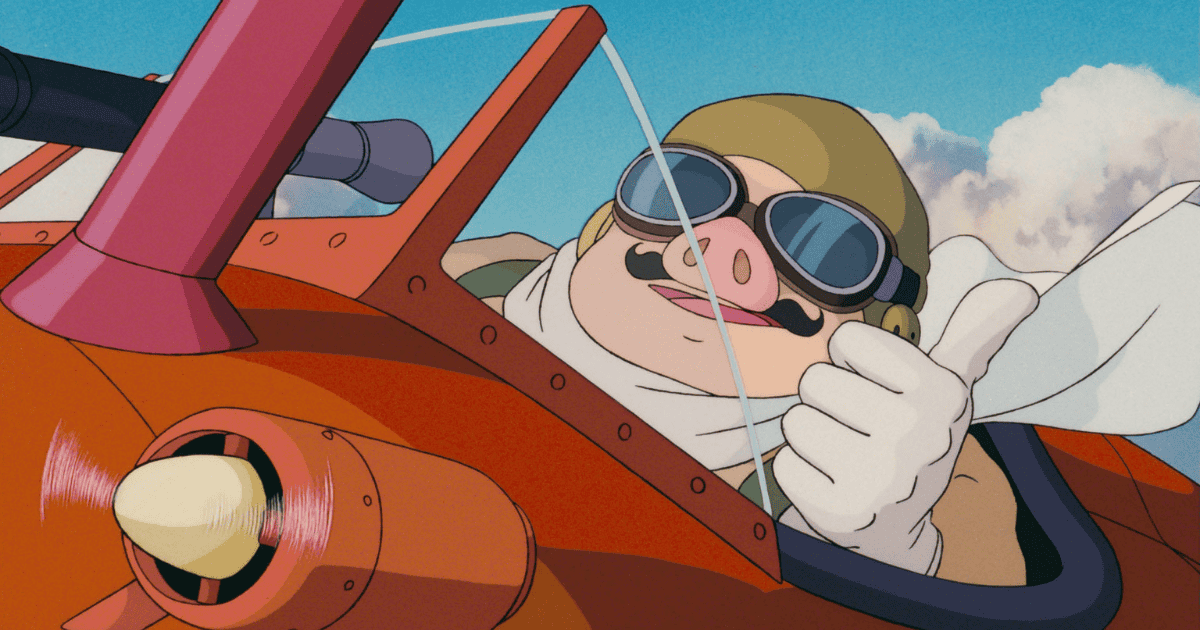
The titular protagonist of the story. He is a 36-year-old veteran with a heavy past.
Once a legendary ace pilot for the Italian Air Force during World War I, he became deeply disillusioned with the rise of fascism and humanity’s endless appetite for slaughter. He mysteriously cursed himself into the form of an anthropomorphic pig, retired from the military, and now ekes out a living as a freelance bounty hunter hunting air pirates over the Adriatic Sea.
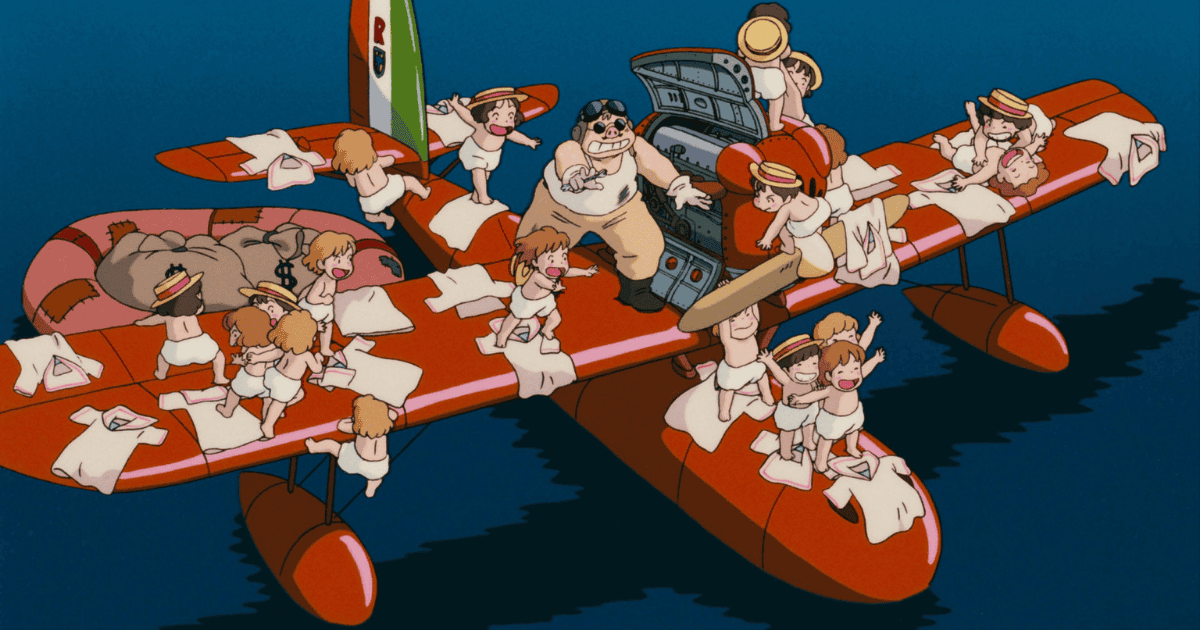
Despite possessing a backstory that screams “hardboiled masculine romance,” the film opens with an incredibly anti-climactic subversion: Porco’s daring attempt to rescue a group of beautiful young women from pirates ends with him rescuing a chaotic swarm of loud, energetic schoolgirls instead.
Porco’s Lack of Change
While Porco is undeniably the protagonist, how exactly does his character arc evolve from the beginning of the film to the end?
The surprising conclusion is: his fundamental approach to life doesn’t actually change at all. And that stubbornness is exactly the point of Porco Rosso.
Of course, minor details shift. It is heavily implied that he finally accepts Gina’s love. During the epilogue, Eagle-eyed viewers can spot Porco’s distinct red seaplane docked behind Gina’s private garden at the Hotel Adriano (a famous Easter egg circled in red below).
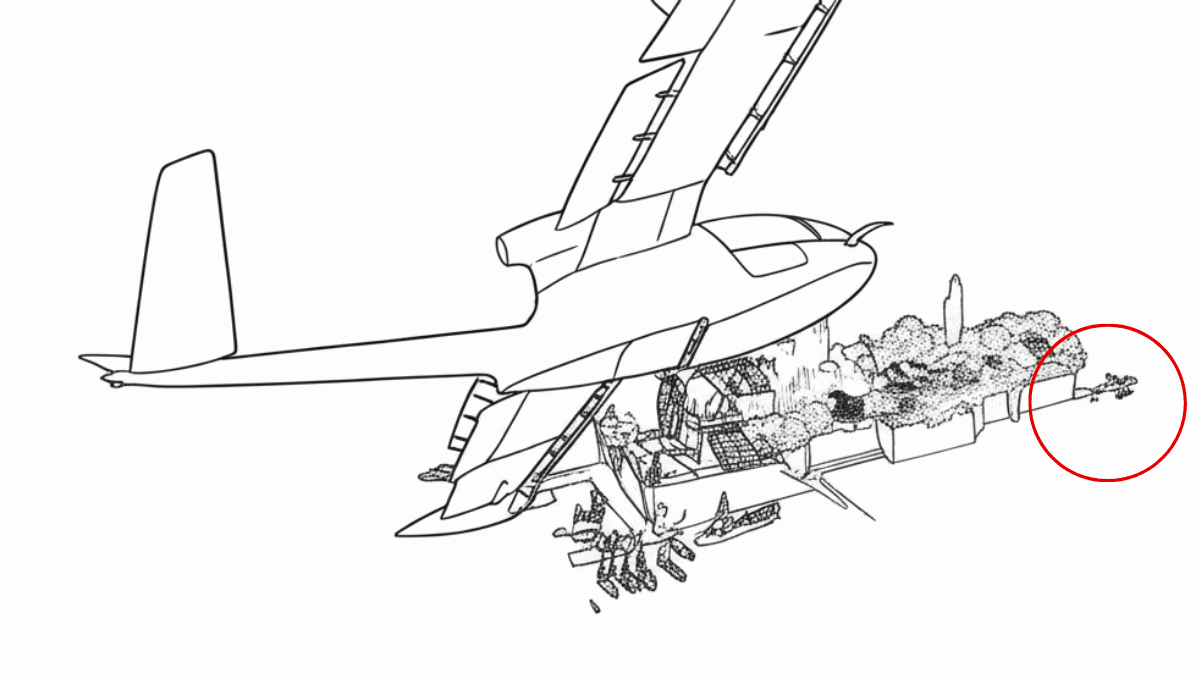
Yet, even if he settled down with her, the narration confirms that Porco stubbornly continues to fly as a bounty hunter. He essentially declares, “I will not be entirely tamed by domestic life!”
This is no different from his rebellious stance after World War I, where he physically turned his back on a changing world and stubbornly insisted on remaining exactly who he was.
Still, finally allowing Gina to stand by his side must bring him immense, quiet happiness. After all, a rebel needs someone to push back against while proudly declaring, “I won’t be tamed!”
Madame Gina | Voiced by: Susan Egan
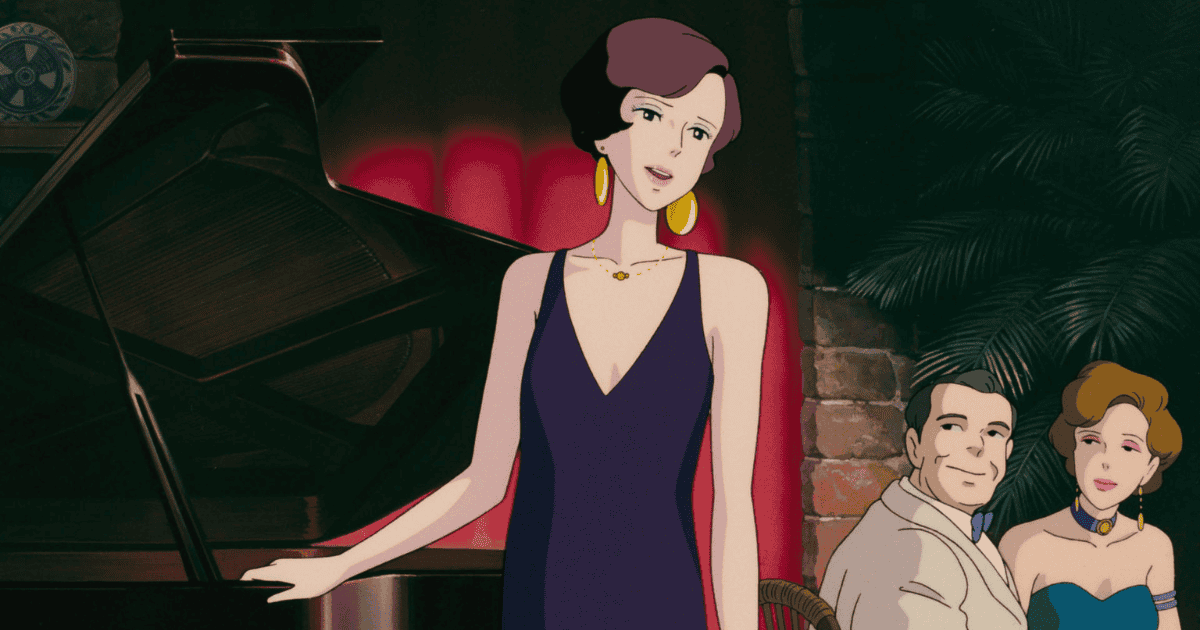
The Queen of the Adriatic
She is the glamorous owner of the Hotel Adriano and Marco’s (Porco’s) oldest childhood friend. As the Boss of the Mamma Aiuto gang bluntly states, absolutely every pilot flying over the Mediterranean is hopelessly in love with Gina.
Before the events of the film, she had already married and buried three pilot husbands. (She receives a telegram confirming the death of her third husband early in the story).
Was she fatally attracted to pilots, or did she simply marry within her exclusive, isolated social circle? One would assume a rational person might reconsider marrying an aviator after burying two of them, but the allure of the sky is apparently unbreakable.
Having exhausted her other options, Gina finally places an incredibly bold, almost condescending “bet” on Porco: “If he visits me in my garden during the day, I will finally allow myself to love him.”
As proved by the Easter egg of the docked plane, it is safe to say Gina ultimately “won the bet.”
A Deeper Psychoanalysis of Gina’s Three Marriages
While the film treats Gina’s three tragic marriages as a brief piece of melancholy exposition, diving into the psychology of her choices reveals a fascinating narrative layer.
The fact that she married three consecutive seaplane pilots borders on masochism. What is even more extreme is that her final target, Porco, is also a seaplane pilot. After so much grief, why not simply marry a wealthy banker who stays safely on the ground?
Furthermore, she effortlessly rejects Donald Curtis, a handsome, incredibly skilled pilot who practically worships her. If Porco is just “husband number four,” wouldn’t Curtis have been an equally fine choice?
When you deeply analyze Gina’s romantic need for control, and cross-reference it with Miyazaki’s profound admiration for the French aviator Antoine de Saint-Exupéry, a stunning hidden lore emerges.
Read the full analysis: The Mystery of Gina’s Marriages and Why Curtis Never Stood a Chance
Fio Piccolo | Voiced by: Kimberly Williams-Paisley

The Teenage Mechanical Genius
A brilliant, fast-talking 17-year-old girl who works at “Piccolo S.P.A.,” her grandfather’s legendary seaplane manufacturing company in Milan. Despite her youth and gender, she boldly steps up and takes complete charge of redesigning Porco’s shattered Savoia S.21.
When I first watched Porco Rosso as a child, I actually found Fio’s relentless pushiness to be incredibly irritating. Why was this kid forcing herself into Porco’s dangerous life? At the time, I just couldn’t bring myself to like her.
However, watching it now as an adult, my irritation has shifted into a complex sense of “philosophical unease.”
Of course, I understand her motivation. Because her radical, unproven modifications were installed, and because she lacks the quiet “confidence born of decades of experience,” it is perfectly natural that a 17-year-old would desperately want to ride along on the test flight to monitor the engine’s performance.
Furthermore, stripping away the engineering excuse, it is obvious Fio simply craved the thrill of an adventure with the legendary Porco Rosso. Taking that reckless leap into the unknown is the absolute privilege of youth.
So, where does my “unease” come from?
It stems from the fact that, from a strict standard of “professional ethics,” it would have been vastly cooler if Fio had stayed behind in Milan.
Fio is a genius; she is destined to engineer countless incredible machines in her lifetime. Is she going to physically ride in the passenger seat of every single plane that leaves her garage? That is not how a true artisan operates. In any craft, once the product leaves your hands and goes to the client, you must let it go. You watch it fly away, think, “Ah, I could have tweaked that one gear better,” and apply that lesson to your next project.
Director Miyazaki, a master craftsman who has released dozens of films into the world knowing they are never truly “perfect,” understands this agonizing artistic separation better than anyone.
If that is true, then it would have been a far more profound display of professional pride for Fio to build a plane so perfect that she didn’t *need* to chaperone it, gracefully waving Porco off from the dock.
So why did Miyazaki write the script to force Fio into the passenger seat? The honest, slightly cynical answer is: “Because having a beautiful teenage girl desperately tag along makes the middle-aged protagonist feel happy.“
The reason Porco caved so easily to Fio’s demands, despite his initial grumpy protests, was because, deep down, his male ego loved it. His gruff rejection was merely the customary performance of “an older man’s restraint.”
As the omniscient audience, we know exactly how this plays out for him:
- The elegant woman he has loved for decades is fiercely trying to claim his heart.
- After winning the climactic duel, the beautiful 17-year-old girl rewards him with a passionate kiss.
And remember, Hayao Miyazaki—the ultimate architect of this universe—is the one pulling these specific narrative strings.
Ultimately, Fio tagging along and fawning over Porco is the manifestation of an “older man’s ultimate fantasy.“
However, the way Porco handles the situation—treating her strictly like a child to be protected and firmly pushing her away at the end—echoes the legendary conclusion of Miyazaki’s Lupin the Third: The Castle of Cagliostro.
Even if an older man harbors a flattering “fantasy” in his head, actively choosing not to act on it is the definition of “an older man’s grace.” You must never clip the wings of a promising youth to soothe your own aging ego. To humbly step back and let the young girl fly away to her own future is the true mark of a gentleman.
We all eventually become the “older man.” When that time comes, it is perfectly fine to indulge in the fantasy, but you must possess the grace to walk away. That is the profound, hardboiled lesson encoded in both Cagliostro and Porco Rosso.
Mr. Piccolo | Voiced by: David Ogden Stiers
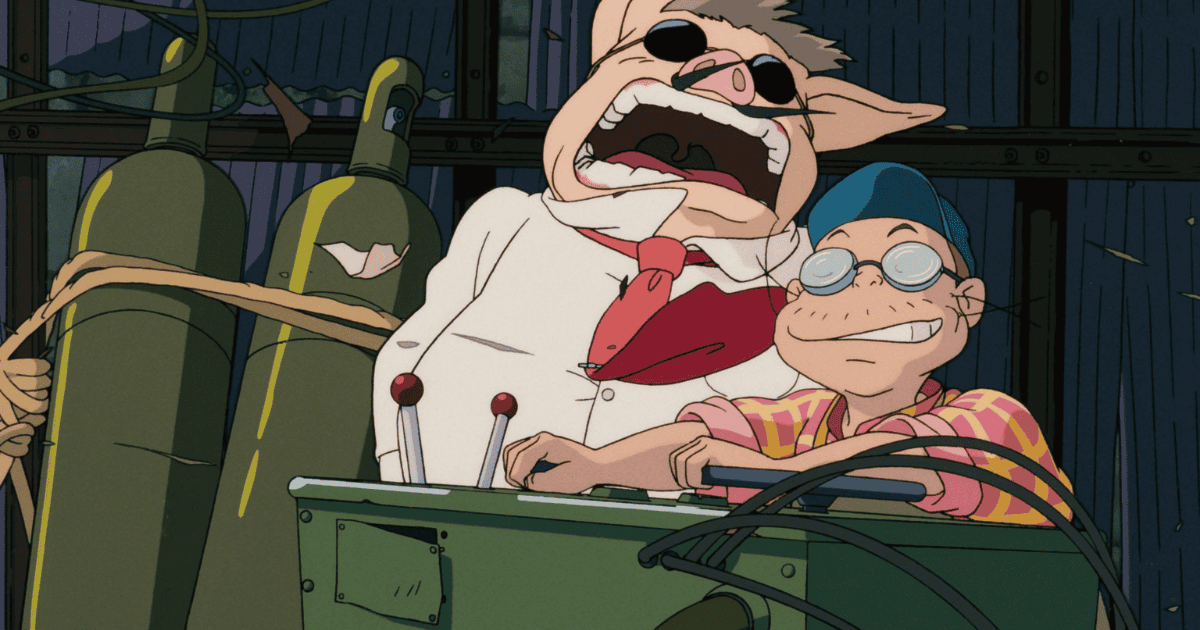
The Master Mechanic
The gregarious proprietor of “Piccolo S.P.A.,” an elite seaplane manufacturing garage in Milan, and Fio’s proud grandfather.
He is an old, trusted comrade of Porco, and Porco implicitly trusts his engineering instincts.
With all his sons away searching for work due to the Great Depression, Piccolo boldly entrusts the entire redesign of Porco’s aircraft to his 17-year-old granddaughter. Furthermore, because all the able-bodied men have left Milan, the grueling physical labor of rebuilding the plane is executed entirely by an army of local women—his female relatives and neighbors.
Trying to reassure a highly skeptical Porco, Piccolo proudly declares, “Don’t worry, women are great. They work hard, and they’re persistent.”
When this scene airs on modern television, it always causes a slight flinch. While Piccolo clearly intends it as high praise, the phrasing skirts the very edge of benevolent sexism. The slightly condescending, generalized tone of “women are great” is exactly the kind of line that ignites fierce debates on modern social media.
Perhaps we have reached the era where even a masterpiece like Porco Rosso requires a brief historical disclaimer before broadcasting: “This film reflects the gender dynamics of the era in which it was produced.”
Boss | Voiced by: Brad Garrett
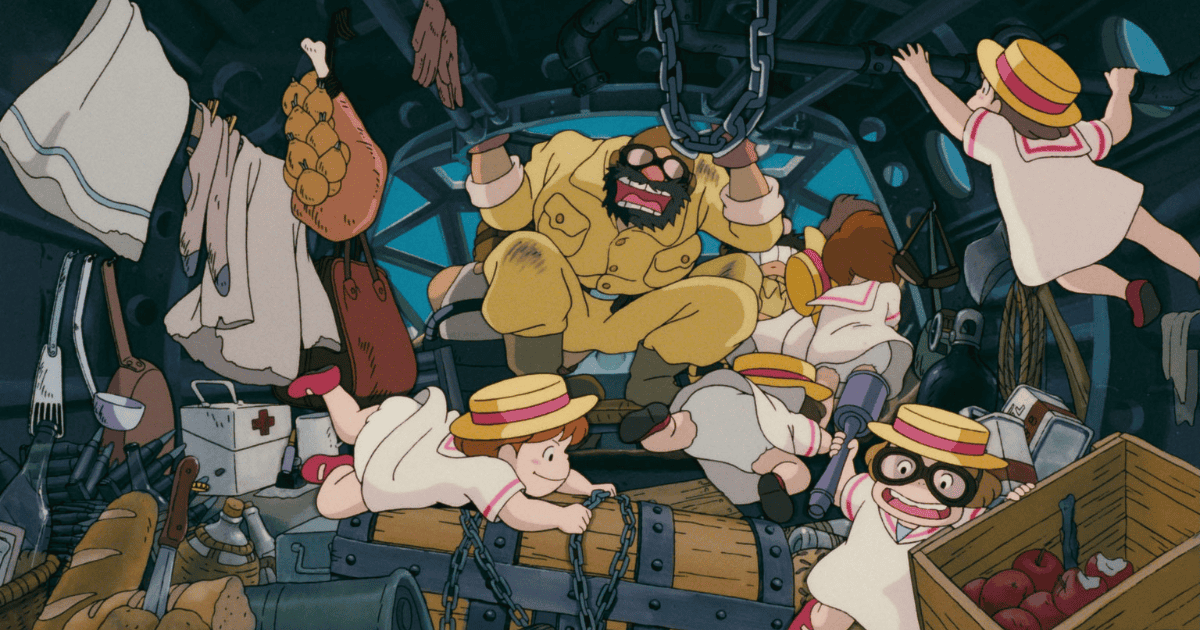
The Lovable Scoundrel
The gruff, physically imposing leader of the “Mamma Aiuto” gang, a notoriously incompetent faction of air pirates terrorizing the Adriatic.
In the opening sequence, he commits the objectively horrifying crime of hijacking a luxury liner and taking a dozen young schoolgirls hostage. However, he justifies taking all of them because “it would be sad to separate them,” and he spends the entire flight being completely bullied and overwhelmed by the toddlers. This brilliant characterization instantly signals to the audience: “Yes, they are criminals, but they are absolutely not evil.”
This dynamic defines the entire tone of Porco Rosso. The geopolitical stakes of the film are incredibly dark and serious, but Miyazaki consistently defuses the tension at the absolute last second with masterful physical comedy, ensuring it remains an “enjoyable adventure.”
This exquisite tonal balance—blending the threat of fascism with lovable, bumbling pirates—is why the film remains a timeless classic.
Donald Curtis | Voiced by: Cary Elwes
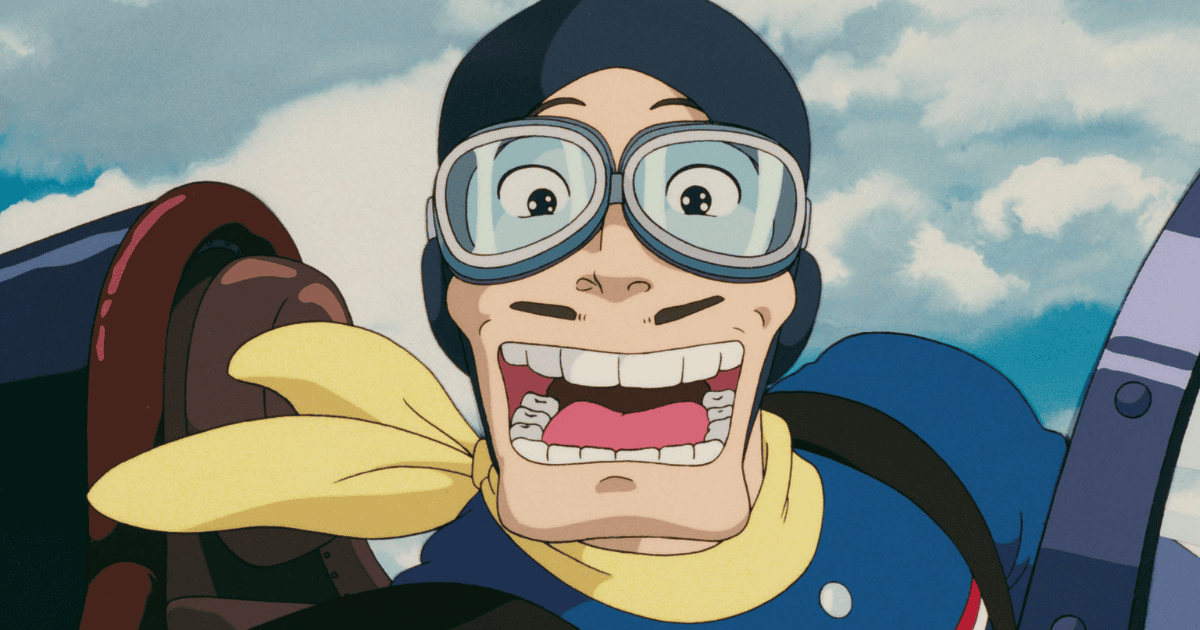
The Hollywood Hotshot
A brash, highly ambitious American pilot. He is hired as a mercenary by the Pirate Coalition to assassinate Porco after the pig continually ruins their heists. He is explicitly framed as the only aviator in the Mediterranean whose skills rival Porco’s.
Despite carrying the deadly title of “mercenary sniper,” Curtis’s personality is wildly comical. Driven by towering American confidence (and fiery Italian blood), he immediately and aggressively proposes to both Gina and Fio mere minutes after meeting them.
His romantic advances are utterly shameless, yet weirdly genuine. And when both women flatly reject his marriage proposals, his towering ego prevents him from feeling even a shred of embarrassment.
However… we must not forget the chilling reality of his actions in the sky.
In their first dogfight, Curtis doesn’t just shoot Porco down; he shoots to kill, and he flies away firmly believing he has murdered his rival. In their climactic rematch, while it eventually devolves into a hilarious, bare-knuckle boxing match in the shallows, the opening aerial duel is lethal. Curtis is actively trying to put a bullet through Porco’s skull (even if Porco is just defensively “playing around”).
Yet, Miyazaki brilliantly masks this violent reality by layering Curtis’s buffoonish, Hollywood-star persona over his lethal actions, completely diluting the bloodshed. We are allowed to laugh at a man who is actively trying to commit murder.
This trick is applied to every antagonist in the film. Despite tackling heavy, grim issues—the rise of totalitarianism, economic depression, piracy, and lethal aerial combat—the sheer, overwhelming charisma of the characters makes the movie a joy to watch. That is the unparalleled genius of Hayao Miyazaki.
Ferrarin | Voiced by: Frank Welker
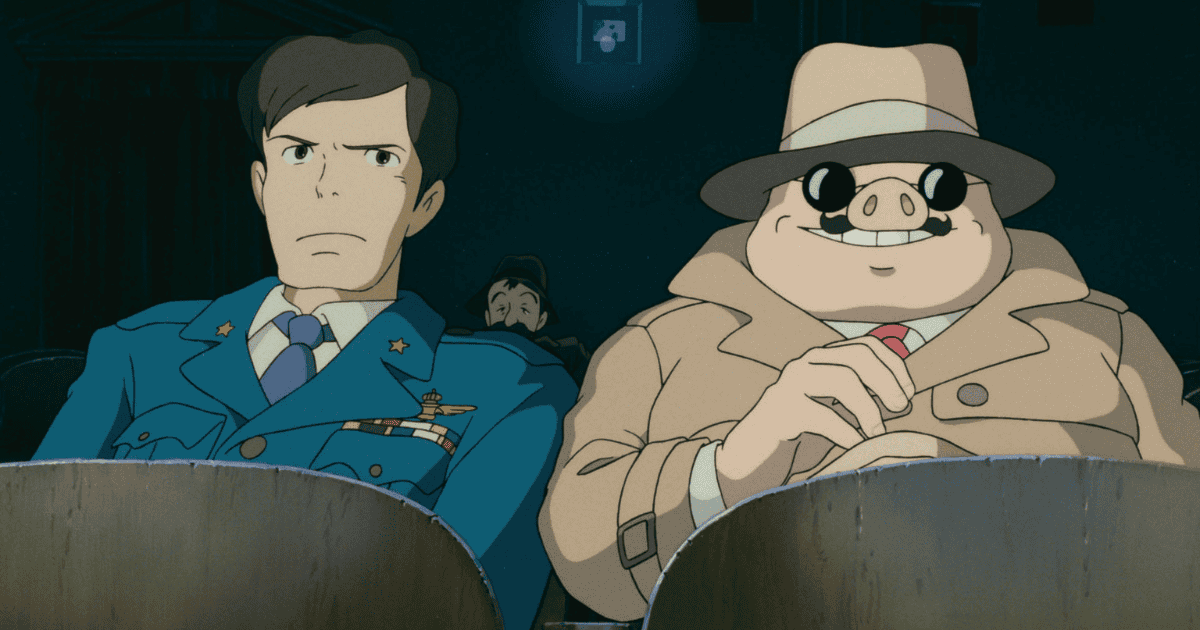
The Straight-Laced Comrade
A high-ranking Major in the Italian Royal Air Force and one of Porco’s oldest, most trusted comrades-in-arms from the trenches of World War I.
Ferrarin serves as Porco’s exact narrative foil. While Porco cynically rejected the changing world and abandoned his humanity, Ferrarin gritted his teeth, compromised his ideals, and continued to live a straightforward, dutiful life within the corrupt system.
If Porco hadn’t cursed himself, he would undoubtedly be sitting in that exact same uniform, holding Ferrarin’s rank.
The film never explicitly declares which man made the “right” choice. However, the audience is forced to decide which philosophy they “respect” or find “cooler.” Your choice acts as a psychological mirror reflecting your own values.
Personally, I believe Porco is only allowed the luxury of playing the cynical, rebellious “pig” precisely because dutiful, stabilizing men like Ferrarin exist to hold the fragile world together. Therefore, if forced to choose the better man, I respect Ferrarin.
Though, admittedly, that might just be my own pragmatic rebellion against the overwhelming romantic allure of the “pig.”
The Air Pirates
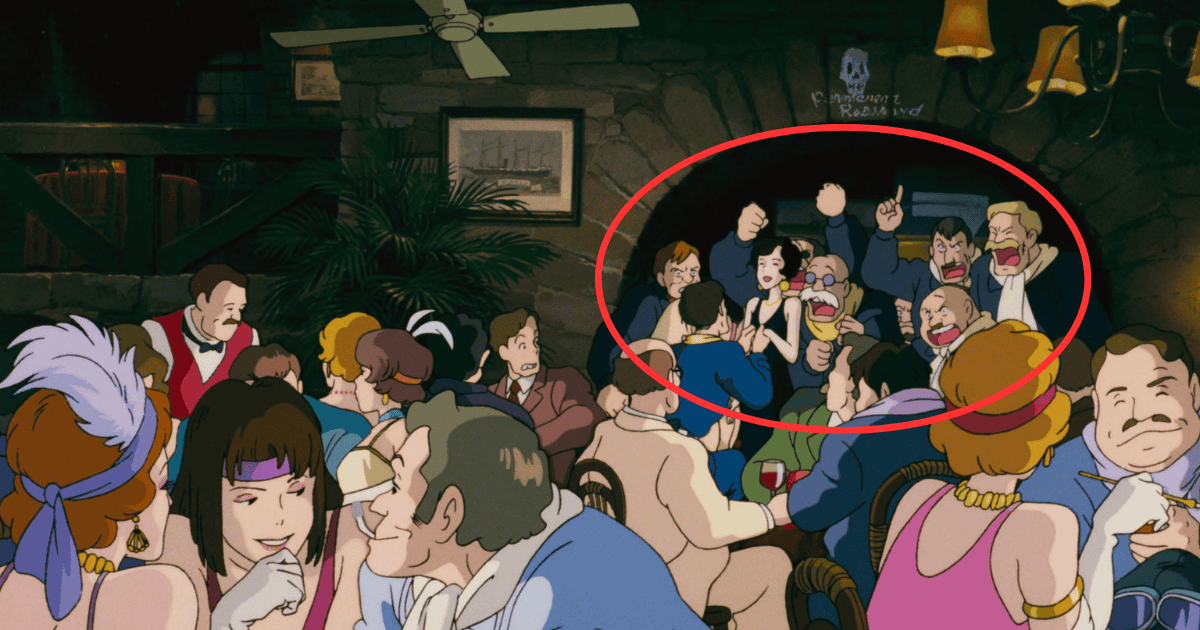
The Bumbling Coalition
Various rival factions of airborne outlaws, including the Mamma Aiuto gang, who plunder luxury ships across the Adriatic. They are fiercely independent but frequently form massive, chaotic coalitions to pull off major heists—or to pool their money to hire Curtis.
Their ultimate nemesis is the bounty hunter Porco Rosso. Despite constantly getting their planes destroyed by him, and harboring deep jealousy over his intimate relationship with Gina, they possess a weird code of honor. Even as cranky, retired old men in the epilogue, they still quietly frequent the Hotel Adriano to peacefully drink in Gina’s presence.
The images used in this article are from the “Studio Ghibli Still Images” collection.
Can you name the movie before the scene comes into focus?
Put your visual memory to the test with a blurred Studio Ghibli scene.


Reader Comments