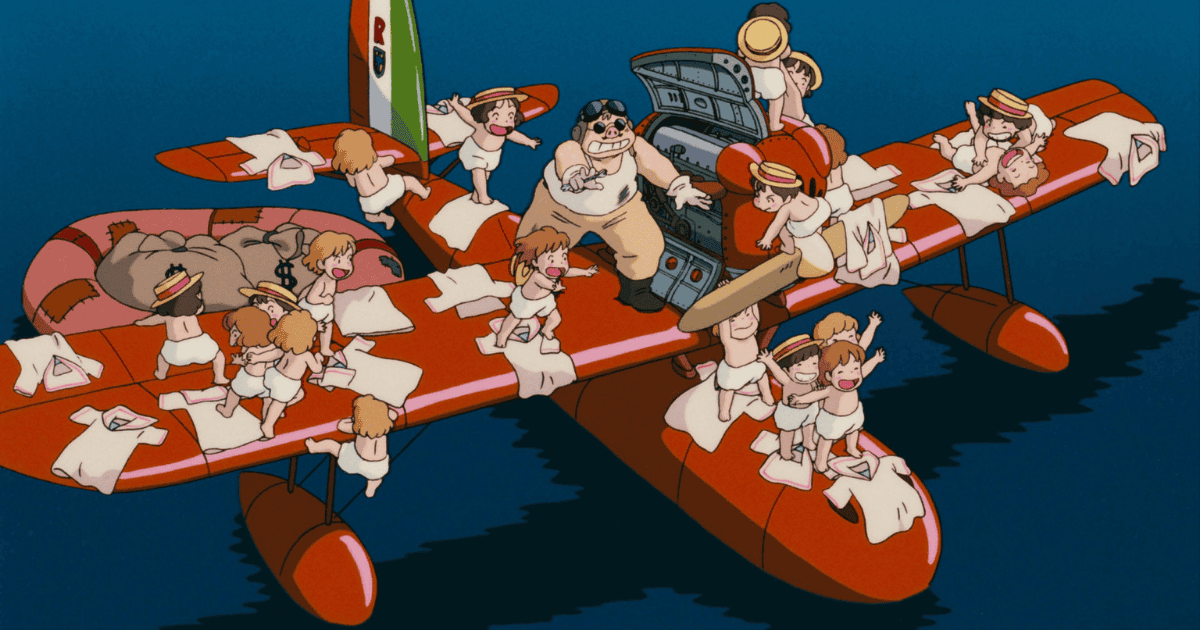
Porco Rosso(Official Studio Ghibli Website) is a feature-length animated film directed by Hayao Miyazaki, released on July 18, 1992. It tells the story of Porco Rosso, undeniably the most physically “unhandsome” protagonist in Miyazaki’s entire filmography. (One has to wonder if the impossibly handsome Ashitaka from Princess Mononoke, released five years later, was a direct, reactionary apology for this).
While the protagonist may have the face of a pig, the film itself is effortlessly cool. Today, I want to break down the complete narrative of Porco Rosso and analyze exactly what makes it such an enduringly entertaining masterpiece. Please be warned: when I say “plot summary,” I mean I am going to spoil everything from start to finish. If you wish to avoid spoilers, please watch the movie first and return here afterward.
*This is a translated version. The original (Japanese) is available here.
- Detailed Plot Summary & Character Map
A brief summary of the film: “Porco, a disillusioned World War I ace who mysteriously possesses the face of a pig, operates as a freelance bounty hunter over the Adriatic Sea. After his beloved seaplane is shot down by the hotshot American pilot Curtis, Porco travels to Milan. There, a brilliant 17-year-old female mechanic named Fio helps him rebuild his plane, setting the stage for a high-stakes, hilarious rematch.” We will provide a comprehensive scene-by-scene breakdown and a visual character map. - The Masterful Humor and “Fun” of Porco Rosso
Unlike the heavy, apocalyptic tones of Miyazaki’s later films, Porco Rosso is fundamentally a “fun” movie. From the Mamma Aiuto Gang’s bumbling incompetence to the absurd, bare-knuckle boxing match finale, the film balances its melancholic themes with brilliant comedic timing. - The Pathos of the Pig
While fans constantly ask why Porco became a pig, the true thematic question is why he chooses to remain one. His porcine form is a deliberate, cynical manifestation of survivor’s guilt and his refusal to participate in the rise of Italian fascism. It is the ultimate expression of middle-aged pathos. - The Mystery of Gina’s Bet
Madame Gina has been widowed by three different seaplane pilots. Yet, her ultimate romantic “bet” is placed on Porco—a fourth seaplane pilot—while completely rejecting the safe, wealthy Curtis. We will explore the complex psychological reasons behind her seemingly self-destructive romantic choices.
On this pageContents
Porco Rosso (1992) Full Synopsis: The Coolest Pig in the Sky (Spoilers)
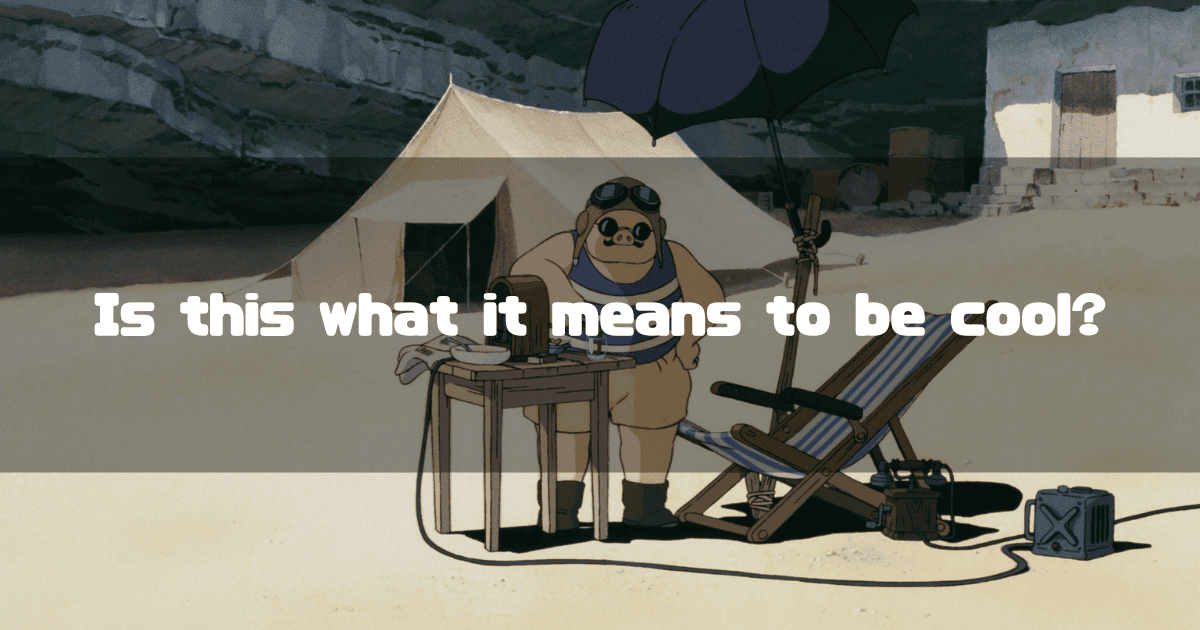
Quick Summary: The 9 Core Plot Points
To grasp the narrative flow of Porco Rosso, here are the vital milestones:
-
The Bounty Hunter
The protagonist is Porco Rosso, a cynical World War I veteran who now bears the face of a pig. He makes a lucrative living hunting sky pirates over the Adriatic Sea. -
The Hotel Adriano
The central neutral ground for all pilots—bounty hunters and pirates alike—is the Hotel Adriano, run by the beautiful, melancholic widow, Madame Gina, who is Porco’s oldest childhood friend. -
The American Challenger
Tired of being humiliated by Porco, a coalition of pirate gangs pools their money to hire a hotshot American pilot, Donald Curtis, to take him down. -
The Ambush
While flying to Milan to service his failing engine, Porco is ambushed by Curtis. Suffering engine failure, Porco’s plane is shot down and destroyed. -
The Journey to Milan
Surviving the crash, Porco hauls the wreckage of his beloved red seaplane by train to Milan, arriving at Piccolo S.p.A. for a complete rebuild. -
The Genius of Fio Piccolo
Due to the Great Depression, all the male mechanics have left to find work. The redesign of Porco’s plane is spearheaded by Fio, the owner’s 17-year-old granddaughter, whose mechanical genius completely wins Porco over. -
The Escape
Hunted by the fascist Italian secret police, Porco and Fio are forced to make a daring, untested escape in the newly built plane, fleeing back to the Adriatic. -
The High-Stakes Rematch
Porco returns to his island hideout, only to be ambushed by the pirates and Curtis. Fio brilliantly negotiates a formal duel: if Porco wins, Curtis pays off Porco’s massive repair debts; if Curtis wins, he gets to marry Fio. -
The Brawl and the Bet
The epic aerial dogfight ultimately descends into a hilarious, exhausted fistfight on the water. Porco narrowly wins, saving Fio. The film ends vaguely, leaving the ultimate fate of Gina’s romantic “bet” on Porco up to the audience’s interpretation.
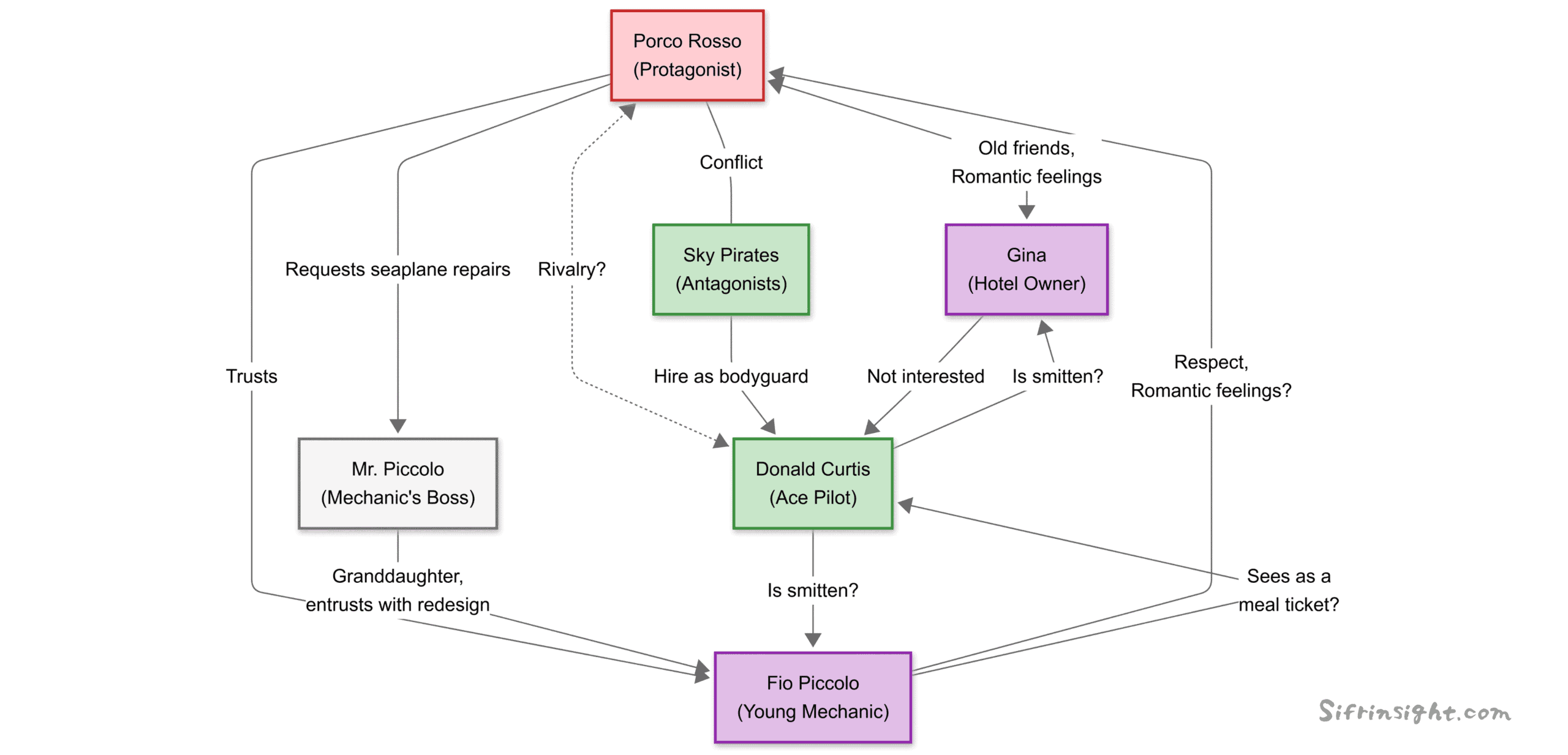
Complete Character Map
The Deeper Meaning of the Narrative
When analyzing Porco Rosso, the most glaring, unavoidable question is: Why is the protagonist a pig? As viewers age, the absurdity of it tends to bother them less, but there are several prominent thematic interpretations.
One prevalent theory is that Porco is a literal avatar for Director Hayao Miyazaki. Miyazaki famously draws himself as a bespectacled pig in his personal manga and storyboards. In this reading, Porco’s cynical, exhausted worldview mirrors Miyazaki’s own middle-aged fatigue.
A more narrative-focused interpretation is that the pig face is a physical manifestation of his survivor’s guilt and profound cynicism. It serves as a visual declaration to the fascist government and the frantic masses struggling through the Great Depression: “What are you all doing? I want no part of your human madness. I’m out of here.”
Rather than a curse of transformation, it can be viewed as a stubborn declaration of autonomy: “I refuse to change to fit your world.”
While we can debate the metaphorical reasons for hours, the primary reason the audience perceives it as a “mystery” is because of Gina’s melancholic line early in the film: “I wonder how I can break the spell that was cast on you.” This single line permanently implants the idea that there must be a specific, magical reason for his condition.
If Gina had never said that line, would we even care that he’s a pig? We might just accept it as the stylistic reality of the world.
Regarding the film’s famously ambiguous ending and “Gina’s bet,” while Fio’s concluding narration is intentionally vague, Miyazaki leaves a massive visual clue. In the final sweeping shot of the Hotel Adriano, you can clearly see Porco’s distinct red seaplane docked at Gina’s private garden during the daylight (circled in red below).
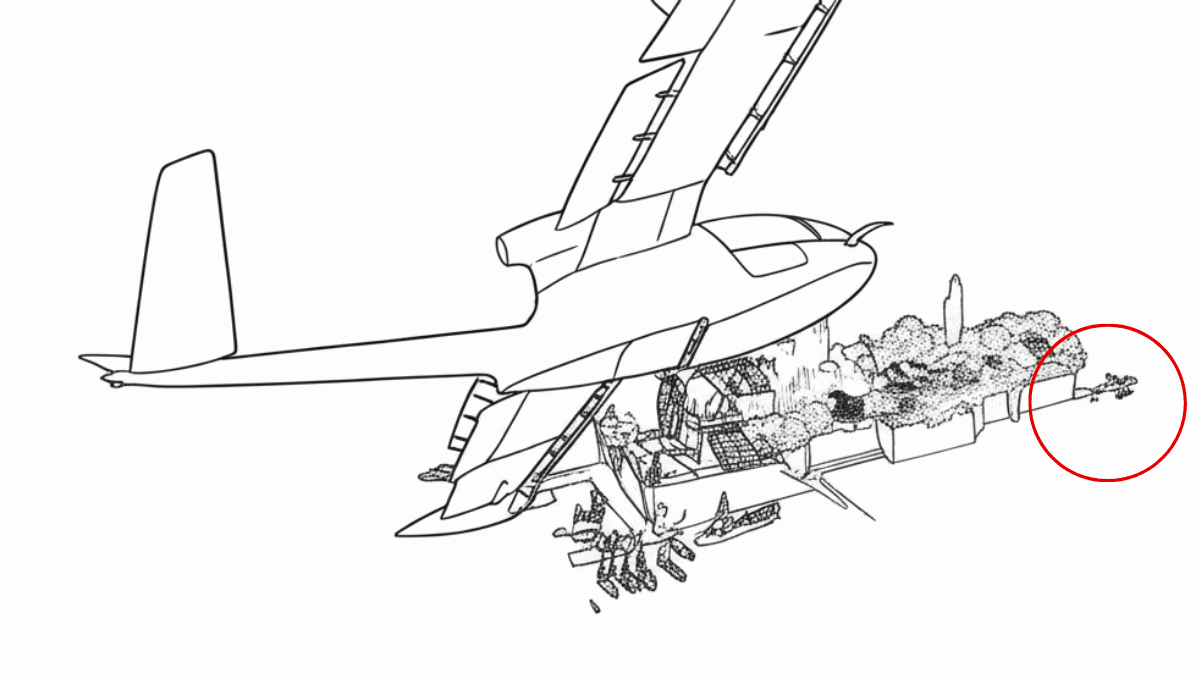
This strongly implies that Gina won her bet, and Porco finally stepped out of the shadows.
With those thematic foundations established, let’s dive into the detailed scene-by-scene breakdown of the plot.
Detailed Synopsis: A Scene-by-Scene Breakdown
The Routine of a Bounty Hunter
The story opens over the sun-drenched Adriatic Sea, sometime after World War I. Our protagonist, Porco Rosso (Marco Pagot), is a former Italian Air Force ace who now lives as a freelance bounty hunter, taking down the clumsy “sky pirates” who terrorize luxury cruise ships.
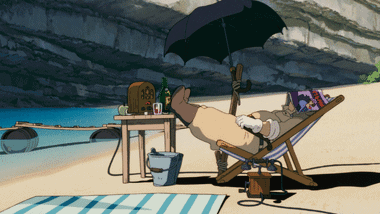
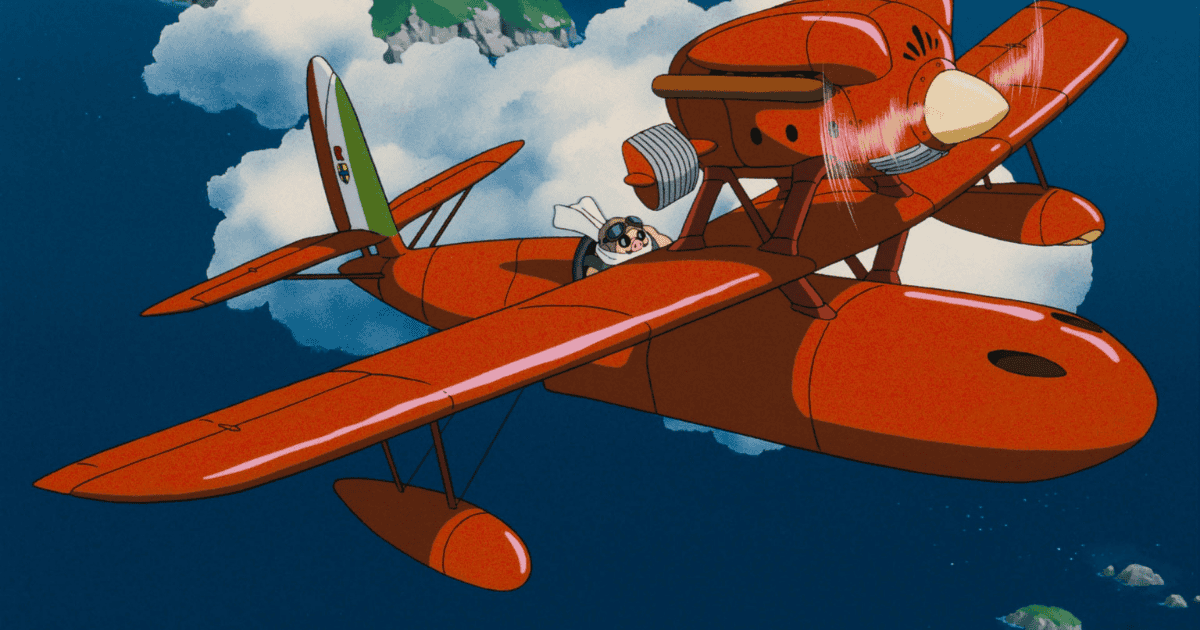
His peaceful nap is interrupted by a distress call: a cruise ship is currently being raided by the notoriously bumbling “Mamma Aiuto Gang.” Porco groans, fires up his iconic crimson seaplane, and heads out to collect his bounty.
Meanwhile, the Mamma Aiuto Gang has successfully hijacked the ship, but they are currently in a state of sheer panic trying to manage their “hostages”: a massive group of energetic, hyperactive little schoolgirls.
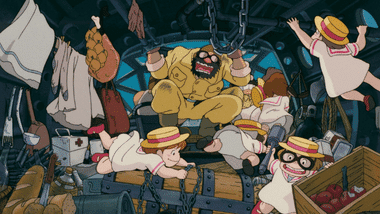
Porco arrives on the scene. He offers the pirates a chance to surrender peacefully, but they foolishly decide to fight. Due to Porco’s masterful flying (and the chaotic interference of the schoolgirls crawling all over the pirate ship), the Mamma Aiuto Gang is swiftly defeated and forced to hand over half their loot.
Porco successfully completes the job, but he soon finds himself just as overwhelmed as the pirates, forced to act as a babysitter for the mob of hyperactive children he just rescued.
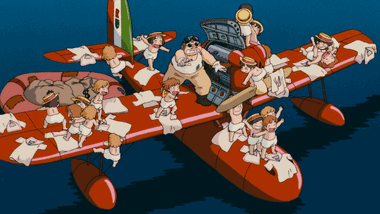
The Hotel Adriano and the American Rival
After dropping off the kids, Porco heads to the Hotel Adriano, an elegant, neutral-ground establishment run by the stunning and melancholic Madame Gina. The hotel pub serves as a sanctuary where bounty hunters and pirates can drink together without drawing weapons.
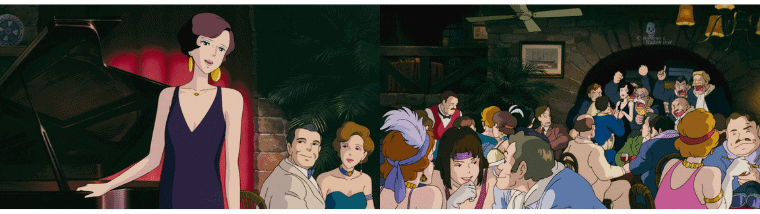
While at the bar, Porco is introduced to Donald Curtis, an arrogant, highly skilled American pilot. Curtis has been hired by a newly formed coalition of pirate gangs who are sick of being humiliated by Porco.
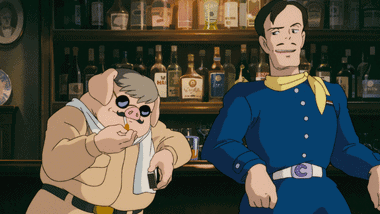
Porco shares a quiet, nostalgic moment with Gina—his oldest surviving friend—before departing into the night.
The next day, Porco departs for Milan to finally overhaul his failing, overworked engine. However, while flying through heavy clouds, he is ambushed by Curtis. Unable to maneuver properly due to catastrophic engine trouble, Porco is completely outflanked. Curtis shoots his plane to pieces, sending it crashing into the sea.
Believing the pig is dead, Curtis proudly claims a piece of the wreckage as a trophy and flies away.
Miraculously, Porco survives. He manages to pull the ruined hull of his seaplane to shore and places a call to Gina, assuring her he is alive. When she scolds him, warning, “You’ll die if you keep flying like this,” Porco delivers his most iconic line: “A pig that doesn’t fly is just a pig.” He then boards a train, hauling the wreckage to Milan for a complete rebuild.
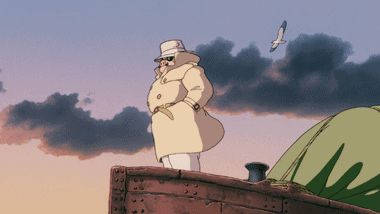
Fio Piccolo and the Milan Rebuild
Upon arriving in Milan, Porco takes his plane to “Piccolo S.p.A.,” a family-run aviation workshop. He expects the senior Mr. Piccolo to handle the rebuild, but faces two massive problems: First, thanks to the Great Depression, his bounty money is practically worthless. Second, the person leading the redesign is Fio, Piccolo’s 17-year-old granddaughter.
Highly skeptical of a teenage girl handling his life-saving machine, Porco attempts to cancel the contract. Fio boldly confronts him, asking, “For a seaplane pilot, what is more important: experience or inspiration?” When Porco admits “inspiration,” Fio successfully guilt-trips him into giving her a chance. She stays up all night drafting a brilliant, aggressive new aerodynamic design.
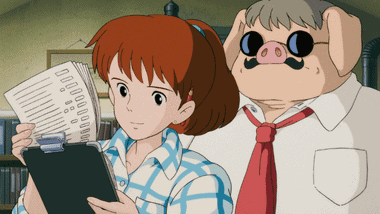
The complications continue. Because the economic depression forced all the men to leave the city to find work, the entire physical reconstruction of the plane is handled by a small army of female relatives—aunts, cousins, and grandmothers. Despite Porco’s initial shock, the women prove to be incredibly efficient, and the build progresses rapidly.
During the build, Porco is secretly visited by his old Air Force comrade, Ferrarin. Ferrarin warns him that the fascist secret police are closing in, preparing to arrest Porco for crimes ranging from “anti-state activities” to “the crime of being a lazy pig.” Ferrarin urges Marco (Porco) to return to the Air Force and fly for the state. Porco bluntly refuses, stating, “I’d rather be a pig than a fascist.”
Realizing the secret police will raid the factory at dawn, Porco is forced to launch the plane immediately, without any test flights. Fio, determined to see her masterpiece function and make any necessary mid-flight adjustments, insists on coming with him. Despite Porco’s protests, she squeezes into the cramped hull.
With the secret police bursting through the gates, Porco fires up the untested engine and launches the plane straight out of the canal, taking flight.
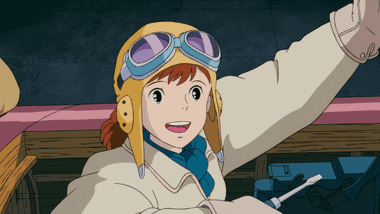
With Ferrarin providing secret air cover to misdirect the military, Porco and Fio successfully escape Italian airspace and head for the Adriatic.
The Proposal and the Pirate Ambush
Arriving back in the Adriatic, Porco performs a massive, roaring flyby over the Hotel Adriano to announce to everyone (especially Curtis) that he is alive and his plane is faster than ever.
Down in the hotel’s private garden, Curtis is currently in the middle of passionately proposing marriage to Gina. He dreams of taking her to Hollywood so he can become a famous actor and eventually President of the United States.
Gina gently deflects his proposal, revealing her secret: “I am making a bet right now. I made a promise to myself that if he visits me while I’m in this garden during the day, I will finally let myself love him. But that fool only comes to the bar at night. He never steps out into the sunlight.”
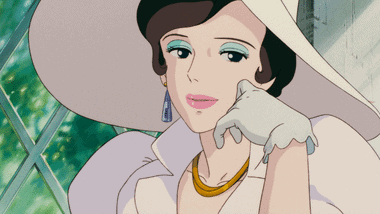
Just then, Porco’s red plane roars overhead. He executes a stunning stunt, but true to form, he does not land. Gina smiles sadly, whispering, “I lost the bet again.” Watching her reaction, Curtis realizes he is competing against a pig for her heart.
Completely unaware of the romantic drama he just caused, Porco lands at his secret island hideout. However, the pirate coalition is waiting for him in ambush. They plan to smash his beautiful new plane to pieces to settle their grudges.
Fio bravely steps out of the plane and delivers a blistering, legendary speech, shaming the pirates for lacking honor and acting like cowards.
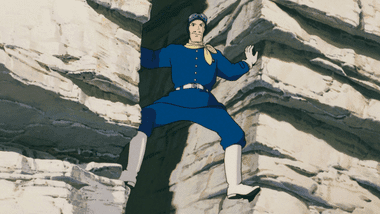
Suddenly, Curtis drops down from a cliff. Heartbroken and furious over Gina, he demands a rematch. Fio brilliantly negotiates the terms: If Porco wins, Curtis must pay off all of Porco’s massive repair bills. If Curtis wins… he gets to marry Fio.
The Most Absurd Duel in Aviation History
The day of the duel arrives. It is treated as a massive festival, with hundreds of pirates acting as bookies and spectators.
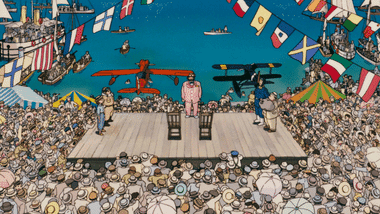
The aerial dogfight is an absolute masterclass in animation. The two geniuses push their machines to the absolute limit. However, the grand, historic battle takes a humiliating turn when both of their machine guns simultaneously jam.
Refusing to back down, they land their planes, pull alongside each other, and begin throwing wrenches and engine parts at each other’s heads. Eventually, they abandon the planes entirely, jump into the shallow water, and engage in a brutal, exhausting, bare-knuckle boxing match.
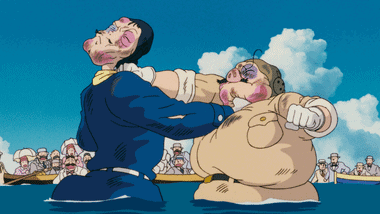
The fight drags on for hours until both men, faces swollen to the point of being unrecognizable, simultaneously knock each other out. As the referee counts to ten, Gina arrives on her boat. She yells at Porco, “Are you planning on making another girl unhappy?!”
Spurred by Gina’s voice, Porco manages to lift his head just as the count reaches ten. Porco wins the bout.
Gina warns the crowd that the Italian Air Force is inbound to arrest everyone. The pirates panic and scatter. Porco tosses Fio into Gina’s boat, entrusting her safety to his oldest friend.
Before the boat pulls away, Fio leans over and gives Porco a deep, grateful kiss on the snout.
Fio’s narration takes over. She reveals that she never saw Porco again, but that she and Gina remained lifelong friends. Curtis eventually returned to America and became a famous actor.
As for the outcome of Gina’s bet? Fio states, “That is a secret between just the two of us.” (But as noted earlier, the final shot of the red plane docked in the garden heavily implies a happy ending).
That is the complete narrative of Porco Rosso. Now, let’s explore the thematic elements that make this film so uniquely brilliant within the Ghibli catalog.
▼ Explore the film’s memorable dialogue in Japanese and English
Many of the film’s defining moments are expressed through its stylish dialogue—from Porco insisting that a pig has to fly and Gina warning that he will end up as roast pork to Fio’s speech about the honor of seaplane pilots. Compare the original Japanese, romanization, English subtitles, literal translations, and detailed commentary in 17 Porco Rosso Quotes in Japanese and English, Explained.
Porco Rosso (1992) Deep Analysis: Unlocking the Film’s Charm
The Unapologetic Sense of “Fun”
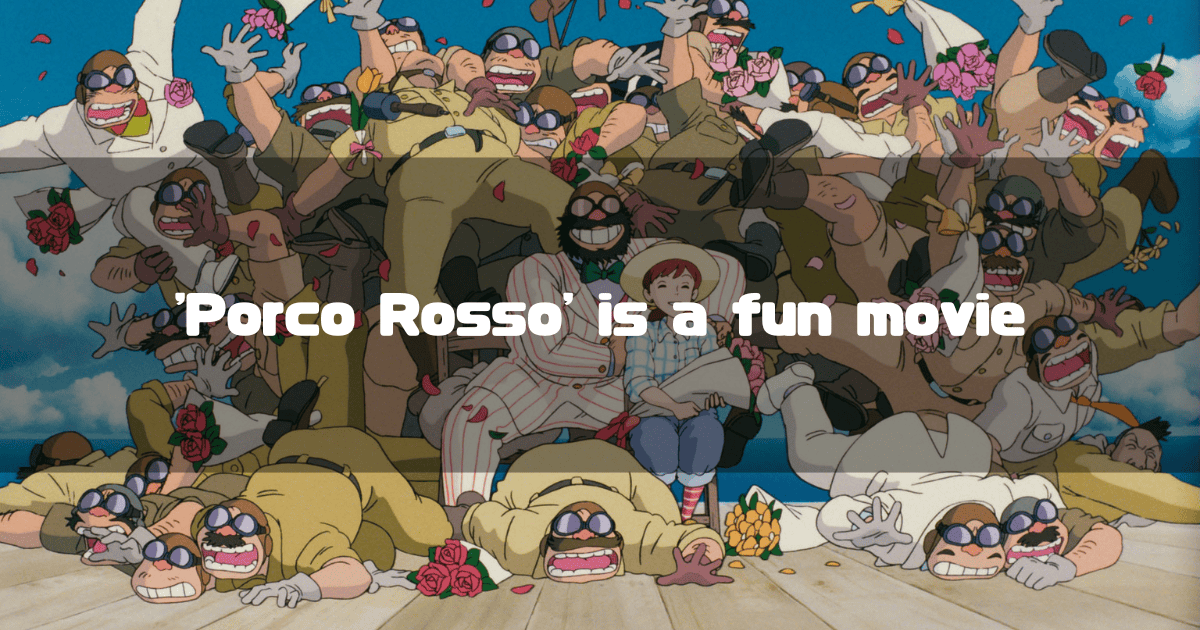
When analyzing Porco Rosso, the most important truth to establish is simply this: It is an incredibly fun movie.
Starting with Princess Mononoke, Miyazaki’s later films became increasingly heavy, apocalyptic, and deeply serious. But Porco Rosso—despite tackling the rise of fascism and the trauma of WWI—is fundamentally infused with a breezy, swashbuckling joy from start to finish.
It is crucial to acknowledge this tone before trying to assign heavy, philosophical meaning to every frame. The movie is designed to make you smile.
“My Engine’s Dead”
A perfect example of this masterful tonal balance occurs in the opening sequence. When the Mamma Aiuto gang hijacks the ship, the audience is initially worried for the little schoolgirls. But Miyazaki quickly establishes that these pirates are fundamentally harmless, blue-collar goofballs who treat the kids with extreme care.
After Porco shoots out their engine and demands they hand over half the gold, the pirate boss furiously screams, “My engine’s dead! My engine’s dead!”
It is a brilliant moment of tension and release. The sheer absurdity of a violent pirate whining about his broken engine instantly turns our underlying “relief” into genuine, out-loud laughter.
The Hilarious Persistence of Curtis
Another brilliant comedic beat is Curtis’s grand entrance at Pirate Island.
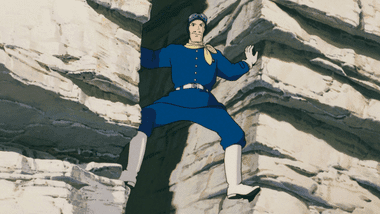
When Fio is fiercely lecturing the pirate alliance, Curtis suddenly drops down from a hidden crevice in the cliff face, striking a heroic, tokusatsu-style pose. It is so blatant and ridiculous you almost want to roll your eyes, but it is undeniably funny.
The comedy deepens when you actually think about the logistics of the scene. Since none of the pirates knew he was there, it implies Curtis arrived at the island hours before everyone else, meticulously hid his seaplane, scaled the cliff, and waited patiently inside a crack in the rock just so he could make a dramatic entrance at the perfect moment.
The sheer, egotistical effort required for that stunt is hilarious.
Two Geniuses Resorting to a Fistfight
Finally, we have the climax: two legendary aviation geniuses ending a historic dogfight by punching each other in the face in shallow water.
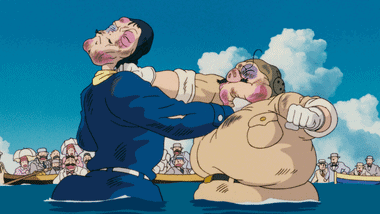
Why did Miyazaki, a famous aviation obsessive who painstakingly researched and drew every rivet on those planes, end the ultimate dogfight with a goofy fistfight?
Because of the tone. If the duel ended in the air, someone would have died. That would violently clash with the lighthearted, “fun” atmosphere of the film.
If Curtis lost his plane, Porco would remain an isolated hermit. If Porco died, it would become a tragic war drama. A goofy, exhausting brawl resulting in a technical knockout was the only possible way to end Porco Rosso while maintaining its joyous, swashbuckling spirit.
The Pathos of the Pig
As I mentioned in the introduction, it is practically a rite of passage for viewers to fixate on the question: “Why did Marco become a pig?”
But obsessing over the cause of the transformation is a distraction, because the film deliberately refuses to provide a clear answer.
The far more interesting psychological question is: Why does he choose to remain a pig? I wrote a comprehensive analysis exploring how his porcine form acts as a shield against the pain of his humanity.
Read the full analysis: Why Does Porco Rosso Choose to Remain a Pig?
The core of Porco’s character is that he has completely accepted his form. He doesn’t view it as a curse to be broken; he views it as the most honest reflection of his soul.
The Mystery of Gina’s Self-Destructive Romance
One of the most complex, tragic elements of the film is the romantic history of Madame Gina. She reveals that she has been married to three different seaplane pilots, and because of the brutal nature of early aviation, she has been widowed three times.
Given that immense trauma, it seems almost masochistic that her ultimate romantic “bet” for her fourth partner is Porco—yet another seaplane pilot.
Furthermore, she completely rejects the passionate proposal of Donald Curtis. Curtis is young, incredibly handsome, undeniably skilled, and on his way to becoming a wealthy Hollywood actor. He represents a safe, glamorous, tragedy-free future. Yet she brushes him off without a second thought.
Her actions seem highly irrational. You could simply shrug and say, “The heart wants what it wants.” But analyzing her psychological motivations leads to a profound understanding of her character, heavily tied to the philosophy of Antoine de Saint-Exupéry (a real-life aviation pioneer highly revered by Miyazaki).
Read the full psychological breakdown: Why Gina Rejected Curtis: The Tragedy of the Aviator’s Wife
Why do you think Gina was so willing to risk her heart on a pig who refused to step into the sunlight?
The images used in this article are from the Studio Ghibli Still Images collection.
Can you name the movie before the scene comes into focus?
Put your visual memory to the test with a blurred Studio Ghibli scene.


Reader Comments