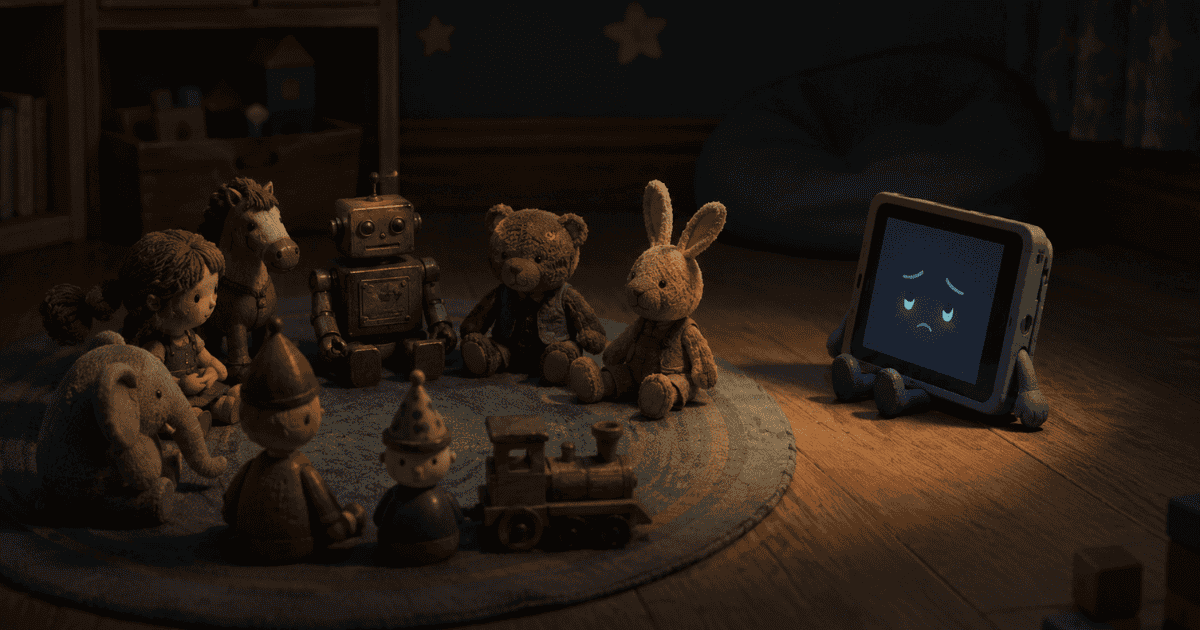
Toy Story 5 begins as a story about traditional toys losing their place to a tablet device.
Jessie and the others refuse to recognize interaction through a screen as “real play.” Lilypad, meanwhile, believes that Bonnie’s attachment to playing with Jessie and the others is isolating her from children her own age.
But by the end of the film, the two sides do not seem all that different.
Both Jessie and Lilypad love Bonnie and want to make her happy through their own abilities. Both want to be needed by a child, and both are afraid of becoming useless.
Bonnie, who had no friends, was not the loneliest character in the film.
Lilypad, who could connect people better than anyone yet had no one she could turn to when she failed, was the loneliest character of all.
At the same time, Toy Story 5 clearly reveals the limitations of the series. The fundamental story of toys and children had already been almost completely told by Toy Story 3.
In this article, I want to examine Lilypad’s loneliness beneath the apparent criticism of devices, as well as the aging of the series itself reflected in an older Woody.
If you would rather avoid spoilers and only want to know how I rated the film and whether it is worth seeing, see my spoiler-free review of Toy Story 5.
The discussion below makes no attempt to avoid spoilers, so please proceed with caution if you have not seen the film.
*This is a translated version. The original (Japanese) is available here.
- Turning the device into a villain: Lilypad conveniently takes on the role of the villain in Bonnie’s process of becoming aware of other people’s judgment and feeling ashamed of her own preferences.
- Toys and devices: There is no fundamental difference between them when it comes to loving a child and wanting to be useful.
- The newcomer’s isolation: If the first film depicted the old guard’s fear of being displaced, Toy Story 5 depicts the pain of a newcomer rejected by the old guard.
- A conveniently human form of salvation: The revelation that Emily never forgot Jessie also reveals the guilt humans feel about leaving toys behind.
- The limits of the series: Even as it introduces new subject matter, the narrative focus is gradually shifting away from toys themselves and toward problems within human society.
On this pageContents
The Device Forced to Play the Villain

The “Real Play” Jessie Tried to Protect
At the beginning of the story, Bonnie is still playing with Jessie, Buzz, and the others as usual. Children her own age, however, have shifted their attention away from traditional toys and toward devices such as computers and tablets.
As a result, Bonnie, who prefers imaginative play with toys, struggles to find common ground with her classmates.
Worried about Bonnie, her parents give her Lilypad, a tablet device that allows her to interact with children her own age through games and chat.
Jessie and the other toys feel deeply threatened by this new arrival.
Children gathering in one place and playing together while imagining the same story—that, to Jessie and the others, is what real play means.
At the sleepover at Chelsea’s house, for example, the children are all in the same room, yet each of them is staring at their own Lilypad.
Taken in isolation, this scene makes the film look like an extremely straightforward critique of modern technology.
Modern children have become so absorbed in screens that they can no longer play with the people directly in front of them. Traditional toys represent the imagination and human relationships that have been lost.
It is a setup that seems almost obviously correct.
Lilypad Wanted to Help Bonnie Too
But Lilypad also has a point.
Jessie and the others can have fun playing with Bonnie. What they cannot do is help her make friends her own age at school.
Could Bonnie be lonely because she values only traditional toy play and keeps her distance from the newer forms of play shared by other children her age?
Lilypad thinks so and sends Chelsea a friend request.
As a result, Bonnie begins interacting with her classmates and is invited to a sleepover. At the very least, Lilypad succeeds in connecting Bonnie with children her own age.
Both Jessie and Lilypad wanted to save Bonnie from loneliness.
The difference was not in how much they loved her. The problem was that each believed the method she knew was the only one capable of making Bonnie happy.
Was Lilypad Really Responsible for Bonnie’s Embarrassment?
On the car ride to Chelsea’s house, Bonnie introduces Jessie and Bullseye to her classmates.
Instead of sharing her excitement, however, they respond coldly, mocking her for still playing with toys like that.
Bonnie is hurt and throws Jessie and Bullseye into the car. Later, when a photo of Bonnie playing with Blaze and the toys is shared in the chat, she is once again laughed at for being “childish.”
As a result, Bonnie tries to give Jessie and the others to Blaze even though that is not what she truly wants.
There is no question that Lilypad’s chat function helped spread the mockery. Even after returning home, Bonnie could not escape the judgment of her classmates.
But the experience of having something you love mocked by others and suddenly becoming ashamed of it did not originate with digital devices.
When children leave their private worlds and enter society or a community, they inevitably encounter other people’s values. They learn that something precious to them may look childish to someone else.
It is a sad change. But to some extent, it is also an unavoidable part of growing up and expanding one’s world.
Lilypad did not create Bonnie’s sense of shame. The device was simply made into a convenient villain for the painful process of growing up and becoming aware of other people’s judgment.
One day, Bonnie will probably look back and realize that there was nothing embarrassing about playing with traditional toys.
But before she can reach that point, she first has to learn that other people see the world differently from her.
Lilypad is used remarkably conveniently as the somewhat cruel gateway into that realization.
Devices Were Toys That Loved Children Too

What Smarty Pants and the Others Proved
At first, Jessie treats Lilypad and the other devices as fundamentally different from herself and the traditional toys.
Lilypad connects people through a screen. Smarty Pants is a toilet-training tech toy, Atlas provides digital maps, and Snappy can take photographs. All of them seem different from traditional dolls and stuffed toys.
But as Jessie spends time with them at Blaze’s house, she begins to reconsider that assumption.
Smarty Pants and the others were once needed by Blaze too. They helped a child through their particular functions, treasured the time they spent together, and continued waiting to see her again even after she stopped playing with them.
Their batteries died, they were abandoned in storage, and they felt lonely after losing their purpose.
Those are the same emotions Jessie and the others have experienced again and again.
They may run on batteries, but they too were toys that loved a child and wanted to be needed.
The conflict between old toys and new devices arose because differences in materials and functions were mistaken for fundamental differences in what they were.
The Next Subject Left After Forky
Toy Story 4 introduced Forky, a character made from a spork and pipe cleaners.
A toy does not have to be a manufactured product sold in a store. If a child loves something and needs it as a playmate, even an object destined for the trash can become a toy.
The devices introduced in Toy Story 5 are an extension of that idea.
A tablet, digital camera, or GPS device can also become a toy if a child plays with it and creates memories with it.
Once Toy Story 4 had expanded the definition of a toy to include a handmade craft, perhaps electronic devices were simply the next category left to explore.
Introduce a kind of toy the series has not depicted before, and you have the basis for a new story.
To put it bluntly, it is difficult not to see a certain franchise-management logic behind the idea.
In the End, the Correct Answer Is That It Depends on How You Use It
The conclusion the film reaches about devices is extremely conventional.
Devices can have negative effects. But they can also connect people.
Lilypad’s chat function hurts Bonnie. At the same time, the communication functions of Lilypad, Smarty Pants, and the others are essential to bringing Bonnie and Blaze together.
In other words, devices themselves are neither inherently good nor inherently bad. The problem lies in how they are used and how people relate to them.
It is an extremely familiar conclusion.
But there is not much that can be done about that, because it is also true. A conclusion can sometimes be a little boring precisely because it is so obviously correct.
Buzz in the First Toy Story and Lilypad in Toy Story 5

Woody Loses His Place to a Newcomer
Buzz Lightyear was also a newcomer who suddenly appeared in Andy’s room in the first film.
As the latest space toy, Buzz instantly captured Andy’s attention. Woody, who had previously been Andy’s favorite, became afraid of losing his status and his role.
What the first film depicted was the old guard’s fear that a new arrival would take away its place.
However, the toys other than Woody accepted Buzz relatively quickly.
Buzz believed that he was a real Space Ranger, but in appearance and in the way children played with him, he was not radically different from the toys that came before him. Andy held him in his hands and made him a character in imaginary stories.
In truth, it could be said that Woody alone was terrified of losing his place as “Andy’s number one.”
Lilypad Is Rejected by the Old Guard
Lilypad stands on the opposite side of the same situation.
She also arrives suddenly as a newcomer in Bonnie’s room. This time, however, the traditional toys refuse from the beginning to recognize the new arrival as one of their own.
Lilypad is not held directly by a child and cast as a character in an imaginary story. She creates relationships between people through a screen and a network.
From Jessie and the others’ perspective, her functions do not appear to complement their role. They appear to threaten the relationship between toys and children itself.
Where the first film depicted the fear of the old guard losing its place to a newcomer, Toy Story 5 depicts the pain of a newcomer being unfairly treated as an enemy by the old guard. Toy Story 5 certainly depicts the old guard’s fear as well, but looking at the story as a whole, I think this is the more revealing contrast.
Lilypad is trying to help Bonnie. Even so, because her way of interacting with the child is different, she cannot enter the community formed by the traditional toys.
Lilypad Never Tried to Become One of Them Either
That said, Jessie and the others are not solely responsible.
Lilypad also does not see herself as the same kind of being as the old toys.
She has access to a network. She can give Bonnie new human relationships. Jessie and the others’ way of playing is outdated and cannot solve Bonnie’s loneliness.
That confidence also kept Lilypad at a distance from Jessie and the others.
The old guard refuses to understand the newcomer, while the newcomer refuses to learn from the old guard.
The difficulty of building relationships in a new environment is always made worse by assumptions on both sides.
Who Was Saved by the Knowledge That Jessie Had Not Been Forgotten?

Jessie’s Wound Left Unhealed Since Toy Story 2
In Toy Story 5, Jessie returns to the former home of her previous owner, Emily. For Jessie, her separation from Emily has remained an unhealed wound for many years.
Emily once loved and played with her dearly. But as Emily grew older, Jessie was forgotten and eventually given away as a donation. The experience left Jessie afraid that no matter how deeply she loved a child, she would ultimately be abandoned.
When Bonnie rejects her again in this film, that old wound reopens.
But beneath the tree associated with her memories of Emily, Jessie finds a box containing old belongings. From a photograph left inside, she learns that Emily gave her daughter the same name as Jessie.
She had not been forgotten.
That knowledge finally begins to heal the wound Jessie has carried for years.
Then Shouldn’t Emily Have Tried Harder to Find Her?
Emotionally, it is a beautiful scene.
Jessie was not a being who loved Emily unilaterally and was simply forgotten. The memories of their time together remained part of Emily’s life as well.
Yet the resolution also feels slightly too convenient.
If Jessie meant enough to Emily that she named her daughter after her, should Emily not have tried harder to find Jessie? Of course, it would be cruel to burden Emily, who was still a child at the time, with the responsibility of searching indefinitely for a lost toy.
Even so, the structure in which Jessie is saved by a human being’s memory reveals a distinctly human wish.
I threw away or lost my toy, but I never truly forgot it. So please forgive me.
The knowledge that Emily continued to love Jessie saves Jessie.
At the same time, it neatly absolves the guilt of the human who let the toy go.
This may be a cynical interpretation. Yet it is also true that Toy Story is remarkably kind to humans. We want the toys to forgive us.
For a broader examination of how Emily’s memories save not only Jessie but also the guilt of the humans who leave toys behind, see Part 1 of my series analysis, “Dependence, Self-Deception, and Unconditional Love”.
An Older Woody and an Aging Series

Fading Paint on His Head and an Expanding Waistline
By Toy Story 4, Woody had already moved into a grandfather-like position after completing his role in raising Andy.
Instead of remaining at the center of one child’s world, he had shifted toward passing his experience on to younger toys and helping support relationships between children and toys.
In Toy Story 5, that grandfatherly quality is reflected in his appearance as well.
The paint on his head has faded more than before, making it look almost like thinning hair in human terms. His waistline has also expanded enough for the film to joke about his “metabolic” belly.
The once-youthful sheriff has finally reached an age when people comment on his hairline and waist.
The details are played for laughs. But they represent more than the aging of a single character.
The image of an older Woody overlaps directly with the aging of the long-running series itself.
For a closer examination of Woody’s transition from a parental figure in Toy Story 4 to a grandfather-like elder whose role continues in Toy Story 5, see my analysis of “the ideal parent real parents wish they could be” and Woody as a grandfather.
The Fundamental “Toy Story” Has Already Been Told
Even in Toy Story 5, the fundamental relationship between toys and children remains unchanged.
Toys love children and want to be needed by them. At the same time, they fear that as children grow up, they will no longer be played with.
Even so, when a child is in trouble, the toys cannot stop themselves from acting despite knowing that they may be hurt in the process.
This relationship has been depicted repeatedly since the first film.
The addition of Lilypad, Smarty Pants, and the other devices does not change its essence. They simply give new electronic forms to beings who possess the same love and fear as traditional toys.
In that sense, it is difficult to argue that Toy Story 5 offers a genuinely new answer to the question of what children mean to toys.
By Toy Story 3, the fundamental “story of toys” had already been almost completely told.
What Is New Is the Problem of Human Society
What this film explores more directly is the human side of the story.
Having something you love mocked by other people and feeling ashamed of it. Being hurt by words online with nowhere to escape. Trying to find your place and make friends within a new group.
More than Bonnie’s relationship with her toys, her story is about a child growing up, becoming aware of other people’s judgment, and entering society.
Lilypad’s story is also less about new technology itself than about the loneliness of a newcomer who cannot enter an established community.
Both are universal and meaningful themes.
But neither is necessarily a story that could only be told through toys.
To continue the series, the definition of “toy” is expanded to include devices, while problems from human society are projected onto those toys.
That approach still produces an entertaining story. At the same time, however, it also reveals the limitation that the series may now have to go this far in order to create something new.
The Loneliest Character Was Lilypad

The Lovable Fools Always Had Friends
Andy’s toys have never always made the right decisions.
In the first film, Woody tried to get rid of Buzz out of jealousy. Buzz completely lost his confidence after discovering that he was a toy.
The other toys have also blamed their friends because of misunderstandings or fear and repeatedly made bad decisions.
Before they are heroes, they are lovable fools who fail again and again.
Perhaps the incidents we have watched as movies are simply the occasions among their countless mistakes when they somehow managed to recover in the end.
But they always had friends.
When someone made a mistake, another person could stop them. When someone became discouraged, another could support them. Even after one failed approach, they could think of another solution together.
The important thing was never that they avoided failure.
What mattered was that after failing, they had someone they could talk to.
The Machine That Connected People Could Not Connect Itself
Lilypad can connect human beings through a network.
She can send friend requests, share photographs, and allow people in different places to communicate with one another.
But Lilypad herself had no friends.
Jessie and the others see her as an enemy trying to take away their place. With Bonnie, Lilypad tries to remain the one providing support, which means she cannot reveal her own weakness or ask for help after making a mistake.
Her network contains countless possible connections.
Yet there is not a single person to whom she can entrust her own worries.
Lilypad had the ability to connect everyone else, yet she herself was connected to no one.
The Answer She Reached Alone Was That She Should Disappear
Lilypad learns that her own functions have hurt Bonnie.
The chat intended to help Bonnie make friends instead becomes a place where people mock what Bonnie loves and push her further into distress.
Rather than discussing the problem with someone else, Lilypad decides that Bonnie would be better off without her.
She then throws herself onto a truck carrying donated items.
Rather than simply looking for a new owner, she is effectively trying to erase herself from Bonnie’s life—an act of self-destruction.
She had only failed once.
Like Jessie and the others, she could have admitted her mistake and looked for another solution. She could have used her functions differently to help connect Bonnie and Blaze.
But because Lilypad had no one to talk to, she could not see those possibilities.
Do not struggle alone, decide on the answer alone, and act alone.
Perhaps this is the most important theme in Toy Story 5.
Bonnie and Lilypad Find Friends at the Same Time
At the end of the story, Bonnie meets Blaze.
Blaze is also an imaginative child who genuinely enjoys playing with traditional toys.
Bonnie finds a friend with whom she can share what she loves without feeling ashamed.
At the same time, Lilypad reconciles with Jessie, Smarty Pants, and the others.
The traditional toys and the new devices come to understand that they are companions who share the same desire to love children and be useful to them.
Toy Story 5 is a story about Bonnie finding a friend.
At the same time, it is also a story about Lilypad finding, for the first time, friends who will accept her mistakes and help her recover from them.
As a story about toys, the series may be approaching its limits.
Even as it adds new subject matter, it has become increasingly difficult to continue without shifting its focus toward human growth and the problems of society.
Even so, the distinction between having the ability to connect people and being genuinely connected to someone is an idea that gives this particular installment a meaning of its own.
It is a good story. At the same time, it leaves the question of how much longer this series can continue to remain a “story about toys.”
Perhaps the fact that Toy Story 5 reveals both its appeal and its limitations at the same time can itself be seen as a form of honesty from a series that has grown older.
For more analysis of the Toy Story series:


Reader Comments