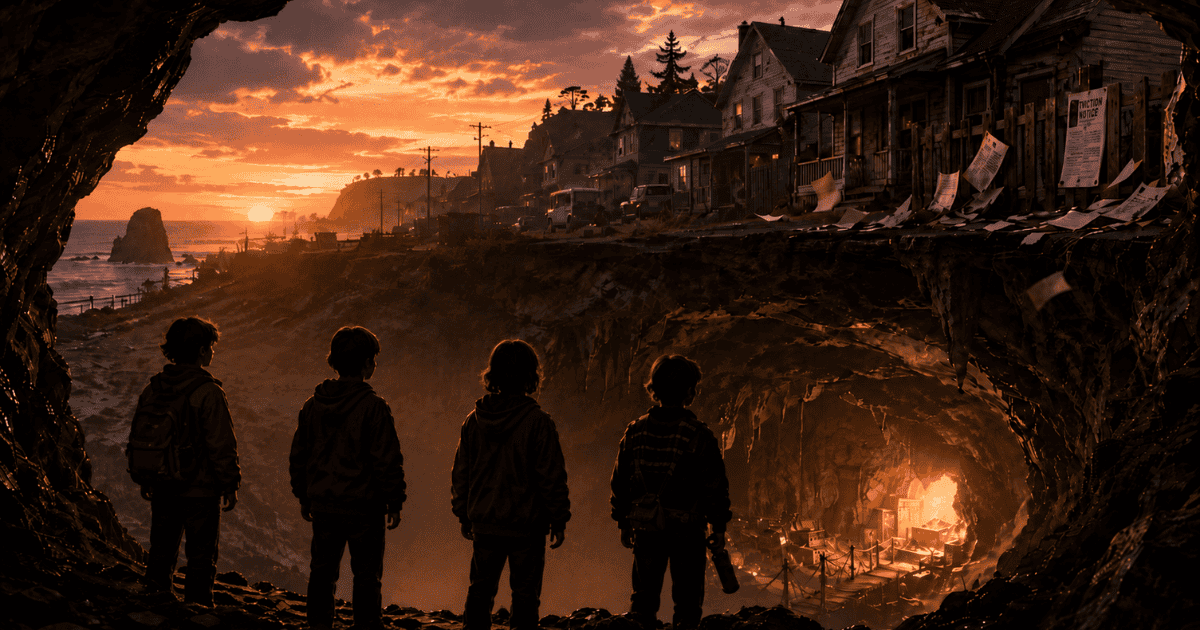
Released in 1985, The Goonies was directed by Richard Donner and based on a story by Steven Spielberg.
Mikey and his friends venture into a dangerous cave while the criminal Fratelli family pursues them. Time and again, their lives are at risk.
However, the film’s true terror does not arise from the darkness underground. Instead, it unfolds in the brightly lit world “above ground.”
Ordinarily, they should have returned to the surface when they reached the well. Mikey refuses because doing so would mean accepting the adults’ defeat. To him, that prospect is even more frightening.
What makes this film so compelling, I think, is how the treasure connects three lonely struggles: those of the parents facing defeat above ground, the children fleeing underground, and Willy, who disappeared into the shadows of history. Separated by time, generation, and place, they come together in a beautiful yet gritty story of a shared struggle against an overwhelming reality.
Focusing on the well scene, I want to untangle the “three parallel battles” running through The Goonies and consider what makes the film so compelling.
The following discussion contains extensive spoilers, so readers who have not yet seen the film should proceed with caution.
*This is a translated version. The original (Japanese) is available here.
- The True Enemy Is Adult Defeat: What lies above the well is not safety, but the reality of losing their homes.
- Three Parallel Battles: The parents, the children, and Willy each face a lonely struggle against an overwhelming reality that threatens to take away the place where they belong.
- Mikey’s Decision: His refusal to return through the well marks the moment when play becomes resistance against reality.
- From Isolation to a United Struggle: The dream discovered underground creates solidarity across different eras and ultimately defeats the reality above ground.
On this pageContents
The Beginning of the Adventure and the Invisible Enemy of Adult Defeat
The Goonies is an adventure film about a group of children searching for pirate treasure.
However, had they simply gone underground to escape the boredom of an uneventful holiday, the film would have amounted to nothing more than an entertaining treasure hunt. What matters is that they discover the map on the day before they are due to lose their homes.
The place where they belong, the Goon Docks, is about to disappear. Their adventure is therefore not an attempt to escape from everyday life, but rather an adventure undertaken to keep that everyday life from being taken away.
Meanwhile, what are the adults doing? The parents, too, have been fighting all along, largely offscreen. Their opponents are the less visible enemies of contracts, payment deadlines, and foreclosure. Fighting alone within the rules of the world above ground, they have been driven to the brink of a decisive defeat: signing the papers.
Under the rules of the world above ground, they have no remaining means of winning. That is precisely why the children’s adventure becomes necessary.
In this sense, the children’s adventure can also be understood as a battle fought on behalf of their parents.
In the years shortly before the film’s release, the United States had endured severe inflation against the backdrop of two oil shocks, in 1973 and 1979.
Inflation had already subsided by the time the film was released in 1985, but memories of rising prices would still have been vivid, and the resulting economic damage was likely still being felt.
These circumstances are discussed in greater detail in the “Appendix.”
The Three Battles Hidden in the Film’s Structure
The Fratelli Family and the British Navy: Three Parallel Battles
The Fratelli family relentlessly pursues the children after they descend underground. They are not merely comical villains.
In fact, the film depicts three different battles in a strikingly beautiful parallel.
Above ground, the parents are fighting the overwhelming reality of foreclosure.
Underground, the Fratelli family pursues and corners the children. They represent the violence of adults intruding mercilessly even into the underground world, and for the children, they are foreclosure itself: an inescapable threat imposed by reality.
In the past, the British Navy that drove One-Eyed Willy deep into the cave served the same role. For Willy, the navy was what the Fratelli family is for Mikey and his friends, and what foreclosure is for their parents: an overwhelming reality. Of course, Willy was a pirate, so this hardly makes him deserving of sympathy.
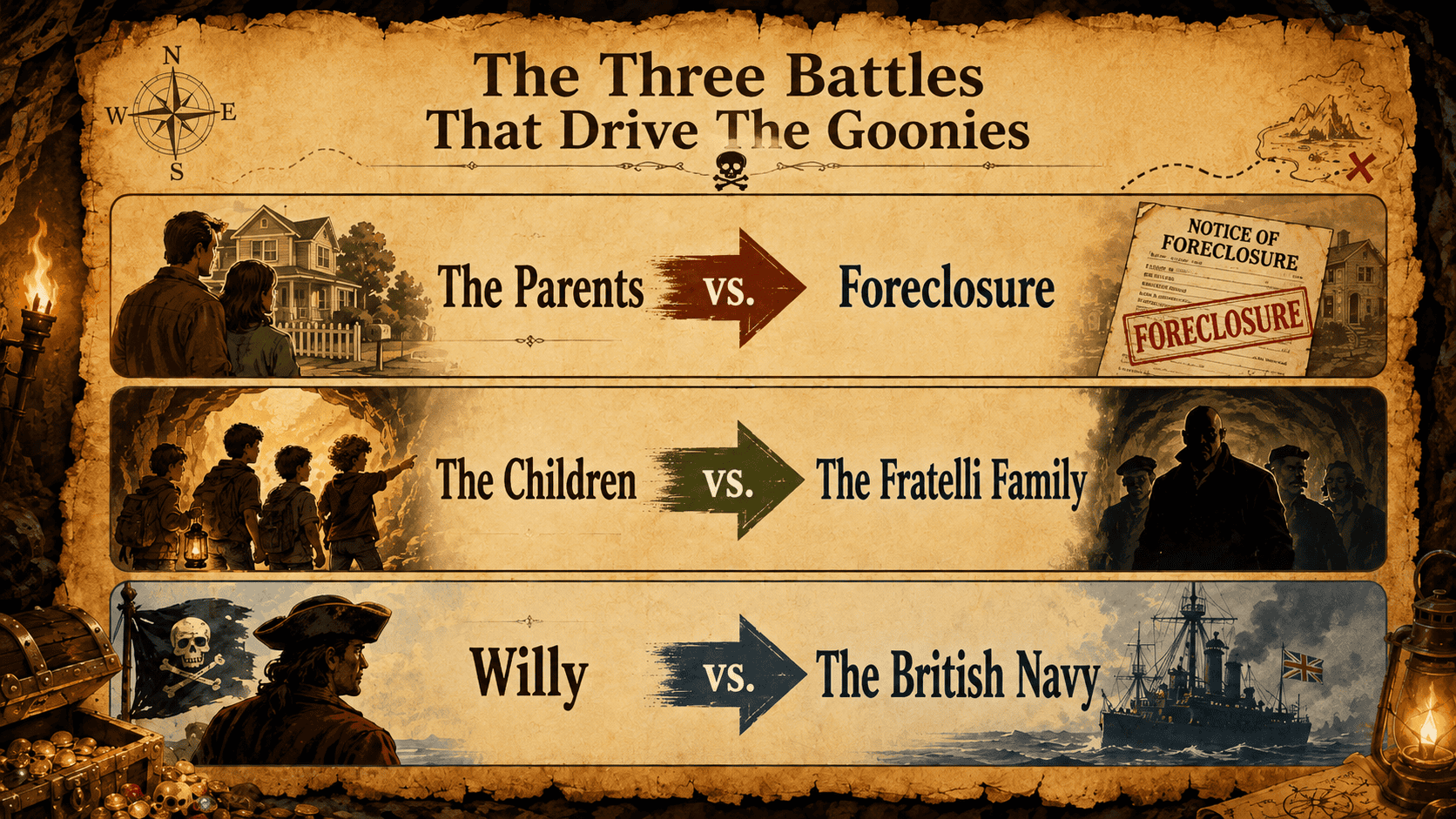
Separated by time and place, the three battles align beautifully: each is a struggle against an overwhelming reality threatening to take away the characters’ world and the place where they belong.
The Well as the Greatest Turning Point: Why Didn’t Mikey Return Above Ground?
Once this parallel structure is recognized, the significance of the scene in which the children reach the well connecting the underground world to the surface becomes much clearer.
Returning above ground would allow them to escape the dangers of the cave, particularly the Fratelli family. Yet what awaits them above the well is not safety. Returning would mean going back to the defeat of foreclosure, which their parents have already begun to accept.
Mikey refuses to return through the well not simply because he is brave. He does so because he understands that returning at this point would truly bring everything to an end.
At this moment, their actions clearly change from an exciting treasure hunt into a counterattack against a reality that is already defeating them.
Even before reaching the well, they wanted enough money to prevent the foreclosure. But there was probably still a simple excitement about the adventure itself. After the well scene, I think their resistance to reality becomes a more single-minded purpose.
Like their parents, Mikey and his friends are cornered by an overwhelming reality. Yet they refuse to run away and choose to keep fighting underground. It is the same battle their parents are fighting above ground.
The Final Scene Where Dreams Defeat Reality
Why One-Eyed Willy Is the First Goonie
Deep underground, Mikey and the others finally come face-to-face with One-Eyed Willy.
Mikey then says to Willy:
You were the first Goonie.
In the Japanese subtitles or dub, I think this is rendered as something closer to “one of the Goonies” or “one of us.”
What does Mikey mean by these words?
Driven underground by the overwhelming reality of the British Navy, Willy left his dream deep beneath the earth to protect his ship, his treasure, and his world, even if that meant disappearing from history above ground. Willy, too, is a Goonie who never gave in when it came to protecting the place where he belonged.
That is why Mikey treats Willy not merely as a pirate, but as a companion fighting the same battle. Willy is dead, but his dream and his will to resist have not died. By refusing to return above ground through the well, Mikey and the others become the inheritors of Willy’s will.
The Miracle That Turns Lonely Battles into a Shared Struggle
In the final scene, the treasure brought back from underground stops the parents from signing the papers at the very last moment.
This is unquestionably a narrative contrivance. What matters, however, is the structure itself: something produced by a dream discovered underground defeats the reality of foreclosure above ground.
The parents have been fighting foreclosure alone above ground and are on the verge of defeat.
The children have been fleeing the unreasonable violence of the Fratelli family underground.
In the past, Willy fought alone in a single ship against the overwhelming power of the British Navy.
Without anyone understanding them, each has been forced into a lonely battle against an overwhelming reality threatening to take away the place where they belong. At this moment, however, the three parallel battles come together as one.
The children inherit Willy’s dream, represented by the treasure, and carry it back above ground. In doing so, the treasure becomes the ultimate weapon that shatters the reality imprisoning their parents.
The ending of The Goonies is cathartic for more than the rescue of the families’ homes. The treasure acts as a baton connecting lonely battles across time and place, bringing them together in a vast shared struggle that transcends time.
It may therefore be described as a story about people whose homes are about to be taken away joining together and using the power of dreams to force reality into submission—a miracle that is both extraordinarily beautiful and unmistakably gritty.
As discussed elsewhere in this article, the United States had suffered from inflation fueled by two oil shocks shortly before the film’s release.
The miracle created by the children decisively overcomes that hardship. In this respect, the film can be viewed as belonging to the same general tradition as Japanese television series such as Hissatsu Shigotonin and Mito Kōmon, in which an oppressive reality is overturned through dramatic intervention.
The ending is a narrative contrivance, but it may have been precisely the kind of contrivance demanded by a painful reality.
Appendix: Why the Families Face Eviction, and America’s Recent Inflation Crisis
Why Were the Residents of the Goon Docks Forced to Leave?
The residents of the Goon Docks, where the film takes place, are being forced to leave their homes. The main story begins on the day before the deadline, when they have almost run out of time.
However, the film itself does not explain the circumstances particularly clearly. The final scene suggests that as many as fifty homes are facing eviction.
A useful clue can be found in the novelization of The Goonies. It was published in the United States on January 1, 1985, with the Japanese translation following on October 10 of the same year. The novel includes a small number of details not depicted in the film. Its account can be summarized as follows:
- At some point in the spring, the residents discover that the Hillside Country Club owns most of the land and houses in the Goon Docks.
- The country club demands that the residents leave so that it can expand its golf course.
- At the last moment, a court rules that the residents possess a right of first refusal, allowing them to purchase the land and houses if they can obtain sufficient funds.
- Because they do not have enough money, they are ultimately forced to leave.
This appears to provide a reasonable explanation, but something still feels inconsistent. Taken literally, this sequence would mean that Mikey’s family was renting its home. If that were the case, it would be strange for the family not to know that the country club owned the property.
The situation becomes more coherent if we assume that events unfolded in the following manner:
- Mikey’s parents purchased their house and land using a mortgage obtained from a bank or another lender.
- Repayment became increasingly difficult because of inflation, high interest rates, and the economic downturn associated with the oil shocks of the 1970s. The inflation of this period is discussed below.
- The banks and other lenders wanted to dispose of distressed loans and properties that had become difficult to recover.
- The country club, which had long sought the land in the Goon Docks, purchased those distressed loans.
- As a result, the country club effectively gained control of the land, the houses, and the security interests attached to them.
- The residents retained certain purchase or occupancy rights, but lacked the money required to exercise them, leading to the situation depicted in the film.
The country club could also have waited to purchase the properties after the banks foreclosed on them. However, the club would not have known precisely when each foreclosure would occur, and purchasing the loans while they were still distressed was probably less expensive. Moreover, properties belonging to residents other than Mikey’s family may already have completed the foreclosure process. Those properties would therefore have come under the country club’s ownership, which would be consistent with the novelization’s claim that it owned “most” of the area.
Japan now has what is commonly called the Servicer Act, under which distressed debt is traded by government-licensed debt collection companies. In the United States at the time, buying and selling such debt was relatively unrestricted, although subsequent collection and foreclosure were subject to regulation.
But why was the country club so determined to build a new course?
The process described above explains the circumstances, but it is extraordinarily complicated. The country club’s behavior begins to resemble an obsession.
One possible reason is that the number of golfers in the United States grew from roughly twenty million in the mid-1980s to thirty million by 2000. See National Golf Foundation, Golf Participation in America, 2010–2020. The club may have wanted to ride the wave of a growing industry.
Another reason is that if the protagonists were driven out and the golf course expanded, surrounding property values would increase.
The paper Golf Courses and Residential House Prices: An Empirical Examination, published in The Journal of Real Estate Finance and Economics, reports a 7.6 percent increase in residential property prices associated with a golf course.
It is therefore reasonable to assume that the country club’s objective involved not only the golf business itself, but also increasing the value of properties owned by its members in the surrounding area.
In this reading, Mikey’s parents and the other residents were obstacles to the value of the club members’ assets. That is why the club wanted them out, even if it took a complicated process to achieve it.
Living in a capitalist society ultimately means confronting realities of this kind, so one may have little choice but to conclude that “that’s simply how it is.”
America’s Inflation Crisis Before the Film’s Release
Although the film does not explain the situation in detail, it can be inferred that the protagonists’ parents were fighting under extremely difficult economic conditions.
To understand the severity of their struggle, the social conditions of the United States during the early 1980s cannot be ignored.
The Goonies came out in 1985, but a film does not spring into existence on its release date. The atmosphere of the preceding years may well have found its way into the planning, script, and filming. To understand its background, it is worth looking beyond 1985 to America in the late 1970s and early 1980s.
Prices rose substantially in the United States during this period. Several overlapping factors contributed to the increase.
One factor was the failure of monetary policy to fully control the inflation that had continued throughout the 1970s. In its discussion of the Great Inflation, Federal Reserve History identifies the Federal Reserve’s tolerance of excessive growth in the money supply as one of its important causes. See Federal Reserve History, The Great Inflation.
Another critical factor was the sharp increase in oil prices. The oil crises of 1973 and 1979 raised not only the price of gasoline and heating, but also the costs of transporting goods, operating factories, and maintaining everyday life. The Bureau of Labor Statistics’ long-term analysis of the Consumer Price Index treats the period from 1968 to 1983 as one of sustained inflation and explains that short-term price movements were strongly affected by energy costs, particularly gasoline prices. See Bureau of Labor Statistics, One Hundred Years of Price Change.
Furthermore, when inflation continues for an extended period, people begin to assume that prices will continue rising. Companies raise prices in advance, workers demand higher wages, and lenders demand higher interest rates because they expect the future value of repaid money to decline. Inflation thus ceases to be a temporary increase in prices and becomes a basic assumption underlying society as a whole.
In fact, the annual increase in the United States Consumer Price Index reached 7.6 percent in 1978, 11.3 percent in 1979, 13.5 percent in 1980, and 10.3 percent in 1981. See Federal Reserve Bank of Minneapolis, Consumer Price Index, 1913–.
An inflation rate of 13.5 percent means that a collection of everyday goods that cost $100 the previous year would cost $113.50 the following year.
Moreover, these increases did not end after a single year. As food, gasoline, utilities, insurance, repairs, and other expenses rose over several years, even steadily employed households would gradually lose their financial breathing room.
To suppress this inflation, the Federal Reserve, the central bank of the United States, implemented severe monetary tightening. In order to stop prices from rising, it moved interest rates throughout the economy sharply upward.
As a result, interest rates during this period were also extraordinarily high. Freddie Mac’s data on thirty-year fixed mortgage rates show that they exceeded 18 percent in October 1981. By the time the film was released in 1985, rates had fallen from their peak, but they still remained above 12 percent in June. See FRED, 30-Year Fixed Rate Mortgage Average in the United States.
It is reasonable to assume that Mikey’s parents had taken out a fixed-rate mortgage before these increases, meaning that their existing monthly payments would not have suddenly risen as a direct result of higher interest rates.
However, households already struggling because of rising living costs might need to reorganize overdue payments, borrow additional money, or use their homes as collateral to obtain funds. In such circumstances, high interest rates would become an enormous burden.
Under these conditions, even an ordinarily employed household could gradually find itself running out of ways to escape.
Mortgage foreclosure rates did in fact rise during the 1980s. According to an FDIC working paper, the foreclosure rate for conventional mortgages increased from 0.31 percent in 1980 to 0.68 percent in 1985. See FDIC Working Paper, The Rising Long-Term Trend of Single-Family Mortgage Foreclosure Rates.
This figure does not mean that homes were being taken away one after another throughout the United States in 1985. It does, however, show that the risk of losing one’s home had increased after the beginning of the 1980s. At the very least, the eviction scenario in The Goonies was close enough to the economic anxieties of the period that it cannot be dismissed as pure fantasy.
The United States also experienced a severe recession from 1981 to 1982. According to Federal Reserve History, the downturn was connected to the severe monetary tightening used to control inflation, and unemployment reached almost 11 percent by the end of 1982. See Federal Reserve History, Recession of 1981–82.
In other words, during the years shortly before The Goonies was made, the United States experienced a period in which prices rose, interest rates increased, and the economy deteriorated.
Conditions had begun to stabilize somewhat by the film’s release in 1985, but the effects were likely still being felt in the finances of ordinary households. Indeed, some families may have exhausted their savings by that point, causing previously hidden problems to become fully visible.
Against this background, the parents above ground were also fighting a harsh battle. Their first recourse was simply to cut spending. Adults on their own might manage any number of sacrifices, but when children are involved, not every expense can be cut.
This context allows us to understand the exhilarating appeal of the narrative contrivance in the film’s ending, where the treasure suddenly reverses the entire situation.




Reader Comments