
Steven Spielberg’s cinematic masterpiece E.T. the Extra-Terrestrial landed in theaters on June 11, 1982, and completely changed the landscape of science fiction.
It is a film I have cherished since childhood. Back then, the things that truly captured my imagination were the tangible wonders of the movie:
- The mysteriously shaped spaceship shrouded in the misty forest
- The incredibly delicious-looking trail of Reese’s Pieces
- The genius, makeshift communication device built from household scraps
Revisiting E.T. as an adult, I find it just as breathtakingly entertaining. In fact, it is even more profound now, enriched by the complex psychological perspectives that only come with age and lived experience.
The beating heart of the film is, of course, the alien E.T. himself. Since humanity has yet to make official contact with intelligent extraterrestrial life, his very existence on screen is a work of pure fiction.
However, Spielberg layers this sci-fi premise with a much darker, almost mythological element of fiction: “E.T.’s death and miraculous resurrection.“
Today, we are going to explore the emotional depths of E.T. by focusing specifically on this cycle of death and rebirth. The core question guiding this deep-dive analysis is: “Why was it psychologically and narratively necessary to subject an alien to the trauma of ‘death and resurrection’?“
Through this lens, we will finally decode “the true reason E.T. was found collapsed by a riverbed” and “the thematic necessity of his resurrection.” Finally, we will unravel the “mystery of the Man with the Keys,” the enigmatic government agent who shadows the children from the very beginning.
But first, let’s recount the magic and recap the full plot of E.T.
*This is a translated version. The original (Japanese) is available here.
- Visualizing Empathy: E.T.’s Friendly Introduction
Through brilliant directorial choices—such as showing E.T. harmlessly collecting botanical samples and using Reese’s Pieces as a universal token of friendship—Spielberg instantly establishes the alien as a “safe, friendly being” rather than a hostile invader, all without a single line of dialogue. E.T.’s “duality” of advanced cosmic intelligence mixed with childlike innocence adds immense depth to his character. - E.T. as an “Imaginary Friend” Curing Loneliness
E.T. serves as a psychological mirror for Elliott, a young boy suffocating under the loneliness of his parents’ divorce and his father’s absence. The alien is the literal embodiment of an “imaginary friend,” born directly from Spielberg’s own formative childhood trauma. Thus, while E.T. is physically an alien, he simultaneously exists as an anchor within Elliott’s fragile inner world. - The Mystery of the River: Killed by the Sickness of “Loneliness”
E.T.’s rapid physical decline and subsequent death are visceral manifestations of the psychological damage caused by “loneliness.” His tragic collapse by the river symbolizes the agonizing, life-threatening pain he felt stranded on the boundary between Earth (this side) and his home (the other side). He only achieves a miraculous resurrection when he is finally freed from that loneliness by the telepathic approach of his family’s rescue ship. - The “Man with the Keys” as a Beacon of Hope
The enigmatic “Man with the Keys” (Keys) serves a vital thematic purpose. He is living proof that Elliott can survive this agonizing farewell and grow into a compassionate, functional adult. Furthermore, Keys acts as a direct cinematic projection of Director Steven Spielberg himself—a man who overcame the profound sorrow of his own childhood to find magic in the stars.
On this pageContents
E.T. (1982) Full Synopsis (Spoilers Ahead)
Quick Summary, Character Map, and Narrative Explanation
-
Encounter with a Lost Soul
An alien botanist, accidentally left behind on Earth by his crew, seeks refuge in the suburban home of a lonely boy named Elliott. Only Elliott and his siblings discover the creature. They name him “E.T.” and forge a secret, magical bond. -
A Telepathic Bond and a Creeping Threat
Elliott and E.T. develop a profound, telepathic connection. Desperate to fulfill E.T.’s wish to return to his family, they construct a makeshift communication device to signal the stars. Meanwhile, the shadow of a ruthless government agency silently closes in on their suburban neighborhood. -
The Halloween Heist and a Fight for Life
Under the cover of Halloween night, Elliott and E.T. sneak into the forest to broadcast their signal. However, the plan goes awry. E.T. vanishes into the night and is later discovered near death by a river. The government agents finally violently raid the house, transforming it into a sterile quarantine zone and trapping both the dying alien and the heartbroken boy. -
Resurrection and a Tearful Farewell
E.T.’s heart stops, devastating Elliott. However, the alien is miraculously resurrected upon sensing the proximity of his returning mothership. With the help of his brother and friends, Elliott hijacks the government van, rescuing E.T. and racing to the forest clearing. Under the glow of the massive spaceship, the two friends share a tearful, eternal farewell.
Character Map
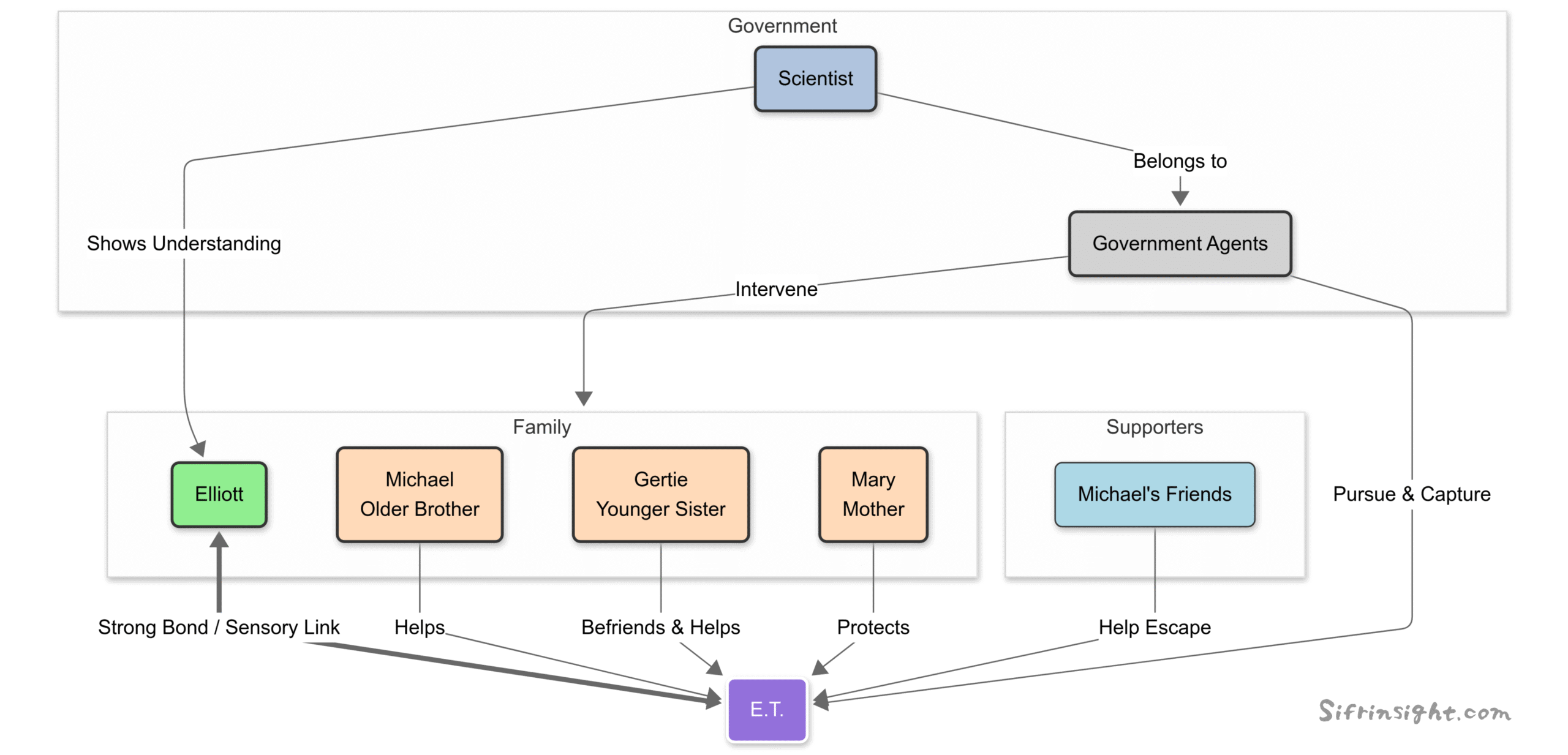
Story Explanation: The Psychological Necessity of the Alien
The focal point of the film is undeniably the extraterrestrial himself. On the surface, E.T. is a classic alien encounter story, but it operates on a fundamentally different emotional frequency than hostile invasion films like Alien or Predator.
E.T.’s narrative function is to represent the ultimate “outsider”—something completely divorced from human common sense.
Thematically, Elliott’s companion could have been a mythical undiscovered animal, a surviving dinosaur, or a magical fairy in the woods.
But the emotional crux of the story relies on the fact that Elliott is suffocating under the “loneliness of a father’s absence.” E.T. becomes the only being in the universe capable of sharing and absorbing that exact frequency of “loneliness” (as E.T. carries the devastating sorrow of being abandoned by his own family).
When Elliott ultimately parts ways with his soulmate at the climax, it is framed not merely as a tragic loss, but as the necessary, bittersweet crucible of growing up.
Choosing an “alien” to share this burden was a stroke of historical and cultural genius. Compared to a fairy or a dinosaur, the concept of extraterrestrial life had recently become a highly “plausible reality” in the public consciousness.
The Roswell incident was deeply embedded in American mythology, Neil Armstrong had conquered the moon in 1969, and Spielberg himself had already primed audiences with the awe-inspiring Close Encounters of the Third Kind (1977).
As scientific literacy exploded, a collective sense emerged that, mathematically speaking, it was actually more unnatural to believe we were entirely alone in the universe.
Furthermore, as I will expand upon in the Analysis section, Spielberg’s personal demons are woven directly into the film’s DNA. E.T. is drenched in the profound loneliness Spielberg endured as a child following his parents’ devastating divorce.
During that incredibly dark chapter of his life, a young Steven Spielberg actually invented an alien as his imaginary friend to cope with the pain.
If we look strictly at plot mechanics, an alien isn’t strictly necessary. But when you fuse the zeitgeist of the Space Age with Spielberg’s intimate childhood trauma, E.T.’s existence becomes an emotional inevitability.
Now, let’s step into the San Fernando Valley and review the plot in intricate detail.
Detailed Synopsis
Close Encounters
In a dense, fog-covered pine forest bordering a sprawling California suburb, a massive, retro-futuristic spaceship sits quietly in the dead of night. A crew of gentle alien botanists roams the woods, carefully harvesting Earth’s flora. One curious alien wanders a bit too far from the group. Suddenly, the roar of engines breaks the silence; government vehicles violently crash through the trees, their high beams sweeping the dark.
The crew panics and rushes back to the ship. The stranded alien runs desperately on his short legs, but he is too late. The ship ascends into the stars, leaving him entirely alone on a terrifying, alien world.
Meeting the Boy
Hunted and terrified, the creature flees into the suburban grid, eventually taking refuge in a backyard tool shed. Inside the house lives a middle child named Elliott. When Elliott goes out to fetch a pizza delivery, he senses a strange presence in the shed. He throws a baseball into the dark, and it is mysteriously thrown back. He alerts his older brother Michael, his mother Mary, and his friends, but when they investigate, the shed is empty. They dismiss it as “just a coyote.”
But Elliott knows better. Armed with a flashlight, he ventures out alone, following a trail of rustling stalks deep into a cornfield. Suddenly, he comes face-to-face with the alien. Both boy and creature scream in sheer terror, and the alien vanishes back into the brush.
The next evening at the dinner table, Elliott desperately tries to convince his family about the creature. His mother, brother, and little sister Gertie relentlessly mock him. Frustrated, Elliott lashes out, declaring that his father—who recently abandoned the family in Mexico—would have believed him. The painful remark instantly shatters the room, leaving his mother in tears.
A Secret Cohabitation
That night, Elliott waits in the backyard with a handful of Reese’s Pieces. He slowly lays a trail of the candy, successfully luring the cautious alien out of the shadows and directly into his bedroom. Though they lack a shared language, they communicate through mimicry and gentle gestures. Exhausted by the sheer magnitude of the discovery, Elliott falls asleep with the alien hiding in his closet.
The following morning, Elliott fakes a fever to stay home from school. He spends the day introducing the alien to human culture. When Michael returns, and Gertie wanders into the room, Elliott is forced to reveal his secret. Sworn to absolute secrecy, the three siblings become the creature’s sole protectors.
Using his powerful telekinesis, the alien levitates several clay spheres to demonstrate that he originates from a distant solar system. Adopting a phrase from Michael’s friends, Elliott formally dubs his new companion “E.T.”
A Deepening Bond and a Longing for Home
As the days pass, a profound, telepathic synchronization develops between the boy and the alien; they begin to share physical and emotional sensations. When E.T. raids the fridge and gets drunk on Coors beer at home, Elliott becomes wildly intoxicated in his middle school science class, leading to a chaotic incident where he frees all the frogs destined for dissection.
Through watching Sesame Street and interacting with Gertie, E.T. rapidly learns English. He points his glowing finger to the sky and utters the iconic phrase: “E.T. phone home.” The children realize he is desperate to contact his family. They scavenge the house for electronics—an umbrella, a circular saw blade, and a Speak & Spell toy. While working, Elliott accidentally slices his finger on a saw blade. E.T. extends his glowing digit, instantly and miraculously healing the wound.
The Halloween Night Plan and a Creeping Shadow
E.T. proves to be a mechanical genius, successfully assembling a makeshift distress beacon. To smuggle E.T. out of the house, the children drape a white sheet over him, disguising him as a ghost for Halloween. Under the cover of the chaotic neighborhood trick-or-treating, Elliott and E.T. slip into the forest on a bicycle, which E.T. miraculously levitates across the sky to escape detection.
They reach the clearing and activate the beacon. However, back in the suburbs, the threat materializes. A shadowy government task force, led by a man with a ring of keys on his belt, has been secretly wiretapping the house and tracking the alien’s energy signature.
A Sudden Separation and a Life-or-Death Crisis
Elliott spends the freezing night in the forest, waiting for a ship that never arrives. He wakes up at dawn to find the beacon still transmitting, but E.T. is gone. Sick, freezing, and terrified, Elliott stumbles home. His frantic mother is already speaking with the police about his disappearance. Elliott collapses into Michael’s arms, begging his brother to find E.T.
Michael races into the woods on his bike, dodging a suspicious government vehicle. Deep in a ravine by a rushing river, he discovers E.T. washed up on the bank—chalk-white, barely breathing, and dying. Michael wraps the alien in his jacket and rushes him home.
Facing a catastrophic medical emergency, the boys finally reveal E.T. to their horrified mother. But before Mary can even process the shock, government agents in hazmat suits violently storm the house. The quiet suburban home is instantly transformed into a terrifying, plastic-wrapped quarantine facility. Scientists hook both the dying alien and the critically ill Elliott up to a maze of life-support machines.
The doctors realize the boy and the alien share synchronized brainwaves. The lead scientist, Keys, pulls Elliott aside. He confesses, “I’ve been waiting for him since I was ten years old. I don’t want him to die.” He reveals they found the beacon in the woods and knows E.T. was simply trying to call his family.
A Miraculous Revival and the Great Escape
Despite the doctors’ desperate efforts, the telepathic link violently shatters. Elliott’s vitals suddenly stabilize, but E.T.’s completely crash. His heart stops. The doctors declare the alien dead and seal his body inside a freezing cryogenic container. Left alone to say a final, agonizing goodbye, Elliott weeps over the capsule.
Suddenly, the wilted flowers nearby spring back to life. E.T.’s chest begins to emit a brilliant, pulsing red glow. His heart is beating again. E.T. weakly signs, “E.T. phone home.” He sensed the telepathic signature of his returning mothership.
Elliott quickly conceals E.T.’s revival. He recruits Michael, and the two pull off a daring heist, hijacking the government medical van with E.T. in the back. A massive police chase ensues. Michael’s friends join the convoy on their bicycles. Cornered by a heavily armed police blockade, E.T. unleashes his telekinesis, lifting all the boys’ bicycles into the sky, soaring over the astonished authorities toward the forest.
Eternal Friendship and Farewell
The boys land safely in the forest clearing. Moments later, an absolutely colossal, brilliantly illuminated spaceship descends from the cosmos, landing gracefully in the pines.
Mary, Gertie, and the scientist, Keys, arrive just in time. The ship’s ramp lowers. E.T. turns to Elliott and pleads, “Come.” But Elliott, tears streaming down his face, shakes his head. “Stay.”
Accepting their different paths, E.T. raises his glowing finger and gently presses it against Elliott’s forehead. “I’ll be right here,” he promises.
They share a final, crushing embrace. E.T. scoops up the pot of resurrected flowers and waddles up the ramp. The doors seal, and the ship blasts off into space, leaving behind a dazzling rainbow trail across the sky, cementing a bond that will transcend the stars.
E.T. (1982) Deep Analysis: The Sickness of Loneliness

Spielberg’s Masterful Visual Storytelling: Instantly Conveying “Safety” and “Friendliness”
From the very first frame, Spielberg faces a massive cinematic challenge: how do you convince the audience that a grotesque, leathery alien is actually a gentle soul?
He achieves this flawlessly by opening the film with E.T. curiously and harmlessly collecting botanical samples in the forest. This instantly frames the alien not as an aggressive conqueror, but as an innocent, vulnerable scientist. This masterful visual shorthand guarantees the audience’s immediate empathy.
While the botany scene establishes his “harmlessness,” it is the deployment of Reese’s Pieces that cements his “friendliness.”
Elliott uses a trail of Reese’s Pieces to lure the alien out of the dark, and later, E.T. cautiously offers the candy back to Elliott during their bedroom encounter. By utilizing candy—the ultimate, universal currency of childhood—Spielberg successfully portrays an “alien you can be friends with” entirely through visual action, requiring zero dialogue.
This brilliant integration of candy as an emotional device heavily mirrors the use of the fruit drops in Studio Ghibli’s Grave of the Fireflies. In that tragic film, the fruit drops symbolize the fleeting “innocence of childhood,” and their depletion visualizes a devastating loss that can never be recovered. Props like candy resonate deeply with audiences precisely because they are universally tethered to the psychology of youth.
Spielberg’s ability to maximize the emotional weight of “small, everyday objects” is the absolute hallmark of his directorial genius.
The “Duality” of Advanced Intelligence and Pet-Like Cuteness
E.T. is a biological marvel—an advanced being capable of interstellar space travel, telekinesis, and cellular regeneration. Yet, when Elliott attempts to teach him basic English in the bedroom, E.T. acts with the clumsy innocence of a toddler, shoving a toy car directly into his mouth.
This stark imbalance between god-like power and profound vulnerability creates E.T.’s “pet-like cuteness” and adds immense psychological depth to his character. This duality is brilliantly highlighted when the family dog, Harvey—who is noticeably absent for the entire first act—suddenly trots into the room and aggressively barks at the alien.
Harvey likely perceives E.T. not as an existential threat to humanity, but as an immediate rival for his owner’s affection and territory. This deeply grounded, comedic reaction subliminally signals to the audience that E.T. safely occupies the same domestic tier as Harvey: he is a beloved “pet.”
Through this meticulous layering—”an alien, but harmless,” “an alien, but a friend,” and “an alien, but like a pet”—E.T. transcends the sci-fi archetype and becomes a profoundly humanized character.
E.T. as “Something That Exists, Yet Doesn’t Exist”—Elliott and E.T. as Two Halves of a Whole
“Non-existence” Portrayed Comically
In a desperate bid to swear Gertie to secrecy, Elliott impulsively lies, telling his little sister, “Grown-ups can’t see him.” While this is framed as a classic playground fib to control a sibling, it actually serves as a massive thematic thesis: Elliott is directly articulating the “existing, yet not existing” duality of E.T.
This theme is weaponized for comedic gold in the legendary kitchen scene. Gertie repeatedly tries to point out E.T. to her frantic mother, but Mary’s gaze is always diverted at the exact wrong microsecond, or E.T. clumsily blends in with the background clutter. The scene is hilarious, but it operates on a devastating subtext: E.T. is a magical entity who absolutely “exists” in the pure world of children, but is entirely invisible to the cynical, distracted reality of adults.
Spielberg’s Childhood Trauma: The Absent Father and Divorce
Why was it so narratively vital to portray E.T. as this liminal, “existing yet invisible” entity? The answer lies in the heavy, relentless depiction of Elliott’s broken home—a subplot that, on paper, has nothing to do with a sci-fi alien invasion. This emotional current is drawn directly from the blood and trauma of Steven Spielberg’s own childhood.
Spielberg’s father was an obsessive electrical engineer. In a deeply personal 2012 interview on CBS’s 60 Minutes, Spielberg confessed:
I missed my dad a lot growing up, even though we were together as a family. My dad was really a workaholic. And he was always working.
His parents eventually suffered a bitter divorce. The fallout devastated young Spielberg, who unfairly placed the blame entirely on his father for years (though they eventually reconciled later in life).
The trauma of that broken home was the creative forge for E.T. In a profound interview with legendary film critic Roger Ebert, Spielberg laid his soul bare (Read the RogerEbert.com interview):
From the very beginning,” Spielberg said, ” ‘E.T.’ was a movie about my childhood — about my parents’ divorce, although people haven’t often seen that it’s about divorce. My parents split up when I was 15 or 16 years old, and I needed a special friend, and had to use my imagination to take me to places that felt good — that helped me move beyond the problems my parents were having, and that ended our family as a whole. And thinking about that time, I thought, an extraterrestrial character would be the perfect springboard to purge the pain of your parents’ splitting up.
Armed with this agonizing context, the true nature of E.T. snaps into brilliant focus. He is not merely a lost spaceman; he is the ultimate psychological coping mechanism.
E.T. as a Stand-in for Elliott, and for Steven Spielberg
Based on Spielberg’s own tragic admissions, we can definitively state that E.T. is the literal, cinematic embodiment of Steven Spielberg’s childhood imaginary friend.
An “imaginary friend” is an entity a child conjures to survive trauma—a safe sounding board to process grief. It is an internal projection of the self. When a child converses with an imaginary friend, they are desperately trying to heal their own soul.
Look at the parallels: Elliott is suffocating under the crushing loneliness of an absent father. E.T. is suffering the terrifying loneliness of being abandoned on a hostile planet. They are two broken halves of the same coin, bound by an identical frequency of “loneliness.”
When the film establishes their telepathic synchronization, it isn’t just a cool sci-fi gimmick. It is a profound, literal translation of the fact that these two beings were, from a psychological standpoint, one and the same entity all along.
In the text of the film, E.T. is a physical, biological alien. But in the subtext of the film, he exists purely as an imaginary savior engineered to fill the gaping void in Elliott’s (and Spielberg’s) heart.
Because Spielberg is a master of audience manipulation, he weaves this complex duality so seamlessly into the popcorn narrative that we ingest the heavy trauma without even realizing it. That is the true miracle of E.T.
With this psychological framework established, we can finally answer the darkest, most compelling mysteries of the film: why E.T. was found collapsed by the river, and why he miraculously returned from the dead.
The Biggest Mystery: Why Did E.T. Collapse by the River, and Then Resurrect?
To understand the resurrection, we must first analyze the mechanics of E.T.’s terrifying physical decline.
“Loneliness” as a Force That Inflicts Serious Damage
As we established, E.T. is built atop the bedrock of Steven Spielberg’s childhood agony: the “sorrow of an absent father” and the “trauma of a broken family.”
Elliott bears the “grief of an absent father,” while E.T. bears the “grief of separation from his species.” Furthermore, E.T. carries the sheer, existential panic of being “left behind.” These overlapping traumas culminate in one inescapable, devastating emotion: absolute “loneliness.”
Spielberg visualizes the rapid decay of E.T.’s life force through the wilting of the potted geraniums that E.T. himself had magically resurrected earlier. The first time we notice the flowers beginning to droop is precisely when E.T. is frantically constructing his communication device.
Why does his biology begin to fail in that specific moment? We can deduce that “his existential loneliness had reached a critical, terminal threshold, driving him to frantically build a cosmic SOS out of garbage.” If he were perfectly happy assimilating into suburban Earth life, he never would have built the beacon.
By explicitly linking this profound loneliness to his physical decay, Spielberg is making a dark, powerful declaration: negative emotions like ‘loneliness,’ ‘grief,’ and ‘sorrow’ are completely capable of inflicting fatal, physical damage on the body. To put it simply: “Loneliness is a sickness unto death.”
E.T. was literally dying of a broken heart.
Why Was E.T. Found Collapsed by the River?
We are finally equipped to answer the core mystery of this analysis: “Why was E.T. found collapsed in that specific location by the riverbed?”
To unravel this, we must divide the mystery into two distinct, analytical questions: “Why did he collapse in the first place?” and “Why by the river?”
– Why did he collapse?
Let’s address the sudden, catastrophic failure of his body.
The night they successfully activate the homemade beacon in the forest, an exhausted Elliott looks at E.T. and begs, “Stay with me.”
In that quiet moment, the dam breaks. The overwhelming, crushing sorrow of having to say goodbye to his only friend explodes within Elliott’s heart.
Because E.T. and Elliott are biologically and telepathically tethered, that massive shockwave of human grief flows directly into E.T.’s fragile nervous system.
E.T. was already operating at the absolute, fatal limit of his own homesick loneliness. When Elliott’s immense sorrow violently poured into his system, it completely overloaded E.T.’s life force, triggering a catastrophic biological collapse that led him to stumble to the river and suffer cardiac arrest.
This is Spielberg utilizing the alien’s biology as a tragic, literal sponge for the devastating weight of human grief.
– Why was he found collapsed by the river?
Next, we must decode the geographical mystery of the “riverside.” This involves two micro-questions: “Why wasn’t he curled up next to Elliott?” and “Why specifically choose a river as his deathbed?”
– Why wasn’t he near Elliott?
After operating the beacon, Elliott, absolutely drained by the emotional weight of impending separation, falls asleep in the dirt.
When E.T. succumbs to his illness, it would have been narratively simple to have him collapse right next to the sleeping boy. Yet, he wanders off and is found miles away by a river.
While this requires some cinematic speculation, two highly logical theories emerge:
- He was frantically pacing the perimeter, scanning the dark sky for any sign of his returning ship.
- As a dedicated botanist, he was observing the local aquatic flora to pass the time until his rescue arrived.
When you are freezing and desperately waiting for an SOS to be answered, pacing is a natural anxiety response. Furthermore, considering the film literally opens with E.T. obsessively studying forest plants, it is entirely within his character to wander toward a water source to examine the vegetation.
A tragic combination of pacing the skyline and studying the riverbank flora likely led him to the water’s edge right as his heart gave out.
– Why was a river chosen as the place of his collapse?
Now, let’s explore the deep, symbolic resonance of the “riverside.” On a purely cinematic level, the answer is obvious: “It radically amplifies the tragedy.” Imagining the sick, freezing alien lying in the wet, muddy shallows of a cold river instantly spikes the audience’s anxiety and pity. It creates a far more pathetic, heart-wrenching tableau than if he had simply fainted on a bed of dry pine needles. This engineered despair makes his subsequent resurrection feel incredibly triumphant.
However, there is a much deeper, literary metaphor at play here.
In mythology and literature, a “river” almost universally represents a “boundary.”
A river is the ultimate dividing line between “here” and “there”—between the realm of the living and the realm of the dead. In the context of the film, “here” represents Earth (isolation), and “there” represents the stars (his home).
Therefore, framing E.T.’s dying body half-submerged in a river is a brilliant visual representation of the life-threatening “loneliness” he suffered while stranded on the agonizing boundary between “Earth” and “Home.”
Spielberg could have dropped him anywhere, but by choosing the boundary of a river, the invisible, suffocating pain of being “trapped on this side” is powerfully, visually manifested.
Why was E.T. able to revive?
With our psychological foundation fully laid, the mechanics of E.T.’s miraculous resurrection become beautifully clear.
Simply put: his heart restarted because he was “finally freed from the terminal ‘loneliness’ that killed him.“
During the resurrection sequence in the freezing chamber, the area around E.T.’s heart begins to emit a brilliant, pulsing red glow. The biological function of this “glowing heart” is explicitly established in the film’s opening minutes.
During the terrifying opening chase, as E.T. flees through the redwoods and his crew waits in the hovering ship, both the abandoned alien and his distant crewmates share the exact same glowing red chests. This establishes that their species communicates via an intense, biological telepathy, and their hearts glow when the connection is active.
Therefore, when E.T. suddenly revives in the freezer, it is because his returning crew had entered Earth’s atmosphere and come close enough to establish a telepathic link. The sheer joy of sensing his family instantly cured his terminal loneliness, shocking his heart back to life.
Yes, it is a highly convenient narrative device. But because Spielberg meticulously established the rule that “psychological trauma directly inflicts physical death,” it perfectly stands to reason that “psychological salvation can instantly reverse physical death.”
The Mystery of the Man with the Keys: A Stand-in for Steven Spielberg
Finally, we must address the ominous “Man with the Keys” (Keys), the faceless government agent who hunts the children from the very first frame.
During the devastating quarantine sequence, Keys reveals himself not as a heartless villain, but as a sympathetic scientist. He drops a massive, shocking piece of exposition on Elliott:
“He came to me, too. I’ve been wishing for this since I was 10 years old. I don’t want him to die.”
If we take this dialogue literally, it implies that Keys had his own close encounter with E.T. (or another alien) when he was a lonely ten-year-old boy, and he dedicated his entire adult life, and his scientific career, to finding his friend again.
From a strict screenwriting perspective, however, this sudden backstory doesn’t actually add much structural depth to the plot of E.T.
Honestly, his character’s personal history has zero impact on the climax. He doesn’t actively help them escape, and his presence doesn’t inherently heighten the emotional stakes of the boys’ bike chase.
And yet, a master storyteller like Steven Spielberg deliberately inserted him into the narrative. Why?
Because Keys serves an absolutely vital, thematic purpose: he is the physical manifestation of a future Elliott. He is living proof that Elliott can endure the agonizing trauma of losing E.T. and still grow up to be a compassionate, fully-functioning adult.
Yes, as the spaceship blasts off, we assume Elliott will be fine. But the crushing reality of his “absent father” remains entirely unresolved, and the permanent loss of his soulmate will leave a massive scar.
Knowing this, Spielberg felt a moral obligation to provide the audience with a tangible, adult guarantee that Elliott’s future would not be destroyed by grief.
And when you analyze it deeply, the person who most accurately guarantees Elliott’s survival is Steven Spielberg himself.
Spielberg was the lonely boy who bore the crushing weight of a workaholic, absent father and the devastation of divorce. E.T. was his literal imaginary friend.
Yet, despite carrying that immense childhood sorrow, Spielberg grew up to become one of the most successful, respected filmmakers in human history. He survived. He thrived.
Therefore, it is undeniable: the Man with the Keys is the direct cinematic projection of Steven Spielberg—the boy who grew up to be a respectable, brilliant adult despite carrying the heavy sadness of the past.
E.T. is truly a film of endless, magnificent dualities.
This concludes my deep, psychological breakdown of E.T. the Extra-Terrestrial. At the end of the day, the only metric that truly matters is that the film is “entertaining.” But peeling back the layers reveals just how much blood and soul Spielberg poured into the script.
This analysis is wildly different from how I perceived the film as a child. Back then, I simply assumed E.T. was dying because Earth’s gravity was too heavy, or because he exhausted his “magic batteries” healing a flower. I can’t definitively rule that out, but the psychological subtext feels infinitely more rewarding.
Cinema is a deeply subjective mirror, and every viewer takes away something different.
What kind of movie was E.T. for you?







Reader Comments