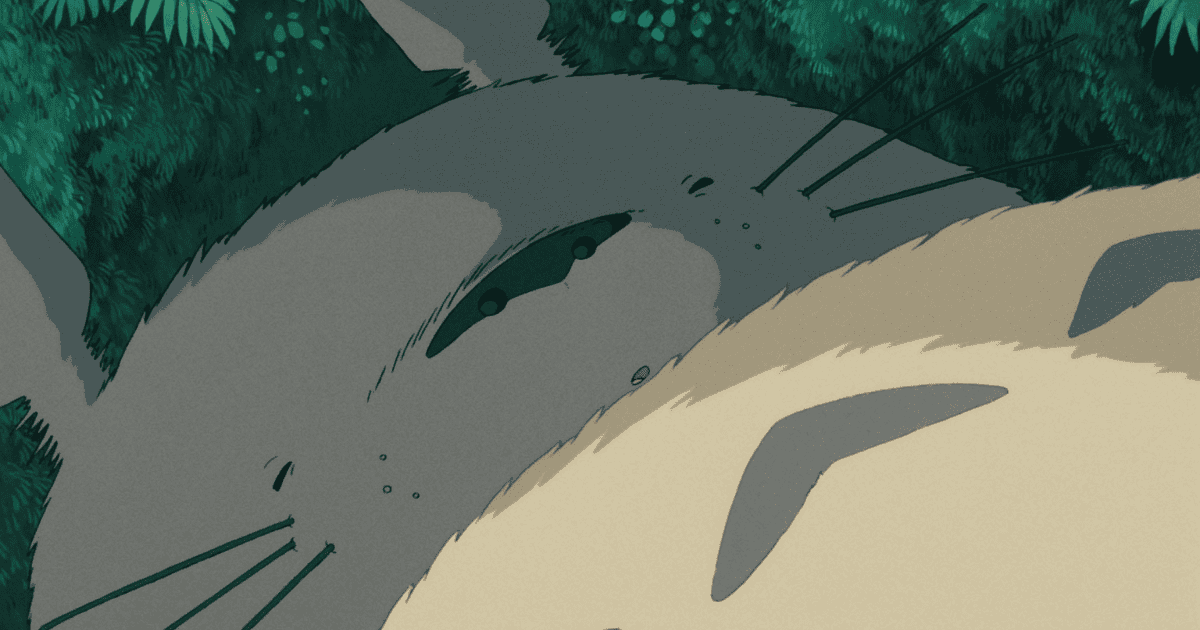
Hayao Miyazaki’s 1988 masterpiece, My Neighbor Totoro(Official Studio Ghibli), is universally beloved as a heartwarming, innocent tale of childhood magic. For decades, audiences have found deep comfort in the nostalgic idea that “Totoro is always there on windy nights.” Yet, hiding just beneath the sun-drenched surface of this Studio Ghibli classic is a psychological shadow so unsettling that it spawned one of the most infamous, terrifying urban legends in anime history: the theory that Totoro is a God of Death.
As fans grow older, childhood nostalgia often gives way to a lingering curiosity about the film’s hidden depths. Hirokatsu Kihara, the production desk manager at the time, chronicled the behind-the-scenes reality of the animation process in his brilliant documentary book, Our Totoro (ふたりのトトロ, in Japanese). It is an absolute treasure trove of valuable insights that paints a much more complex picture of the film’s creation.
Today, we are not going to simply debunk or verify the morbid details of the Totoro fan theory. Instead, we are going to dive deep into the psychology of the film to answer a much more fascinating question: why was the My Neighbor Totoro urban legend born in the first place? Before we dissect the psychology of “the scent of death,” let’s review the chilling details of the legend itself.
*This is a translated version. The original (Japanese) is available here.
- An Urban Legend Born from the “Scent of Death”
The viral theory that Mei and Satsuki are dead doesn’t stem from secret lore, but from the psychological “scent of death” triggered by the terrifying precariousness of their childhood situation. - The Mortal Peril of Innocence
Toddlers instinctively gravitate toward mortal danger. Because Miyazaki animated the sisters with such unnerving, hyper-realistic accuracy, the audience’s protective instincts go into overdrive, resulting in an unconscious premonition of tragedy. - Miyazaki’s Desperate Plea for a “Fun Film”
From day one, the director constantly forced the staff to remember that “this is a fun film.” Cynically, one could argue he had to overemphasize the lightheartedness to mask the dark, creeping shadow of death inherent in the script. - The Connection to Matasaburo of the Wind
Mirroring Kenji Miyazawa’s classic literature Matasaburo of the Wind (風の又三郎), Totoro uses the motif of the wind to explore how vulnerable children navigate life-threatening danger to achieve profound personal growth.
On this pageContents
My Neighbor Totoro (1988) Analysis: Breaking Down the Urban Legend
If we were to compile the darkest corners of the internet’s theories regarding My Neighbor Totoro, the grim narrative generally unfolds like this:
- The sandal found floating in the pond actually belonged to Mei, meaning she drowned.
- Satsuki, realizing her sister is dead, desperately seeks out Totoro—a God of Death (Grim Reaper)—and begs him to open the gates to the underworld. The name “Mei” is said to be a dark pun on “Meikai” (the Japanese word for the underworld). By entering the Catbus, Satsuki also crosses over into death.
- During the emotional climax at the hospital, the mother cannot see Mei and Satsuki sitting in the tree because the girls are merely lingering ghosts.
- Alternatively, the entire final act is a hallucination of a father grieving the loss of his daughters. As “proof,” fans point out that Mei and Satsuki literally lose their cast shadows in the final scenes of the film.
- Finally, theorists claim the core narrative is loosely based on the horrific Sayama Incident (Wiki), a real-life murder case from the 1960s.
This theory leans so heavily into macabre tragedy that it almost feels like a malicious attack on the purity of Mei and Satsuki. Yet, it remains undeniably captivating because the “evidence” feels chillingly plausible.
To be clear, these claims have been officially debunked. The sandal in the pond is a completely different design; the missing shadows were simply an animation shortcut because the scene takes place at high noon when shadows are directly underneath objects; and the story initially featured only one protagonist, completely detaching it from the Sayama Incident. But as a piece of internet lore, it is a brilliantly constructed nightmare.
So, why did our collective consciousness invent such a dark narrative for a children’s movie? The answer lies in Miyazaki’s terrifyingly brilliant direction: “My Neighbor Totoro portrays the fragile reality of being a child far too perfectly.” Let’s break down what it truly means to be a “child.”
My Neighbor Totoro (1988) Psychology: The Fragile Nature of Childhood
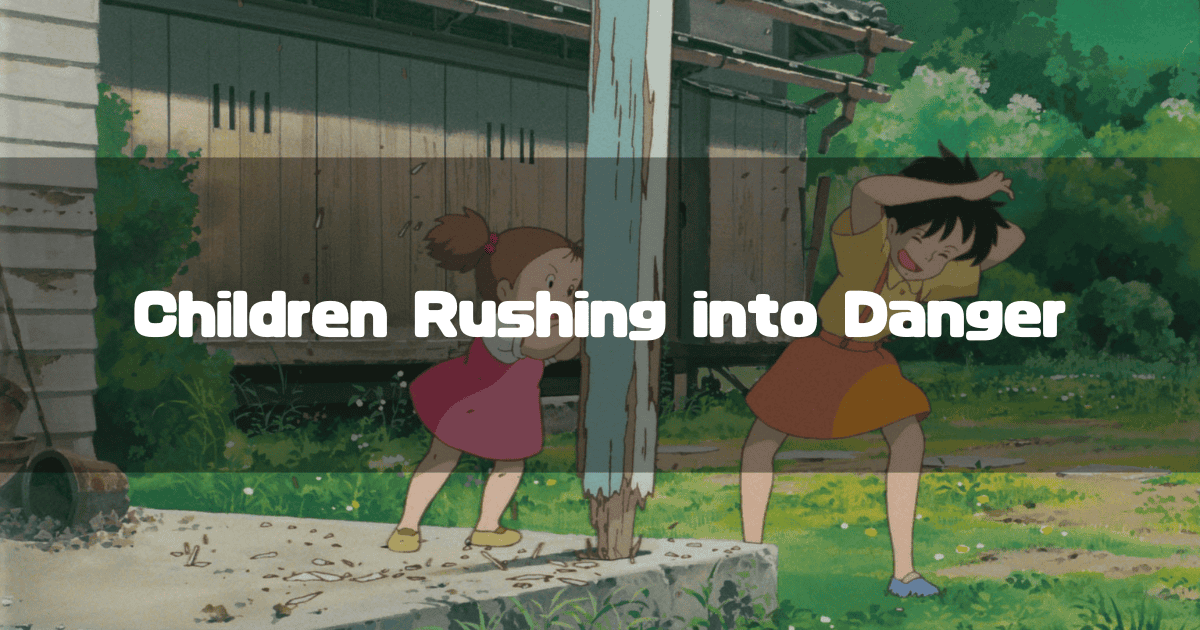
Living on the Edge: Children Are Always Next to “Death”
If you observe toddlers closely, you will quickly realize their most defining characteristic is that they gravitate toward mortal danger. Children operate purely on blind curiosity; they deliberately touch what they are told not to touch, and they gleefully wander into places that are strictly off-limits.
When adults yell to stop a child, it isn’t out of malice; it is out of sheer, suffocating panic. Children rush headlong into peril with absolutely zero sense of self-preservation. For parents, watching a child navigate the world is a constant source of heart-stopping anxiety. It only takes a single fleeting second—the moment an adult looks away—for a child to cross the irreversible borderline into tragedy.
While it is fundamentally true that “children cannot grow without experiencing danger,” no parent can calmly watch their child waltz into a life-threatening situation. The eternal conflict of childhood is the chaotic energy of “children rushing into danger” colliding with “adults desperately trying to keep them alive.” We can only pray they stay on the safe side of that invisible line.
When you strip away the magic, it is an undeniable truth that “children exist perpetually on the verge of death.”
If an animator captures this chaotic, fragile nature with raw psychological accuracy, the characters will inevitably look like they are dancing on the edge of the abyss. And in the case of Mei and Satsuki, their environmental circumstances are a recipe for disaster.
The Extreme Vulnerability of Mei and Satsuki
Simply by being a toddler, Mei is already a magnet for danger. She is at an age where she can sprint toward a fatal accident the second her guardian blinks. Compounding this terror is the Kusakabe family’s devastating dynamic: their mother is bedridden in a hospital, and their father is utterly consumed by his academic research, routinely taking his eyes off Mei while working from his study. Leaving a hyper-curious toddler completely unattended near a dense forest and deep ponds is exceptionally perilous.
In fact, the film explicitly shows Mei going missing twice. Fortunately, she is found safe both times. However, when you rewatch these scenes as an adult, the film reeks of the “scent of death.” This happens because Miyazaki animated “Mei and Satsuki as children” so perfectly that the inherent, terrifying vulnerability of childhood becomes visceral.
If the animation had been slightly more cartoonish or sanitized, this urban legend would never have gained traction. However, because Mei and Satsuki are depicted with such unnerving realism, our adult brains subconsciously calculate the odds and conclude that “a tragic outcome was highly probable.” This parental anxiety manifests as the thought, “Mei and Satsuki might actually be dead,” which the internet neatly packaged into the urban legend we know today.
My Neighbor Totoro (1988) Conclusion: Why the Dark Theory Endures
To summarize this psychological deep dive:
Because the very nature of childhood is a constant dance on the edge of mortality, animating children with true psychological realism inevitably casts a shadow of death over the narrative.
Furthermore, the Kusakabe sisters are effectively left to fend for themselves—with a hospitalized mother and an emotionally distracted father—making it terrifyingly easy for them to slip past the boundaries of adult supervision. This grim reality magnifies the “scent of death,” and the Totoro urban legend was naturally born to rationalize that lingering dread.
Ultimately, the reason we so easily accept the God of Death theory is because, deep down, we all unconsciously sensed that very same danger.
Of course, this is purely an analytical perspective. The legend might have originally started as a simple, cynical internet joke. But the argument that My Neighbor Totoro inadvertently exudes a “scent of death” precisely *because* it achieves peak realism feels undeniably true.
My Neighbor Totoro (1988) Appendix 1: Miyazaki’s Plea for a “Fun Film”
To truly understand the atmosphere during the film’s creation, we must look at Our Totoro (ふたりのトトロ, in Japanese) by Hirokatsu Kihara. In his book, he records a highly revealing quote from Director Hayao Miyazaki to his animation team.
“Listen, let me be clear from the start. This is a fun film. Please make it in a fun way. That’s all I have to say to the production team.”
To forcefully cultivate this “pleasant” atmosphere, Miyazaki allegedly rearranged the studio’s desk layout to maximize the natural light and wind flowing through the windows. He was aggressively thorough about “making a fun film in a fun way.” Reading this, I almost feel guilty for seeing phantoms of death in such a pure project, and perhaps I should just enjoy the magic.
However, taking a more cynical view, why did Miyazaki feel the need to relentlessly emphasize that the film was “fun”? Perhaps he subconsciously realized that if they didn’t actively fight against it, the terrifying vulnerability and “scent of death” inherent in the script would traumatize their young audience.
Or perhaps I am just an overthinking adult, hopelessly trapped by my own anxieties. Getting old certainly changes how you watch movies.
My Neighbor Totoro (1988) Appendix 2: The Kenji Miyazawa Connection
In My Neighbor Totoro, Mei wanders off twice, plunging into highly dangerous situations. Interestingly, this echoes another legendary Japanese work where a child faces mortal peril: Kenji Miyazawa’s literary masterpiece, Matasaburo of the Wind (風の又三郎). Miyazawa’s story contains the following chilling sequences:
- A boy named Kasuke chases a runaway horse deep into the mountains. Thick fog blinds him, and he wanders aimlessly until he collapses from exhaustion. In a dream state, he sees Matasaburo wearing a glass cloak, soaring into the sky. Kasuke wakes up to find the horse, and a search party rescues him. The terrifying reality of the situation is confirmed by Kasuke’s grandfather, who mutters, “That was close. That was close. If you had gone down the other way, both horse and man would have been lost.”
- In another scene, the children are playing by the river after school when a sudden, violent rainstorm hits. While the local children seem completely unbothered by the heavy winds, Matasaburo stands there, violently trembling.
The danger in the first scenario is explicitly stated by the grandfather. The second scenario, however, is much more psychological. A flash flood or sudden downpour at a river is incredibly deadly. While the local kids are too accustomed to the river to panic, Matasaburo’s sheer terror is actually the *correct* survival response. In that moment, he is the only one who senses the creeping approach of death.
Matasaburo of the Wind (風の又三郎) masterfully depicts the mortal danger surrounding children, illustrating how navigating the edge of death is a necessary catalyst for growth. In this specific narrative design, My Neighbor Totoro and Miyazawa’s work are deeply connected by the themes of “danger” and “the proximity to death.”
Consider the powerful motif of the “wind” in Totoro—the terrifying gust that knocks Satsuki over while fetching firewood, or Totoro and the Catbus moving as the wind itself. I firmly believe that these works are connected on a fundamental, atmospheric level. In many ways, My Neighbor Totoro feels like Director Hayao Miyazaki’s personal cinematic response to Miyazawa’s Matasaburo of the Wind (風の又三郎).
The images used in this article are from the “Studio Ghibli Still Images” collection.
Can you name the movie before the scene comes into focus?
Put your visual memory to the test with a blurred Studio Ghibli scene.

Reader Comments