
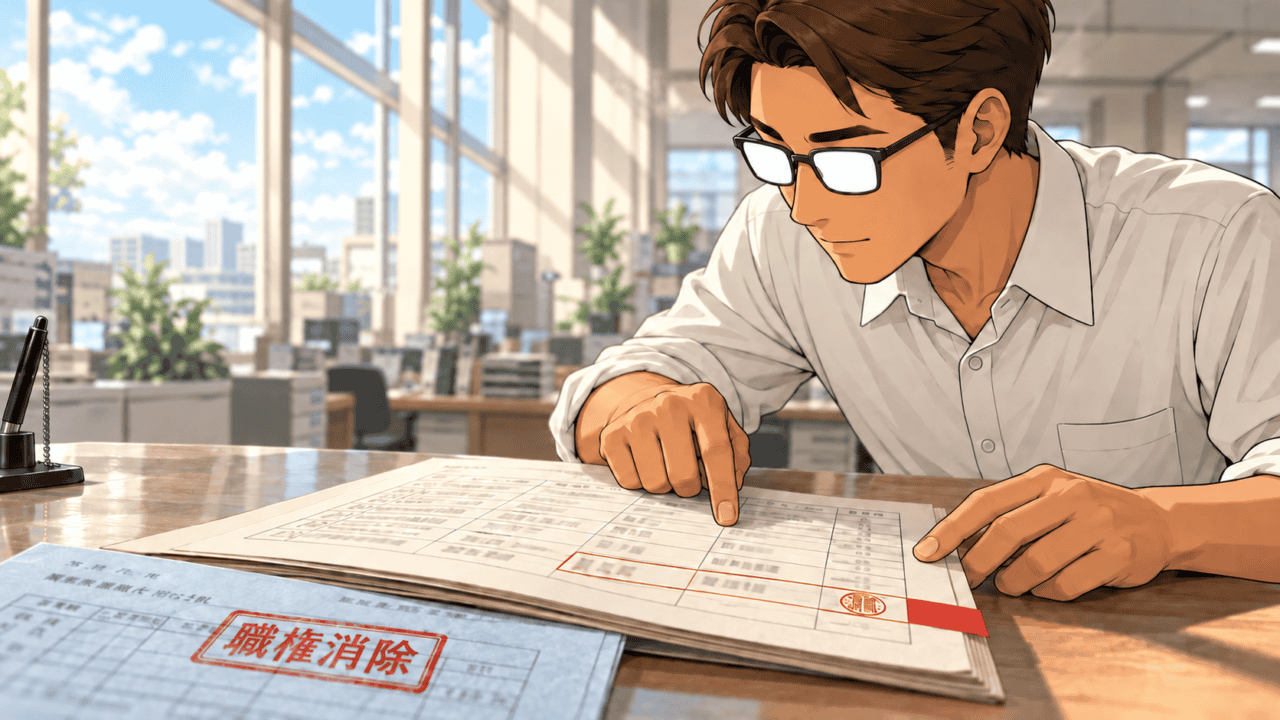
In Mamoru Hosoda’s animated feature The Boy and the Beast (Official Website), Kyuta (Ren) returns to the human world after eight years and discovers that his resident record has been deleted through an administrative procedure known as ex officio deletion.
While arranging to restore his resident record, he learns the current address of his estranged father and goes to see him. At first glance, that discovery might look like a convenient way of bringing them back together.
However, Japanese administrative procedures offer a plausible explanation for the scene. They do not establish exactly which procedure Ren followed.
Here, I consider how the paperwork might have led him to his father’s address.
*Please read this as a discussion of the film, rather than guidance on completing a real application. The precise documents and identity checks depend on the applicant’s circumstances and the municipality.
*This is a translated version. The original (Japanese) is available here.
On this pageContents
A Possible Key: The Address Record Attached to the Family Register
The familiar Japanese family register (koseki tōhon) records family relationships and civil status. A separate document, the “address record attached to the family register” (koseki no fuhyō), records the registered addresses of the people listed in that register.
That distinction suggests a way in which paperwork about Ren’s own status could also have led him to information about his father.
Family Registers and Their Attached Address Records
The distinction between the two documents matters to this reading of the scene.
| Document Name | Main Purpose (What it Proves) | Address Listing |
|---|---|---|
| Family Register (Koseki Tohon) | It legally proves family relationships. (e.g., Who the parents are, date of birth, marriage records) |
Current address is NOT listed at all. (The “Registered Domicile” is listed, but this is a permanent family anchor point and often differs from where a person actually lives). |
| Supplementary Family Register (Koseki no Fuhyo) | It legally proves address history. (e.g., A timeline of exactly when and where a person has moved since the family register was created). |
Current address IS listed. (Crucially, if you request a “Copy for All Members,” it lists the complete address history—from past to present—for *everyone* legally bound to that Family Register). |
One possibility is that Ren remained in his father’s family register after his parents’ divorce. If he obtained an address record covering everyone in that register, it could include his father’s registered address as well as his own address history.
A child can remain in the father’s family register even when the mother has custody after a divorce. Given Ren’s situation with his mother’s relatives, though, it is also understandable to imagine that he had moved to her register.
Learning his father’s address does not prove that they shared a register. Municipal guidance also permits direct-line relatives to request these records. Remaining in the same register is one possible explanation, rather than the only one.
Why Might Ren Have Obtained an Attached Address Record?
An attached address record can help document someone’s address history. It is therefore a plausible part of the paperwork Ren might have obtained while restoring his resident registration, but the film does not establish that it was a universally required document.
After eight years away, Ren finds that his resident record has been deleted. A municipality dealing with his return would need to establish his identity and residence. In reconstructing the scene, two relevant kinds of information are:
- His identity as Ren
- His previous address history
A family register can help establish family relationships and civil status, while an attached address record can help establish address history. Neither replaces all the checks needed for an individual application.
My reading is that Ren sought paperwork to restore his registration, rather than setting out to find his father. Obtaining an attached address record could have connected those two developments. The film leaves the exact application and sequence of checks unstated.
How Might He Have Proved His Identity?
That leaves another question. Applications for these certificates involve identity checks. After spending eight years in the Beast Realm, did Ren have a driver’s license or another acceptable identity document?
He probably did not. How, then, might he have obtained the documents?
A possible answer is “identity verification through oral questioning.”
Some municipalities explain that, when ordinary identity documents cannot be presented, they may use questions or other documents to help verify identity. That does not make oral questioning an automatic substitute in every case.
Officials may ask about details held in the records to help establish that the applicant is who they claim to be. The underlying idea is to check information connected with the person’s identity; the exact questions and assessment vary.
Oral questioning is therefore a plausible explanation for how Ren could have obtained his paperwork. It remains an interpretation of the scene, not a procedure the film explicitly shows.
Municipal Guidance on Oral Identity Checks
The following municipal guidance shows that oral questioning can be part of identity verification. These passages establish that such a method exists; they do not document Ren’s fictional application.
English Translation:
(Note) When the above [physical ID] cannot be presented, we may supplement identity verification through oral questioning, so we ask for your cooperation.(Original Text in Japanese)
Source: Sagamihara City “Question: I want to know how to obtain a copy of the Supplementary Family Register.“
(注)上記のものが提示できないときは、口頭での質問により補充的に本人確認することがありますので、ご協力ください。
English Translation:
If [ID] cannot be confirmed, we will perform identity verification through oral questioning.(Original Text in Japanese)
Source: Ise City “Fees for Family Register Related Certificates“
確認できない場合は、口頭質問により本人確認を行います。
English Translation:
Those who do not have documents to verify identity can still apply for issuance, but we will verify identity through oral questioning or other documents.(Original Text in Japanese)
Source: Kannami Town “Identity Verification When Applying for Resident Records and Family Register Certificates“
本人確認ができる書類をお持ちでない方も交付申請はできますが、口頭での質問やその他の書類によって本人確認をさせていただきます。
English Translation:
If you do not have documents to verify your identity, we will verify your identity by asking questions orally, etc.(Original Text in Japanese)
Source: Toride City “Presentation of identity verification documents is required when submitting notifications regarding Family Registers or Resident Records, or applying for certificates“
本人確認できる書類をお持ちでない場合、口頭等で質問をすることで本人確認をさせていただきます。
Summary: A Plausible Reading of the Registration Scene
The sequence can be reconstructed as follows, with the important qualification that the film does not show every administrative step:
- Requesting the Documents
- Ren might request his family register and its attached address record from the municipality holding that register.
- Verifying His Identity
- If he lacks acceptable identity documents, questions and other available information might help establish his identity.
- Receiving the Documents and Learning the Address
- He might receive an attached address record.
- If he and his father share a register, a record covering everyone in it could include both their addresses. Alternatively, his relationship as a direct descendant could provide a basis for requesting his father’s record.
- Restoring His Resident Registration
- He completes the registration procedure with the municipality where he is living, supplying the information and documents it requires for his circumstances.
Seen this way, the reunion in The Boy and the Beast need not be a simple plot convenience. Japanese administrative records offer a plausible route to his father’s address, even though the film does not establish the exact route.
I still find the narrative connection impressive: Ren wants to take the high school equivalency examination, needs to sort out his registration, and encounters his father’s address in the process. As a way of bringing him back into the human world, I think it deserves a “Well done!”
Why Might His Resident Record Have Been Deleted?
Why had Ren’s resident record been deleted in the first place?
Having been absent for eight years, he may have been found no longer to be living at his registered address.
Under Japan’s resident registration system, a municipality can remove an entry through its own administrative authority when the registered address does not reflect actual residence. This is known as ex officio deletion.
Returned mail, information from relatives or neighbors, and other inquiries can prompt an investigation into whether someone still lives at an address. Long absence may therefore lead to deletion after the municipality’s investigation; the passage of eight years alone does not tell us which checks were carried out.
Here is an example of a municipality’s explanation of circumstances that can prompt such an investigation:
English Translation:
(Concrete Examples of Ex Officio Deletion)
1. When doubts arise regarding items listed in the resident record due to responses at the counter for resident record transfer tasks, etc.
2. When information regarding a person whose residence is unknown is provided by other departments such as the Tax Division, National Health Insurance Section, Elderly Welfare Division, or administrative agencies due to non-delivery of mail or home visits.
3. When there is a report or notification from relatives, cohabitants, nearby residents, house owners, or house managers that the person is a non-resident.
4. When a notification of moving in does not arrive from the municipality of the new address even after six months have passed since obtaining a moving-out certificate.
5. For foreign nationals, when there is a notification from the Ministry of Justice that they have returned to their home country or that their period of stay has expired.
In such cases, the Citizens’ Division conducts a factual investigation, and when it is determined that there is no reality of residence, ex officio deletion of the resident record is performed.(Original Text in Japanese)
Source: Kawasaki Town, Fukuoka Prefecture “Ex Officio Deletion of Resident Record“
(職権消除の具体例)
①住民票異動事務の窓口の対応等で、住民票記載事項に疑義が生じた場合
②税務課や国民健康保険係、高齢者福祉課など他所管及び行政機関から、 郵便不達や臨戸訪問等により居住が不明な方の情報提供
③親族及び同居人、近隣の住民等、家屋の所有者又は家屋の管理人などから、 不現住者である旨の申し出や通報があった場合
④転出証明書を取得してから6ヶ月経過後においても、転入先の市区町村から 転入通知が届かない場合
⑤外国人の方で法務省からの帰国した旨の通知や、在留期間満了の通知 があった場合
などにより、住民課が実態調査を行い、居住の実態がないと判断した時に住民票の職権消除を行っております。
English Translation:
When residence at the address on the resident record cannot be confirmed, the city may perform deletion, entry, or correction by ex officio in accordance with laws and regulations.(Original Text in Japanese)
Source: Itoshima City “Let’s Register Residency Correctly.“
住民票上の住所での居住が確認できないときなど、法令に則り市が職権による消除又は記載、修正を行うことがあります。
Ren’s long absence fits the general situation in which residence at a registered address may no longer be verifiable. That makes the premise plausible, without establishing which of the listed circumstances applied to him.







Reader Comments
Have a thought or interpretation? Leave a comment