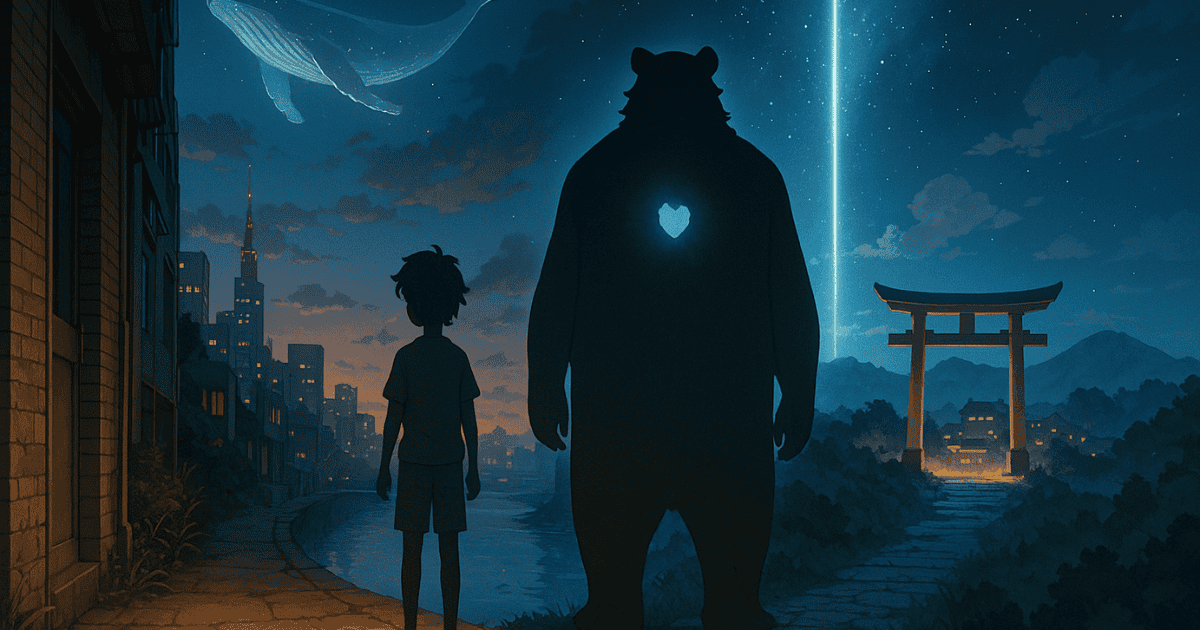
The Boy and the Beast (Official Website) is a stunning, theatrical animated feature directed by the acclaimed Mamoru Hosoda, released on July 11, 2015.
This cinematic masterpiece bridges two distinct worlds: the Human World (the bustling streets of Shibuya) and the Beast World (the mystical realm of Jutengai). At its core, it is a coming-of-age story that chronicles the turbulent, unorthodox master-disciple relationship between Ren (Kyuta), a profoundly lonely human boy, and Kumatetsu, a fiercely powerful but equally isolated beast.
This article provides a complete breakdown of the film. We start with a spoiler-free synopsis for newcomers, followed by a detailed, spoiler-filled plot summary, and conclude with an in-depth thematic analysis to help you fully grasp the movie’s emotional depths. But first, let’s review the essential details.
*This is a translated version. The original (Japanese) is available here.
On this pageContents
The Boy and the Beast (2015): Basic Information

Film Overview
| Release Date | July 11, 2015 |
|---|---|
| Director | Mamoru Hosoda |
| Screenplay | Mamoru Hosoda |
| Character Design | Mamoru Hosoda, Takaaki Yamashita, Daisuke Iga |
| Music | Masakatsu Takagi |
| Theme Song | Mr.Children “Starting Over” |
| Production | Studio Chizu |
| Runtime | 119 minutes |
Main Characters and English Voice Cast
| Character | Voice Actor (English Dub) | Character Overview |
|---|---|---|
| Kumatetsu | John Swasey | A bear-like beast from Jutengai. He is rough, impatient, and violent, yet possesses unmatched combat skills. He reluctantly becomes Kyuta’s master. |
| Kyuta / Ren | Eric Vale (Teen) Luci Christian (Child) |
The protagonist. A runaway 9-year-old who crosses paths with Kumatetsu in Shibuya. He grows up torn between his human roots and his beast upbringing. |
| Kaede | Bryn Apprill | A highly intelligent human high schooler. She meets Kyuta in a library, teaches him how to read, and becomes his vital tether to the human world. |
| Grandmaster (Soushi) | Steve Powell | The wise, rabbit-like leader of Jutengai. He is searching for a worthy successor so he can ascend and reincarnate as a god. |
| Hyakushubo | Alex Organ | A mild-mannered, pig-faced monk. As an old friend of Kumatetsu, he serves as an intellectual guide and a sympathetic ear for Kyuta. |
| Tatara | Ian Sinclair | A cynical, monkey-faced beast. Despite his constant complaining, he deeply cares for Kumatetsu and watches over Kyuta’s growth. |
| Iozen | Sean Hennigan | A noble boar beast and Kumatetsu’s ultimate rival. He is the favored candidate for Grandmaster, possessing both immense power and societal dignity. |
| Ichirohiko | Austin Tindle (Teen) Morgan Berry (Child) |
Iozen’s eldest son. He reveres his father but harbors a dark, devastating secret regarding his true origins, which breeds a dangerous darkness in his heart. |
| Jiromaru | Josh Grelle (Teen) Brittney Karbowski (Child) |
Iozen’s boisterous second son. Initially a bully, he quickly develops a deep respect and friendship with Kyuta. |
| Chico | Monica Rial | A mysterious, tiny white creature that latches onto Ren early in the film. It serves as a quiet, spiritual guardian across both worlds. |
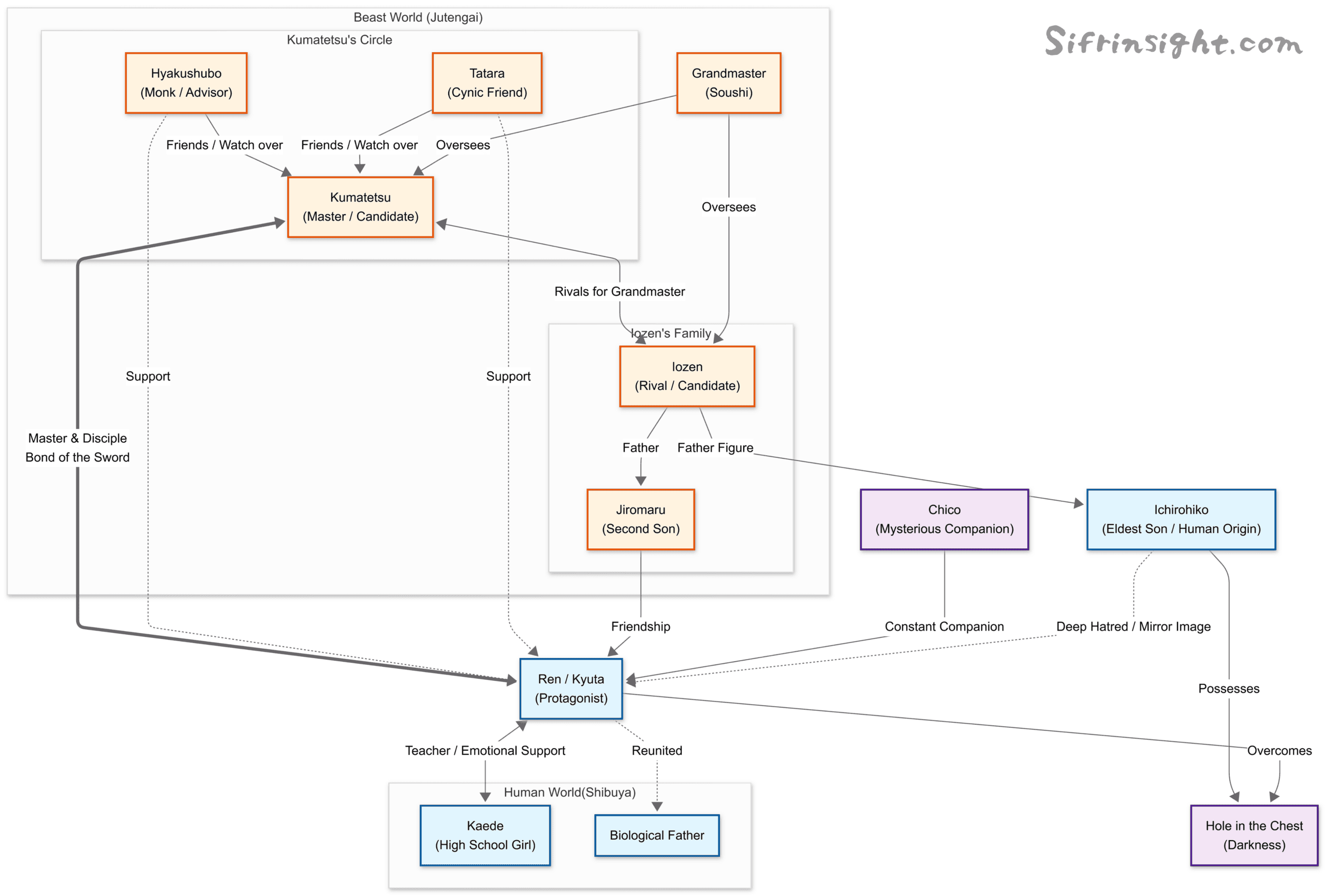
Character Map
The Boy and the Beast (2015): Quick Synopsis (Spoiler-Free)
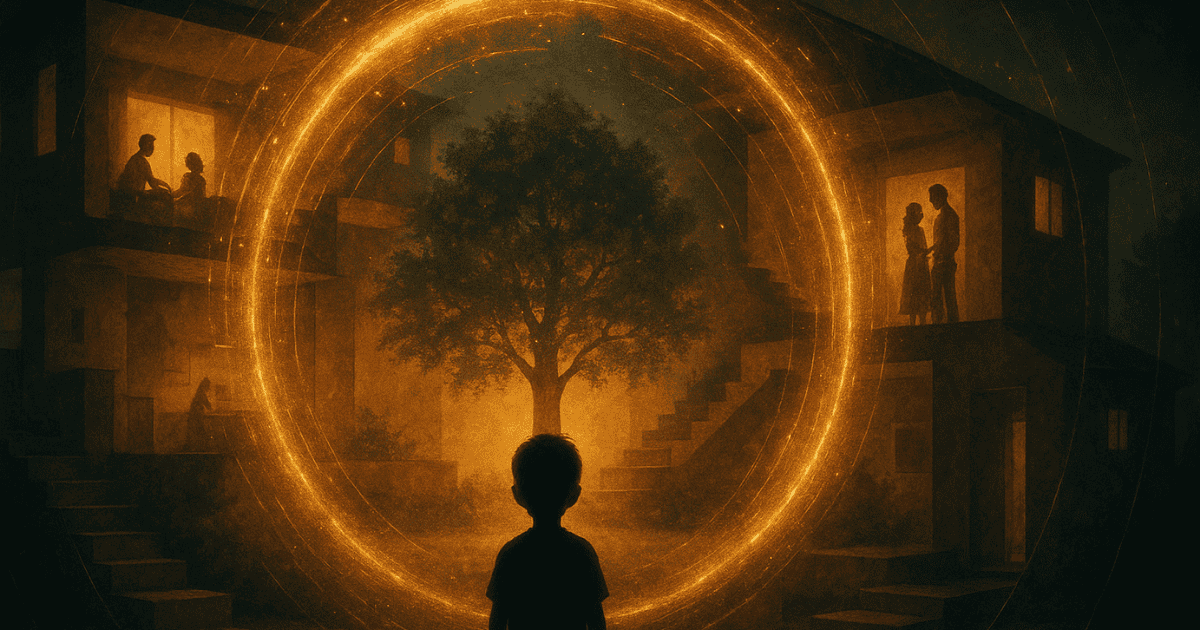
Following his parents’ divorce and the sudden, tragic death of his mother, nine-year-old Ren is consumed by a suffocating loneliness. Furious at his extended family and his absent father, Ren runs away, losing himself in the neon labyrinth of Shibuya’s back alleys.
There, lurking in the shadows, he encounters Kumatetsu—a towering, bear-like beast from a parallel dimension.
“Hey, you. Wanna be my disciple?” Kumatetsu grunts.
Drawn by a strange pull, Ren follows the beast through a hidden maze of alleyways, accidentally crossing the threshold into “Jutengai,” a vibrant realm inhabited entirely by anthropomorphic beasts. Unable to return, Ren is renamed “Kyuta” and begins a bizarre new life as Kumatetsu’s apprentice.
Kumatetsu is vying to succeed the “Grandmaster” as the ruler of Jutengai. While his physical strength is legendary, he is widely despised for his crude behavior and lack of dignity. To qualify for the succession tournament, he must prove he can take on a disciple. The pairing is volatile; Kyuta and Kumatetsu clash constantly, but through their explosive arguments and harsh training, they begin to forge an unbreakable bond, teaching each other what “true strength” really means.
The Boy and the Beast (2015): Full Synopsis & Ending (Spoilers Ahead)

*WARNING: The following section contains major plot spoilers, including the film’s climax and ending. Proceed with caution.
Detailed Synopsis
Ren’s Loneliness and Meeting Kumatetsu
The story opens with nine-year-old Ren reeling from the sudden death of his mother in a traffic accident. With his parents already divorced, Ren is slated to be adopted by his mother’s distant, unsympathetic relatives. Angry at his father’s absence and feeling entirely abandoned by the world, Ren flees into the streets of Shibuya.
While hiding in a dark alley, a tiny, mysterious fluff-ball of an animal named “Chico” nestles into his side, offering a sliver of comfort. Suddenly, a massive, cloaked bear-beast named Kumatetsu, accompanied by his monkey companion Tatara, spots the boy.
Kumatetsu offhandedly offers to make the boy his disciple before disappearing into the crowd. Moments later, pursued by police officers who suspect he is a runaway, Ren dashes into a narrow, winding gap between two buildings, desperately following the beast’s trail.
A New Name in Jutengai: “Kyuta”
Ren emerges from the alleyways into “Jutengai,” a sun-drenched, bustling marketplace populated entirely by beasts. Panicking, he tries to turn back, but the gateway to the human world has vanished.
He is intercepted by a pig-faced monk named Hyakushubo, who attempts to safely return the human child. However, Kumatetsu intervenes, stubbornly declaring that he is taking the boy as his apprentice. Despite the protests of his friends, Kumatetsu drags Ren to his filthy, dilapidated home.
When asked his name, a defensive Ren refuses to answer, claiming it is “personal information.” Annoyed, Kumatetsu learns the boy is nine years old and bluntly dubs him “Kyuta” (derived from kyu, the Japanese word for nine).
Kumatetsu’s Dilemma and a Rocky Apprenticeship
The political climate of Jutengai is tense. The aging “Grandmaster” is preparing to retire and ascend to godhood. He must select a successor who perfectly balances martial prowess with noble dignity. The title will be decided via a grand tournament between the two strongest warriors: Kumatetsu and Iozen.
Iozen is a noble boar-beast with a massive following, pristine manners, and two proud sons. Kumatetsu is a lone wolf—messy, hated by the public, and entirely lacking in dignity. To prove his leadership capabilities, the Grandmaster mandates that Kumatetsu must successfully train a disciple. His previous apprentices all quit within hours due to his unbearable temper.
The morning after taking Kyuta in, Kumatetsu wakes up to an empty house and assumes the boy fled. He is secretly relieved and touched when he finds Kyuta sleeping in the chicken coop.
Their peace doesn’t last. A fierce argument prompts Kyuta to run into the city, where he is intercepted by Iozen. Recognizing Kyuta as a human, Iozen demands the boy be exiled back to the human world. He warns that humans are uniquely susceptible to “darkness in their hearts,” which could bring catastrophe to Jutengai.
Kumatetsu arrives, and a brutal street brawl erupts between the two masters. While the entire crowd cheers for Iozen, Kyuta recognizes the same profound, agonizing loneliness in Kumatetsu that he feels himself. Against the entire city, Kyuta screams in support of Kumatetsu. The Grandmaster interrupts the fight, officially blessing Kyuta’s apprenticeship and accepting full responsibility for the human.
Thus begins Kyuta’s training. Unsurprisingly, Kumatetsu is a catastrophic teacher. He operates entirely on instinct, barking useless, abstract instructions like “Grasp the sword in your heart!” Frustrated by the lack of progress and Tatara’s endless complaining, Kyuta begins mimicking Kumatetsu’s daily movements—footwork, breathing, chores—essentially tricking the beast into teaching him.
The Journey for True Strength and the Time Skip
One day, Kyuta gets into a scuffle with Iozen’s younger son, Jiromaru. Iozen’s older, stoic son, Ichirohiko, effortlessly breaks up the fight using telekinesis. He coldly tells Kyuta, “A weakling like you will never become a monster,” a comment that deeply wounds Kyuta’s pride.
At home, Kyuta criticizes Kumatetsu’s sloppy footwork, sparking another massive blow-up. The Grandmaster intervenes, handing them letters of introduction and ordering Kumatetsu to embark on a pilgrimage to meet the wise grandmasters of other regions to learn what “true strength” is.
Kumatetsu, Kyuta, Tatara, and Hyakushubo travel the realm. They receive abstract, contradictory advice from the various sages. While Kumatetsu dismisses the advice as useless nonsense, telling Kyuta he must “find the meaning himself,” Kyuta quietly absorbs the wisdom.
Upon returning, Kyuta officially begins training by perfectly anticipating and countering Kumatetsu’s movements. This forces Kumatetsu to refine his own sloppy technique. Through this aggressive, mirroring choreography, the two propel each other to new heights.
Eight years pass in a flash of intense training and camaraderie.
Returning to the Human World: Meeting Kaede
Kyuta, now a powerful 17-year-old warrior, inadvertently stumbles upon a portal back to human Shibuya. Exploring the alien world he left behind, he wanders into a public library. He is embarrassed to discover he can barely read basic Kanji.
He is aided by Kaede, a highly intelligent but socially pressured high school girl. She agrees to tutor him. Kyuta begins living a double life, training in Jutengai by day and studying secretly with Kaede by night. She opens his eyes to the vast expanse of human knowledge.
Encouraged by Kaede, Kyuta decides to take the High School Equivalency Exam to reclaim his human identity. However, registering requires his official residency records, which leads him directly to his biological father’s address.
Reuniting with his father, Ren learns a heartbreaking truth: his father didn’t abandon him maliciously. He had been stonewalled by the mother’s relatives and had spent the last eight years desperately searching for his missing son.
Learn more about the legal reality of Ren’s situation:
How Ren Tracked Down His Father Through Residence Records
The Darkness Within and the Clash of Two Worlds
Torn between his two lives, Ren tells Kumatetsu he wants to attend a human university. Feeling betrayed, Kumatetsu explodes in anger, violently forbidding it. Ren storms off to the human world and moves in with his biological father. But the transition is jarring; his father casually suggests they “forget the painful past,” invalidating the eight brutal, beautiful years Ren spent growing up in Jutengai.
Trapped in an agonizing identity crisis—neither fully human nor fully beast—a physical, black void begins to rip open in Ren’s chest. He is manifesting the very “darkness” Iozen warned about.
The Grand Tournament and Ichirohiko’s Betrayal
Ren returns to Jutengai just as the succession tournament begins. He visits Iozen’s home to wish them luck. As he leaves, Ichirohiko escorts him out, but his demeanor turns lethal. Consumed by jealousy and hatred for humans, Ichirohiko attacks Ren. During the clash, Ren realizes with horror that Ichirohiko is also harboring the exact same black “darkness” in his chest.
In the arena, the Grandmaster officially abdicates, and the duel between Kumatetsu and Iozen commences. Distracted and heartbroken by Kyuta’s absence, Kumatetsu is brutally beaten down by Iozen. Just as he is about to lose, Kyuta pushes through the crowd and screams encouragement. Energized by his son’s voice, Kumatetsu rallies, utilizing his refined footwork to spectacularly defeat Iozen.
But the victory is instantly shattered. An enraged Ichirohiko, unable to accept his father’s defeat, unleashes his dark telekinesis, driving a katana straight through Kumatetsu’s back. As Kumatetsu bleeds out, Kyuta’s own darkness threatens to swallow him in a fit of murderous rage, but the calming bite of Chico and the grounding presence of a bookmark Kaede gave him pull him back from the brink.
Iozen reveals the tragic truth: Ichirohiko is actually a human baby he found abandoned years ago. He raised the boy as a beast to protect him, but as Ichirohiko grew and realized he lacked animal traits (like tusks), the psychological dissonance warped into a violent, consuming darkness.
The Climax in Shibuya and a God’s Sacrifice
Knowing Ichirohiko will destroy both worlds, Kyuta pursues him back into human Shibuya to settle the score. Consumed entirely by his darkness, Ichirohiko manifests as a colossal, ghostly spectral whale, tearing through the modern city grid and overwhelming Kyuta.
Back in Jutengai, a dying Kumatetsu drags himself to the Grandmaster. He demands his prize for winning the tournament: he invokes his right to immediately reincarnate into a god so he can save his foolish disciple.
Just as Ren decides to commit a sacrificial suicide by absorbing Ichirohiko’s darkness into himself, Kumatetsu appears in Ren’s soul, reincarnated as a blazing, divine greatsword. Fusing with Kumatetsu’s spirit, Kyuta swings the blade, shattering the spectral whale and purifying the darkness from Ichirohiko’s heart.
The Future They Chose
Ichirohiko awakens safely back in Jutengai, surrounded by his loving adoptive family, free of the darkness and with no memory of his rampage. With Kumatetsu having ascended to godhood, the old Grandmaster reclaims his throne to maintain order.
Having finally reconciled his dual identities, Kyuta permanently returns to the human world as “Ren.” He mends his relationship with his biological father, continues his studies with Kaede, and prepares for his university exams. Though he walks the human path, he is never truly alone—Kumatetsu lives on forever, a fiery, protective presence grasped firmly as the “sword in his heart.”
The Boy and the Beast (2015): Thematic Analysis & Explanations

To truly appreciate Hosoda’s narrative architecture, we must decode the powerful symbols and metaphors running through the veins of The Boy and the Beast.
Explanation 1: The Psychology of the “Hole in the Chest”
The most crucial visual metaphor in the film is the “darkness of the heart,” manifesting as a literal, gaping “hole in the chest.” Crucially, this affliction is entirely unique to humans (specifically Kyuta and Ichirohiko). It is the physical embodiment of existential negative emotions: profound loneliness, identity crisis, jealousy, and self-loathing.
The film brilliantly juxtaposes Kyuta and Ichirohiko, who share identical origin stories—human orphans raised in the beast realm—but wildly divergent outcomes.
Kyuta was raised by a “terrible role model” in Kumatetsu. However, because they constantly argued and forced each other to confront their flaws, Kyuta learned to recognize his own weaknesses. He learned the emotional resilience required to accept his own darkness.
Conversely, Ichirohiko was raised by the “perfect father,” Iozen. But because Iozen lied to him about his humanity in an attempt to protect him, Ichirohiko developed a crippling cognitive dissonance. When he failed to grow fur or tusks like his family, his self-hatred festered in silence, expanding the hole in his chest until it consumed him entirely.
This “darkness” represents the universal insecurities inherent to the human condition. The film posits that acknowledging and accepting our flaws is the only way to conquer them.
Furthermore, Hosoda provides a clear methodology for combating this darkness: “never isolate yourself.” If Ichirohiko had been exposed to honest, abrasive companions like Tatara, Hyakushubo, or Kaede—people who challenge you rather than shield you—he likely would have never succumbed to his inner demons. Human connection, messy as it is, is the ultimate anchor for our sanity.
Explanation 2: The Reincarnation of Kumatetsu
After winning the tournament, Kumatetsu earns the right to become the new Grandmaster. Yet, he immediately throws away the political power he spent years chasing, choosing instead to “reincarnate as a god” strictly to save his surrogate son.
The rules state that a Grandmaster must possess both “martial arts and dignity” to ascend to godhood. For the entire film, Kumatetsu was mocked for having zero dignity. However, through the agonizing, beautiful process of raising Kyuta—and allowing Kyuta to raise him in return—Kumatetsu achieved the highest form of nobility: absolute, selfless sacrifice.
By abandoning his physical body to become a “Tsukumogami” (an artifact spirit), he transforms into Kyuta’s literal “sword in the heart.” He ceases to be a flawed, mortal beast and becomes an eternal, infallible pillar of spiritual strength for his son. It is the ultimate narrative payoff: Kumatetsu’s confusing, abstract lesson to “Grasp the sword in your heart” is finally fulfilled in the most literal, heartbreaking way possible.
Explanation 3: The Symbolism of the Moby Dick Whale
The colossal spectral whale that terrorizes Shibuya in the climax serves a dual purpose. It is the narrative bridge that connects Kyuta to Kaede (through their shared reading of Herman Melville’s Moby Dick), and it is the physical manifestation of Ichirohiko’s corrupted soul.
In Melville’s classic novel, the White Whale represents an invincible, uncontrollable force of nature, serving as the blank canvas upon which Captain Ahab projects his fanatical, self-destructive obsession. Similarly, the whale in the film symbolizes the uncontrollable, chaotic darkness of the human heart—a titanic psychological trial that must be confronted.
Pay close attention to the character design: the spectral whale Ichirohiko transforms into possesses massive tusks. This is a brilliant, tragic detail. The root of Ichirohiko’s madness was his self-hatred over “not being a boar-beast like his father.” His subconscious desperation to be a beast materialized in the form of tusks on his monstrous avatar.
As Kaede notes when analyzing the book, Captain Ahab wasn’t really fighting a whale; he was fighting his own demons. In the climax, the whale is Ichirohiko. He is drowning in a sea of his own making.
In summary, the whale serves as a spectacular cinematic reminder that our own internal identity is often the greatest, most terrifying monster we must ever face.
This concludes our deep dive into the world of The Boy and the Beast. Where Hosoda’s previous triumph, Wolf Children, explored the agonizing sacrifices of motherhood, this film successfully flips the lens to examine the messy, transformative power of the father-son dynamic.
What did you take away from Kumatetsu and Kyuta’s journey? Let us know your thoughts!
If you want to unravel more of the film’s hidden lore, including the spiritual identity of the fluff-ball Chico and why the Grandmaster was secretly biased toward Kumatetsu, check out our extended analysis below.
Dive deeper into the lore here:
Decoding The Boy and the Beast: Chico’s True Identity and the Grandmaster’s Secret



Reader Comments