Wolf Children (Official Website) is a stunning animated feature film directed by the visionary Mamoru Hosoda, released on July 21, 2012. Serving as his first original work following the massive success of Summer Wars, this project also marked Hosoda’s debut as a co-screenwriter, sharing credit with Satoko Okudera.
Spanning 13 emotional years, this film chronicles the profound journey of a young mother, Hana, and her two extraordinary children, Yuki and Ame. Born half-human, half-“Wolfman,” the siblings must navigate the excruciatingly beautiful process of growing up and ultimately choosing their own distinct paths in the world.
This article provides a meticulous, chronological breakdown of Wolf Children. Whether you are looking for a quick spoiler-free summary before watching, or a detailed plot deep-dive (complete with major spoilers) explaining the tragic and triumphant ending, you will find it here.
*This is a translated version. The original (Japanese) is available here.
On this pageContents
Wolf Children: Basic Information

Film Overview
| Release Date | July 21, 2012 |
|---|---|
| Director | Mamoru Hosoda |
| Screenplay | Mamoru Hosoda, Satoko Okudera |
| Character Design | Yoshiyuki Sadamoto |
| Music | Masakatsu Takagi |
| Theme Song | Ann Sally “Okaasan no Uta” (Mother’s Song) |
| Production | Studio Chizu |
| Runtime | 117 minutes |
Main Characters and English Voice Cast
| Character | Voice Actor (English Dub) | Character Overview |
|---|---|---|
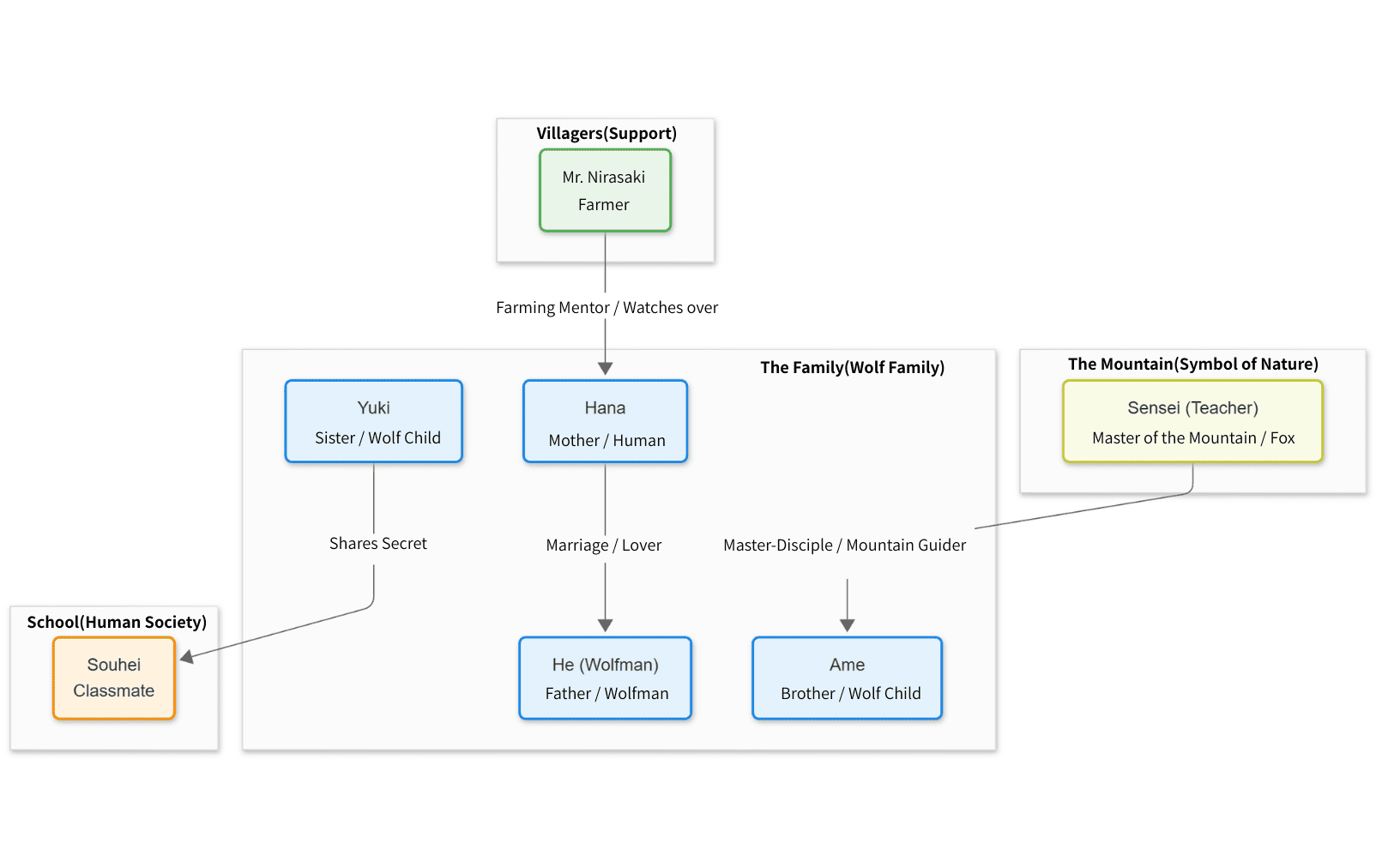
| Hana | Colleen Clinkenbeard | The emotional anchor of the film. She falls deeply in love with the “Wolfman” during college. A fiercely resilient mother who raises two magical children entirely on her own. |
| He (The Wolfman) | David Matranga | The last living descendant of the extinct Japanese wolf. He becomes Hana’s soulmate and the father of Yuki and Ame, but suffers a tragic, premature death. |
| Yuki | Jad Saxton (Teen) Lara Woodhull (Child) |
Hana’s daughter and Ame’s older sister. Born on a snowy day. As a child, she is a feral, hyper-energetic tomboy deeply connected to her wolf instincts. |
| Ame | Micah Solusod (Teen) Alison Viktorin (Child) |
Hana’s son and Yuki’s younger brother. Born on a rainy day. Initially a fragile, introverted child who is terrified of his own wolf heritage. |
| Nirasaki | Jerry Russell | An elderly, gruff farmer in the remote village where Hana relocates. Despite his sharp tongue, he becomes a vital mentor, teaching Hana how to survive off the land. |
| Souhei | Jason Liebrecht | A perceptive transfer student who joins Yuki’s elementary school class. He becomes intimately, and dangerously, entangled in Yuki’s darkest secret. |
Character Map
Wolf Children: Quick Synopsis (Spoiler-Free)
The story begins with our protagonist, Hana, navigating life as a hardworking university student on the outskirts of Tokyo. Juggling grueling part-time jobs and academic scholarships, her routine is upended one early summer day when she notices a mysterious man auditing her class.
He attends lectures without a textbook, and Hana’s simple offer to share her notes sparks a profound romance. Eventually, he reveals his impossible secret: he is a “Wolfman,” the last surviving descendant of the Japanese wolf. Undeterred by this revelation, Hana’s love only deepens, and the two forge a beautiful life together.
Their union brings two “wolf children” into the world: a fiery daughter named Yuki (Snow), and a timid son named Ame (Rain). But their fragile domestic bliss is violently shattered when the Wolfman goes out hunting on a rainy day and never returns, leaving Hana completely alone.
Devastated but resolute, Hana vows to raise her children in secret. However, managing toddlers who involuntarily transform into destructive wolf cubs whenever they throw a tantrum proves impossible in a cramped Tokyo apartment. Cornered by suspicious neighbors and threatening visits from child welfare services, Hana makes a desperate choice. She packs up her family and moves to a dilapidated house deep in the remote countryside, giving her children the ultimate freedom to choose their own destiny: to live as humans, or to run wild as wolves.
*WARNING: The following section contains a highly detailed plot breakdown, including massive spoilers and the film’s emotionally devastating conclusion.
Wolf Children: Full Synopsis & Ending (Spoilers Ahead)

The narrative unfolds as an intimate retrospective, narrated by the adult daughter, Yuki, looking back on her mother’s monumental sacrifices.
Part 1: A Magical Romance and a Devastating Loss
Hana is a relentlessly optimistic university student in Tokyo, struggling to pay tuition through a web of part-time jobs. Her life changes forever when she spots a rugged, solitary man auditing her class. Wearing a stretched-out T-shirt and taking diligent notes without a textbook, “He” radiates an aura completely alien to the typical student body.
When Hana catches him slipping out without turning in an attendance card, he coldly brushes her off, claiming he isn’t officially enrolled. But Hana’s persistent kindness breaks down his walls. She offers to share her textbook, and a quiet, profound romance blossoms.
On Christmas Eve, “He” finally entrusts Hana with his ultimate secret. Under the moonlight, he transforms into a majestic wolf. He shatters the Hollywood myths of full moons and bloodlust, explaining he is simply the last mixed-blood survivor of the extinct Japanese wolf. He had lived his entire life in the shadows—until he met Hana.
Hana accepts his true nature without a shred of hesitation. They build a life together in her cramped apartment, and soon, Hana becomes pregnant. Knowing they cannot risk a hospital delivery exposing their child’s nature, they opt for a terrifying, unassisted home birth. They welcome a vibrant baby girl, Yuki, and the following spring, a quiet baby boy, Ame.
But tragedy strikes with cruel suddenness. On a torrential rainy day, “He” goes out to hunt pheasant for his recovering wife. Hana later discovers his lifeless body in a city canal, trapped in his wolf form and being unceremoniously scooped into a garbage truck. The exact circumstances of his death are never fully explained, leaving Hana shattered.
Part 2: Escape to the Mountains
Left entirely alone to raise two hybrid infants, Hana’s life becomes a waking nightmare. She isolates herself, desperately reading parenting books alongside dense veterinary encyclopedias.
The stress is suffocating. The children spontaneously morph into wolves whenever they are angry, hungry, or sick. Hana faces eviction due to their nocturnal howling, and when she avoids taking them to pediatricians to hide their secret, child protective services begin knocking on her door. Realizing the city is a death trap, Hana makes the ultimate sacrifice: she abandons modern convenience and relocates her family to a desolate, rural mountain village.
Their new home is a dilapidated, rotting farmhouse completely isolated from society. While the house requires backbreaking labor to repair, it offers the one thing they desperately need: safety. Here, Ame and Yuki can finally run through the forests in their wolf forms without fear of discovery.
However, Hana’s savings rapidly evaporate. She attempts to become self-sufficient by farming the barren land, but her crops repeatedly wither and die. Her desperate, failing efforts eventually catch the eye of Nirasaki, a terrifyingly gruff 90-year-old neighboring farmer. Refusing to watch her starve, he essentially forces her into a brutal agricultural boot camp, teaching her how to properly till the harsh soil.
Through Nirasaki’s tough love, the other villagers slowly warm up to the strange single mother. They bring her seed potatoes, share farming equipment, and offer quiet support. For the first time since her husband’s death, Hana finds a community.
Part 3: The Diverging Paths (Yuki’s Struggle)
During a brutal winter, while the family is playing in the snowy mountains, a massive shift occurs. Ame, previously terrified of nature, accidentally falls into an icy river while hunting a kingfisher. Though Yuki saves him, the near-death experience acts as a profound catalyst, slowly awakening Ame’s dormant, fearless wolf instincts.
When spring arrives, Yuki makes a demanding request: she wants to attend the local elementary school. Terrified of exposure, Hana initially refuses, but eventually relents, drilling a mantra into Yuki: “Be a human girl.”
Yuki’s integration into human society is chaotic. Her feral, tomboyish instincts—collecting dead animal bones and keeping reptiles as pets—horrify the other girls. Desperate to fit in, Yuki consciously suppresses her wolf nature. Empowered by a beautiful new dress her mother sews for her, she successfully pivots, adopting a highly feminine, “human” persona to gain social acceptance.
But the facade cracks in 4th grade when a perceptive boy named Souhei transfers to her class. Souhei immediately notices the “scent of a beast” on Yuki, constantly asking if she owns a dog. Terrified that he has exposed her, Yuki aggressively avoids him. When Souhei corners her out of frustration, Yuki’s suppressed instincts violently explode. She partially transforms, slashing Souhei’s ear with her claws, leaving him bleeding profusely.
The incident is a disaster, resulting in a tense meeting between the parents. However, in a shocking twist, Souhei protects Yuki. He lies to his furious mother and the teachers, claiming a “stray wolf” attacked him. Crushed by guilt, Yuki refuses to return to school. Souhei, feeling responsible for pushing her, visits her house every single day to drop off homework. Eventually, his quiet persistence breaks her guilt, and she returns to class.
Part 4: The Call of the Wild (Ame’s Awakening)
While Yuki successfully assimilates into human society, Ame’s trajectory violently reverses. Enrolling a year after his sister, the once-timid boy finds the human classroom suffocating and irrelevant. By 3rd grade, he begins chronically skipping school, drawn entirely to the deep mountains.
Concurrently, Hana takes a job as an assistant at a local nature conservation center. This allows Ame access to a captive timber wolf kept in a small enclosure. Staring into the cage, Ame is profoundly disturbed by the tragic, broken spirit of the confined beast.
Rejecting the human world entirely, Ame ventures deeper into the wilderness, eventually apprenticing himself to an entity he calls “Teacher”—an ancient, majestic red fox who serves as the apex guardian of the mountain range.
The ideological chasm between the siblings reaches a boiling point. During a terrifying, violent brawl that destroys their home, Yuki screams, “I am human!” while Ame roars, “I am a wolf!” Ame, who used to cower behind his sister, easily overpowers her. The sibling dynamic is permanently shattered.
Conclusion: The Final Storm and a Mother’s Letting Go
In the summer of Yuki’s 6th-grade year, a catastrophic typhoon slams into the region. The ancient fox “Teacher” has suffered a severe leg injury, leaving a massive power vacuum in the ecosystem. Ame knows he must step up to become the new guardian of the mountain. Sensing she is losing her son, Hana begs him, “Don’t go to the mountain anymore,” and locks him inside.
But as the storm reaches its apocalyptic peak, Ame’s instincts cannot be contained. He shifts into his adult wolf form and vanishes into the raging tempest. Panicked and terrified, Hana plunges into the deadly mountains to find him. She slips down a muddy ravine, knocking herself unconscious in the freezing rain.
Simultaneously, a different emotional climax occurs at the school. Yuki and Souhei are trapped in the gymnasium waiting out the storm. In the quiet dark, Souhei confesses his own deep insecurities about his mother’s remarriage. Moved by his vulnerability, Yuki finally drops her facade. She transforms into a wolf, confessing the truth of her attack. Souhei simply smiles and says, “I’ve known all along.” He promises to keep her secret forever, fully accepting her.
Back in the mountains, Hana wakes up in a parking lot at dawn. She was rescued and carried out of the ravine by Ame. She opens her eyes just in time to see Ame, fully transformed into a magnificent adult wolf, preparing to disappear into the deep forest forever.
Hana desperately cries out, begging him to stay, sobbing that she “hasn’t done anything for him yet.” But as Ame pauses, turns back, and unleashes a triumphant, echoing howl into the rising sun, Hana realizes the truth: he doesn’t need her protection anymore. Through her tears, she smiles and screams her final blessing: “Live a full life!”
The epilogue reveals the aftermath. Yuki leaves the mountain village to attend a junior high school in a bustling dormitory, fully embracing her human identity. Ame has claimed his birthright, ruling as the unseen guardian of the mountains. And Hana? She remains in the quiet, empty farmhouse, listening to the distant howling of the wind, fiercely proud of the two incredible lives she nurtured.
Wolf Children: The Ending Explained (Themes & Analysis)
While the film is widely celebrated as a breathtaking “story of a mother’s sacrifice,” its psychological core runs much deeper. It is an exploration of identity, nature versus nurture, and the excruciating pain of letting go.
The Brilliant Reversal of Identities
The narrative brilliance of Wolf Children lies in the total inversion of the siblings’ identities as they age.
- Yuki (The Wolf who became Human): As a toddler, Yuki is a chaotic force of nature, constantly transforming and chasing prey. Yet, when thrust into the human hierarchy of elementary school, her desire for social acceptance overrides her genetics. Through trauma (the attack) and eventual unconditional acceptance (Souhei), she actively chooses to bury her wolf half and assimilate into humanity.
- Ame (The Human who became Wolf): Ame is introduced as a sickly, crying infant who hates the woods and clings to his mother’s human comforts. But his failure to integrate into the rigid structure of human schooling pushes him toward the wilderness. Guided by the fox “Teacher,” he discovers a brutal, authentic freedom in nature that human society could never offer.
This perfect cross-trajectory makes the film an absolute masterclass in character development.
Ame’s Choice: The Brutal Reality of Independence
The apocalyptic typhoon at the climax serves as the ultimate crucible for the characters. Ame’s decision to abandon his mother and claim the mountain is heartbreaking, especially considering he is chronologically only 10 years old.
However, biologically and spiritually, he has matured into an adult wolf. His instincts have vastly outpaced his human age. When he walks away from a begging, sobbing Hana, it is a devastating but necessary metaphor. It represents the brutal, inevitable moment every parent must face: when a child rejects their protection to forge their own destiny in a world the parent cannot enter.
Yuki’s Choice: The Courage to be Vulnerable
While Ame conquers the physical storm, Yuki conquers an emotional one. Trapped in the school, her decision to reveal her wolf form to Souhei is an act of ultimate vulnerability.
She has spent years suppressing her true nature out of fear and guilt. When Souhei casually accepts her monstrous side, he heals her deepest trauma. This unconditional acceptance gives her the psychological permission she needs to permanently leave the safety of her mother’s mountain and confidently enter human society.
Hana’s Final Tears: The Ultimate Parenting Victory
The emotional crescendo of the film is Hana’s realization in the parking lot. She has lost her husband, sacrificed her youth, destroyed her body with farm labor, and now, she is losing her children.
When she screams, “Live a full life!” to the departing wolf, she is achieving the ultimate, bittersweet goal of parenting. She realizes that her job was not to keep them safe forever, but to make them strong enough to leave her. The tears she sheds at the end of the film are not tears of tragedy; they are tears of profound relief and staggering triumph. She survived the impossible, and her children are free.
This concludes the deep dive into the heartbreaking beauty of Wolf Children. If you want to explore the philosophical subtext of this film even further, check out our dedicated analysis piece below.
Explore the philosophical themes here: The Invisible Themes of Wolf Children: Nature, Nurture, and Sacrifice

Reader Comments