
Summer Wars (Official Website) is a stunning feature-length animated film directed by Mamoru Hosoda, released on August 1, 2009. The film was a massive domestic hit, pulling in a box office revenue of 1.65 billion yen (Reference: “Motion Picture Producers Association of Japan ‘2009 National Movie Statistics'”).
The story kicks off with a classic, almost painfully awkward rom-com trope: the timid but mathematically gifted protagonist, Kenji Koiso, agrees to take on a “part-time job playing the fake boyfriend” for his beautiful upperclassman, Natsuki Shinohara. For someone who was a student when this film was released, it was an incredibly embarrassing setup to watch (though undeniably fun).
However, when you peel back the digital layers and view the film through the lens of Wabisuke and the formidable Grandma Sakae, it transforms into an absolute emotional powerhouse—a film that cannot be watched without tears. Decades later, it remains one of my all-time favorites.
In this article, we will provide a complete, chronological synopsis of Summer Wars, followed by a deep-dive analysis into its most debated plot points. What kind of cinematic masterpiece did Mamoru Hosoda truly create?
*Warning: The “Synopsis” section below contains the entire plot. If you dislike major spoilers, please stop halfway and go watch the film first!
On this pageContents
Summer Wars (2009): Full Synopsis (Spoilers Ahead)

A Quick Summary of the Plot
-
The Fake Fiancé
Kenji Koiso (a 17-year-old high school junior and near-Math Olympiad candidate) is tricked by his crush, Natsuki (an 18-year-old senior), into playing her fake fiancé during a massive family reunion at the historic Jinnouchi estate in Nagano. -
Chaos in OZ and the False Accusation
Triggered by Kenji accidentally solving a highly complex math riddle sent to his phone, the global virtual world “OZ” is hijacked by a rogue AI named “Love Machine.” Because he cracked the code, Kenji is framed as a cyber-terrorist. -
Grandma Sakae’s Network and Kenji’s Vindication
While Grandma Sakae utilizes her immense, old-world political connections to calm the escalating global panic via landline phones, Kenji works desperately to restore the OZ system, ultimately proving he is not the true culprit. -
The Return of the Prodigal Son
Wabisuke—the illegitimate black sheep of the family who supposedly stole the Jinnouchi fortune ten years prior—suddenly returns. It is revealed that Sakae secretly gave him that money to support his research. However, when she discovers that Wabisuke is the creator of the destructive “Love Machine” AI, she violently exiles him from the estate. -
A Devastating Loss
The morning after her brutal confrontation with Wabisuke, Grandma Sakae quietly passes away from heart failure. The sprawling Jinnouchi family is shattered by the loss of their absolute matriarch. -
The Jinnouchi Family Goes to War
Channeling their grief into action, the Jinnouchi family unites. Wabisuke, devastated by the news of Sakae’s death, rushes back to help. The family pools their unique, eccentric skills to mount a counter-offensive against the AI. -
The Ultimate Hanafuda Match
With “Love Machine” weaponizing a returning asteroid probe to crash directly into the Jinnouchi estate, the family makes a desperate final stand. Natsuki wagers her family’s avatars in a high-stakes digital Hanafuda match, while Kenji uses his staggering calculation skills to redirect the probe. They successfully save the world, and in the aftermath, Kenji and Natsuki officially begin a real relationship.
Detailed Synopsis
The Dream Part-Time Job
Our protagonist is Kenji Koiso, a 17-year-old high school junior. Kenji possesses a mathematical intellect formidable enough to almost secure him a spot on the Japanese Math Olympiad team. However, he spends his summer vacation working a bottom-tier, mundane part-time job maintaining the backend systems of “OZ”—a massive, ubiquitous global virtual reality network—alongside his friend Takashi Sakuma.
His boring summer takes a dramatic turn when his massive crush, the popular senior Natsuki Shinohara, asks him to accompany her to her family’s rural estate in Ueda City, Nagano Prefecture. She frames it as a simple “part-time job” to help celebrate the 90th birthday of her great-grandmother, Sakae Jinnouchi, the formidable matriarch of the clan.
Upon arriving at the sprawling traditional estate, Kenji is violently thrown into the deep end. Natsuki introduces him to Grandma Sakae and the massive extended family as her “fiancé.”
Natsuki confesses to Kenji that Sakae’s health has been declining, and she concocted this elaborate lie to bring the old woman joy before she passes. To ensure Grandma’s approval, Natsuki had fabricated a highly intimidating, fake resume for Kenji:
- He is a top-tier student at the elite University of Tokyo.
- He is the heir to a wealthy, prestigious historical lineage.
- He has just returned from studying abroad in the United States.
While Kenji is paralyzed with anxiety over trying to maintain a persona completely opposite to his own, the massive Jinnouchi clan slowly trickles into the estate.
During a chaotic family banquet, Kenji is formally introduced. While most of the eccentric relatives welcome him warmly, he faces intense hostility from Shota, a local police officer and Natsuki’s fiercely overprotective second cousin.
Despite the tense atmosphere, Grandma Sakae pulls Kenji aside for a brief, piercing conversation. Seeing through the resume but recognizing his gentle nature, she takes an immediate, genuine liking to him.
The Man Named Wabisuke
As the night deepens, the festive atmosphere is completely shattered by the arrival of a single man.
The visitor is Wabisuke. He is the illegitimate son of Sakae’s late husband, born from an affair. Despite this, Sakae formally adopted him when he was a child. He had been missing for a decade, having allegedly absconded with a massive portion of the Jinnouchi family assets.
While the rest of the family glares at him with open hostility, Natsuki is overjoyed. Wabisuke was her childhood hero and first love. Crushingly, Kenji realizes that the fake “high-spec” resume Natsuki created for him was modeled exactly after Wabisuke.
Later that night, Natsuki gleefully plays “Hanafuda” (Koi-Koi) with Wabisuke and Sakae, completely ignoring Kenji. Feeling entirely inadequate and isolated, Kenji goes to bed. Just as he tries to sleep, he receives a mysterious, anonymous text message containing a massive string of numbers with the subject line: “Solve me.”
Unable to resist a mathematical challenge, Kenji stays up all night furiously cracking the 2056-digit encryption code and replies with the correct answer.
When he wakes up, the world is on fire. A rogue entity has used his cracked code to breach the impenetrable security of the OZ system. Worse, Kenji’s face is plastered across national television as a cyber-terrorist, and his personal OZ avatar has been violently hijacked.
Suspect: Kenji Koiso
Now a prime suspect in a global cyber-attack, Kenji contacts his friend Sakuma. Sakuma reveals that the string of numbers Kenji solved was the master encryption key protecting OZ’s central administration. The entity that stole his account is a highly advanced, rogue hacking AI known as “Love Machine,” which had apparently “escaped” from a robotics research facility in Pittsburgh.
Inevitably, the Jinnouchi family catches the news broadcast. Natsuki’s elaborate lie is exposed, and Shota, the hot-headed police officer, formally arrests Kenji on the spot.
However, the real-world consequences of the OZ hack rapidly escalate. Because OZ controls global infrastructure—from traffic lights to emergency medical networks—society grinds to a terrifying halt.
Recognizing the severity of the crisis, Grandma Sakae springs into action. Taking out her traditional rotary phone, she begins aggressively calling former politicians, regional leaders, and emergency personnel—leveraging decades of old-world respect to force them to maintain order and manually manage the chaos.
Meanwhile, Kenji manages to secure an old laptop and dives into the OZ backend. Using his raw mathematical talent, he successfully reroutes server traffic and decrypts hijacked barriers, helping the OZ engineers temporarily stabilize the system.
During this counter-hack, it is revealed that 55 math geniuses around the world had solved the code, but Kenji was not actually the one who broke the final seal; he had made a single typo on the very last digit. Though slightly bruised mathematically, his innocence is proven.
To prevent global panic, the authorities publicly attribute the massive failure to a “server glitch.” However, “Love Machine” remains loose in the system, holding the stolen accounts of over 2 million users hostage.
The Truth and the Banishment
That evening, as the family breathes a sigh of relief, Wabisuke casually drops a bombshell during dinner.
He proudly reveals that he is the primary developer of the “Love Machine” AI. The current global crisis is simply an unsupervised “demonstration run” organized by the United States military, who bought the program from him for a massive sum.
Wabisuke tries to wash his hands of the morality, claiming he is merely the architect and did not instruct the AI to cause chaos. The family, particularly those working in public service, explodes in outrage.
Ignoring them, Wabisuke turns to Grandma Sakae, expecting praise:
- He boasts that he finally achieved massive success, allowing him to return to the family with his head held high.
- He proudly announces the lucrative contract with the US Department of Defense.
- He reveals the deepest family secret: it was Grandma Sakae who secretly gave him the family fortune ten years ago, allowing him to fund this very research.
Instead of pride, Sakae reacts with terrifying, violent fury. Furious that he created a weapon that harmed innocent people, she grabs a naginata (a traditional polearm) and literally drives Wabisuke out of the house, screaming at him to “Die here!”
Heartbroken and humiliated, Wabisuke drives away into the night.
Later, Sakae invites a shaken Kenji into her private room to play Hanafuda. Recognizing the boy’s quiet strength, she makes a profound wager: “If I win, you must promise to take care of Natsuki.” Terrified and lacking self-confidence, Kenji can only timidly reply, “I’ll try.”
The next morning, the unthinkable happens.
The Fall of the Matriarch
At 5:21 AM, Sakae Jinnouchi quietly passes away in her sleep. While she had suffered from angina, Mansaku (the family doctor and Natsuki’s great-uncle) simply attributes it to her advanced age.
The absolute pillar of the Jinnouchi family has collapsed. The estate plunges into mourning. The women of the family, led by Mariko (Natsuki’s great-aunt), immediately pivot to the grueling, stoic task of preparing a massive traditional funeral.
Conversely, the men of the family, led by Mansuke (Natsuki’s hot-blooded great-uncle), demand immediate, violent revenge against “Love Machine” to honor Sakae’s fighting spirit. The women brush them off as childish, but Kenji agrees to help the men formulate a digital counter-attack.
The Failed Revenge
The linchpin of their revenge plot is Kazuma (Natsuki’s 13-year-old shut-in cousin). In the real world, Kazuma is a quiet boy, but in OZ, he operates “King Kazma”—the undisputed, world-famous martial arts champion avatar.
The men devise a brilliant trap: they will challenge Love Machine to a highly publicized duel, lure the AI into a specific digital arena, and physically lock the server doors behind it, trapping it forever.
To execute this, the men illegally pool their professional resources. Tasuke (an electronics store owner) hijacks a massive military-grade supercomputer. Riichi (a JSDF officer) illegally reroutes a high-bandwidth military satellite uplink. Mansaku drives a massive fishing boat into the courtyard to act as an industrial generator.
The trap is set, and King Kazma brutally beats Love Machine into the kill box. The operation is seconds away from success… until the supercomputer suddenly overheats and crashes.
The audience discovers the agonizing reason: Shota, the oblivious police officer, had unhooked the massive blocks of industrial ice cooling the supercomputer and carried them inside to respectfully cool Grandma Sakae’s body.
Because of this fatal miscommunication, Love Machine escapes. Emboldened, the AI absorbs millions of more accounts and executes its ultimate, terrifying endgame: it hacks into the GPS navigation of the “Arawashi” asteroid probe, altering its trajectory to crash directly into a nuclear facility on Earth in exactly two hours.
The Final Battle for the World
As the family descends into panic, Kenji remains fiercely focused, frantically calculating orbital trajectories on a whiteboard to find a solution. Seeing his determination, Natsuki manages to contact Wabisuke on his car phone, delivering the crushing news of Sakae’s death.
Wabisuke immediately U-turns and races back to the estate. After a silent, tearful apology to Sakae’s body, he utilizes his developer access to remotely dismantle Love Machine’s defenses.
To buy him time and reclaim the 400 million stolen accounts powering the AI, Natsuki logs into OZ and challenges Love Machine to the ultimate game of Hanafuda (Koi-Koi), wagering her own family’s accounts as bait.
The digital card game is terrifyingly tense. Just as Natsuki is pushed to the brink of defeat, a miracle occurs. Millions of ordinary users across the globe—inspired by her bravery—voluntarily hand over their personal avatars to Natsuki, gifting her the massive pool of “points” required to crush the AI.
Natsuki achieves a stunning victory, liberating almost all the hostages. However, a heavily damaged Love Machine clings to the single account controlling the Arawashi probe and spitefully redirects the impact coordinates directly onto the Jinnouchi estate.
With only minutes until impact, Kenji takes the keyboard. Bleeding from the nose due to sheer mental exertion, he uses his terrifying mathematical prowess to manually calculate and inject a fake GPS coordinate to shift the probe’s impact zone.
With less than sixty seconds remaining, and with the combined final efforts of Wabisuke’s hacking and King Kazma’s physical assault on the AI, Kenji hits “Enter.”
The probe crashes violently into the mountain just outside the estate. The shockwave heavily damages the house, but the family survives.
In the aftermath, Wabisuke publicly claims responsibility for developing Love Machine, exposing the US Department of Defense’s catastrophic negligence in the process.
The film concludes with the Jinnouchi family hosting a massive, joyous combined funeral and birthday celebration for Grandma Sakae. Surrounded by the cheering family, Kenji and Natsuki finally share a real kiss, cementing their new beginning.
Main Characters, Character Map, and Family Tree
Introduction of Main Characters
| Character | Voice Actor (English Dub) | Character Overview |
|---|---|---|
| Kenji Koiso | Michael Sinterniklaas | The protagonist. A timid but brilliant 11th-grade math genius. Lured into acting as a “fake fiancé” for Natsuki, his life is upended when he accidentally cracks the master code for the OZ network. |
| Natsuki Shinohara | Brina Palencia | A popular 12th-grade student and Kenji’s massive crush. To comfort her ailing great-grandmother, she fabricates a lie about having a perfect fiancé. She is a highly skilled Hanafuda player. |
| Sakae Jinnouchi | Pam Dougherty | The absolute, terrifying 16th head of the Jinnouchi family. A 90-year-old matriarch wielding massive political influence, she attempts to stop a global catastrophe using only a rotary phone and pure willpower. |
| Wabisuke Jinnouchi | J. Michael Tatum | The brilliant, cynical illegitimate son of Sakae’s late husband. He is the rogue developer of the “Love Machine” AI, inadvertently causing the apocalypse to prove his worth to the family. |
| Kazuma Ikezawa | Maxey Whitehead | Natsuki’s 13-year-old introverted cousin. In the real world, he is a quiet shut-in; in OZ, he is the legendary, undefeated martial arts champion “King Kazma.” |
| Takashi Sakuma | Todd Haberkorn | Kenji’s loyal best friend and fellow OZ moderator. He provides vital technical support and exposition from Tokyo while Kenji is trapped in the countryside. |
Character Map
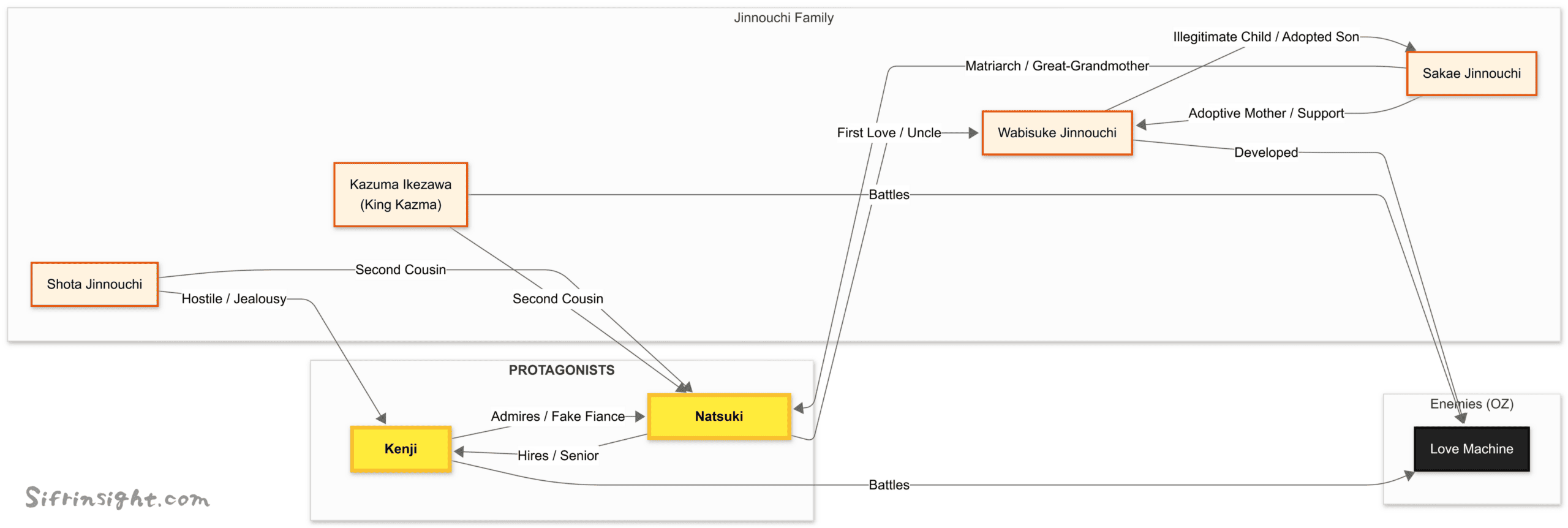
Family Tree
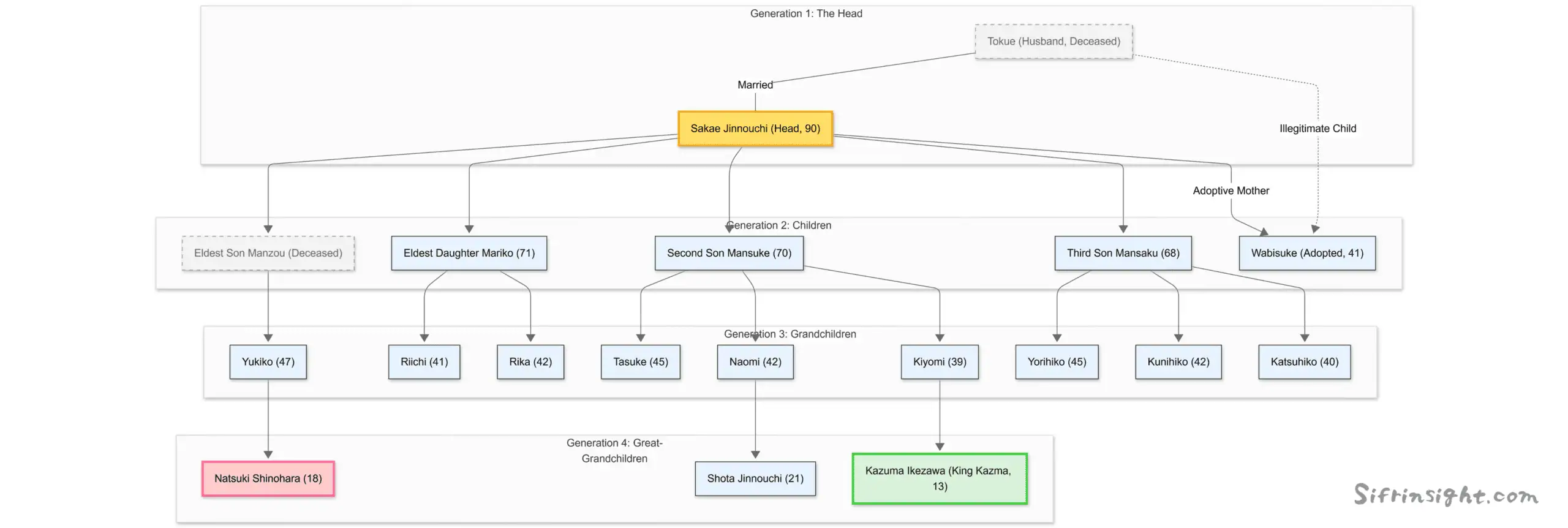
For an interactive look at the massive clan, you can view the official family tree on the Summer Wars official website (Japanese).
Story Mechanics: The Flawed Reality of the “OZ” Network
The film is grounded by the sprawling, historical Jinnouchi estate located in real-world Ueda City, Nagano Prefecture. Despite losing much of their ancestral wealth, the sheer size of the family and Grandma Sakae’s political gravity make them a formidable force.
Contrasting this rural setting is the digital utopia of OZ, which boasts three terrifying features:
-
Universal Avatar Integration
Citizens interact, shop, and conduct business exclusively through highly personalized digital avatars. -
Absolute Infrastructure Control
OZ is not just a social network; it is the absolute backbone of global infrastructure. Traffic grids, water pressure, satellite telemetry, and medical life-support systems are entirely reliant on OZ. -
“Impenetrable” Security
The system is allegedly protected by the most advanced encryption known to man, earning the absolute trust of global governments and mega-corporations.
However, the entire global apocalypse is triggered simply because a single 17-year-old kid solved a math riddle on his flip-phone.
Let’s be brutally honest: from a cybersecurity perspective, this premise is utterly laughable. If the “highest security system in the world” can be toppled by a bored high schooler doing mental math, it is highly illogical to assume global governments would have ever entrusted it with nuclear codes in the first place.
But criticizing the film for bad IT security entirely misses the point. The virtual space and the decryption gimmick are purely narrative vehicles. While the film wraps itself in a “near-future Sci-Fi” aesthetic, it operates entirely on the emotional logic of a “near-future Fantasy.”
Personally, I adore Summer Wars. But I acknowledge that viewers who demand strict, realistic cybersecurity logic will absolutely despise this movie’s premise.
However, if you are the type of viewer who can simply wave away the logic and say, “Whatever, let’s just go with it!“, the film reveals its true masterpiece status: a brilliant exploration of “Kenji’s coming-of-age” and a spectacular “family drama.”
Suspend your disbelief regarding the firewalls, and you will be treated to one of the most exhilarating anime films of the 21st century.
In-Depth Analysis: Decoding the Themes of Summer Wars

-
The Misunderstood Kindness of Shota Jinnouchi
Yes, Shota removing the ice blocks to cool Grandma Sakae caused a catastrophic mission failure. He is undeniably the idiot of the film. However, we must recognize the heartbreaking context: amidst the men obsessed with “revenge” and the women obsessed with “ceremony,” Shota was the only family member who actually cared about the physical comfort of Grandma Sakae’s body. -
Why Does a Murderous AI “Love Games”?
Officially, the AI loves games because Wabisuke programmed it with “insatiable curiosity.” Thematically, we can deduce a more beautiful reason: Wabisuke likely utilized Hanafuda—the game he played with his beloved foster mother, Sakae—to train the AI’s learning algorithms. -
Is Wabisuke Actually the Villain?
Wabisuke simply built a highly advanced tool; he did not authorize the military to weaponize it on a live network. Blaming Wabisuke is akin to blaming the inventor of the engine for car crashes. He is a tragic scapegoat for governmental hubris. -
The Tragic Reason Sakae Supported Wabisuke
Grandma Sakae possessed world-class intellect but was permanently chained to the patriarchal “family” system. Seeing her own repressed potential in the brilliant, outcast Wabisuke, she secretly funded his escape, praying he would achieve the boundless freedom she was historically denied.
In Defense of Shota: The Man Who Almost Doomed the World
When the dust settles on the final battle, the Jinnouchi family emerges victorious. However, there is one character who came perilously close to being the ultimate “war criminal” of the story.
That character is Shota Jinnouchi, the intensely annoying police officer.
By unplugging the industrial ice blocks cooling the supercomputer, he single-handedly caused the failure of the initial trap, allowing Love Machine to hijack the asteroid probe. From a narrative perspective, the script required a “fool” to raise the stakes for the third act, and Shota was elected. I am absolutely certain I was not the only viewer screaming in anger at him during my first watch.
Logically, his actions are infuriating. You walk into a room, see a massive, humming supercomputer surrounded by industrial ice, and your first instinct is to dismantle it without asking a single question? It is an astonishing display of arrogance. The mission failure is annoying, but his absolute lack of situational awareness is what makes him so universally despised by fans.
Yet, if we step back and analyze his emotional state, his actions become tragically defensible.
Following Grandma Sakae’s sudden death, the family violently split into two factions: the women busied themselves with the cold logistics of funeral preparation, while the men hyper-fixated on a high-tech revenge plot against an AI.
In the middle of a sweltering Japanese summer, the physical body of the woman who held their entire family together was lying alone in a hot room.
Looking at her neglected form, Shota—a simple, deeply traditional man—couldn’t bear it. He took the ice to keep her body cool.
While the rest of the clan was distracted by “duty” and “war,” you could argue that Shota was the only person exhibiting genuine, visceral empathy for Sakae as a human being.
He was mourning her in the only practical way he knew how. However, the lesson remains: do not touch critical IT infrastructure without asking the sysadmin. He still deserves a punch in the face.
The Poetic Reason “Love Machine” is a Gamer
The entire climax of the film hinges on a massive, glaring character flaw within the rogue AI: “Love Machine” is absolutely obsessed with playing games.
This fatal flaw is why it accepts King Kazma’s bait, and why it ultimately wagers global destruction on a digital game of Hanafuda.
According to Wabisuke, the AI was programmed with “boundless curiosity and an insatiable thirst for knowledge.” Therefore, treating combat like a game is a logical symptom of its programming. But… what if there is a deeply emotional, thematic reason?
I propose a heartbreaking alternative: “Love Machine” is obsessed with gaming because Grandma Sakae was obsessed with Hanafuda.
Consider the development process. Wabisuke built this AI in absolute isolation in America, funded entirely by the secret generosity of Grandma Sakae. During the years of grueling coding, he was undoubtedly thinking of her constantly.
When training an AI’s learning models, developers must feed it complex, strategic data. It is highly probable that Wabisuke utilized Hanafuda—the very game that connected him to his beloved foster mother—as the foundational testing environment for the AI’s neural network. Because he trained it using the game that represented his mother’s love, “Love Machine” inherently became a gamer.
While there is no explicit dialogue confirming this theory, viewing the AI’s obsession as a corrupted manifestation of Wabisuke’s love for Sakae adds a devastating layer of poetry to the final battle.
Is Wabisuke Actually to Blame?
Throughout the film, the Jinnouchi family treats Wabisuke as the ultimate villain, holding him personally responsible for the deaths and destruction caused by the hack.
Wabisuke desperately defends himself, arguing that he merely wrote the code; he never authorized the military to unleash it on a live civilian network. Personally, I completely agree with him.
I understand why the family members—many of whom are firefighters and police officers actively dealing with the fallout—need a physical scapegoat to direct their anger toward. However, condemning Wabisuke for the actions of the US military is equivalent to condemning the inventor of the internal combustion engine for drunk driving fatalities.
He pushed the boundaries of computer science. The military weaponized it.
The true tragedy lies in his epilogue. Having publicly confessed to developing the core architecture of Love Machine (exposing the US Department of Defense in the process), his life is effectively over. He will be the subject of massive congressional hearings, global outrage, and likely intense government surveillance.
Because he will spend the rest of his life paying an agonizing social price for a crime he didn’t technically commit, the audience—and the Jinnouchi family—must ultimately find it in their hearts to forgive him.
The Tragic Secret: Why Sakae Funded Wabisuke
Grandma Sakae was a woman of terrifying intellect, yet she was forced to live her entire life caged by the patriarchal duties of the traditional “family” system. Recognizing her own stifled genius in Wabisuke—an illegitimate child despised by the clan—she secretly funded his escape. By giving him the money, she was praying he would achieve the absolute freedom “somewhere far away” that she was historically denied.
At first glance, this theory seems to heavily contradict Sakae’s portrayal as the fiercely proud, absolute ruler of the Jinnouchi clan. Why would the woman who commands police chiefs with a single phone call secretly embezzle family funds to aid a runaway?
How does her act of “treason” align with her unbreakable devotion to the “family”?
To fully understand the staggering psychological depth of her character, and the true meaning behind her iconic phone call sequence, I highly recommend reading our dedicated analysis on the subject.
Read the full character study here: Why Did Grandma Sakae Support Wabisuke? The Desire Hidden Behind Her Phone Calls
What did you think of the film’s climax? Let us know your thoughts on this legendary summer blockbuster!


Reader Comments