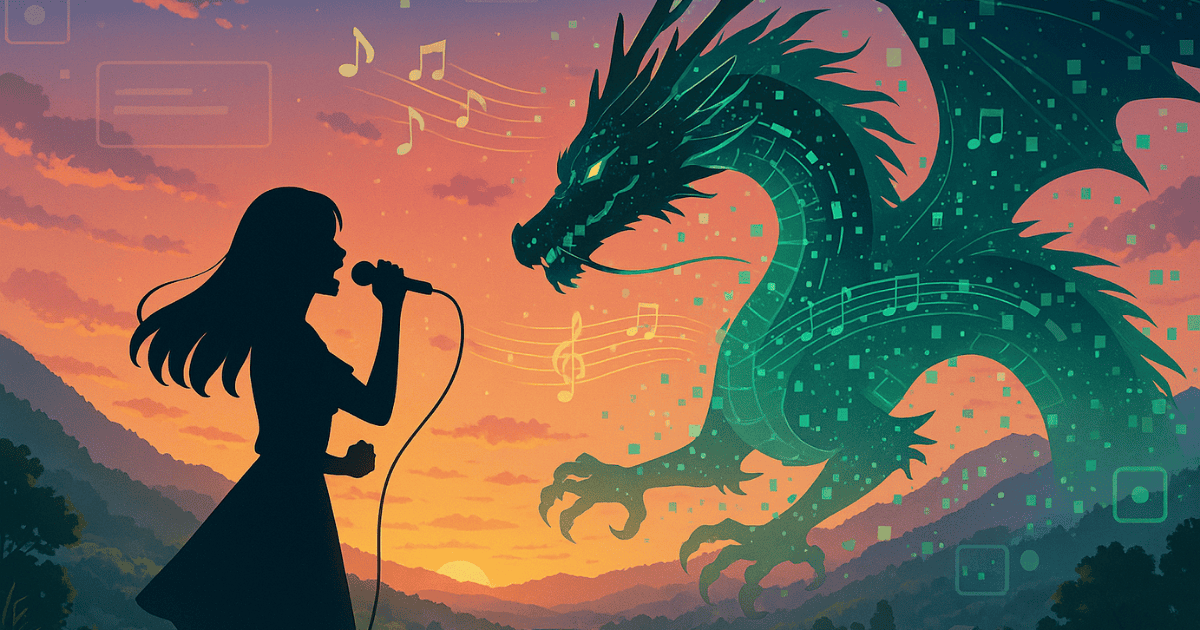
Belle (Official Website) is a stunning, highly ambitious theatrical animated film directed by Mamoru Hosoda, released on July 16, 2021.
The film follows Suzu, an introverted 17-year-old high school student living with her distant father in a rural town in Kochi Prefecture. Traumatized by her mother’s tragic death, she finds her voice again inside a massive, global virtual reality network known as <U>, where she gains unprecedented worldwide fame as the mysterious diva, “Belle.” Using the classic fairy tale Beauty and the Beast as its thematic backbone, the film is a deeply moving exploration of modern internet society—tackling issues of anonymous slander, cancel culture, and the profound, healing power of “singing for someone else.”
This comprehensive guide provides a quick “spoiler-free synopsis” for those who haven’t seen the film yet, followed by a highly detailed “full synopsis with spoilers,” and concludes with an in-depth thematic analysis. But first, let’s review the essential details of the production.
*This is a translated version. The original (Japanese) is available here.
On this pageContents
Belle (2021): Basic Information
Film Overview
| Release Date | July 16, 2021 |
|---|---|
| Director, Screenplay, Original Story | Mamoru Hosoda |
| <U> Animation Director & CG Animation Director | Takaaki Yamashita |
| Real World Character Design & Animation Director | Hiroyuki Aoyama |
| Dragon Design & CG Character Design | Kageichi Akiya |
| CG Character Design | Jin Kim |
| Music | Taisei Iwasaki, Ludvig Forssell, Yuta Bandoh |
| Main Theme | millennium parade × Belle “U” |
| Production | Studio Chizu |
| Runtime | 121 minutes |
Main Characters and English Voice Cast
| Character | Voice Actor (English Dub) | Character Overview |
|---|---|---|
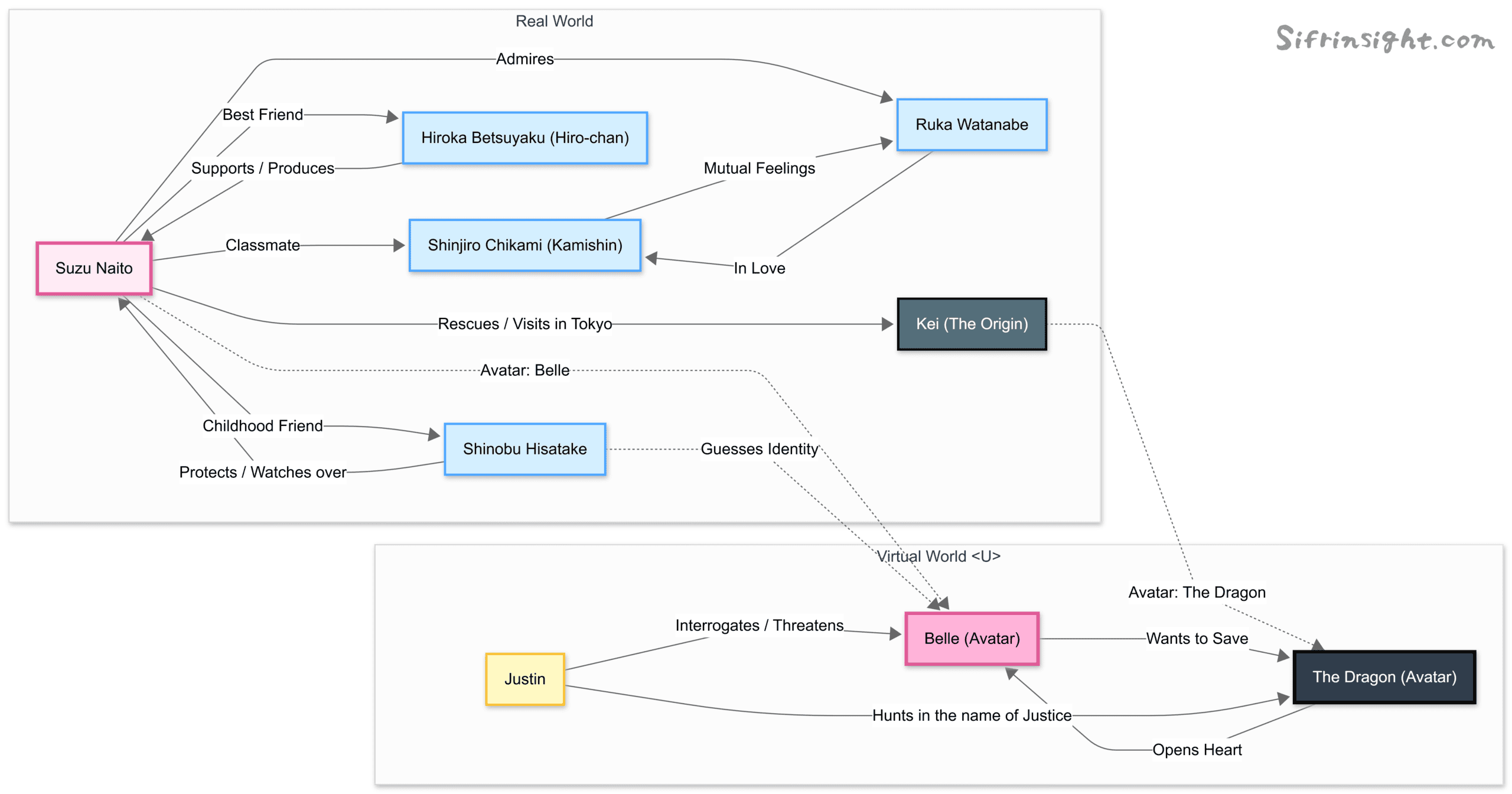
| Suzu Naito / Belle | Kylie McNeill | A shy 17-year-old high school girl living in rural Kochi. Traumatized by her mother’s death, she lost her ability to sing in reality, but finds her voice and becomes a global superstar in the virtual world <U>. |
| The Dragon / Kei | Paul Castro Jr. | A terrifying, mysterious avatar loathed by the citizens of <U>. He is violent and abrasive, and his virtual body is covered in countless glowing bruises. |
| Shinobu Hisatake (Shinobu-kun) | Manny Jacinto | Suzu’s childhood friend. A star player on the basketball team, he is highly protective of Suzu and serves as her emotional anchor in the real world. |
| Shinjiro Chikami (Kamishin) | Brandon Engman | Suzu’s classmate. An intensely passionate, single-minded member of the canoe club. He is a comedic mood-maker who constantly misreads the room. |
| Ruka Watanabe (Ruka-chan) | Hunter Schafer | A popular, beautiful girl in the high school brass band. Universally adored for her kindness and looks, she is a source of intense insecurity and admiration for Suzu. |
| Hiroka Betsuyaku (Hiro-chan) | Jessica DiCicco | Suzu’s sharp-tongued, tech-savvy best friend. She acts as the mastermind manager and secret producer behind Belle’s sudden rise to fame. |
| Justin | Chace Crawford | The arrogant, self-appointed leader of the vigilante group “Justice” within <U>. Operating under a banner of absolute righteousness, he relentlessly hunts The Dragon. |
Character Map
Glossary: The Virtual World <U> and the Threat of “Unveiling”
<U>, the central setting of the film’s fantasy elements, is the ultimate virtual reality space, boasting over 5 billion registered users worldwide. Operating under the seductive tagline “Come, live another you. Come, start a new life. Come, change the world,” it offers users an escape from the limitations of their physical reality.
Users log into the system as avatars known as “As” (pronounced “A’s”). These avatars are automatically generated by the app after it scans the user’s biometric information, meaning the avatar’s design heavily reflects the user’s hidden inner psychology and physical traits. The groundbreaking feature of <U> is its “body sharing” technology, which links real-world physical sensations and latent abilities directly to the avatar. This technology allows users who lack confidence in the real world to unlock their hidden potential in the digital space.
A critical plot device in the film is the ultimate administrative punishment known as “Unveiling.” This is the terrifying process of forcibly ripping away the digital guise of an “As” and permanently exposing the user’s “Origin” (their real-world face and identity) to billions of people. In a world where anonymity is an absolute right, being Unveiled is viewed as a virtual death sentence, ensuring social ruin. Officially, this punitive power is reserved only for the creators of <U> and Justin, the leader of the vigilante group “Justice.” However, as the story unfolds, the moral and emotional weight of “Unveiling” changes dramatically.
From a hard sci-fi perspective, the biometric scanning device used in the film is literally just a small wireless earbud. We are supposed to believe it maps the entire human soul and nervous system via a bluetooth headphone. Considering the film appears to be set in modern-day Japan, this super-technology is incredibly jarring if you think about it too hard. It’s best not to view the film as strict “Sci-Fi,” but rather as a beautiful “Sci-Fi Fantasy” where you just accept the magic.
Belle (2021): Quick Synopsis (Spoiler-Free)
Suzu Naito is an introverted 17-year-old girl living in a lush, nature-rich village in Kochi Prefecture. Her life was derailed during her childhood when she witnessed her mother die in a horrific river accident. Her mother had given her own life jacket to a stranded child she didn’t even know, allowing herself to be swallowed by the muddy rapids.
To compound the tragedy, the internet and local community viciously bashed her mother’s sacrifice, labeling her “reckless” and questioning why she would abandon her own daughter to save a total stranger. This trauma paralyzed Suzu. She lost her ability to sing the songs she once loved, built an emotional wall between herself and her grieving father, and lived a muted, invisible life.
One day, coaxed by her tech-savvy best friend Hiro, she reluctantly downloads the app for the virtual reality world <U>, a digital utopia with over 5 billion active users.
In <U>, Suzu manifests as a stunning avatar she names “Belle.” Miraculously, she discovers that the trauma blocking her vocal cords in the real world doesn’t exist in the digital realm. She can sing again.
Her breathtaking voice goes viral almost instantly, transforming her from a forgotten high schooler into a global, charismatic diva overnight. However, during her massive, highly anticipated virtual concert, a violently destructive avatar known only as “The Dragon” crashes the stage. The Dragon is a monstrous beast, hated by millions, yet Suzu notices the countless glowing bruises on his back and the profound, agonizing loneliness in his eyes.
Hunted by billions of users and the self-righteous vigilante group “Justice,” the Dragon retreats into the shadows. Unexplainably drawn to his pain, Suzu embarks on a dangerous digital quest to uncover his true identity and heal his shattered heart.
Detailed Synopsis
The following section contains a highly detailed breakdown of the plot, including the identity of the Dragon, the resolution of key mysteries, and the emotional climax of the film. Please proceed with caution if you have not watched it yet.
Introduction: The Birth of a Diva and the Encounter with “The Dragon”
Suzu Naito is suffocating in her quiet, rural hometown in Kochi Prefecture. When she was a child, her mother drowned saving an unknown girl from a flooded river. Instead of being hailed as a hero, her mother was brutally dragged on the internet by anonymous commenters who shamed her for abandoning her own daughter. The trauma of losing her mother, compounded by the vitriol of the public, emotionally crippled Suzu. She lost her beloved singing voice, began treating her loving father like a stranger, and retreated into a shell of anxiety.
Her cynical, highly intelligent best friend, Hiroka (Hiro), forces her to join the colossal virtual reality platform <U>. Upon logging in, the system scans Suzu and generates a breathtaking, pink-haired avatar she names “Belle.” To her absolute shock, the psychological block that prevents her from singing in reality is bypassed by the system’s “body sharing” tech. She opens her mouth and sings perfectly. Initially, she performs to an empty street, catching the attention of only a single, tiny angel avatar. But thanks to Hiro’s aggressive, secret marketing tactics as her “producer,” Belle’s hauntingly beautiful voice goes viral. She becomes the undisputed queen of <U>, sparking a massive internet frenzy as millions try to deduce the real-world identity of the diva.
At the peak of her popularity, Belle holds an unprecedented mega-concert, riding a massive, speaker-clad whale. However, the performance is violently interrupted by the arrival of “The Dragon,” a terrifying, wolf-like beast avatar. The Dragon is an undefeated underground fighter, universally despised for his sheer brutality. He crashes the concert while fleeing from “Justice,” a self-righteous, heavily armed vigilante group led by the arrogant Justin. The Dragon effortlessly massacres the vigilantes, leaving only Justin standing, before fleeing the scene. The incident fractures the internet; while adults demand his deletion, children worldwide begin hailing him as a misunderstood anti-hero. An online witch hunt ensues to locate his hidden domain, the “Castle.”
Development: The Castle of Pain and Real-World Drama
Utilizing her hacking skills, Hiro successfully pinpoints the coordinates of the Dragon’s castle. With Hiro stuck in detention, Suzu decides to infiltrate the castle alone as Belle. She is guided through the treacherous virtual landscape by the same tiny angel avatar who first listened to her sing. When she breaches the castle walls, the Dragon is furious. He violently threatens her, roaring, “Get out or I’ll crush you!” However, Suzu notices a glaring contradiction: he is incredibly gentle and protective toward the tiny angel avatar. Although he violently ejects her from the castle before she can uncover his identity, Suzu realizes he is not the mindless monster the internet claims he is.
Meanwhile, the harsh realities of high school life catch up with Suzu. Her childhood friend, Shinobu, is a wildly popular basketball star. After a game, Shinobu casually holds Suzu’s hand to comfort her in front of the entire school. The rumor mill instantly ignites, and Suzu becomes the target of a vicious, flaming bullying campaign by Shinobu’s jealous fan club.
Hiro expertly diffuses the cyberbullying, but a new complication arises. Ruka, the universally adored, model-beautiful star of the school band, approaches Suzu for romantic advice. Suzu, operating under massive insecurity, automatically assumes Ruka is in love with Shinobu. Crushed by the realization that she cannot compete with a girl like Ruka, Suzu spirals into a deep depression.
Seeking emotional refuge, Suzu logs back into <U> and returns to the Dragon’s castle, only to be violently rejected a second time. On her way back to the virtual city, she is intercepted by Justin and his vigilantes. Suspecting she is harboring the fugitive, Justin threatens her with “Unveiling”—the ultimate digital execution. Just as he corners her, the Dragon bursts onto the scene, rescuing Belle and carrying her to safety. In a quiet, intimate moment hidden from the world, Belle realizes the glowing, jagged bruises covering the Dragon’s back are physical manifestations of real-world trauma. She sings a gentle, healing song directly to him, finally bridging the gap between them.
However, the peace is short-lived. The global witch hunt escalates, and Justin’s forces corner Belle, demanding the Dragon’s location. Saved at the last microsecond by Hiro’s hacking and the intervention of the AI bots that guard the Dragon’s castle, Suzu realizes the vigilantes are closing in for the kill. She resolves to find the Dragon’s real-world identity to save him.
The Twist: High School Confessions and the Horrors of Reality
Back in the real world, the romantic tension resolves in a highly comedic twist: Ruka is not in love with Shinobu; she is hopelessly, awkwardly in love with Kamishin, the loud, oblivious canoe club member. With Suzu’s reluctant help, Ruka successfully confesses her feelings at the train station (a rare happy ending!). Watching from the sidelines, Shinobu approaches Suzu and says, “There’s something I’ve been wanting to tell you.” Suzu braces for a romantic confession, but instead, Shinobu drops a bombshell: “You are Belle, aren’t you?”
Panicking that her secret is out, Suzu flees the station, only to receive a frantic call from Hiro. Justin’s forces have breached the Dragon’s castle and are currently burning it to the ground. Desperate to warn him, Suzu and Hiro frantically scour the internet for clues to his real-world identity (“Origin”). They stumble upon a low-view-count live stream of a young boy singing the exact, secret song Belle sang to the Dragon.
The video feed reveals a horrifying reality: the young boy (who controls the angel avatar) and his older brother, Kei, are victims of severe domestic abuse. As their deranged father storms into the room and attacks them, Kei desperately shields his younger brother. Suzu instantly realizes the truth: Kei is the Dragon, and the bruises on his avatar are the digital scars of his real-world beatings. Suzu frantically initiates a video call, revealing to Kei that she is Belle. But Kei, utterly broken and distrustful of a world that ignores his suffering, refuses to believe her. He severs the connection, completely rejecting her help.
How can she possibly prove she is Belle and gain the trust of a boy who has been betrayed by everyone? Shinobu steps in with the ultimate, terrifying solution: she must Unveil herself. She must destroy her own anonymity. Mustering unimaginable courage, Suzu logs in and activates the Unveil protocol in front of billions of hostile users. Stripped of the flawless, beautiful avatar of Belle, she is exposed to the virtual world as Suzu Naito—a plain, freckled, trembling teenage girl. Ignoring the shock and initial jeers of the crowd, she begins to sing. Stripped of her digital armor, her raw, vulnerable voice moves the entire world to tears, finally piercing the thick walls of Kei’s closed heart.
Conclusion: The Standoff in the Rain and the Cycle Broken
Watching the stream, Kei and his brother are deeply moved and attempt to call her back. However, mid-call, their violent father discovers them, beats them, and cuts the internet line. Time is up. Using environmental audio clues from the video feed, Hiro and the friend group triangulate the boys’ location to an apartment complex in Musashi-Kosugi, Kanagawa Prefecture (hundreds of miles away in the Tokyo metropolis). They alert child protective services, but knowing the bureaucratic red tape will be too slow, Suzu makes a shocking decision: she is going to Tokyo herself.
Boarding a bullet train and a night bus, Suzu calls her estranged father. He has already been briefed on the situation by her friends. Instead of scolding her or forbidding the dangerous trip, he smiles, validates her choice, and simply says, “Be kind to that child.” The ice between them finally breaks.
Suzu arrives in the concrete jungle of Musashi-Kosugi during a torrential downpour. She finds Kei and his younger brother huddled in an alley, having fled their apartment. Seconds later, their enraged father arrives, demanding they return. Without a moment’s hesitation, the small, frail Suzu steps between the towering abuser and the boys. The father strikes her, scratching her face, but Suzu does not flinch. She stares him down with absolute, unbreakable resolve. Unnerved and terrified by the sheer force of a teenage girl willing to take a beating to protect strangers, the cowardly father collapses and flees the scene. Witnessing Suzu’s incredible, fearless strength, Kei finally finds the courage to stop running. He resolves to fight for his and his brother’s future.
Her mission complete, Suzu returns to the lush green mountains of Kochi. She is warmly welcomed at the station by her father and her tight-knit group of friends. Having finally laid the ghost of her mother’s death to rest, she walks alongside her father, their relationship fully healed. Suzu finally understands why her mother jumped into that raging river years ago: she didn’t do it out of reckless logic; she did it because her soul demanded she protect the vulnerable. Having made the exact same impossible choice, Suzu finally understands the staggering depth of her mother’s love, and she is ready to sing again in the real world.
Belle (2021) Analysis: Deconstructing the Themes
- The Thematic Necessity of the “Unveil”
Suzu had to literally destroy the perfect, invincible armor of “Belle” to prove her sincerity. To save a boy whose life was destroyed by hypocrites, she couldn’t offer empty platitudes from behind the safety of a digital mask. She had to expose her own life-sized, traumatized, trembling self and meet him as an equal, bleeding soul. - Internet Toxicity as a Narrative Balancing Act
While the film harshly depicts cyberbullying and mob mentality, it ultimately indicts “superficial goodwill” (like the useless adults who ignore Kei’s abuse) as the true evil. The film is actually a profound love letter to the internet. Just as the film’s production recruited global talent online, <U> is portrayed affirmatively as a miraculous space where nameless, marginalized voices have the literal power to change the world. - The Technical Reality Behind the “Weird” Character Designs
The uniquely elongated, lanky character designs in <U> (and subtly in the real world) weren’t just an artistic quirk; they were an architectural necessity. To achieve the incredibly complex, emotive “acting” Hosoda demanded from 3D CG models, the animators required exaggerated limb proportions to convey rich, fluid body language on screen.
1: Why Only “Song” Could Change the World
At its very core, Belle is an exploration of the “power of song”—a primal force that transcends language, logic, and physical distance. Suzu, who lost her literal voice and her mother in one fell swoop, simultaneously lost her entire “means of connecting with the world.” When she regains her voice as Belle inside <U>, it is initially an act of selfish healing; donning the mask of anonymity simply bypassed her crippling anxiety, allowing her to seek the validation she desperately craved.
However, the narrative pivots entirely when the purpose of her singing shifts from “for myself” to “for someone else.” When Suzu meets the broken, abused Kei, her music sublimates from pop entertainment into a desperate prayer. Yet, no matter how beautifully she sings “I want to help you,” as long as she is hiding behind the flawless avatar of Belle, her words register as “hypocritical nonsense” to a boy who is being physically beaten in reality. Text chats can lie, and avatars can deceive, but a human being tearing their soul apart through raw vocals cannot.
That is why the terrifying “Unveil” at the climax was an absolute thematic necessity. To discard the god-like invincibility of “Belle” in front of billions of hostile users, and to sing as the incredibly ordinary, freckled, and terrified “Suzu,” was the ultimate act of vulnerability. It was the only possible way she could step down from her digital pedestal and stand on equal, painful footing with the severely wounded Kei.
As a result, her raw voice became a beacon of light in the virtual void, physically illuminating Kei’s despair in the real world. Just as her mother abandoned logic to jump into a lethal river, Suzu abandoned logic, sacrificed her secret identity, and rushed across the country. The film boldly asserts that even in an era suffocated by toxic, anonymous malice, when a human being sings purely for the sake of another, that sound can shatter emotional walls and change the world. In Hosoda’s universe, losing your “song” is as catastrophic as losing your humanity.
2: The Sins and Miracles of the Internet: An Attack on Superficial Goodwill
It is undeniable that Belle explicitly portrays internet discourse as an absolute cesspool. The rolling text chats of anonymous users spewing vile, reactionary garbage are depicted so clearly that it can almost feel preachy to a modern audience. When the cyberbullying is shown that bluntly, it is easy to roll your eyes and think, “Yes, we know Twitter is toxic.”
However, that explicit toxicity is actually a brilliant misdirection. The true villain of the story isn’t anonymous internet trolls; the film is a searing indictment of “superficial goodwill” in the real world. The true evil is the neighbor who hears Kei being beaten but looks the other way, or the child protection workers who promise to “look into it” while leaving a child in a warzone.
Furthermore, the film refuses to paint anonymity as an absolute evil. Suzu was only able to heal her trauma and take her first steps toward recovery because the anonymity of <U> shielded her. The virtual world was the life raft that saved both Suzu and Kei.
It is highly likely that the exaggerated “malice of anonymity” was included as a necessary narrative counterweight. If the film only portrayed the internet as a magical utopia where everyone holds hands and sings, critics would have torn it apart for being dangerously naive. The trolls were necessary to ground the fantasy.
In fact, Hosoda’s fundamental belief in the positive power of the internet is baked into the very production of the movie. In an interview with Anime Hack titled “Belle Director Mamoru Hosoda’s Internet-like Creation Method,” he revealed:
“This movie is set inside the internet, and isn’t it a story about nameless talents blossoming there? So, guided by the themes of the film, we decided to search the internet to find the people to design that world. For example, there is a brilliant architect in London named Eric Wong; we found his work online, reached out to him via the internet, and hired him to design the world of <U>.”
*(Note: The director famously recruited British architect Eric Wong via the internet to design the sprawling cityscape of <U>, and legendary Disney character designer Jin Kim for the avatars, proving the global, connective power of the web).*
From this meta-perspective, it is clear that Belle fundamentally views the “Internet” not as a dystopia, but as a miraculous tool capable of unearthing hidden brilliance.
3: The Mystery of the Lanky Character Designs: A CG Necessity
Finally, let’s address a technical “elephant in the room” regarding the film’s highly distinctive art style—specifically, the oddly elongated, lanky limbs of the characters.
I know I wasn’t the only one in the theater who thought, “Why are their legs so incredibly long? How many heads tall is Suzu’s dad?” the moment the real-world characters appeared on screen.
While cynics might complain that “the proportions are weird and don’t look like real Japanese people,” I believe there is a highly technical, compelling reason for this specific aesthetic choice.
The answer lies in the same Anime Hack interview mentioned above. Director Hosoda stated:
“We have tried various things regarding how to utilize CG in animation, such as rendering natural environments or moving massive crowds. But this time, we finally challenged the absolute highest hurdle: forcing CG character models to genuinely ‘act’ and express rich, subtle human emotions. That was our main fortress to conquer.”
In the realm of 3D animation, subtle emotional body language is notoriously difficult to capture without looking stiff or robotic. Therefore, in order to allow the CG models (especially in <U>) to execute grand, sweeping, highly emotive theatrical movements, their arms, legs, and overall heights had to be mathematically exaggerated.
And because it would be jarringly inconsistent if the avatars in <U> were eight heads tall while the 2D characters in the real world had realistic, stubby proportions, the real-world character designs by Hiroyuki Aoyama were adjusted to match that elongated, elegant aesthetic, ensuring a cohesive visual language across both realities.
While this is an analytical speculation, it perfectly explains the mysterious, beautiful proportions that define the film’s look.
This concludes my extensive breakdown, explanation, and thematic analysis of Belle.
Ever since Summer Wars, Mamoru Hosoda has relentlessly explored the concept of “family.” In Belle, he tackled the incredibly dark, heavy issue of child abuse. Yet, by leveraging the modern miracle of the “Internet,” he managed to weave a narrative that concludes with a fiercely positive, triumphant ending.
It is a visually staggering, emotionally exhausting triumph of a film. But what did you take away from Suzu’s journey? How did “Belle” resonate with you?


Reader Comments