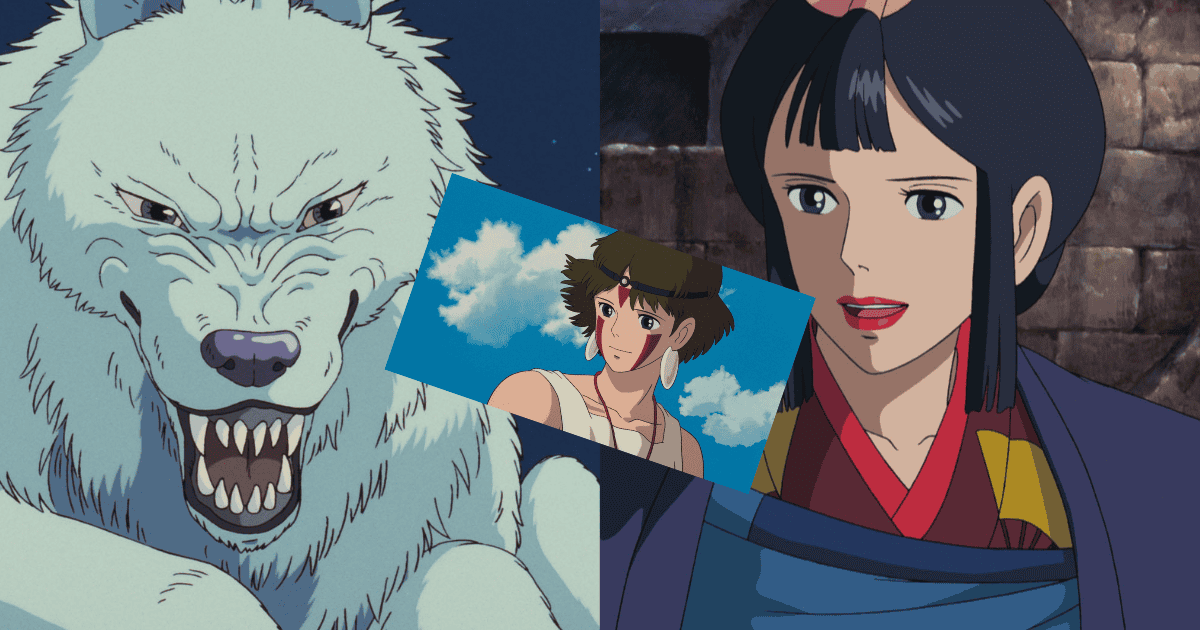
Hayao Miyazaki’s Princess Mononoke(Studio Ghibli Official) was released in 1997.
This time, I want to consider the puzzling circumstances surrounding San.
The first person to consider is Eboshi. She can be merciless elsewhere in the film, yet she seems strangely sympathetic toward San.
Where does that attitude come from?
The other person is Moro, the wolf god who raised San.
Watching the film normally, nothing seems odd. But pause to think, and there seems to be a contradiction in Moro’s behavior, too.
I will revisit Eboshi’s sympathy and Moro’s contradiction, then consider three possible explanations.
Why does Eboshi seem sympathetic toward San, and why does Moro raise a human child while attacking humans?
*This is a translated version. The original (Japanese) is available here.
- Eboshi’s Unusual Sympathy
Eboshi can make cold decisions, yet speaks of San eventually becoming human with unexpected composure. I wonder whether there is a feeling beyond ordinary hostility behind that attitude. - Moro’s Contradiction
Moro expresses hostility toward humans, yet saves and raises San. Perhaps our idea of dogs as humanity’s friends—and Miyazaki’s own feelings about them—helps explain why this does not usually strike us as odd. - Theory 1: San Is Eboshi’s Daughter
This hypothesis could explain both Eboshi’s sympathy and Moro’s intense hostility toward her. There is no decisive evidence, but its ability to make sense of the situation is compelling. - Theory 3: San Is Eboshi’s Mirror
San’s hostility toward human society may remind Eboshi of her own past. Perhaps she sees herself in San, and that is why she sympathizes with her.
On this pageContents
Eboshi’s Sympathy and Moro’s Contradiction
Why Is Eboshi Sympathetic Toward San?
Before looking at her attitude toward San, let us recall how cold Eboshi can be.
In Princess Mononoke, consider two of Eboshi’s decisions:
- She shows no sympathy for the men who fall into the valley during the wolf attack.
- Late in the film, she does not return to Irontown even when it is under attack from local samurai.
Perhaps “unavoidable” is fairer than “cold” as a description of those decisions. What matters is their speed: she makes them without hesitation.
Yet she says this about San:
“Without that ancient god, the animals here would be nothing but dumb beasts once more. When the forest has been cleared and the wolves wiped out, this desolate place will be the richest land in the world, and Princess Mononoke will become human.“
When San attacks Irontown and tries to take her life, Eboshi meets her with a grin. Even after Ashitaka intervenes, she continues talking while dealing with the situation.
Could she not have killed San quickly if she had wanted to?
There must be a reason for her composure. What might it be?
Of course, the film gives a practical reason: Eboshi wants the women whose husbands were killed to take their revenge themselves. She could disable San and let them finish her off.
For the following discussion, though, I will deliberately set that aside and ask whether there might be another motive as well.
Why Does Moro Raise a Human Child?
Moro’s behavior seems natural as we watch Princess Mononoke. Yet I think there is a contradiction beneath it.
She saves San, yet attacks humans.
Moro explains San’s arrival this way:
“I caught her human parents defiling my forest. They threw their baby at my feet as they ran away.”
If Moro hates humans, she could have eaten San even as a baby. But she did not.
That seems a clear contradiction to me. Perhaps we do not feel it because we think of dogs as humanity’s friends.
Miyazaki himself grew up with a dog, which seems especially relevant here.
In the documentary How Princess Mononoke Was Born, he looks troubled while checking drawings of a wolf panting with its tongue out. He says:
“I can’t help but remember the dog I used to have.”
(Original Text, in Japanese)
「つい、自分の飼っていた犬を思い出す。」
He asks animation director Masahiko Ando and other key staff for their opinions on the drawings, but does not seem to receive a clear answer. Then he says:
“After all, you didn’t grow up with a dog that was like a part of you…”
(Original Text, in Japanese)
「やっぱりね、子供の頃に一心同体の犬と育たなかった・・・」
(You have to feel bad for the staff in that moment.)
Would a director who feels that way about dogs portray a wolf as a creature that only hates humans?
Surely there is a reason for Moro’s “contradiction.”
Let us consider a few possibilities that might make sense of these portrayals.
The first is the familiar theory that San is Eboshi’s daughter.
Three Possible Readings of Eboshi, Moro, and San
Theory 1: San Is Eboshi’s Daughter
One theory that resolves our unease about both characters is that San is Eboshi’s child.
There is no decisive evidence. What makes it interesting is how much it can explain.
If we assume San is her daughter, then:
- Eboshi is sympathetic toward her because she is her own child.
- Moro’s hatred is not just directed at the leader of Irontown: Eboshi would be the person who abandoned San, whom Moro regards as her daughter.
Its treatment of Moro is particularly convincing. A wolf who cannot entirely hate humans might still fiercely hate the person who abandoned San.
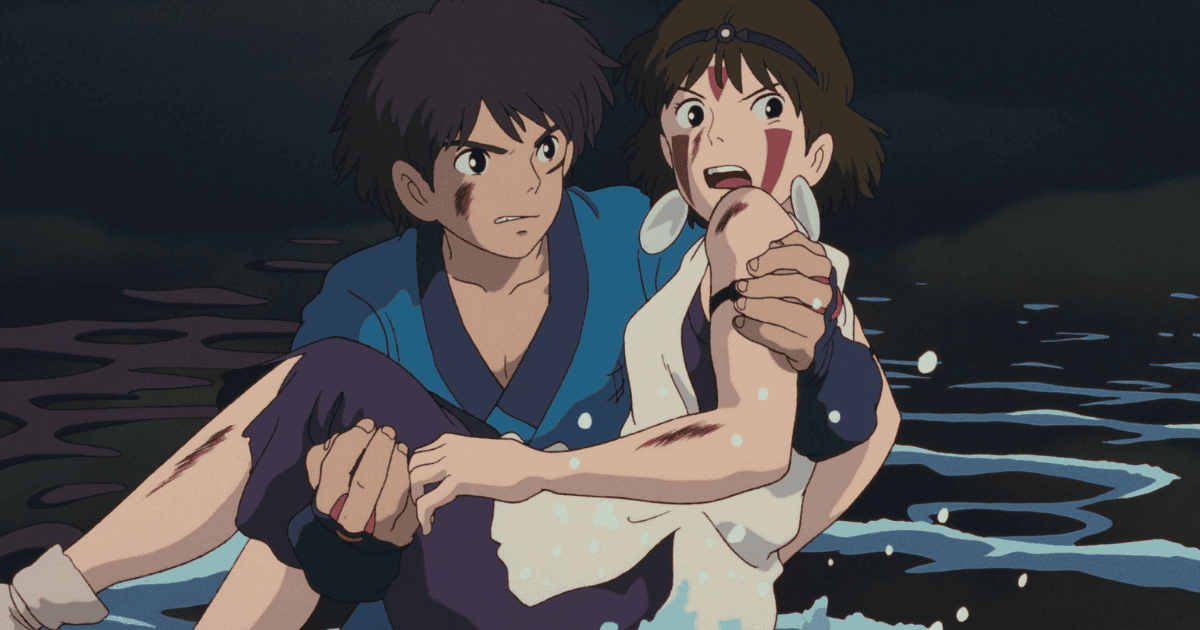
Again, there is no decisive evidence. But look at the image below:
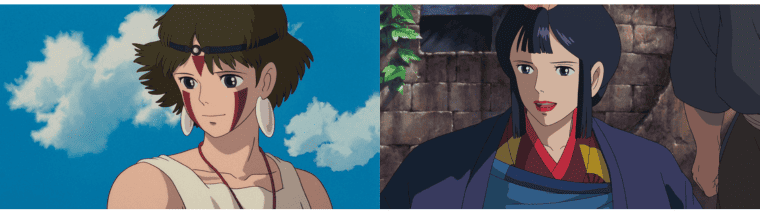
Their faces are strikingly alike, are they not? That does not make them mother and daughter. Still, it is understandable to feel that something is being suggested.
There is a difficulty, though. The film seems to place Eboshi’s arrival at Irontown, beside the Forest Spirit’s forest, shortly before she drove out Nago—the boar god who later attacks Ashitaka’s village.
For the daughter theory to work, we would have to imagine this sequence:
- Eboshi once lived near the Forest Spirit’s forest. She abandoned San there.
- Later, she was made the wife of a pirate chief.
- She and Gonza killed the chief and escaped.
- She then returned to the forest and encountered San again.
Requiring her to have lived near that same forest before feels like a stretch. Even so, the theory has remarkable explanatory power.
It is an excellent theory, but I do not know who first proposed it publicly. If you do, please tell me in the comments. Who first noticed this possibility? I would like to quote their writing.
Theory 2: Eboshi Once Abandoned Another Daughter
There is another possibility that removes the slight strain in the first theory.
What if Eboshi once abandoned a daughter, but that daughter was not San?
Eboshi was made the wife of a pirate chief. Perhaps she had a child during that time.
She might have been unable to escape with the child and had to leave her daughter behind.
Or she may have had a child before being taken by the pirates, and been forced to leave that child then.
Perhaps she subsequently lived with the resolve never to abandon those who had been abandoned.
Bringing women who had been sold into prostitution to Irontown could be one expression of that resolve.
On this reading, San might remind Eboshi of the daughter she lost, giving her another reason to sympathize.
Like the first theory, this one lacks decisive support. It does not require Eboshi to have lived near the forest before, but it cannot explain Moro’s contradiction.
I do not think it is a bad theory, but it explains less than the first.
Theory 3: San Is a Mirror of Eboshi
Both ideas have weaknesses, which is hardly surprising without decisive evidence. We should also look for an explanation that does not depend on a daughter whose existence we cannot establish.
The first two theories leave something important out: Eboshi’s inner life. I have written about what I think she is trying to achieve here:
Read my analysis: Why Eboshi Does Not Return to Irontown
The film uses the word “kunikuzushi,” or overturning a country. In that period, it would mean upsetting the order of a region, rather than overthrowing Japan as a whole.
But I suspect Eboshi wants to overturn Japan—or the world itself. She wants revenge against the existing order that has brought her inexpressible suffering, sorrow, and humiliation.
How would someone with that ambition see San?
Let’s review San’s tragic life:
- Her parents abandon her to save themselves.
- She is raised by the wolves who were part of the reason for that abandonment.
- She deeply loves those wolves and the forest, and lives as a wolf herself.
- Yet she recognizes the contradiction of having a human body.
- She tries to protect her identity through limitless aggression toward the human world.
That is how I read her life. The crucial point is her aggression toward human society.
Eboshi, too, is serious about “kunikuzushi.” What she wants to overturn is the human world. Neither gods nor wolves nor boars made her suffer.
San stands with the wolves, who did not hurt Eboshi, and attacks the human world that did.
In that sense, San is already doing what Eboshi has been carefully preparing to do.
Perhaps that makes Eboshi’s sympathy natural. Looking at San would be like looking at herself: San is her mirror.
None of this finally explains Moro’s contradiction. But given Miyazaki’s remarks quoted above, perhaps it is natural to see it as a reflection of the idea that dogs are humanity’s friends.
A wolf can fight the humans who attack it and still show kindness to a baby left in front of it. That is how I understand Moro here. Perhaps such kindness is why humans have lived with dogs for so long. At the very least, we should try not to betray them, harsh though the reality around them may be.
Those are my thoughts on why Eboshi seems sympathetic toward San. I now lean toward the mirror interpretation, though I still find the daughter theory compelling and interesting. What do you think? One pleasure of Princess Mononoke is that it keeps offering new discoveries.
The images used in this article are from Studio Ghibli Works Still Images.
Can you name the movie before the scene comes into focus?
Put your visual memory to the test with a blurred Studio Ghibli scene.

Reader Comments