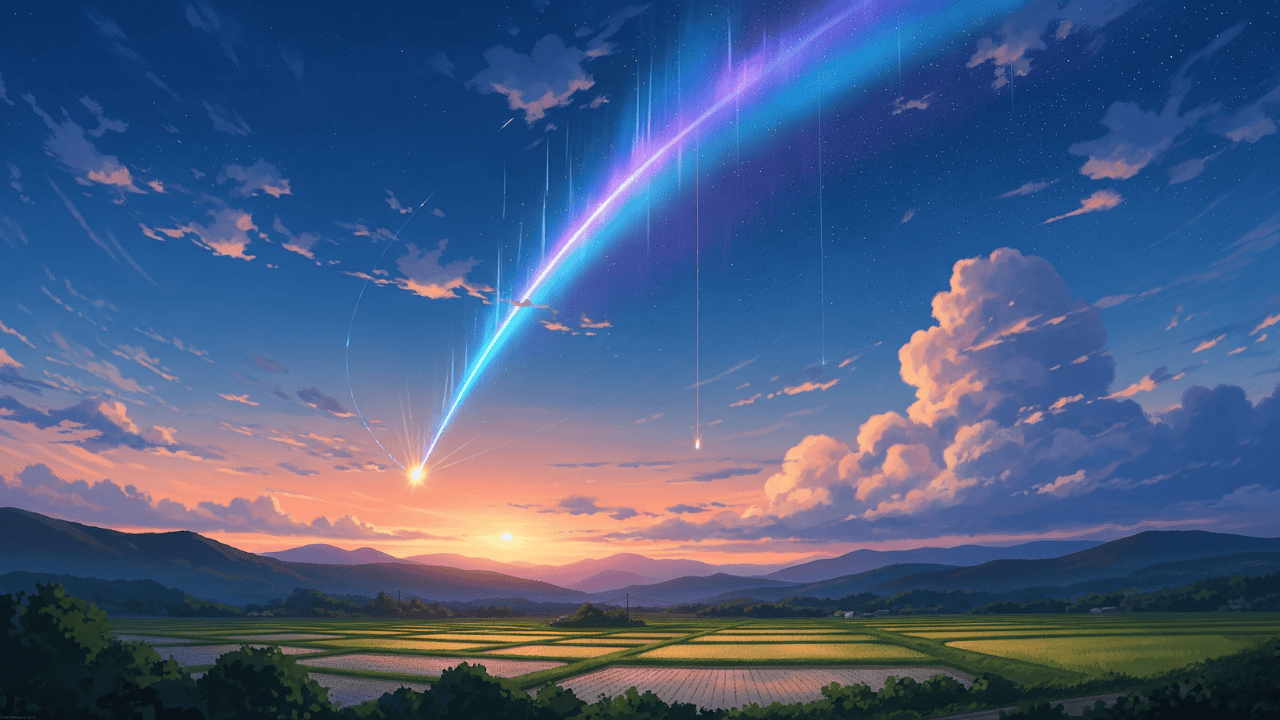
Makoto Shinkai’s Your Name. isn’t just a beautiful romance; it’s a desperate battle against a 1,200-year-old cycle of tragedy. Yet, a vocal portion of the fanbase insists the film should have faded to black on that snowy pedestrian bridge—leaving Mitsuha and Taki as tragic strangers passing in the winter chill. But did the movie really need a bittersweet, heartbreaking conclusion?
Following up on our deep dive into the baffling mystery of the mayor’s evacuation order, it is time to decode the film’s highly debated climax. (For a complete breakdown of the timeline and more hidden secrets, make sure to explore our Ultimate Your Name. Synopsis and Analysis Summary).
I vividly remember my first time watching the film in theaters. When the pedestrian bridge scene arrived, I did not think, “It should end here.” I thought, “It will end here.” Since the film was already a massive blockbuster a month into its release, I fully expected a classic, melancholic Shinkai conclusion. But the scene kept going. It transitioned into the mundane, everyday lives of the characters. I assumed Shinkai was simply padding a “happily ever after.” Yet, the sequence stretched on. The music continued to swell, building tension until that final, breathless reunion. By the time the credits rolled, I was overwhelmed with the deeply satisfying feeling of having witnessed a cinematic masterpiece.
While I unapologetically love this happy ending, today we are going to dig deeper. We will prove exactly why Mitsuha and Taki absolutely had to reunite for the narrative of Your Name. to successfully work.
To understand this, we first need to take a brutal, slightly cynical look back at what Your Name. is actually about.
*This is a translated version. The original (Japanese) is available here.
- The Miyamizu Shrine Lost Its “Power to Connect”
Ancestors attempted to warn future generations of the meteorite strike using braided cords and Kagura dances. However, over 1,200 years and the devastating “Great Fire of Mayugoro,” the true meaning was lost. Humanity failed to connect the most vital information. - Mitsuha: The “Unconscious Witch” Who Stole Taki’s Heart
While swapping bodies, Mitsuha actively sabotages Taki’s romance with his senior coworker, redirecting his affection toward herself. This operates as a survival strategy engineered by the Miyamizu DNA to ensure Taki is desperate enough to drink the kuchikamizake (mouth-chewed sake). - The Final Reunion Conquers Human Forgetfulness
The climactic reunion isn’t just fan service; it exists to reject the nihilistic idea that “humanity always forgets.” It delivers a powerful message of hope and responsibility: “This time, we will connect without forgetting.” - The Dark Trigger for Body-Swapping: Survival of the Bloodline
The body-swapping phenomenon acts less like a miracle and more like a curse. It activates specifically when a Miyamizu woman is in danger of dying before passing on her DNA. Grandmother Hitoha likely triggered this ability in her youth simply to survive an air raid. - The Men Were Pawns Manipulated by Miyamizu DNA
The mystical Miyamizu bloodline twisted the fates of the men around them. Taki was used as a time-traveling messenger. The mayor’s entire political career existed solely so he could issue the evacuation order. Even Mayugoro was forced to become the arsonist of the Great Fire just to eventually lure the mayor to Itomori. Your Name. is a story of female curses dictating male destinies.
On this pageContents
Your Name. (2016) The Tragic Reality Before the Ending
Braided Cords, Kagura, and a Disconnected Legacy
Early in Your Name., Grandmother Hitoha delivers a profound monologue about the concept of “Musubi” (connecting). Make no mistake: “connecting” is the most critical thematic pillar holding this entire film together.
Historically, the Miyamizu Shrine desperately tried to warn future generations about the impending meteorite disaster by weaving the prophecy into braided cords and the movements of the Kagura dances (a brilliant piece of world-building hidden in plain sight).
However, this method was far too subtle. The message became so abstracted that even the modern Miyamizu shrine maidens have no idea what the rituals mean. To make matters worse, whatever written records survived were incinerated during the infamous “Great Fire of Mayugoro.”
Ultimately, across a staggering span of 1,200 years, the Miyamizu lineage completely failed to connect the most important warning in their history.
Framed this way, Your Name. is fundamentally a “story of forgetting”—a theme that strongly echoes Makoto Shinkai’s earlier work, The Place Promised in Our Early Days.
The Miyamizu DNA Awakens: Mitsuha the “Unconscious Witch” and Taki’s Madness
Faced with humanity’s failure to remember, the ancient DNA running through the veins of the Miyamizu women takes drastic action.
The bloodline shifts its survival strategy from passive warnings (cords and dances) to aggressive intervention: dispatching a messenger from the future using a “kuchikamizake time machine” to avert the catastrophe.
But this strategy hinges on one critical, horrifying requirement: Who on earth would willingly drink someone else’s chewed-up, fermented spit?
Let’s be brutally honest. When you watched that scene, you definitely thought, “There is absolutely no way I am drinking that.“
Taki downs the kuchikamizake as if it’s perfectly normal, but from an objective standpoint, his action borders on sheer lunacy. There is only one psychological state where a teenage boy would actually do this.
He must be **desperately, irrevocably in love with the girl who made it**.
Viewing the plot through this lens, Mitsuha’s true biological mission in Your Name. is simply to force Taki to fall in love with her. And the methods her unconscious mind uses to achieve this are remarkably ruthless. Think about it:
By using Taki’s body to secure a date with his beautiful senior coworker, Mitsuha effectively neutralizes the coworker’s romantic interest in the “real” Taki, completely destroying his chances with anyone else.
Taki never even gets the dignity of a proper heartbreak. Mitsuha executes a flawless romantic sabotage that rivals Seiji Amasawa’s legendary tactic of reading every library book before the girl he likes in Studio Ghibli’s Whisper of the Heart. And the most terrifying part? Mitsuha has no conscious idea she is doing it.
With his other romantic prospects annihilated, Taki has nowhere to turn but toward his growing obsession with the girl sharing his mind. He becomes completely fixated on Mitsuha.
Consequently, Taki willingly drinks the kuchikamizake—the biological time machine engineered by the Miyamizu bloodline—and hurls himself three years into the past. He is stripped of his agency; Taki is merely a pawn, a messenger.
Taki, you got played. In this grand scheme, Mitsuha operates as an “unconscious witch” who ruins a boy’s love life just to make him obsessed with her. We can only applaud the terrifying ingenuity of the Miyamizu DNA.
Regardless of the manipulation, their miraculous body-swapping dynamic successfully saves the town of Itomori from total annihilation.
Your Name. (2016) Why the Final Reunion Was the Only Acceptable Ending

The Illusion of a “Success Story”
If we look only at the surface level, Your Name. presents itself as follows:
An uplifting sci-fi romance where two teenagers bridge space and time to avert a forgotten 1,200-year-old disaster caused by a recurring meteorite strike.
If you view the film purely as a “success story,” then a heartbreaking ending where the two saviors pass each other by on a bridge works perfectly fine. It balances the overwhelming joy of saving the world with the poignant sadness of personal sacrifice. It is a clean, poetic narrative.
However, the entire purpose of this analysis is to prove the “inevitability of the reunion.” Therefore, we need to throw out that surface-level interpretation.
Re-evaluating the Plot as a “Story of Failure”
What happens if we view Your Name. through a darker lens—as a “story of failure”?
Despite the flashy miracle of two teenagers swapping bodies across time, the grim reality is that humanity spent 1,200 years failing to pass down a vital warning, ultimately leading to the tragic deaths of hundreds in a horrific meteorite strike.
This isn’t just a pessimistic rewording; it is the fundamental tragedy of the Your Name. universe. The core conflict is rooted in a massive societal failure to “connect.”
Escaping the Cycle of Forgetting
When analyzing the film as a story of failure, we must recognize that Mitsuha and Taki are guilty of a massive failure themselves. They failed at something far more personal than warning a town about a comet.
During twilight (Katawaredoki) at the crater’s edge, the two desperately promise never to forget each other’s names. Minutes later, they forget everything. The historical failure of the town forgetting the comet is perfectly mirrored by Mitsuha and Taki forgetting each other. Therefore, if the film ended with them passing each other on the pedestrian bridge forever, Shinkai would be delivering a brutally depressing message:
Humanity forgets everything over time, leading to endless suffering. Just as Mitsuha and Taki failed to remember the names of the people they loved the most, humanity is doomed to forever repeat its catastrophic mistakes.
This reads like the cynical nihilism of an edgy teenager. It leans heavily into the tired “humans are fundamentally flawed” trope. While some indie films thrive on that kind of bleak despair—and I admit, a younger version of myself might have found it profound—pushing that message as an adult feels hollow and irresponsible.
Storytellers have a duty to look toward the future and inspire audiences with the resilience of “even so, we push forward.”
When it comes to the theme of “remembering what matters,” the next 1,200 years of human history will fundamentally differ from the last 1,200 years. The simple reason? The evolution of “records” and technology.
Take tsunamis, for instance. When I was a child, textbooks told me tsunamis were terrifying, but without visceral evidence, I couldn’t truly comprehend the horror. However, the catastrophic Great East Japan Earthquake was heavily documented on video. The horrific footage is permanently etched into our digital history. Nobody who watches those videos will ever underestimate a tsunami again.
In the world of Your Name., the ancestors failed because they relied on fragile methods like braided cords and abstract dances. We failed “until now” because we lacked the tools to communicate directly across generations. But the future will be different. It must be different.
Director Makoto Shinkai injected this powerful realization directly into that climactic reunion scene. The true message is this:
We are creatures prone to forgetting. History proves we have lost countless essential truths. But just as Mitsuha and Taki fought against fate to remember “the important things they had lost,” we too must fight to remember. This time, we have the power to connect our thoughts and truths without losing them to time. We failed in the past 1,200 years, but we will triumph in the next 1,200 years!
This soaring declaration of hope is why the final scene exists. And more importantly…
Because Shinkai absolutely had to deliver this message of hope to a post-disaster Japan, the two lovers had no choice but to reunite.
That reunion culminates in the simplest possible line: “Your name is…” I examine why that line had to close the film, together with its original Japanese and English subtitle, in my Your Name. quotes guide.
Releasing a cynically depressing movie in the wake of the Great East Japan Earthquake was never an option. (If you want to dive deeper into Shinkai’s intricate storytelling, including why the mayor finally caved and issued the evacuation order, check out our massive Your Name. Plot Breakdown and Analysis Summary).
Your Name. (2016) Appendix: The Dark “Curse” of the Miyamizu Women
If you pay close attention, Your Name. features several highly suspicious, seemingly out-of-place lines of dialogue. In our previous article, we decoded the mayor’s bizarre political motivations.

Now, let’s unpack a deeply unsettling comment made by Grandmother Hitoha. When Taki (trapped in Mitsuha’s body after drinking the kuchikamizake) confronts Hitoha, she casually remarks, “I feel like I swapped places with someone when I was a ‘young girl’ too.” The strange phrasing here is “young girl.” Why didn’t she just say “when I was a child”?
While I am venturing into pure theory-crafting here, I suspect “when I was a young girl” implies “when I was old enough to experience romance.” Or, to be more blunt: “when I was old enough to seduce a boy my age.” As we established earlier, Mitsuha’s biological imperative was to seduce Taki so he would drink the time-traveling sake. It appears the Miyamizu DNA has been weaponizing female charm to manipulate men for over a millennium. If that is true, who did Grandmother Hitoha swap with, and what was her mission?
Diving deeper down the rabbit hole, I believe Grandmother Hitoha was originally destined to die in the Nagano Air Raid of World War II. Set in 2016, the film establishes Hitoha as 82 years old, meaning she would have been an 11-year-old girl during the devastating bombings. Did young Hitoha swap bodies with someone right before the bombs fell, forcing them to orchestrate her survival? In her case, the mission wasn’t saving a town—it was simply “surviving.”
At 11 years old, Hitoha had obviously not passed on the Miyamizu bloodline to the next generation. The grim reality is that the Miyamizu DNA effectively ordered its host: “You are not permitted to die until you produce an heir.”
This leads us to a highly uncomfortable conclusion. The trigger condition for the “miracle” of body-swapping is actually incredibly morbid: “The host is in imminent danger of dying before passing the Miyamizu DNA to the next generation.”
While Mitsuha’s immediate goal was making her messenger fall in love, the ancient DNA was playing a much longer game. Knowing a meteorite strikes every 1,200 years, the DNA needed to ensure Mitsuha survived long enough to pass the baton to the next generation of shrine maidens. The body-swapping isn’t a whimsical superpower; it is a terrifying “curse” of survival. Perhaps the reason Mitsuha and Taki reunite at the end is because the curse is finally broken. By surviving the comet, the Miyamizu women are finally freed from their 1,200-year supernatural burden.
Looking closely, Your Name. hides a disturbing narrative about a “curse cast upon women.”
And yet, as I write this “Bonus” section titled “Two More ‘Your Name'”, we have to ask: if Hitoha is one, who is the other person who experienced body-swapping? It’s not Mitsuha’s mother, Futaba (we already covered her tragic fate).
I theorize that alongside Mitsuha, Futaba, and Hitoha… the arsonist Mayugoro also experienced the phenomenon.
Mayugoro is briefly mentioned at the start of the film as the ultimate villain who caused the “Great Fire,” wiping out the Shrine’s written records and destroying the true meaning behind the braided cords.
Why do I think Mayugoro swapped bodies? Because his catastrophic fire was the exact catalyst that lured the mayor to Itomori Town generations later.
Before entering politics, the mayor was a passionate folklorist. He likely traveled to Itomori specifically to investigate the tantalizing mystery of the Miyamizu Shrine—a shrine holding an ancient ritual whose true purpose was lost in a legendary fire. While researching this mystery, he met Futaba, fell in love, and threw away his academic career to become the chief priest.
If we connect the dots, Mayugoro likely swapped bodies with a Miyamizu ancestor, and his entire life was ruined to orchestrate a fire that would one day draw a politician to the town.
When you step back and look at the big picture, the “men” in Your Name. are treated as entirely disposable tools, their lives completely hijacked by the Miyamizu DNA.
Taki has his teenage romance systematically destroyed and is turned into a biological time machine.
The mayor is forced to abandon his life’s passion as a folklorist, manipulated into a miserable political marriage just so he has the legal authority to issue an evacuation order decades later.
And poor Mayugoro was branded a historical criminal just to set the bait for the mayor.
While the film portrays the heavy burden of the female Miyamizu bloodline, you have to admit—the men in Makoto Shinkai’s universe have it pretty rough, too.

Reader Comments