Home Alone is a cinematic landmark directed by Chris Columbus, released in 1990. Its equally successful sequel, Home Alone 2: Lost in New York, followed in 1992, with Columbus again at the helm.
For my generation, these films are unforgettable masterpieces. I was an elementary school student when they were released, and I vividly remember watching them on a loop until the VHS tapes practically disintegrated.
While the franchise eventually stretched to five numbered titles and a sixth Disney+ original, Home Sweet Home Alone, for most fans, the series begins and ends with the two iconic installments starring Macaulay Culkin.
In this article, I want to explore why the Culkin-led Home Alone films remain so uniquely entertaining decades later. This analysis is a blend of two perspectives: “how I felt as a child” and “what I think now as an adult.”
First, let’s revisit the narratives that defined our childhoods. Please note: the following synopses contain major spoilers for the endings of both films.
*This is a translated version. The original (Japanese) is available here.
On this pageContents
Home Alone (1990): Full Synopsis & Ending (Spoilers Ahead)
Summary of Key Points and Character Map
-
The McCallister Departure and the Forgotten Son
In the frantic rush to catch a flight to Paris for Christmas, the sprawling McCallister family accidentally leaves 8-year-old Kevin behind in the attic. His mother, Kate, only realizes the mistake mid-flight and begins a desperate journey back to Chicago. -
Kevin’s Sovereignty and Solitude
Initially terrified, Kevin soon celebrates his freedom, transforming his home into a personal “kingdom.” However, he quickly learns that independence comes with the heavy responsibilities of chores, shopping, and self-preservation. -
The Siege of the “Wet Bandits” and Old Man Marley
Burglars Harry and Marv target the house, but Kevin defends his territory with a series of ingenious, brutal booby traps. When the burglars finally corner him, the mysterious neighbor Old Man Marley—whom Kevin once feared—intervenes to save him. -
A Christmas Miracle and Reconciliation
Kevin’s wish for his family’s return is granted. He reunites with his mother on Christmas morning, followed by the rest of the clan. The film ends on a classic comedic note as his brother Buzz discovers his trashed bedroom.
Character Map

[Setup] The Chaos of the McCallister House
Eight-year-old Kevin McCallister is the runt of the litter in a massive family gathering. With fifteen people packed into one house preparing for a Paris vacation, tensions are high. After being bullied by his older brother Buzz and subsequently blamed by the entire family for a spilled dinner, Kevin is banished to the third-floor attic. In a fit of rage, he wishes his family would simply disappear.
The next morning, an accidental power outage resets the alarm clocks. In the ensuing panic to reach the airport, Kevin is overlooked and left sleeping in the attic. By the time he wakes up, his family is thousands of feet above the Atlantic Ocean. His mother, Kate, experiences the ultimate parental nightmare as she realizes her youngest son is home alone.
[Development] Building a Kingdom
Kevin initially believes he has magically willed his family out of existence. He revels in his autonomy—eating junk food, watching R-rated movies, and jumping on beds. But the “king of the castle” soon realizes that maintaining a kingdom requires work. He learns to do laundry, grocery shop, and fend for himself.
Meanwhile, in Paris, the McCallisters are paralyzed by a lack of available flights during the holiday peak. Kate refuses to wait, embarking on a grueling series of connecting flights and a cross-country van ride with a polka band to reach her son.
Spoilers ahead (The Battle for the House ~ Ending). Click to read
[Twist] The Battle for the House
The “Wet Bandits,” Harry and Marv, have been casing the neighborhood. They eventually realize that the massive McCallister residence is being defended by a single child. Kevin, overhearing their plan to strike at 9:00 PM, decides to stand his ground rather than call the police, viewing the house as his responsibility.
What follows is a spectacular “circus of pain.” Kevin lures the burglars into a gauntlet of sadistic traps—from blowtorches to red-hot doorknobs. It is the ultimate playground fantasy of a child outsmarting incompetent adults. However, the burglars eventually catch Kevin. Just as they prepare to retaliate, the “South Bend Shovel Slayer”—actually the kindly, misunderstood neighbor Old Man Marley—hammers them with his shovel, allowing the police to arrest the duo.
[Conclusion] The True Miracle
On Christmas morning, Kevin is disappointed to wake up to an empty house. But moments later, Kate bursts through the door. They share an emotional reunion, followed shortly by the arrival of the rest of the family. Kevin has grown significantly in just a few days, earning the begrudging respect of his siblings. But the peace is shattered when Buzz screams from upstairs, discovering the absolute wreckage Kevin left in his bedroom.
The subplot of Old Man Marley is vital to Kevin’s growth. Initially, Kevin sees him through the lens of Buzz’s terrifying urban legends. By actually speaking to him in a church, Kevin realizes that Marley is just a lonely grandfather. This transition from “fear of the unknown” to “empathy for a fellow human” is the true emotional backbone of the film.
Home Alone 2: Lost in New York (1992): Full Synopsis & Ending (Spoilers Ahead)

Summary of Key Points and Character Map
-
Lightning Strikes Twice: The New York Flight
One year later, history repeats itself. Amidst the chaos of a Florida-bound Christmas trip, Kevin is separated from his family at O’Hare airport. While his family heads to the sunshine state, Kevin boards a flight to the concrete jungle of New York City. -
The Plaza Hotel and the Fugitive Life
Equipped with his father’s credit card, Kevin cons his way into a suite at the luxurious Plaza Hotel. However, after being caught by the suspicious concierge, he is forced into the streets of New York as a pint-sized fugitive. -
The Return of the Wet Bandits
Harry and Marv, having escaped from prison, are in NYC planning a heist on “Duncan’s Toy Chest.” They kidnap Kevin, but he escapes after tricking them into revealing their criminal plot on tape. -
The Second War for Christmas
To save the toy store’s charity money, Kevin lures the burglars to his uncle’s abandoned, renovated townhouse. He unleashes a series of traps far more violent and high-stakes than the previous year, successfully neutralizing the threat. -
Reunion and the Bill
Kevin reunites with Kate at the Rockefeller Center Christmas tree. The family spends a lavish morning at the Plaza, but the film ends with the father discovering Kevin’s $967 room service bill.
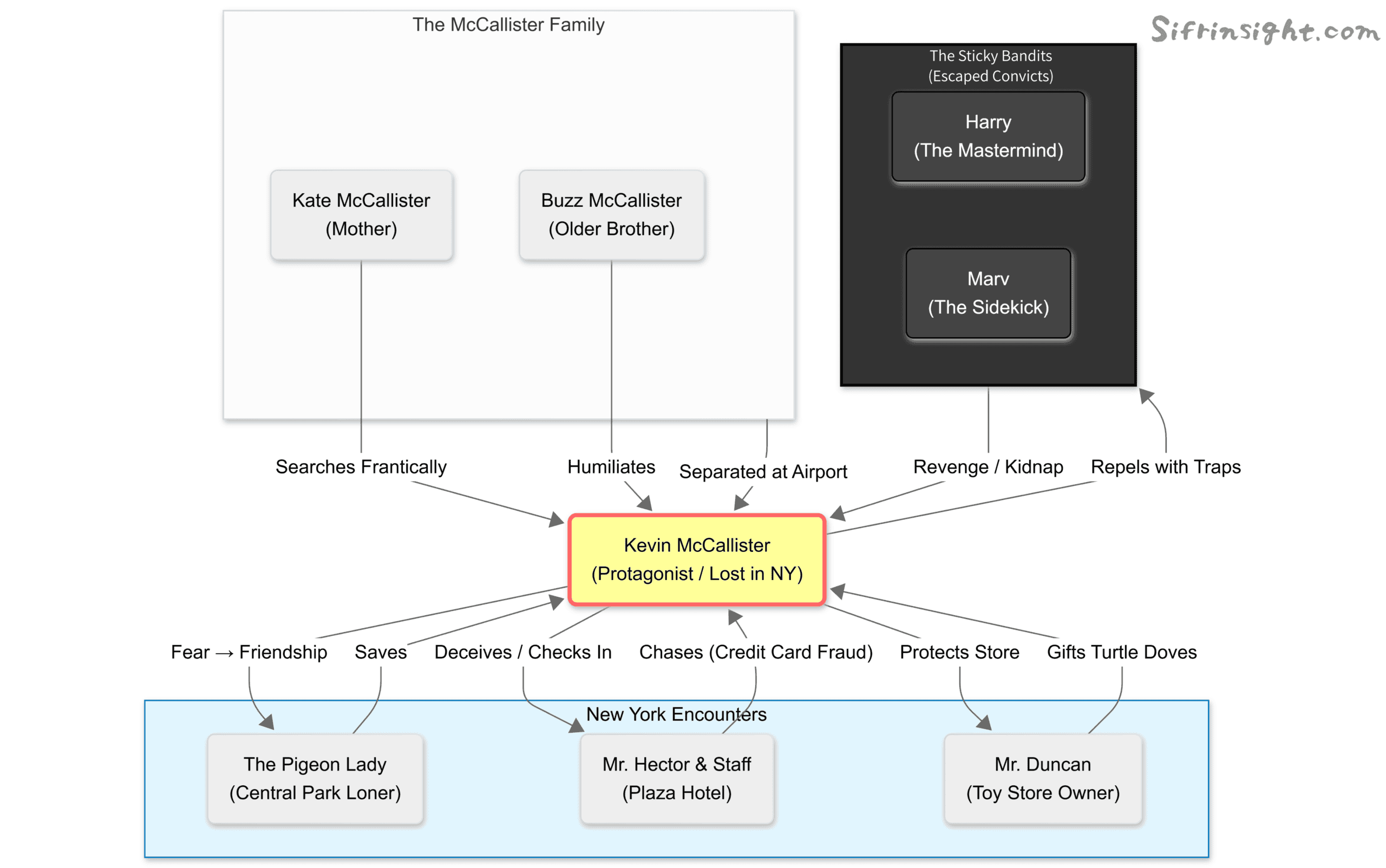
Character Map
[Setup] From Florida Frustration to the Big Apple
The McCallisters are heading to Miami for Christmas. After Buzz humiliates Kevin during a school pageant, Kevin is again punished. This time, he voluntarily goes to the attic, declaring he never wants to see his family again. The next morning, the family makes it to the airport, but Kevin loses sight of them while changing batteries for his recorder. He accidentally follows a man wearing an identical coat onto a flight to New York.
[Development] The Ultimate NYC Vacation
Kevin realizes he is in New York and decides to make the most of it. Using his father’s credit card and a voice-changing tape recorder, he checks into the Plaza Hotel. He spends his days eating cheese pizza in limousines and visiting world-famous toy stores. However, the hotel staff, led by a suspicious concierge, eventually flags his credit card as stolen. Kevin narrowly escapes the hotel and finds himself alone in the freezing, dangerous streets of the city.
Spoilers ahead (The Toy Store Heist ~ Ending). Click to read
[Twist] The Toy Store Siege
Kevin discovers that Harry and Marv are planning to rob “Duncan’s Toy Chest” on Christmas Eve. Knowing the proceeds are intended for a children’s hospital, Kevin takes it upon himself to stop them. He lures them to his Uncle Rob’s townhouse, which is currently a gut-renovated construction site. The traps this time are escalated to near-lethal levels—including falling bricks, electrified sinks, and kerosene explosions. After a grueling battle, Kevin leads them to Central Park where the “Pigeon Lady” helps him secure the burglars for the police.
[Conclusion] A Gift for the Goddaughter
Kate tracks Kevin to his favorite spot: the Rockefeller Center Christmas tree. They reunite and spend the night at the Plaza with the rest of the family. In the morning, Mr. Duncan sends a truckload of gifts to the family in gratitude for Kevin’s heroism. Kevin sneaks out to give a “turtle dove” ornament to the Pigeon Lady, symbolizing their eternal friendship. But the sentimental moment is cut short by his father’s roar from the hotel room, discovering the massive bill Kevin racked up on room service.
The Pigeon Lady serves as the emotional counterpart to Old Man Marley. While Kevin’s fear of Marley was learned from Buzz, his fear of the Pigeon Lady was an internal prejudice he had to overcome himself. Their friendship represents a deeper level of moral maturity for Kevin.
Deep Analysis: Loneliness, Absurdity, and the Child’s Mind
-
The Resonance of Childhood Absurdity
The story hooks us by tapping into the universal “absurdity” of being a child: being punished for things you didn’t do and feeling invisible in your own home. By reversing this loneliness into power, the film offers the ultimate cathartic fantasy. -
Fear as a Construct
The “villains” of the films aren’t just the burglars; they are the illusions of fear Kevin creates—the basement furnace, Marley, and the Pigeon Lady. Kevin’s growth is defined by his ability to dismantle these mental monsters. -
The Problem of Violent Comedy
While the physical comedy is legendary, modern audiences sometimes struggle with the level of violence. However, the film successfully justifies this through a “self-defense” narrative, framing Kevin as a pint-sized enforcer of divine justice. -
Home Alone 2: The Radicalized Sequel
The sequel pushes the violence to the edge of reality. While less narratively tight than the first, its precision in plot setups and its sheer scale make it a masterpiece of the “bigger and louder” sequel trope.
The Absurdity That Drives the Narrative
Looking back as an adult, the primary reason Home Alone resonates so deeply is its authentic depiction of the “absurdity” of childhood. The opening scenes are genuinely frustrating: Buzz’s unrepentant bullying and the parents’ dismissal of Kevin’s feelings. This creates an immediate, visceral bond between the audience and Kevin.
The film then takes that “loneliness of being ignored” and flips it into a “loneliness of sovereignty.” In the first movie, Kevin is king of his house; in the second, he is a “god” in New York, outmaneuvering professional hotel staff. It is a brilliant structural reversal that fulfills every child’s desire for agency.
The World of Illusions
A secondary theme is the dismantling of childhood “illusions.” Kevin is haunted by three primary fears:
- The demonic furnace in the basement.
- The “Shovel Slayer” (Marley).
- The “Pigeon Lady.”
The basement furnace is the most telling. There is no logical reason for a furnace to be scary, yet for a child, it is a monster. This is a pure “childhood illusion.” Kevin’s arc is about conquering these illusions. By the end of the film, the furnace is just a machine, and the scary neighbors are his most trusted allies. The story starts with absurdity forced upon Kevin by others and ends with Kevin conquering the absurdity he created himself.
Violence and the Comedy of “Divine Punishment”
The “Kevin vs. The Bandits” sequences are essentially R-rated Looney Tunes. In today’s hyper-sensitive climate, some critics view the violence as problematic. However, Home Alone protects itself by ensuring its “bad guys” are cartoonishly resilient and unequivocally evil. Kevin isn’t an aggressor; he is a defender of the “sacred” home and the “charity” of the toy store. This moral justification allows the audience to laugh at the brutality without guilt.
Home Alone 2: A Sequel on the Verge of Collapse
While the first film is a perfectly structured coming-of-age story, Home Alone 2 is a radicalized escalation. Let’s be honest: If you drop a brick from a four-story roof onto a man’s head, that man is dead.
The violence in the sequel is so extreme that it moves away from “comedy” and into the realm of “surreal horror.” If a third movie starring Macaulay Culkin had been made, the burglars would have had to be supernatural entities to survive. However, the sequel’s “runaway” nature—its refusal to play it safe—is exactly why it remains a cult classic. It takes the formula of the first film and pushes it until it almost breaks, resulting in a chaotic, high-energy holiday masterpiece.
Ultimately, the Macaulay Culkin Home Alone films are more than just comedies; they are explorations of the resilience of children in a world that often ignores them. They remind us that even when we are small and afraid, we have the power to dismantle our own monsters.
Want more Home Alone secrets? Check out our behind-the-scenes guides:
Shocking Trivia: The Fake Movie and the Munch Inspiration
Home Alone 2 Secrets: Why Donald Trump was forced into the movie




Reader Comments