
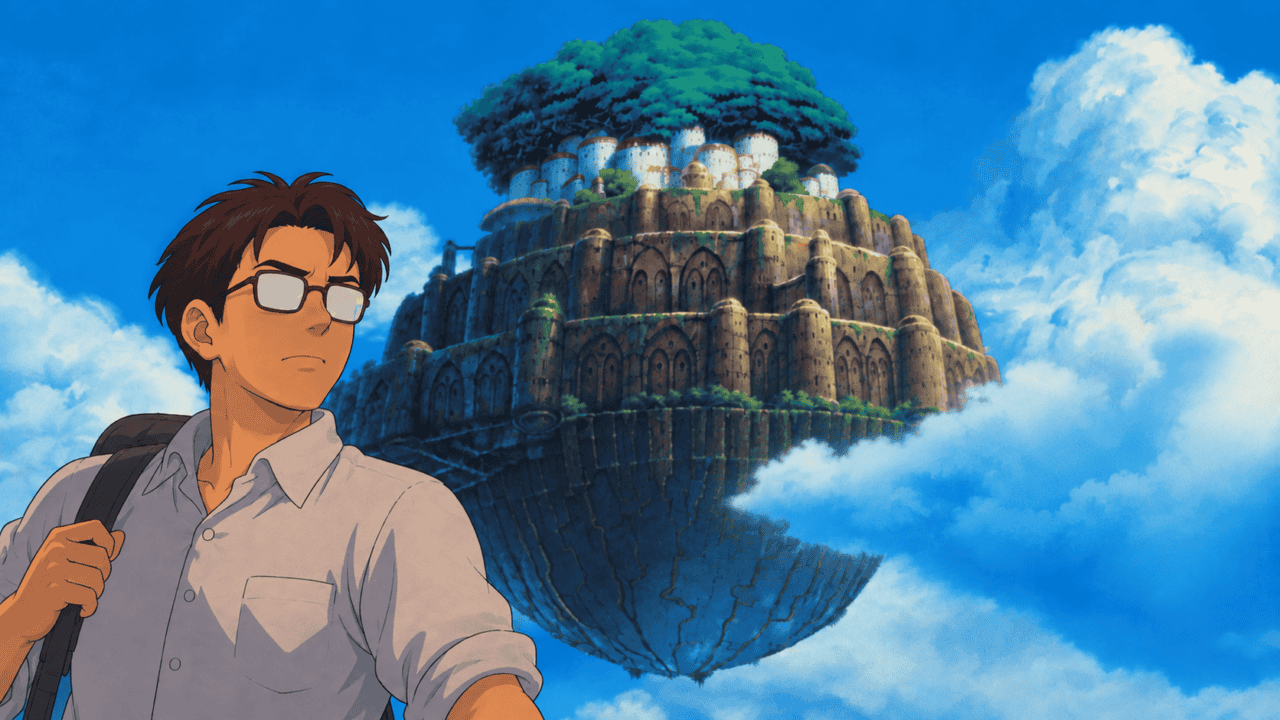
Hayao Miyazaki’s 1986 film Castle in the Sky(Studio Ghibli Official) is, I think, one of his most popular works. It was probably the Miyazaki film I watched most often as a child. Here, I want to consider one of my favorite Pazu lines: “The wind there is blowing in the wrong direction.”
It is hard to believe that such a remarkable animated film was made in about a year, following Studio Ghibli’s establishment in 1985. Hirokatsu Kihara (Wikipedia, in Japanese), then a production assistant, wrote about that period in his behind-the-scenes book Another “Balse” (もう一つのバルス, in Japanese).
For some reason, that line has stayed with me since childhood. Why does it move me so much? Let’s begin by thinking about Pazu’s life.
*This is a translated version. The original (Japanese) is available here.
- The Boy Who Built an Airplane at Night
With no one believing his father’s claim to have seen Laputa, Pazu devotes his nights to building an ornithopter. I read his efforts as an expression of his desperate wish to believe his father. - The Validation of Sheeta and Uncle Pom
When Sheeta descends from the sky, accompanied by Uncle Pom’s deep knowledge of the Levistone and Sheeta’s secret royal name, Pazu finally secures concrete proof that the legendary floating city exists. - “The wind there is blowing in the wrong direction.”
Confronting the terrifying Dragon’s Nest, Pazu witnesses the exact meteorological anomaly his father described. This cements his belief, leading to the emotionally explosive realization that his father truly found Laputa. - The Roles Uncle Pom Takes On
Uncle Pom is described as a descendant of Laputa’s working class. I think he also takes on a role that might otherwise have belonged to the man who saw Laputa with Pazu’s father, allowing the film to keep its cast small.
On this pageContents
Castle in the Sky (1986): Pazu Before the Adventure
Pazu’s everyday life and his memories of his father give his words about the wind a personal weight. They also help explain what the adventure changes for him.
The Lonely Nights Building an Ornithopter
To understand Pazu, we need to look at the homemade airplane—the ornithopter—in his house. After a hard day’s work under his boss, he spends his nights building it. One remark about his father is crucial to understanding why he puts himself through such an exhausting routine:
“My father was treated like a fraud and died.”
Pazu says this so casually that it is easy to let it pass. Yet it must have been a hard truth for him to live with as a child. Imagine a situation in which no one believes what your father says.
Could Pazu have believed his father’s story without a trace of doubt? Perhaps he did at first, just after his father returned. But as he grew older, remembering the cold response around him, it would have been natural for him to question his father’s words.
Seen this way, I think Pazu works on the ornithopter night after night, fighting off sleep, not because he already believes his father, but because he wants to believe him.
Miyazaki’s characters do not show their pain, not because they feel none, but because they do not make a display of it. Pazu is a fine young man, too. But shouldn’t we recognize the suffering behind that smile?
The Miracle of Sheeta and the Wisdom of Uncle Pom
How thrilling it must have been for Pazu, after those difficult days, to see Sheeta fall from the sky. That must have been the moment when what he wanted to believe became something that might actually be true.
I think this helps explain why he tries so hard to protect Sheeta. If he can discover why she fell so slowly from the sky, he might recover his father’s good name—and perhaps reclaim his own life. That would make his motives entirely self-interested, but I find them easier to understand than “love at first sight.”
Eventually, Pazu learns Sheeta’s secret name: “Lusheeta Toelle Ul Laputa.” How many people has she told it to? He may not be the first, but surely the number is small enough to count. His determination to find Laputa has drawn the word “Laputa” from her. His face lights up, and he shouts, “Alright, let’s do it!” Of course he does. But even before that scene, he has already heard some crucial testimony from Uncle Pom.
Uncle Pom says the rocks are stirring because Laputa is passing overhead. Again, imagine how many adults around Pazu have ever spoken of Laputa as a real place. Surely none. Some may have said kind things to him, but his remark that his father died being treated as a fraud suggests otherwise. Uncle Pom was probably the first adult to affirm Laputa’s existence. I imagine Pazu was delighted.
By piecing together these three crucial elements:
- Sheeta falling from the sky
- Uncle Pom’s testimony
- Sheeta’s secret, royal Laputian name
These three things must have changed Laputa, for Pazu, from something he wanted to believe in into something whose existence he could be sure of.
Yet, proving the island exists is only half the battle.
Castle in the Sky (1986): Decoding Pazu’s Unforgettable Wind Quote
Sheeta and Uncle Pom seem to have made it possible for Pazu to believe in Laputa. But there is still a considerable gap between knowing that Laputa exists and knowing that his father saw it.
Then Pazu sees the decisive sign. “The wind there is blowing in the wrong direction.” At that moment,
How can we imagine Pazu’s excitement on seeing the Dragon’s Nest? The treasure his father spoke of, which everyone had dismissed, is right in front of him. And the words his father left him—“The wind there is blowing in the wrong direction”—prove that his father really saw it.
At this moment, Pazu is invincible. What he kept trying to believe, through all that hard work, has turned out to be true.
Then comes the line I cannot watch without tears:
With these words, he persuades the Tiger Moth’s crew—though he has already earned their trust through his work. The people aboard the Goliath foolishly follow the Levistone’s light and Muska’s orders, but Pazu truly believes Laputa is there, and that he can return from it. For me, it is a scene that brings tears every time.
That is why I love the line “The wind there is blowing in the wrong direction.” You did well, Pazu!
For the original Japanese, romanization, English subtitle, and literal translation of this line, see our complete guide to memorable quotes from Castle in the Sky.
Castle in the Sky (1986) Appendix: The Mystery of Uncle Pom
In the book introduced earlier, Another “Balse” (もう一つのバルス, in Japanese), Hirokatsu Kihara recalls Miyazaki asking him during production, “Kihara-kun, do you understand how important Uncle Pom is?” Kihara’s answer was excellent:
“Uncle Pom is a descendant of the Laputians… Is that… wrong…?”
[Omitted]“Sheeta is a descendant of the Laputians, and Muska is also a descendant of royalty. The story has these two in a chase centered around the Levistone, but I thought there should be one more Laputian from the working class, who used to mine the stones, grounded in the story.”
Their exchange continued, but Kihara managed to answer Miyazaki’s barrage of questions.
Kihara’s explanation makes perfect sense, yet I would never have noticed it without his pointing it out. I nod along, feeling rather foolish, but then find myself thinking, “Isn’t there another reason Uncle Pom matters?” In a fit of entirely pointless rivalry with Kihara, I want to explore that possibility.
As I argued earlier, Uncle Pom gives Pazu crucial testimony. But there is someone else who ought to have done that: the bearded man who saw Laputa with Pazu’s father. It seems very strange that he never appears in Castle in the Sky. This does not mean Uncle Pom is that man—their ages simply do not fit.
If that man had appeared, what would he have done? Perhaps his role would have been to tell Pazu that he really did see Laputa.
Of course, he ought to have stood by Pazu’s father when everyone doubted him. But faced with such overwhelming disbelief, it would have been hard to insist, “I really saw it!” And the memory of failing to tell the truth might have troubled him.
I imagine he could have appeared as a man haunted by his failure to do what he should have done, when he should have done it—now determined to tell Pazu the truth.
But, if not quite so directly, isn’t that what Uncle Pom does?
This takes us slightly off the subject, but there are other people who, for some reason, never appear in Castle in the Sky.
Pazu’s mother, the bearded man, and Dola’s lover, for example.
Pazu’s mother and Dola’s husband appear only in photographs. Dola’s lover is even harder to find, and even if you spot his picture, you would not know who he is. It is hidden in a jewelry box beneath the familiar picture of a young Dola in her cabin.
Leaving Dola’s lover aside, it still seems strange that Pazu’s mother and the bearded man never appear.
Why leave them out? Because including them would scatter the story in too many directions, making it hard to fit into a film of about two hours.
Kihara’s Another “Balse” (もう一つのバルス, in Japanese) has something important to say about this, too.
An early storyboard for the scene in which Dola takes Sheeta into her cabin showed a photograph of a young Dola beside a mysterious man seated in a chair. When Kihara asked who he was, he heard that the man had invented the Flaptters and was a priest. The storyboard even called him “Dola’s lover.” Miyazaki then said:
“But suddenly introducing this person here—who is he? It won’t work if he doesn’t actively drive the plot forward. So, we’re cutting this.”
The film was made by cutting away various elements. Pazu’s mother and the bearded man, too, would have had no active role in the story.
To return to Uncle Pom: he may indeed be a descendant of Laputa’s working class, but I think he also carries a role that should have belonged to the bearded man.
By introducing Uncle Pom, the film avoids the inconvenience of adding another character. I think this may be another reason he matters. Perhaps other “Uncle Pom-like” figures are hidden elsewhere, carrying similar roles that we have not noticed.
Your Take
What is your view? Choose the answer that comes closest to your own response.
Reader poll
The images used in this article are from Studio Ghibli Works Still Images.
Can you name the movie before the scene comes into focus?
Put your visual memory to the test with a blurred Studio Ghibli scene.

Reader Comments
Have a thought or interpretation? Leave a comment