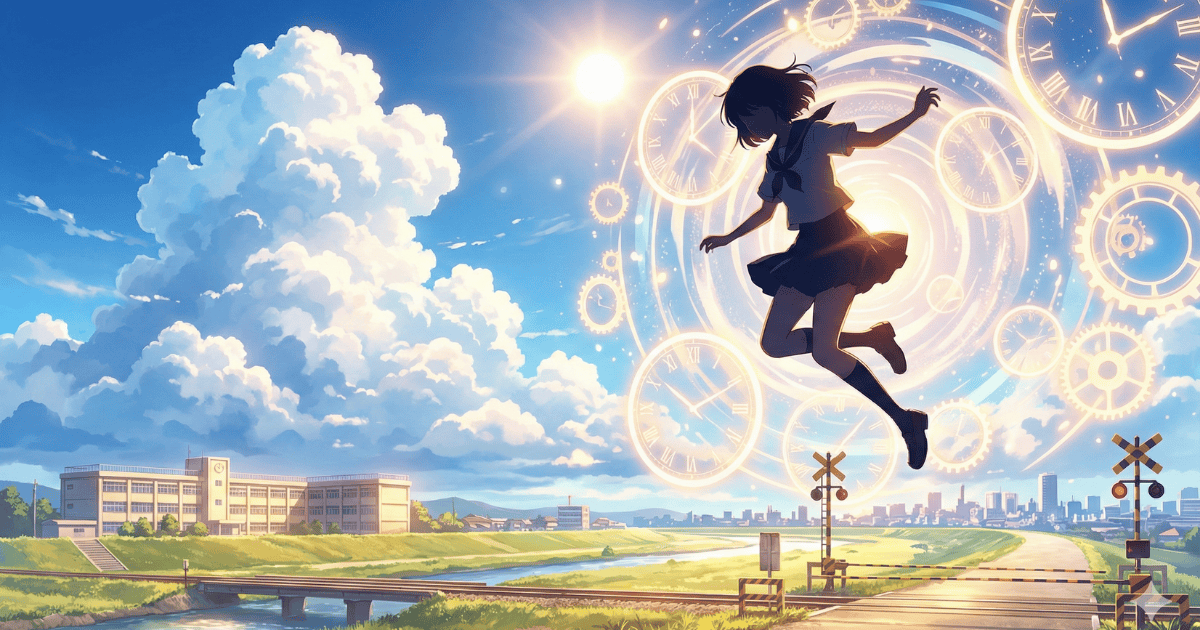
The Girl Who Leapt Through Time (Official Website) is a stunning feature-length animated film directed by Mamoru Hosoda, released on July 15, 2006. It serves as a spiritual sequel to Yasutaka Tsutsui’s classic science fiction novel of the same name. Hosoda’s adaptation introduces a new narrative featuring Makoto Konno, the niece of the original novel’s protagonist. (The timeline of the original work has also been subtly shifted; for details, please refer to the “Outline of the Original Novel and Differences” section below.)
The film brilliantly captures the essence of youth, depicting Makoto—a fiercely energetic high school girl who accidentally acquires the ability to “Time Leap”—as she navigates the agonizing growing pains of friendship, first love, and unavoidable farewells.
In this article, I will provide a thorough, chronological breakdown of The Girl Who Leapt Through Time. This includes a spoiler-free synopsis for newcomers, followed by a highly detailed plot summary up to the ending (with major spoilers) for those looking to revisit the magic. Furthermore, we will dive deep into a thematic analysis of the story, exploring the hidden message behind the mysterious painting and addressing some of the “plot holes” left lingering in the sci-fi mechanics.
First, let’s review the basic production information.
*This is a translated version. The original (Japanese) is available here.
On this pageContents
The Girl Who Leapt Through Time (2006): Basic Information
Film Overview
| Release Date | July 15, 2006 |
|---|---|
| Director | Mamoru Hosoda |
| Original Work | Yasutaka Tsutsui |
| Screenplay | Satoko Okudera |
| Character Design | Yoshiyuki Sadamoto |
| Music | Kiyoshi Yoshida |
| Theme Song | Hanako Oku “Garnet” |
| Production | Madhouse |
| Running Time | 98 Minutes |
Main Characters and English Voice Cast
| Character | Voice Actor (English Dub) | Character Overview |
|---|---|---|
| Makoto Konno | Emily Hirst | The protagonist. A tomboyish second-year student at Kuranose High School. She accidentally acquires the ability to “Time Leap.” She is relentlessly cheerful but highly impulsive, often acting without considering the consequences. |
| Chiaki Mamiya | Andrew Francis | A laid-back transfer student who arrived in the spring. He forms an inseparable trio with Makoto and Kosuke. He hides a massive secret beneath his aloof, popular exterior. |
| Kosuke Tsuda | Alex Zahara | Makoto’s classmate. The son of a wealthy family of doctors, he is a brilliant student aspiring to enter medical school. He serves as the mature, responsible anchor for Makoto and Chiaki. |
| Kazuko Yoshiyama | Saffron Henderson | Makoto’s enigmatic aunt who restores classical paintings at the Tokyo National Museum. Makoto affectionately calls her “Auntie Witch.” She is the protagonist of the original 1960s novel. |
| Kaho Fujitani | Natalie Walters | A shy, plain underclassman in the volunteer club. She harbors a deep, secret crush on Kosuke. |
| Yuri Hayakawa | Kristie Marsden | Makoto’s friend and classmate. She develops a crush on Chiaki, which severely complicates the trio’s dynamic. |
Character Map

Quick Synopsis (Spoiler-Free)

Makoto Konno is a profoundly average, tomboyish second-year high school student living in Tokyo. She spends her idyllic summer days playing baseball and cracking jokes with her two best friends: the studious Kosuke and the aloof transfer student Chiaki. They exist in that perfect, fleeting bubble of adolescence.
However, on the afternoon of July 13th, Makoto’s reality shatters. While returning notebooks to the school’s empty science lab, she spots a mysterious, walnut-shaped device on the floor. Startled by a sudden shadow, she trips and falls onto the device. A blinding light engulfs her. When she opens her eyes, she is lying on the floor, unharmed, as if nothing happened.
Later that afternoon, Makoto faces a terrifying, fatal crisis. While racing her bicycle down a steep hill, her brakes completely fail. She plunges directly into a railroad crossing just as a commuter train roars past. In the exact moment she braces for a violent death, she opens her eyes to find herself lying safely at the top of the hill, minutes before the accident occurred. She had quite literally leaped backward through time.
Confused and terrified, she visits her aunt Kazuko at the museum. Kazuko calmly informs her that she has experienced a “Time Leap,” noting casually that “it’s common for girls your age.” Encouraged by her aunt’s nonchalance, Makoto begins to experiment. She discovers that by taking a running start and physically launching herself into the air, she can rewind time.
Intoxicated by this newfound superpower, Makoto begins exploiting the Time Leaps to create the perfect, invincible high school life. She aces pop quizzes, avoids embarrassing mistakes in cooking class, and sings karaoke for ten hours straight. But as she selfishly rewrites her days to maximize her own happiness, she remains entirely blind to the devastating ripple effects her actions are having on the people around her.
Full Synopsis & Ending (Spoilers Ahead)
The following section contains a highly detailed breakdown of the plot, including the identity of the time traveler, the resolution of the timeline, and the film’s emotional ending. Proceed with caution.
Part 1: The Invincible Summer and an Unwanted Confession
Having mastered her new “Time Leap” ability, Makoto Konno treats the fabric of reality like her own personal playground. By literally throwing herself through the air, she constantly rewinds time to edit out minor inconveniences. She secures perfect test scores, avoids a fire in home economics, and extends her karaoke sessions indefinitely. She is living an invincible, friction-less adolescence.
When she brags about her luck to her wise aunt Kazuko (affectionately known as “Auntie Witch”), Kazuko offers a chilling warning: “Makoto, if you are profiting from this, doesn’t that mean someone else is suffering for it?” Drunk on her own power, Makoto ignores the advice.
The perfect bubble of their trio is threatened one afternoon. Walking home after baseball, Chiaki and Makoto are left alone after Kosuke turns down a confession from an underclassman. In the quiet of the sunset, Chiaki abruptly turns to Makoto and asks, “Makoto… why don’t you go out with me?”
Terrified that a romantic shift will permanently destroy the comfortable dynamic of their friendship, Makoto panics. She immediately initiates a Time Leap to rewind the conversation. She desperately tries to avoid the confession, but Chiaki relentlessly finds new ways to ask her out in every timeline. Ultimately, Makoto abuses her power, aggressively shutting down the conversation before it even begins, forcing Chiaki to drop it. She preserves her comfortable status quo, completely oblivious to the emotional damage she is inflicting.
Part 2: The Butterfly Effect and the Tragedy of Substitution
Because Makoto aggressively erased the confession, Chiaki has absolutely no memory of ever asking her out. However, Makoto retains the memory, leaving her trapped in a state of suffocating, one-sided awkwardness. Meanwhile, the dark reality of her aunt’s warning begins to manifest: the “distortions” caused by her selfish Time Leaps start ruining the lives of her classmates.
Because Makoto used a Time Leap to avoid the frying pan fire in cooking class, a bullied male student was assigned to that station instead, suffering the accident and the subsequent humiliation. Furthermore, Makoto’s best friend, Yuri, who harbors a massive crush on Chiaki, gets injured in a freak accident that Makoto inadvertently caused. Chiaki takes Yuri to the infirmary, and a romance sparks between them. Despite being the one who aggressively rejected Chiaki, Makoto is consumed by intense, irrational jealousy seeing him with another girl.
That evening, while washing her arm in the bath, Makoto makes a horrifying discovery. A glowing digital number “90” (which she realizes in the mirror is actually “06”) is tattooed on her forearm. It is a countdown. Her power is not infinite.
Part 3: The Depleting Counter and the Fatal Mistake
Seeking to play matchmaker, Makoto decides to use her dwindling leaps to help the shy underclassman, Kaho, successfully confess her love to Kosuke. She burns through her remaining jumps, orchestrating the perfect romantic scenario for them. But when she finally checks her arm, the glowing number has plummeted to “01.” She has exactly one Time Leap left.
The timeline she manipulated for Kosuke happens to align with the exact afternoon she first acquired her powers in the science lab. Hoping to catch the mysterious figure who dropped the device, Makoto waits in the lab. To her shock, Yuri enters. Makoto realizes she isn’t the owner of the device.
Suddenly, Makoto’s flip-phone buzzes. It’s a text from Kosuke: “I’m borrowing your bike to ride Kaho home.”
Makoto’s blood runs cold. She remembers that she never fixed the faulty brakes on her bicycle. The exact same lethal accident she narrowly escaped is about to kill Kosuke and Kaho. As Makoto sprints out of the school in a blind panic, Yuri casually mentions, “The person I passed in the hallway just now was Chiaki.”
Racing toward the deadly railroad crossing, Makoto’s phone rings again. It’s Chiaki. He casually asks her a question that shatters her reality: “Makoto… are you leaping through time?”
Terrified that her darkest secret has been exposed, Makoto instinctively panics. Without thinking, she burns her final “01” charge to leap backward a few minutes, completely erasing Chiaki’s phone call.
She successfully avoids his question, but the number on her arm drops to “00.” She is completely powerless. In that exact horrifying second, she sees Kosuke pedaling her broken bicycle down the steep hill, with Kaho sitting on the back. The brakes fail. The crossing barriers drop. The train approaches.
Makoto sprints toward them, screaming for them to stop, but she is too late. She watches helplessly as her two friends are violently thrown into the path of the speeding train.
Part 4: Frozen Time and the Boy from the Future
At the exact millisecond of impact, the world violently loses all its color. The roar of the train ceases. Time completely freezes.
Makoto stands in a silent, monochromatic world. Chiaki casually walks out of the frozen crowd, pushing Kosuke’s bicycle back up the hill, safely away from the tracks. He turns to a weeping Makoto and asks quietly, “If I told you I came from the future, would you laugh?”
Chiaki reveals the truth: he is a time traveler from a distant, bleak future where “Time Leaps” are a scientifically manufactured commodity. The walnut-shaped sphere Makoto found was his lost charging device. Because she exhausted the charges, he was trapped in her era.
He explains his singular, desperate mission: he traveled back to 2006 for the sole purpose of seeing one specific painting—White Plum, Camellia, and Chrysanthemum—currently undergoing restoration by Makoto’s aunt at the Tokyo National Museum. In Chiaki’s dark, dystopian future, the painting was destroyed. He needed to see it with his own eyes before it was lost to history.
However, by triggering a Time Leap to freeze time and save Kosuke from the train, Chiaki consumed his own final, emergency charge. By exposing the reality of time travel to a citizen of the past, he violated the highest law of his era. He can no longer return home, and he can no longer exist in Makoto’s timeline.
As the color slowly bleeds back into the world and time prepares to unfreeze, Chiaki smiles. “See ya.” He vanishes into the bustling crowd, instantly erasing himself from the timeline’s history.
Ending: “I’ll Be Waiting in the Future”
Time resumes. Kosuke and Kaho are safe, but Chiaki is entirely gone. The school simply records his absence as a sudden “voluntary withdrawal.” Makoto is crushed by absolute despair. She wails on the school rooftop, completely broken by the realization that Chiaki sacrificed his only ticket home just to fix her selfish, fatal mistake.
That night, Makoto confesses everything to her aunt Kazuko. Kazuko smiles sadly, revealing that she, too, fell in love with a boy who vanished, promising to return. Kazuko looks at her devastated niece and says, “But Makoto… you aren’t the type of girl who waits around for someone who is late, are you? You’re the type to run toward them.”
Wiping her tears, Makoto looks down at her arm. A miracle has occurred. The glowing “01” has returned. Because Chiaki rewound time to a point before Makoto used her final leap, her last charge was completely restored.
Determined to fix everything, Makoto takes a massive, soaring leap off the rooftop, plunging all the way back to the afternoon of July 13th—the day it all began. She lands in the schoolyard and sprints to the science lab. She finds Chiaki there, who hasn’t yet lost his device or realized she knows his secret.
Makoto returns his device. She promises him that she will personally ensure the painting he loves so much is protected and preserved, guaranteeing that it will survive the centuries so he can see it in his own time.
The time for farewell arrives. Makoto fights back her tears, forcing a smile as she prepares to send him back to the future. She bravely swallows the romantic confession she was too terrified to accept days earlier. As Chiaki turns to leave, he pauses. He walks back, pulls her into a tight embrace, and whispers into her ear: “I’ll be waiting in the future.”
Sobbing, Makoto responds with fierce determination, “I’ll go right away. I’ll run.”
The timeline resets. Chiaki officially withdraws from school to “study abroad.” While Kosuke is bewildered by the sudden departure, Makoto stares up at the towering, brilliant summer clouds. She smiles and says, “He finally decided what he wants to do.” In her heart, she knows she has found her own purpose. The film ends on a note of infinite, beautiful hope.
Analysis: The Hidden Message in the Painting

- Connecting the Lore: Auntie Witch and the 1983 Film
Hosoda’s film operates as a brilliant stealth sequel to the original 1960s novel. Aunt Kazuko is the original protagonist. While her memories were tragically erased in the book, Hosoda alters the lore: Makoto retains her memories, gifting her with a fiercely proactive “reason to step into the future.” - The Metaphor of the Painting
The fictional painting, White Plum, Camellia, and Chrysanthemum, was created during a time of apocalyptic war and famine. It symbolizes the indomitable power of “human creation” and “hope.” The director’s message is clear: even in our darkest eras, we must never stop creating, because our art will transcend time and save someone in the future. - Decoding the Final Promise
Physically, Makoto and Chiaki will never reunite; the centuries between them make it impossible. However, the promise “I’ll be waiting in the future” refers to a spiritual reunion. If Makoto protects the painting in the present, and Chiaki views it hundreds of years later, their souls will reunite through the canvas. - The Sci-Fi Plot Holes
The film entirely ignores basic sci-fi logic. For instance, Makoto’s clothes change when she leaps (implying only her consciousness travels back), yet Chiaki exists as a physical, biological time traveler. We must accept these gaps as the necessary, messy mechanics of a fairy tale.
The Double Time Slide: Understanding the Source Material
To fully grasp the depth of Hosoda’s film, we must understand its relationship with Yasutaka Tsutsui’s original 1967 novel. The protagonist of the original book is none other than Kazuko Yoshiyama—Makoto’s “Auntie Witch.”
A brief summary of the original 1967 plot:
Junior high student Kazuko Yoshiyama gains the power to time travel after inhaling the scent of lavender in the science lab. She discovers her classmate, Kazuo Fukamachi, is actually a time traveler from the year 2660 AD, visiting the past to harvest medicinal herbs. Before returning to the future, Kazuo complies with future laws and entirely erases Kazuko’s memory of him. Stripped of her memories but left with a lingering, subconscious ache, Kazuko lives her life perpetually waiting for a boy whose name she cannot remember, haunted only by the faint scent of lavender.
The crucial difference in Hosoda’s adaptation is that Makoto does not have her memories erased. This drastically shifts the narrative from a passive, melancholic tragedy into an active, empowering coming-of-age story.
Furthermore, the timeline is highly convoluted. Tsutsui’s novel was published in 1967. Hosoda’s film is set in 2006. If Aunt Kazuko experienced her time leap in 1967, she would be nearly 60 years old in the anime, which clearly doesn’t match her youthful design. This heavily implies that Hosoda structured his lore not on the novel, but on the famous 1983 live-action film adaptation directed by Nobuhiko Obayashi, which shifted Kazuko’s youth into the 1980s.
While officially an adaptation of the novel, if you want to understand the exact backstory of Aunt Kazuko, watching the 1983 Obayashi film provides the perfect contextual prequel.
The Meaning of the Painting: The Power of Creation
If we treat the time-travel mechanics as a mere narrative device (which they are), the true philosophical anchor of the film is the painting: White Plum, Camellia, and Chrysanthemum.
This is not a real historical artifact; it is a fictional painting created specifically for the film by the late animator Toshio Hirata. But why is it the most important object in the movie?
Consider what Aunt Kazuko says about its origins:
“This painting was created during an era of historic great wars and famines hundreds of years ago. I wonder how someone could paint something so beautiful when the ‘world’ was about to end.”
(Original Text in Japanese)
「この絵が描かれたのは、何百年も前の歴史的な大戦争と飢饉の時代。『世界』が終わろうとしてた時、どうしてこんな絵が描けたのかしらね。」
Now pair that with Chiaki’s description of his dystopian future:
“I saw a river flowing on the ground for the first time. I rode a bicycle for the first time. I learned for the first time that the sky is so wide. Above all, I saw a place with so many people for the first time.”
(Original Text in Japanese)
「川が地面を流れているのを初めて見た。自転車に初めて乗った。空がこんなに広いことを初めて知った。何よりこんなに人がたくさんいるところを初めて見た。」
Chiaki’s future is an apocalyptic wasteland. Rivers are dry, the skies are likely choked with smog, and humanity has been decimated. Living in absolute despair, Chiaki found salvation in historical records of a single painting—a painting created by an unknown artist who was also living through an apocalypse centuries earlier.
Therefore, the painting symbolizes the absolute, indestructible power of “human hope” and “artistic creation.”
The unknown artist refused to succumb to the despair of war. They poured their hope for a better tomorrow onto a canvas. Centuries later, that exact same hope transcended time and space to pierce the heart of a boy living in a dead future. It is a stunning metaphor for the power of art.
The core message of the film is a roaring command from Hosoda: “Never stop creating. Never stop your activities. Even in the darkest times, your actions today will transcend time and save someone in the future!”
This is why Makoto retaining her memory is so vital. She isn’t passively waiting like her aunt. She has a mission. She must become a restorer or curator to ensure that painting survives the centuries so Chiaki can one day look at it.
Decoding the Tragic, Beautiful Promise
When Chiaki embraces Makoto and whispers, “I’ll be waiting in the future,” it is a masterclass in tragic romance. Logically, it is completely impossible for them to ever physically reunite.
Chiaki comes from an era where time travel was invented. Based on the lore of the original novel, he is likely from the 27th century. Makoto will be dead and buried centuries before Chiaki is even born.
But we must look past the physical limitations of the flesh.
Makoto promises to protect the painting. If she succeeds, she is ensuring that the canvas survives the apocalypse. When Chiaki finally stands in front of that painting in the 27th century, he will not just be looking at art; he will be looking at Makoto’s soul.
Her devotion will literally reach across the centuries to touch him. It is a spiritual reunion achieved through the preservation of art. It is one of the most profoundly beautiful, bittersweet endings in cinematic history.
A Note on the Sci-Fi Plot Holes
While the emotional logic of the film is flawless, the sci-fi mechanics are undeniably messy.
For example, when Makoto leaps, her clothes magically change to match the timeline (e.g., leaping from home in her pajamas and arriving at school in her uniform). This strongly implies a Quantum Leap style of time travel, where only her consciousness is transmitted back into her past body.
However, if only consciousness travels, how is Chiaki physically present in 2006? He wasn’t born yet; he has no past body to inhabit. He had to travel physically, Terminator-style. The mechanics contradict each other entirely.
Furthermore, when Chiaki erases himself from the timeline, the school administration formally announces he “transferred abroad to study.” How could they possibly have the paperwork for a boy who just wiped his own existence from the week? Did the time device hack the school board’s filing cabinets?
These plot holes are glaring if you look for them. But honestly, dwelling on them misses the point entirely. The time travel is merely a magical vehicle designed to deliver a profound story about youth, regret, and the power of art.
This concludes my extensive breakdown of The Girl Who Leapt Through Time. While many hail it as Hosoda’s absolute best, my personal bias will always lean slightly toward the chaotic family dynamic of Summer Wars.
However, the emotional resonance of Makoto and Chiaki’s final goodbye is undeniable. What did you take away from their tragic romance? Did you find the ending devastating, or beautifully hopeful?



Reader Comments