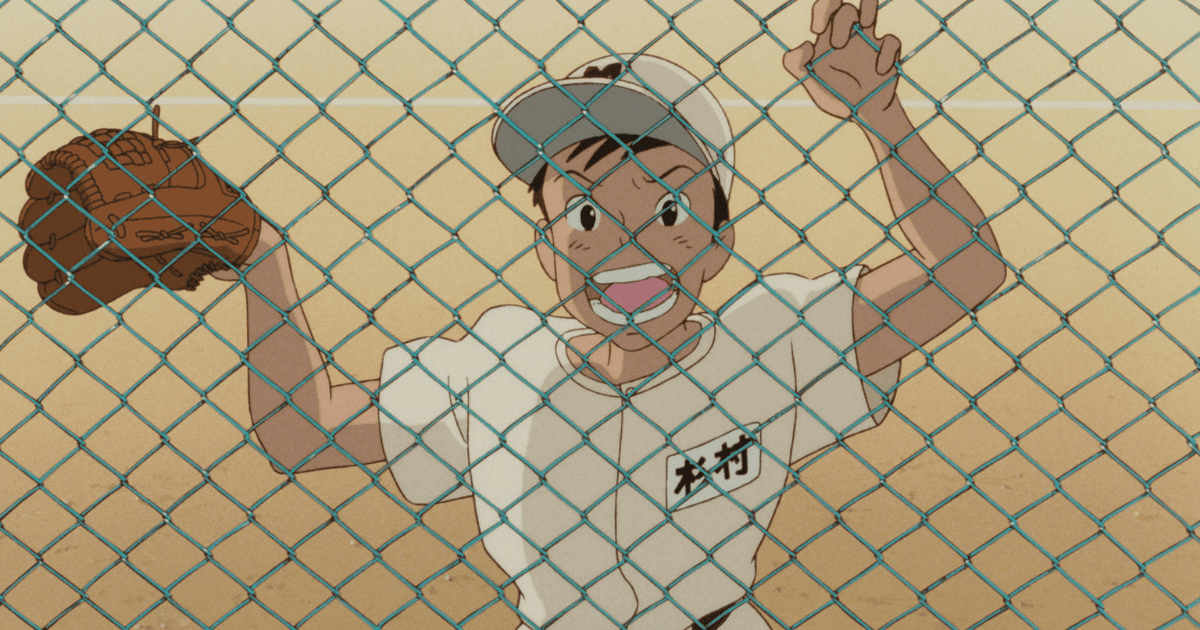
Whisper of the Heart(Studio Ghibli Official) is a 1995 animated feature directed by Yoshifumi Kondo. I was still in elementary school when it came out, but somehow I couldn’t get interested enough to see it at the cinema.
Years later, I learned that On Your Mark had been shown alongside it and was filled with regret. I want to reach back in time and punch my younger self.
Despite that lingering regret, Whisper of the Heart is now a film I love. I no longer remember when I first watched it, but I want to consider why I came to like it so much.
Let’s begin with our beloved supporting character, Sugimura: the idiot who confesses to Shizuku Tsukishima and goes down in flames, oblivious to the classmate who likes him. Yet I cannot look away from him.
Perhaps that is because I, too, played third base on my junior high baseball team. More importantly, though, I think Sugimura is part of the very foundation of Whisper of the Heart. Let’s work through that idea.
*This is a translated version. The original (Japanese) is available here.
- A Story Seen Through Shizuku’s Eyes
Changes to a library checkout card and the way Sugimura is drawn can be read as expressions of the film’s “shojo-manga subjectivity.” - Sugimura: The “Unimportant” Character
His apparently left-handed play at third base and his changing sports bag suggest a character outside Shizuku’s field of interest. - The Audience Shares Shizuku’s Perspective
When we overlook Sugimura’s small changes, we follow the story as Shizuku does, ignoring his changing feelings. - Why Sugimura “Lost” to Seiji
Seiji takes an interest in Shizuku and reads voraciously, while Sugimura appears not to know what she likes. I read their different approaches as part of the reason for his defeat.
On this pageContents
Whisper of the Heart (1995) Analysis: Sugimura and the Shojo Manga Lens
Reading Ghibli Textbook 9: Whisper of the Heart (ジブリの教科書9:耳をすませば, in Japanese), we learn that one question behind the film’s production was: “What does it mean to adapt shojo manga into a film?” Such concerns can be difficult to understand from our position as the people for whom films are made.
Shojo manga (少女漫画) refers to Japanese manga aimed primarily at girls. In the visual convention discussed here, flowers may surround someone who looms large in the protagonist’s feelings, expressing a subjective response rather than something literally present in the scene.
Shojo manga had already been adapted into anime, including films. Perhaps “making a film” means something quite different to filmmakers than it does to us. Still, rather than stopping at “I don’t understand,” I want to think it through for myself.
My starting point is that adapting the “extreme subjectivity” of shojo manga may have been one of the filmmakers’ concerns. Think of those flowers that appear around a character who means something overwhelming to the protagonist. What matters is that some characters never get flowers. It is a harsh distinction: the protagonist’s perspective separates what matters from what does not. How might Whisper of the Heart achieve something similar?
The Library Card: Shizuku’s Subjective World
Early in the film, Shizuku looks at a library checkout card.
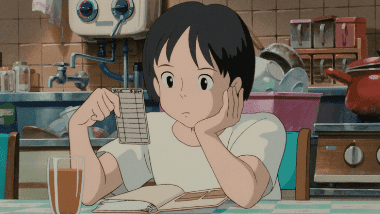
She finds the name “Seiji Amasawa.” The card is for The Adventures of Usagi-go, and his name appears on the first line, with June 28 as the borrowing date and July 5 as the return date.
Remembering the same name on other cards, Shizuku returns to her room to check her books. Three cards appear in close-up: Battle of Fire, Luu of the Lizard Forest (5), and The Adventures of Usagi-go.
Watch Luu of the Lizard Forest (5). Earlier, Seiji’s name was on the second line, with the same June 28 and July 5 dates. But when we see the card again, his name is on the fourth line, and the dates are July 26 and July 28.
An animation mistake? Surely not. I am convinced this is deliberate.
I read the scene as the film announcing, “This is Shizuku Tsukishima’s subjective story.” At that moment, the important thing to her is the name “Seiji Amasawa”; the other information does not matter. Brushing aside what does not matter is part of the shojo-manga perspective I am describing. The film seems to be telling us, “This is how we are going to do it.”
Sugimura: Someone Who Does Not Matter to Shizuku
Having made that declaration through the checkout cards, the film puts it into practice almost immediately, in the scene below.
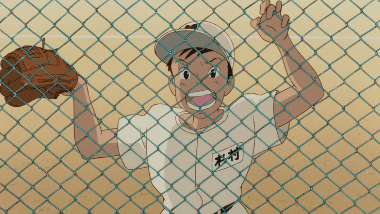
Anyone who knows a little baseball should find something odd here. Sugimura wears number 5, the number associated with third base, but his glove is on his right hand. That would make him a left-handed thrower: you throw with your dominant hand.
For anyone unfamiliar with baseball, a left-handed third baseman makes no sense in the usual defensive arrangement. An infielder needs to get the ball to first base quickly. A left-hander must turn before making that throw, losing time, which is why these positions are normally played right-handed. So why is Sugimura drawn this way?
An animation mistake? Surely not. He could, of course, wear number 5 and happen to play another position. But the storyboards say “Number 5, Third Baseman”—I bought the book just to check this. The filmmakers could hardly be ignorant of baseball, once Japan’s most popular sport. Everyone knows which hand Shigeo Nagashima wore his glove on. At least someone on the team must have known.
In my reading, this is “Sugimura as Shizuku sees him.” Her attitude amounts to: “Sugimura is my friend, but I have no interest in this sport called baseball. Its details do not matter to me.” This one scene tells us that Sugimura will never have shojo-manga flowers around him.
This is not his first appearance. Just before it, we see him from behind, wearing his glove on his left hand: Sugimura is, after all, right-handed. It is also interesting that Yuko’s father watches baseball on television while he and her mother are fighting. Sugimura remains someone who does not matter to Shizuku.
Of course, the story’s structure makes Sugimura’s feelings for Shizuku clear from the start. What matters in Whisper of the Heart is that this is also conveyed through the images themselves. Perhaps that is one aspect of turning shojo manga into film—or so I think.
Sugimura’s Sports Bag
That is essentially my conclusion, but there is a little more I want to discuss. I once looked through the film for clues to Sugimura’s dominant hand, and several scenes offer possible evidence.
On a rainy morning during the exam period, Shizuku calls out to him as he walks to school. He holds his school bag in his left hand and his umbrella in his right. Since people generally hold umbrellas in their dominant hand, this suggests he is right-handed. During an exam, he also holds his pencil in his right hand.
The pencil alone is not conclusive: some people use their right hand only for writing. But another curious moment comes just before the confession scene.
Sugimura approaches Shizuku carrying a large sports bag, presumably containing baseball equipment, in his left hand. Why use that hand when his right is empty? To me, the answer is that he has entered “Shizuku’s subjective world.” For her, which hand holds the bag does not matter. After she turns him down, he walks away holding it in his right hand. At that point, the camera shows both characters, rather than staying within her perspective.
Later, Shizuku and Sugimura run side by side through the rain, apparently late for school.
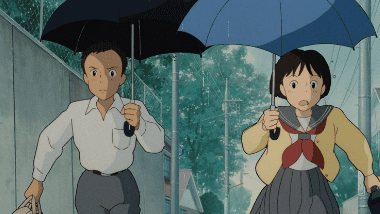
He now holds his umbrella in his left hand and the larger, heavier bag in his right—another indication that he is right-handed. But by now the hand is not the important thing. The sports bag itself has changed: it is much smaller than before.
I wonder: how many viewers noticed that the bag had changed?
Perhaps, after Shizuku rejected him, Sugimura needed a fresh start and changed his sports bag. It is easy to miss on a first viewing. Yet I think Whisper of the Heart is so carefully constructed around her perspective that we share it by completely overlooking the changes in Sugimura.
And why is the bag smaller? Because, in this reading, he no longer carries his feelings for Shizuku. He has put down that heavy load. That is why the bag shrinks.
Whisper of the Heart (1995): A Conclusion About Sugimura
Here is how I would sum up the argument:
If adapting shojo manga meant finding a way to express its extreme subjectivity, Sugimura must be a symbol of someone who does not matter to Shizuku. Within her perspective, he is drawn in odd ways—a third baseman with his glove on his right hand, for instance. What impresses me about Whisper of the Heart is how deftly it draws us into that perspective. We have been well and truly had. That, at least, is my conclusion.
Today I focused on Sugimura. Next, I want to consider Whisper of the Heart more closely as the story of Seiji Amasawa and Shizuku Tsukishima.
Read the full analysis: The True Meaning of Seiji and Shizuku’s Promise
Whisper of the Heart (1995) Appendix: Why Sugimura Lost to Seiji
Having considered Sugimura’s role in the film, it is also interesting to ask why he lost to Seiji Amasawa.
Seiji’s strategy for winning the girl he likes is one that most of us would never think of: fall for a girl, then read books. Realizing that Shizuku loves reading, he spends his time in the library devouring books. He even seems to have been nearby without her noticing him.
Some people jokingly call Seiji a “stalker,” but the important difference, I think, is where each boy’s interest lies. Seiji is interested in Shizuku and what she cares about; Sugimura is interested in himself.
Sugimura probably could not name a single book Shizuku had read. Yet he “likes” her. Perhaps it is no surprise that feelings rooted so deeply in self-love came to nothing.
Of course, Seiji’s approach is excusable because he is in junior high; an older person copying it really would be a creep. Even so, taking an interest in the other person is fundamental. Perhaps Seiji’s victory was only natural.
That defeat is condensed into just a few painfully short words during his confession scene. The Japanese “Kore kara mo ka?” is rendered simply as “Forever?” in the English subtitle, while his final “Sō ka…” becomes “I see…” Compare the original Japanese, romanization, subtitle, literal translation, and dub in our analysis of Sugimura’s “Just friends?” exchange.
That is how I read Sugimura’s place in Whisper of the Heart.
The images used in this article are from Studio Ghibli Still Images.
Can you name the movie before the scene comes into focus?
Put your visual memory to the test with a blurred Studio Ghibli scene.


Reader Comments