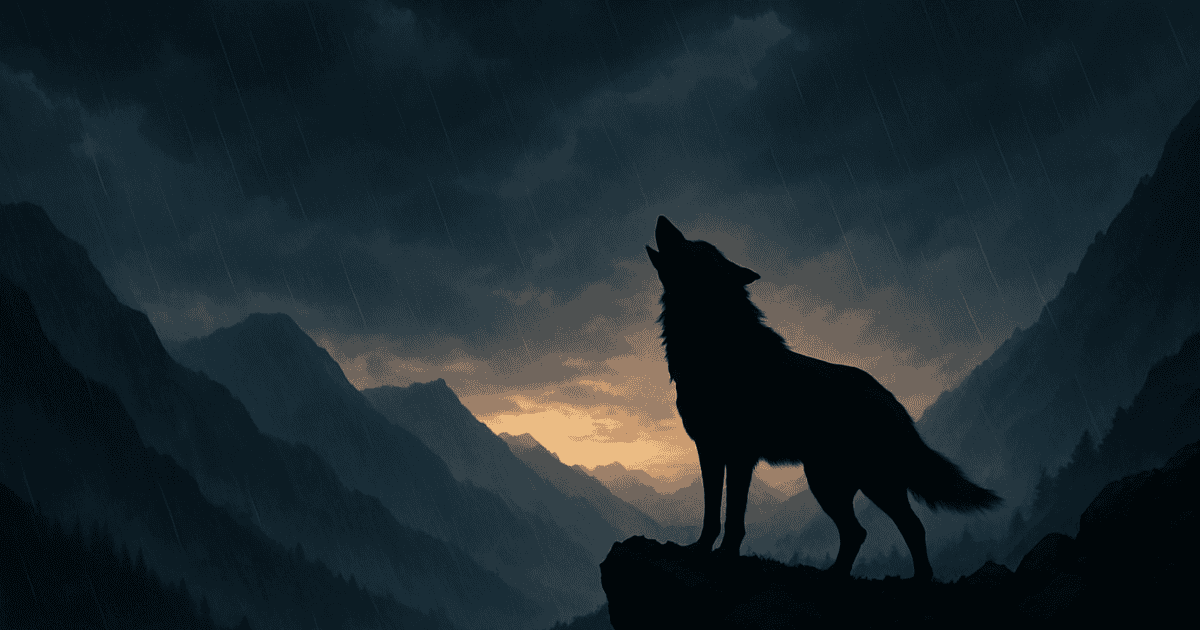
Wolf Children (Official Website) is a staggering, theatrical animated masterpiece directed by Mamoru Hosoda, released on July 21, 2012.
I still vividly remember seeing the trailer for this film in theaters. Just from those brief, fleeting glimpses and the central premise of “wolf children,” I felt an immediate, overwhelming sense of dread: “This is going to be a devastatingly tough movie to watch.” I had absolutely adored his previous blockbuster, Summer Wars, so I fully intended to see it. But fearing my heart couldn’t handle the emotional weight of the narrative, I actually skipped its theatrical run.
Years later, I finally watched it via online streaming—right around the time The Boy and the Beast or Mirai was released—suddenly remembering it had slipped past me. By the time the credits rolled, I deeply regretted not experiencing it on the big screen. It is an absolute triumph of a film.
Today, I want to peel back the emotional layers of Wolf Children. What is the true psychological subtext hiding beneath this beautiful modern fairy tale?
Please note that this is an in-depth analytical piece that assumes you have already seen the movie, and it contains major spoilers.
Need a refresher on the plot? Read our full breakdown: Wolf Children (2012): Full Synopsis and Ending Explained
*This is a translated version. The original (Japanese) is available here.
-
The Missing Rebellious Phase
By intentionally concluding the narrative right before the agonizing teenage rebellious phase begins, the film delivers a profound message: “Child-rearing is essentially over” the moment a child firmly chooses their own path (Ame as a wolf, Yuki as a human) and their autonomous ego fully emerges. -
Ame, Yuki, and the Ghost of Their Father
The two divergent paths—”wolf” and “human”—chosen by Ame and Yuki are the exact, physical manifestations of the internal war that raged inside their late father. Furthermore, his tragic death was likely caused by his lack of a wilderness mentor, a fatal flaw directly mirrored in the scene where Ame nearly drowns. -
The Narrative Power of the “Wolf” Motif
The “wolf children” premise acts as a brilliant theatrical device. It vividly captures the visceral “ferocity” and “unpredictability” of toddlers, while simultaneously serving as a heavy metaphor for the deep “secrets” people carry, and the atrocity of having those boundaries carelessly violated by others. -
Decoding the Symbolism of the Butterflies
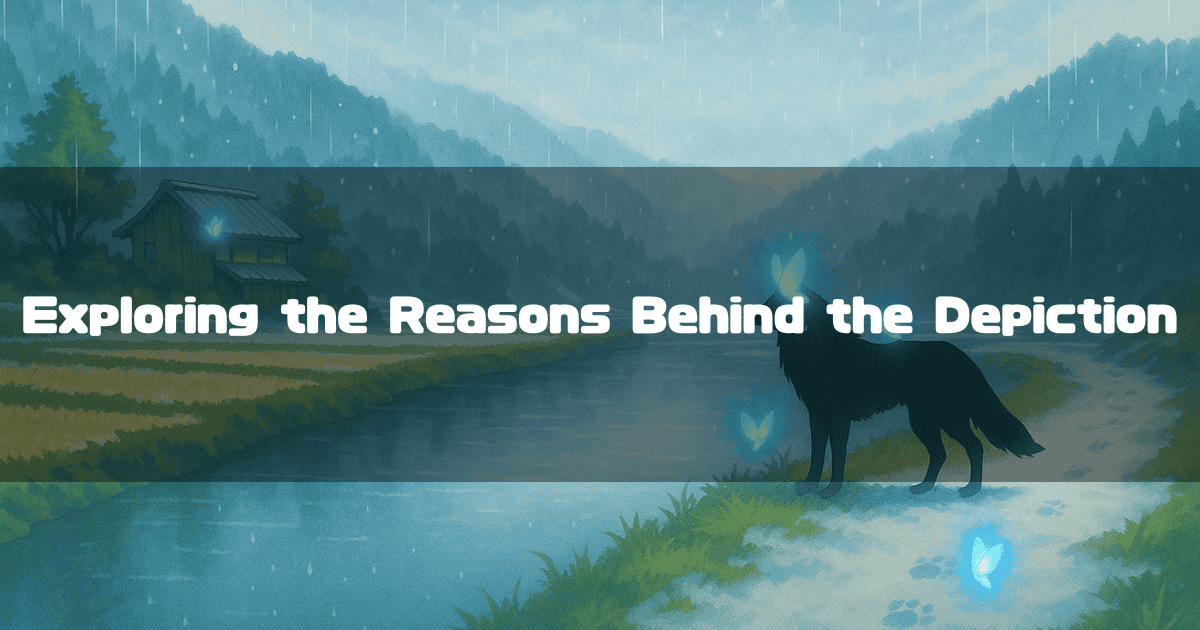
The butterflies that flutter past when Souhei brutally tells Yuki she “smells like a beast” symbolize the metamorphosis of her identity as she resolves to “live as a human.” Crucially, they also represent the “Butterfly Effect,” where a single, careless remark irrevocably alters the entire trajectory of a life.
On this pageContents
Wolf Children In-Depth Analysis
Analysis ①: Why Does the Story End Before the Rebellious Phase?
Wolf Children is a raw, unflinching look at the agonizing hardships of single motherhood and the saving grace of rural communities. But as a viewer, the one emotional crucible I kept bracing myself for was entirely absent from the film. Specifically, the movie intentionally refuses to depict any bitter, teenage conflict between Hana and her children, Ame and Yuki, as they transition into adolescence.
Given that the film is already emotionally devastating simply because they are “wolf children,” perhaps showing a brutal, spiteful rebellious phase would have made the viewing experience unbearably bleak. It is also entirely possible that the sheer constraints of the runtime forced the director’s hand.
However, from an analytical standpoint, I believe ending the story exactly where it does creates a staggeringly powerful thematic statement. Wolf Children is boldly declaring that “once a child’s ego solidifies and they take their first true step of independence, the fundamental job of child-rearing is over.“
Every parent dreads the rebellious phase, but psychologically speaking, it is a vital milestone. It signifies that “a child’s ego has properly developed, and they are preparing to walk a path entirely their own.”
If society simply treated teenagers as fully-fledged adults the moment they rebelled, the matter would be simple. But modern society doesn’t allow for that. Parents are forced to keep these fiercely budding, independent egos under their protective roofs, which inevitably breeds explosive conflict. It is a profoundly painful transition for a parent—especially because their children are, beneath all the anger, still so precious to them.
Despite the agonizing practicalities of the teenage years, the spiritual essence of parenting boils down to this: the moment your child looks at the world and says, “This is the path I will take,” your primary mission is accomplished. (This isn’t to say you kick them out, but rather, your role shifts from ‘protector’ to ‘spectator’).
This is most explicitly realized in Ame’s heartbreaking decision to abandon human society and “live as a wolf.” But we must not overlook Yuki. By choosing to move into a junior high dormitory, Yuki firmly decides on her own path to “live as a human.” In essence, her departure is no different from Ame’s. By finding a confidant in Souhei who accepted her darkest secret, Yuki was finally able to establish her ego. And so, she too left her mother’s nest.
Ultimately, the film utilizes both Ame and Yuki to whisper a universal truth to parents: “Your job is done the moment they know who they are.”
Whether stopping the clock just before the rebellious phase was a conscious artistic choice or a byproduct of pacing, it birthed one of the most magnificent, bittersweet endings in anime history.
Analysis ②: The Ghosts of the Father
A Mirror of “His” Agonizing Internal Conflict
Next, let’s explore the narrative genius behind giving Hana and “Him” (the Wolfman) two children with diametrically opposed personalities. On a basic storytelling level, it obviously “broadens the narrative scope.” But the true brilliance lies in how it broadens it.
I firmly believe that “the conflicting axis of ‘wolf’ and ‘human’ split between Ame and Yuki is the exact, physical manifestation of the psychological war their father fought within himself every single day.“
We barely got to know “Him” before his sudden death. But in truth, the agonizing years Ame and Yuki endured, desperately trying to reconcile their dual natures, were the exact same years “He” lived through.
Hana constantly tortured herself, wishing she could ask “Him” how to properly raise wolf children. But the tragic reality of being a “Wolfman” is that there is no magical instruction manual. There is no “correct” way to exist. They are doomed to live in a perpetual state of identity crisis. The ancestors of his lineage undoubtedly suffered the exact same anxieties Hana faced.
Deep down, “He” harbored the exact same desperate yearning as Yuki—the desire to assimilate and live quietly as a “human” in a bustling city. Conversely, the primal, irresistible call of the wild that ultimately claimed Ame was undoubtedly howling within his soul as well.
Through the disparate lives of Ame and Yuki, Hosoda allowed us to witness the complete, fractured lifetime of the father. This is exactly why the film didn’t need to show us “His” childhood—we were already watching it play out in his children.
Solving the Mystery: Why Did “He” Die?
In the opening act, the father tragically perishes, leaving a young Hana alone with two infants.
We are led to believe he was hunting a bird for his recovering wife, slipped into a swollen canal, and drowned. But for an apex predator… how does a simple slip turn fatal?
While left intentionally ambiguous, a massive cinematic clue lies in the scene where Ame nearly drowns in the mountain river.
Ame also suffers a life-threatening accident while hunting a kingfisher. That sequence feels like the director violently shaking the audience, screaming, “Remember what happened to the father!” We are meant to draw a direct parallel.
The core reason Ame fell into the river can be summarized in one sentence: “He hadn’t yet learned how to operate his own body.” He clumsily tripped over his own scarf. The feral, confident Ame from the end of the movie would never make such a rookie mistake. Ame simply lacked wilderness survival skills.
Wasn’t “He” exactly the same? Yes, he was an adult “wolf,” but he spent 99% of his existence trapped in a human form, navigating concrete jungles. He may have taken the occasional run in the mountains, but his primal instincts were fundamentally blunted. It is highly probable that “He” was actually quite terrible at navigating the world as a wolf.
Think back to the scene where he proudly brings Hana a dead bird while she is pregnant with Yuki. He doesn’t look like an ancient, masterful apex predator. He looks like an amateur who got lucky and thought, “Hey, I actually caught one!”
If “He” had been properly trained in the ancient ways of the wolf from childhood—in other words, if he had been guided by a mentor like Ame’s fox “Teacher,” that tragic death in the canal might never have happened.
When you view it through this tragic lens, the fact that “He” lost his own parents at a young age sealed his doom.
His entire existence was a cursed balancing act, forced to survive as a fractured “intermediate being.” That lack of true mastery over either domain is what killed him.
In that context, Ame discovering his “Teacher” in the deep woods wasn’t just a plot point—it was the ultimate salvation that broke the family curse.
Analysis ③: The Narrative Weapon of “Wolf Children”
Let’s shift our perspective to screenwriting mechanics. What exactly did the “wolf children” trope achieve for the narrative?
On a literal level, the spontaneous wolf transformations are a brilliant visual metaphor for the chaotic “ferocity” and “unpredictability” of toddlers. It perfectly captures the sheer panic of parenting.
However, when we analyze the devastating scene where Yuki slashes Souhei’s ear, a much darker, profound thematic purpose is revealed.
Terrified that Souhei has deduced her true nature, Yuki desperately tries to retreat. But Souhei, oblivious and insistent, physically corners her in the school hallway.
The specific “secret” here is that “Yuki is a werewolf.” But on an abstract, psychological level, this scene is a chilling exploration of how society handles the deeply guarded “secrets” people carry inside themselves.
Children, in their innocent cruelty, act purely on their own curiosity. They speak and prod without considering whether the other person is terrified of having their boundaries crossed. Regardless of whether Souhei had malicious intent, the film makes a definitive statement: violently barging into someone’s deepest trauma with muddy shoes is, fundamentally, an atrocity that triggers severe, destructive retaliation.
Yet, the genius of Hosoda’s writing is that we completely empathize with Souhei. The truth of “being a werewolf” is so astronomically outside the realm of human logic that Souhei couldn’t possibly have known the stakes. If he navigated his entire life tiptoeing around the assumption that his classmates might be mythological creatures, he would be the crazy one.
Because the secret is so absurd, the audience forgives Souhei’s intrusion (and his incredibly noble actions afterward certainly help redeem him).
To summarize, the “Wolf Children” premise is an unparalleled narrative weapon because it:
- Visually manifests the feral “unpredictability” of young children.
- Brilliantly illustrates the agonizing weight of carrying a societal “secret.”
- Generates immense, tragic drama when someone carelessly approaches that boundary.
- Maintains deep empathy for the person doing the intruding, because the secret defies human logic.
The werewolf concept isn’t just a fantasy gimmick; it is a masterclass in psychological staging.
Analysis ④: The Symbolism of the Butterflies
Finally, building on the trauma of the hallway scene, we must decode the imagery of the “butterflies” fluttering outside the window the exact moment Souhei tells Yuki she “smells like an animal.”
In the meticulous art of animation, nothing exists in the frame by accident. If a butterfly is on screen, an artist spent hours drawing it. Therefore, the production team desperately needed those butterflies in that specific shot.
The classic literary interpretation is that butterflies symbolize “transformation,” “metamorphosis,” and “evolution.”
That fleeting moment is the absolute turning point of Yuki’s entire existence. It is the catalyst that forces her to “live as a human.” If Ame had been told he “smelled like a beast,” he likely would have shrugged it off, or even viewed it as a compliment. “So what?”
But Yuki was consumed by the terror of being exposed. And in a brilliant psychological twist, that paralyzing fear of “not wanting to be found out” forced her to a profound realization: “Ah… I truly want to belong to the human world.”
To visually underscore that this was the exact moment her soul metamorphosed, the butterflies drift through the frame.
However, there is an equally compelling, secondary interpretation: The imagery is a literal nod to the “Butterfly Effect.”
The “Butterfly Effect” dictates that a microscopic, seemingly trivial action can trigger a massive, catastrophic chain reaction. The “trivial action” in this context is Souhei casually blurt out, “You smell like an animal.”
Souhei has absolutely zero comprehension of the apocalyptic weight of his words. He is certainly not trying to force a classmate to permanently alter the trajectory of her life’s destiny. Yet, his careless observation triggers a devastating psychological chain reaction. It is the Butterfly Effect in its purest emotional form.
To summarize, the butterflies are heavily layered visual metaphors designed to:
- Symbolize “metamorphosis,” marking the definitive death of Yuki’s wolf persona and the birth of her human identity.
- Represent the “Butterfly Effect,” illustrating how a single, careless remark can permanently alter the course of a human life.
While we can’t definitively confirm Hosoda’s intent without a direct interview, the cinematic framing makes this reading incredibly potent.
While that specific scene ultimately catalyzed a “possible future” where Yuki successfully integrates into human society, we must remember a harsh reality: walking up to a little girl and telling her she “smells like a beast” is incredibly cruel. For an elementary school student, it is soul-crushing.
Yuki stopped going to school out of guilt for physically maiming Souhei. But in the real world, a young girl could easily develop crippling agoraphobia and stop attending school purely from the emotional devastation of that single insult.
The person who delivers the insult often brushes it off, thinking, “I just said what was on my mind; I didn’t mean to destroy them.” But this highlights the terrifying, dark side of the “Butterfly Effect.” The film quietly, desperately reminds us that our words wield terrifying power, and we must handle them with absolute care.
This concludes my deep dive into the psychological undercurrents of Wolf Children. Unpacking its themes only deepens my awe for what Mamoru Hosoda achieved.
What did you take away from this modern masterpiece? Did you view it as a story of triumph, or a tragedy of letting go?

Reader Comments